She Was Robbed in Broad Daylight — The Moment a Biker Revved His Engine, Everyone Thought He’d Make It Worse
The scream didn’t come from fear alone—it came from the moment everyone realized help was close, yet no one moved.
The sidewalk outside the small grocery store rippled with confusion. A paper bag split open. Oranges rolled. A woman stumbled, one hand clawing for a purse that was already gone. Her heel scraped concrete. Her breath snagged. People froze in the shape of witnesses, not helpers.
The man who took her bag didn’t look dramatic. He didn’t shout. He moved like someone who had done this before—quick fingers, practiced turn, eyes already scanning for gaps. The crowd made a hole without meaning to. Phones lifted. Someone gasped. Someone else muttered, “Hey—”
The woman tried to stand. Her knee buckled. She looked smaller than she had a second ago, as if the theft had stolen her balance, her voice, her right to take up space. She called out once. It landed nowhere.
Across the street, an engine growled.
Not loud. Not wild. A controlled rumble, patient and deliberate. Heads turned. A motorcycle eased off the curb. Black helmet. Plain jacket. No patches that shouted for attention. The rider didn’t rush. He rolled forward like he had time—and that scared people more than speed.
The biker appeared out of nowhere, and no one knew why he was there.
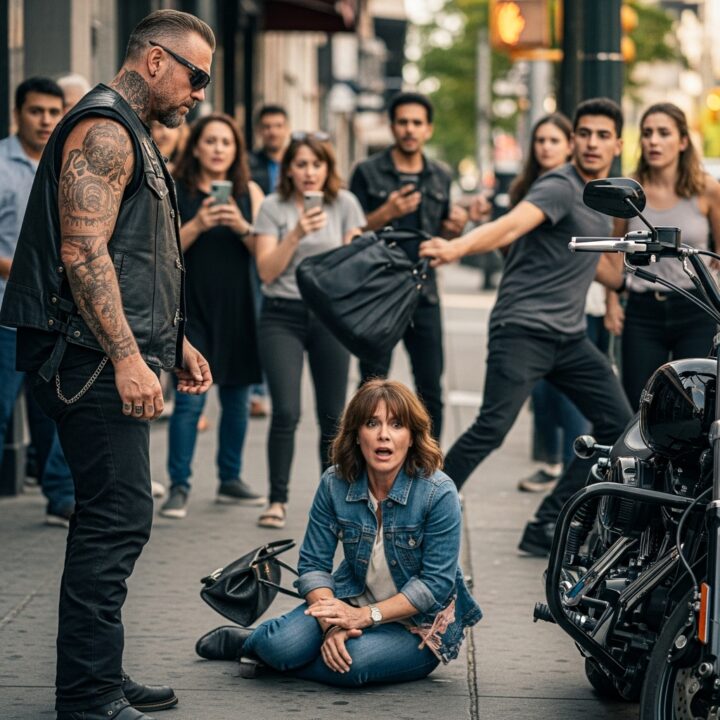
The thief cut left. The biker cut right.
It looked wrong immediately.
The motorcycle surged, then stopped hard—too close to the man with the stolen bag. The biker dismounted in one smooth motion. His boots hit the ground with a dull certainty. The woman flinched, thinking the danger had doubled.
“Hey!” someone yelled. “Don’t—!”
The biker stepped between the thief and the crowd. He didn’t shove. He didn’t swing. He placed one gloved hand against the man’s chest and said nothing. That silence read as menace.
“Call the cops!” a voice cracked.
The thief tried to dart. The biker pivoted, blocking the angle, eyes steady. To the crowd, it looked like a confrontation about to explode. The woman clutched her knee, watching two men stand too close, one of them armored and unreadable.
“Back up,” a passerby shouted at the biker. “You’re making it worse!”
The biker didn’t answer. He reached into his jacket. Gasps spiked. Fear jumped ahead of facts.
He pulled out his phone.
That didn’t calm anyone.
Security from the store spilled out, hands raised. Someone dialed 911 and narrated loudly, as if volume could turn confusion into certainty. The thief sneered, sensing the shift, playing the part of the wronged man. “This guy jumped me,” he said. “He tried to run me over.”
The biker looked at him once. Then he looked past him—to the woman on the ground. His gaze held there longer than comfort allowed.
Everything tightened.
The thief edged backward, crowd at his back, biker in front. The woman’s breathing went shallow, the kind that steals air from your chest. A security guard’s radio chirped. Sirens were still far enough to be a promise, not a solution.
The biker typed a message with his helmet still on. His hands were steady. Too steady for a man about to lose control.
“Sir,” the guard said, voice thin, “step away.”
The biker didn’t. He finished the text. Then he made a call.
He spoke four words. Low. Certain. Final.
“I need you here.”
He ended the call and slipped the phone away. No explanation. No appeal. The waiting pressed down like weather.
The thief lunged, trying to bolt through a narrow gap. The biker shifted his weight and the man stumbled—not from a hit, but from losing his own balance. The stolen purse skidded across the pavement and stopped inches from the biker’s boot.
A hush fell, brittle and sharp.
Everyone waited for the wrong thing to happen.
They heard it before they saw it.
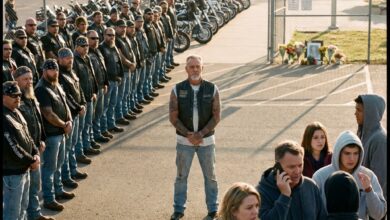
Engines. Not one. Several. A coordinated sound, rolling in without hurry. The crowd turned as a line of motorcycles eased onto the street, spacing precise, movements disciplined. No revving for show. No aggressive weaving. Just presence.
Helmets came off. Faces were ordinary. Ages mixed. Jackets plain. The kind of people you pass without noticing—until they stand together.
They formed a loose perimeter without touching anyone. The security guard lowered his hands without realizing it. The thief’s bravado evaporated. The street learned a new quiet.
One rider stepped forward, nodding once at the biker on the ground. No words. Another picked up the purse and walked it—slowly—to the woman, kneeling to set it within reach without forcing contact.
Sirens arrived late, confused by the calm.
An officer assessed the scene, eyes moving from the fallen purse to the thief’s shaking hands to the woman’s scraped knee. Power shifted without a shove.
The truth didn’t come as a speech. It came as small facts lining up.
The woman spoke, voice still thin but steady now. The store’s camera footage played on a phone. The thief’s story collapsed under its own weight. Handcuffs clicked softly, almost apologetic.
Someone asked who the biker was.
He shrugged once. Not false modesty—just disinterest. He checked the woman’s knee with a practiced glance and pointed to a bench in the shade. One of the riders offered a bottle of water. Another called for an ice pack from the store.
The woman finally looked up at him. “Thank you,” she said, like she wasn’t sure the word was big enough.
He nodded. That was it.
When the officers finished, the riders mounted up. The engines returned to that controlled rumble, and then they were gone—leaving behind a sidewalk that felt rearranged.
The crowd drifted, embarrassed by its earlier certainty. Phones slipped back into pockets. Judgment had nowhere to stand.
The last image lingered: the woman sitting on the bench, purse on her lap, watching the street empty. She touched the scuffed leather once, not to check it was there, but to remind herself that someone had chosen to act when fear made everyone else still.
No speeches. No victory lap.
Just the quiet after doing the right thing—and the uneasy understanding that courage doesn’t always look like help when it arrives.