She Was Being Harassed on an Empty Street — A Biker Stepped Out of the Darkness
She realized she was in danger not when footsteps followed her, but when the street stayed silent as she asked for help.
The block was poorly lit, a stretch of closed storefronts and dim streetlamps that made night feel heavier than it should have. A young woman in her early twenties walked fast, keys threaded between her fingers, phone pressed to her ear though no one was on the line anymore. Her pulse climbed with every echo behind her.
The man appeared too close, too sudden. His voice cut the air—low, familiar, unwanted. He laughed when she didn’t answer. He matched her pace. Her shoulders tightened, her breath shortened, her steps lost rhythm.
She crossed the street. He crossed too.
A car passed without slowing. A window lit up, then went dark. The city pretended not to see. She stopped and turned, hoping that confrontation would end it. It didn’t. He leaned in, words slurred, confidence borrowed from the emptiness around them.
“Leave me alone,” she said, louder now.
The sound fell flat.
From the mouth of an alley came the low cough of an engine. Not revving. Not rushing. A controlled idle, patient and deliberate. A motorcycle rolled forward just enough to catch the light.
A biker stepped out of the shadows.
No one knew who he was. Or why he was there.
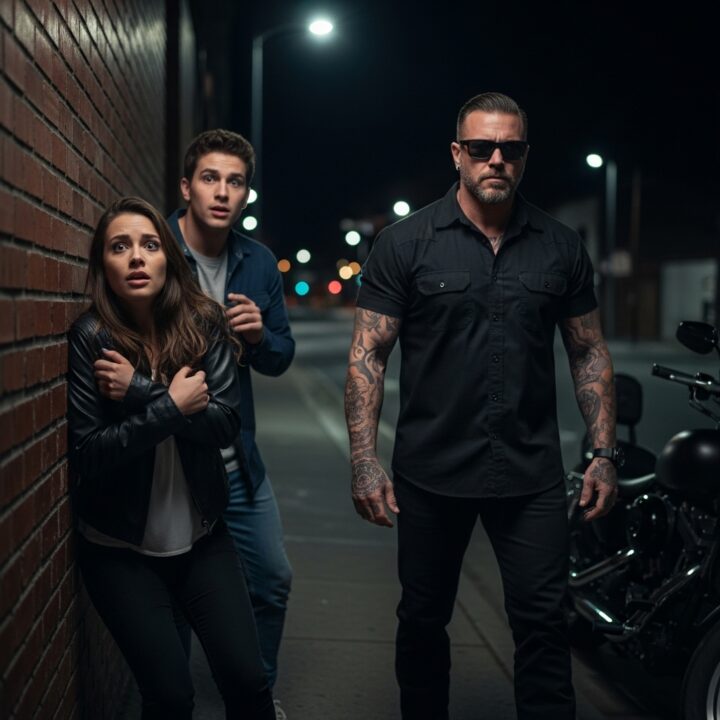
The biker didn’t shout. He didn’t threaten. He placed himself between the man and the woman as if it were the most natural thing in the world. His posture was calm, squared, unmistakably intentional.
The man scoffed. “Mind your business.”
The biker said nothing.
That silence made the moment louder.
A couple down the block noticed and slowed. A bartender leaned out of a door. Eyes widened at the sight of a biker closing distance in a dark street. Tattoos traced the man’s forearms beneath a short-sleeve shirt. Sunglasses hid his eyes even at night. He looked, to anyone glancing quickly, like trouble that had finally arrived.
“Hey!” someone called. “Back off!”
The man seized the moment. “He’s threatening me,” he said, stepping back, hands raised. The lie landed because it fit the picture people expected.
Phones came out. Someone mentioned calling the police. The woman stood frozen, unsure who the danger was now—the one who followed her, or the one who blocked him without a word.
The biker lifted one hand, palm open, not at the crowd but toward the woman. A small, steadying gesture. He angled his body, giving her space to move behind him if she chose.
She didn’t yet.
The tension thickened. Judgment rushed in where facts hadn’t arrived.
The man tried to slip past, muttering insults. The biker shifted once, closing the lane without touching him. The movement was efficient, practiced, unsettling.
“Don’t do this,” the bartender warned. “Cops are on their way.”
The woman’s voice shook. “Please.”
It wasn’t clear who she was asking.
The biker reached into his pocket. A collective inhale rippled down the block. Assumptions sharpened into fear. He pulled out his phone.
He typed quickly. Then he called.
“I need you here,” he said. Four words. Flat. Certain.
He ended the call and slipped the phone away. No explanation. No performance.
Sirens were still far enough to be an idea, not a solution. The man grew louder, angrier, sensing the crowd’s eyes. He tried to provoke a reaction—anything that would confirm the story he’d already told.
The biker didn’t bite.
He spoke once, finally, voice low and even. “You’re done here.”
The waiting pressed down like weather. Everyone braced for the wrong outcome.
They heard it before they saw it.
Footsteps. More than one set. Measured. Unhurried. A door opened across the street. Another alley answered with movement. A second motorcycle rolled into view, then a third—engines quiet, lights dimmed.
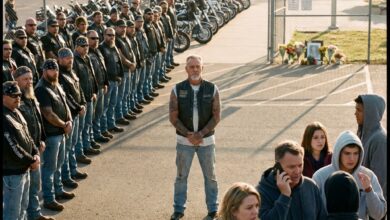
The riders dismounted without ceremony. Men and women. Different ages. Plain jackets. The kind of presence that doesn’t need to announce itself.
They formed a loose line—not boxing anyone in, not touching a soul. Just enough to change the geometry of the street.
The crowd stilled. Phones lowered. The bartender stopped mid-sentence. The man’s bravado drained, replaced by calculation. He glanced left, right, then back at the biker who hadn’t moved an inch.
“Is there a problem?” one of the newcomers asked—not aggressive, not friendly.
The question didn’t need an answer.
Sirens arrived at last, embarrassed by how calm the scene had become. An officer stepped out, took in the riders, the shaken woman, the man who suddenly wanted to explain himself.
Power shifted without a shove.
The truth emerged in fragments, not speeches.
The woman spoke first, voice steadier now, recounting the walk, the words, the fear. The bartender added what he’d seen. The officer listened. The man’s story frayed under gentle pressure.
One of the riders handed the woman a bottle of water. Another stood a respectful distance away, giving her the space to breathe. The biker who had stepped out of the alley removed his sunglasses at last. His eyes were tired, not triumphant.
No one introduced themselves. No one claimed credit.
When the officer finished, the man was escorted away—no drama, no applause. The street returned its noise cautiously, as if testing whether it was allowed to be normal again.
The woman finally looked at the biker. “Thank you,” she said. The words trembled, then steadied. Gratitude found its footing.
He nodded once. Not a bow. Not a smile. Just acknowledgment.
The riders mounted up. Engines whispered. They dispersed in different directions, leaving behind a block that felt subtly rearranged.
The last image stayed small: the woman standing beneath a streetlamp, wrapping her jacket tighter, watching the darkness where the biker had appeared. She didn’t wave. She didn’t chase the moment. She simply stood there, breathing, safe.
No lecture followed. No moral was spoken aloud.
Only the quiet understanding that help doesn’t always look friendly when it arrives, and that courage sometimes steps forward from the darkest corner, willing to be misunderstood for a few crucial minutes.