She Was Being Evicted in the Middle of Winter — Until a Biker Parked in Front of Her Door
The eviction notice hit the door with a sound louder than it should have — sharp paper against old wood, final and cold, like the winter pressing in behind it.
Martha stood frozen in the hallway, coat half-zipped, one glove missing. Snow slipped through the cracked window frame and melted on the floor near her shoes. Her breath came out in short, uneven clouds.
“Ma’am, you need to vacate the property tonight.”
The landlord didn’t shout. He didn’t need to. His voice was flat, practiced — the voice of someone who had said this too many times to feel anything anymore.
“It’s below zero,” Martha said. “Just give me until morning.”
He shook his head. “Rules are rules.”
Her phone buzzed in her pocket. Power company. Missed call. Again.
Neighbors watched from behind curtains. Some shook their heads. Others turned away. No one stepped outside.
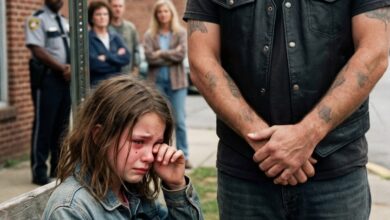
Martha’s hands trembled as she knelt to zip her daughter’s jacket. The little girl didn’t cry. She just held her stuffed bear tighter, eyes wide, confused by the hurry, the raised voices, the way home suddenly felt unsafe.
Snow began to fall harder.
Then came the sound.
A low engine growl. Slow. Heavy. Deliberate.
A motorcycle pulled up and stopped directly in front of the house.
The engine cut off.
A biker swung his leg over the seat and stood up in the snow.
No one knew who he was.
No one knew why he was there.
And suddenly, everything felt more dangerous.
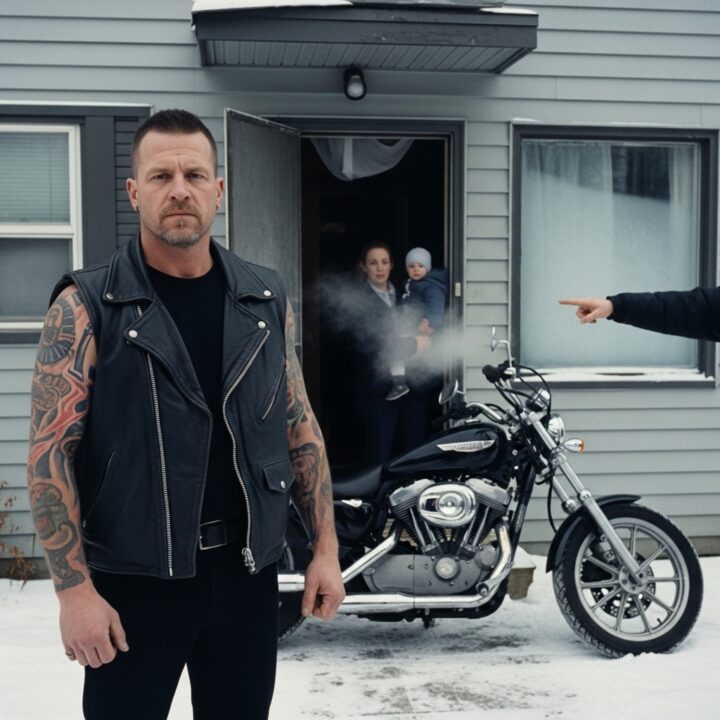
The biker didn’t rush.
That alone made people uneasy.
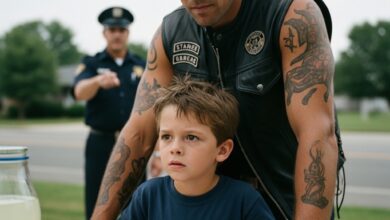
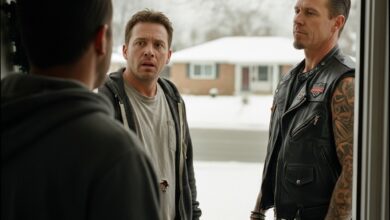
He was tall. Broad-shouldered. Late forties, maybe early fifties. Short sleeves despite the cold. Tattoos ran down his forearms like stories no one here wanted to read. A worn leather vest creaked as he moved.
The landlord stiffened immediately.
“This is none of your business.”
The biker looked at the eviction notice still taped to the door. Then at Martha. Then at the child shivering beside her.
“You kicking them out tonight?” he asked.
His voice was calm. Too calm.
Martha felt her stomach drop. This wasn’t help. This was more trouble. She pulled her daughter closer, instinctively stepping back.
“I’ve already called the police,” the landlord snapped. “So you can leave.”
The biker didn’t leave.
He stepped closer to the porch.
Phones came out. Someone whispered, “This is going to turn ugly.”
A neighbor yelled, “Hey! Don’t start anything!”
To everyone watching, it looked bad. A biker confronting a landlord in the snow. A frightened woman caught in between. A child clinging to her coat.
The biker raised one hand — slow, open — as if asking the world to pause.
“I’m not here to cause problems,” he said.
But no one believed him.
The landlord backed up a step. “You threatening me?”
The biker shook his head once. “I’m asking a question.”
Sirens echoed faintly in the distance.
The tension thickened, heavy as the snow piling on the steps.
Martha felt it then — that awful sense that things were slipping past control, that her situation had just become something worse.
The police cruiser arrived faster than Martha expected.
Red and blue lights washed over the house, the snow, the biker’s leather vest. The officer stepped out slowly, hand near his radio, eyes fixed on the motorcycle.
“What’s going on here?”
Everyone talked at once.
The landlord pointed. “He showed up and started interfering.”
A neighbor added, “He looked aggressive.”
Another voice: “There’s a kid here!”
The biker stayed where he was.
Didn’t argue.
Didn’t explain.
Didn’t move toward anyone.
He reached into his jacket.
Martha gasped.
The officer’s hand went to his belt. “Sir — don’t.”
The biker stopped immediately.
“Phone,” he said quietly.
He pulled it out and unlocked the screen.
For a moment, no one spoke. Snow fell between them, slow and steady, like time itself had decided to wait.
The biker typed a short message. One line. Then he put the phone back in his pocket.
“Who did you just text?” the officer asked.
The biker met his eyes. “Someone who should be here.”
That was all he said.
The landlord scoffed. “This is ridiculous. I want them gone now.”
Martha’s daughter started to cry — small, frightened sobs muffled against her coat.
The biker glanced down at her.
Something changed in his face. Just slightly.
Then came a sound from down the street.
Another engine.
Then another.
And another.
The officer turned.
So did everyone else.
The waiting had begun.
The sound came before the sight.
A low rumble.
Then another.
Then a steady, growing chorus of engines cutting through the winter air.
The officer turned fully now, squinting down the street. Snowflakes glinted red and blue in the flashing lights as three motorcycles rolled into view, then five, then more — all slowing, all controlled, all stopping with deliberate distance.
No revving.
No shouting.
No chaos.
Just presence.
They parked along the curb, one by one, forming a quiet line that somehow felt heavier than noise ever could. Men and women dismounted calmly. Leather jackets. Denim. Boots crunching softly on snow. Not a gang. Not a show.
A formation.
The first biker — the one who had arrived alone — didn’t move to greet them. He didn’t smile. He didn’t signal.
He simply stood there, hands visible, shoulders squared, as if this was exactly what he had expected.
The landlord swallowed.
“What is this?” he muttered.
One of the bikers stepped forward. Gray in his beard. A small American flag patch stitched on his vest. His voice was respectful when he spoke — not to the landlord, but to the officer.
“Evening, sir. We were asked to check on a situation involving a mother and child in freezing conditions.”
The officer glanced back at Martha, then at the little girl shaking quietly beside her.
The landlord raised his voice. “This is private property. They’re trespassing now.”
No one argued.
Instead, the bikers spread out slightly — not blocking, not surrounding, just… present. A wall made of patience.
The officer exhaled slowly.
“Ma’am,” he said to Martha, softer now. “Is that true? You’re being evicted tonight?”
She nodded. “Yes. I have nowhere to go.”
The biker who had first arrived stepped closer — but stopped a few feet short.
“She won’t be sleeping outside tonight,” he said. Not loud. Not threatening. Just certain.
The landlord scoffed again, but the sound lacked confidence now.
“You don’t decide that.”
The officer did.
He looked at the notice again. Looked at the temperature reading on his dash. Looked at the child.
“This eviction can wait until morning,” he said. “Given the conditions.”
The landlord opened his mouth — then closed it.
Snow kept falling.
And suddenly, the power in the space shifted — quietly, unmistakably.
The truth came out slowly. It always does.
One of the bikers handed the officer a folded document. Another made a phone call — not to threaten, not to escalate, but to confirm emergency housing resources already contacted.
The first biker — the quiet one — finally spoke again.
“My sister was evicted like this once,” he said, eyes still on the ground. “In winter. She didn’t make it through that night.”
No one replied.
The officer nodded once, deeply, as if filing the words somewhere permanent.
The landlord stepped back. His voice was smaller now. “I didn’t know.”
No one corrected him. No one comforted him either.
Martha didn’t cry. Not yet.
Instead, she watched as one biker laid down a thermal blanket around her daughter’s shoulders. Another offered hot coffee from a thermos. No speeches. No explanations.
Just actions.
Within minutes, arrangements were made. Temporary housing. A ride. Warmth.
As Martha climbed into the back of a heated SUV, she turned to the man who had parked his bike in front of her door.
“I don’t even know your name,” she said.
He shook his head. “You don’t need to.”
The engines started again — one by one — softer this time, almost respectful.
The bikers rolled away into the snow, leaving behind tire tracks that slowly disappeared beneath falling white.
The house stood quiet again.
The porch light flickered.
And for the first time that night, Martha exhaled — not in fear, but in relief.
Some people watched from behind their curtains.
They would remember this.
Not the noise.
Not the fear.
But the moment they mistook quiet courage for danger — and how wrong they had been.