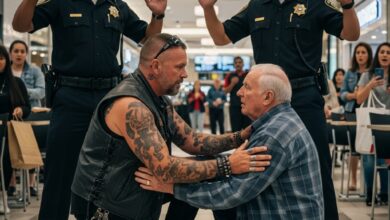
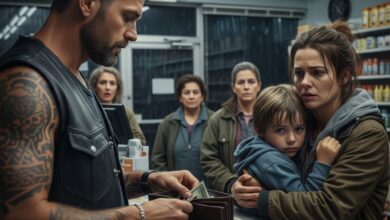
She Was Asked to Leave the Funeral for Being Poor — Then a Biker Convoy Did Something No One Expected
They asked her to leave the funeral because she didn’t look like she belonged there, and the silence that followed was louder than the prayers.
The chapel was warm, polished, and carefully arranged. Fresh flowers lined the aisle. Soft organ music drifted through the room like it had a schedule to keep. People wore dark suits, pressed dresses, quiet grief measured in appropriate amounts.
She stood near the back.
Her coat was thin.
Her shoes were worn.
Her hands wouldn’t stop shaking.
The woman kept her eyes down, clutching a folded piece of paper—the obituary she had cut from a newspaper and smoothed over so many times the edges were soft. She had come alone. No family name on the program matched hers.
When she tried to step forward, a man in a tailored suit gently blocked her path.
“This section is for family,” he said, not unkindly, but firmly. His eyes moved over her clothes, her bag, the way she smelled faintly of laundry soap instead of perfume. “You can wait outside.”
She swallowed. “I just… I need to say goodbye.”
A woman behind him whispered something sharp. Another guest glanced over and then away. Grief, apparently, had a dress code.
The usher cleared his throat. “Ma’am, we don’t want to cause a scene.”
The words landed like a verdict.
Her face flushed. She nodded too quickly, stepped back, and turned toward the door, humiliation walking ahead of her like a shadow.
As she pushed outside into the cold, the sound of engines rolled across the parking lot.
Low.
Steady.
Unmistakable.
Motorcycles pulled in—one, then several—forming a neat line near the entrance.
Leather vests.
Disciplined movements.
Faces unreadable.
The woman froze, unsure whether to keep walking or turn back.
No one knew yet who the bikers were.
Or why they had come.
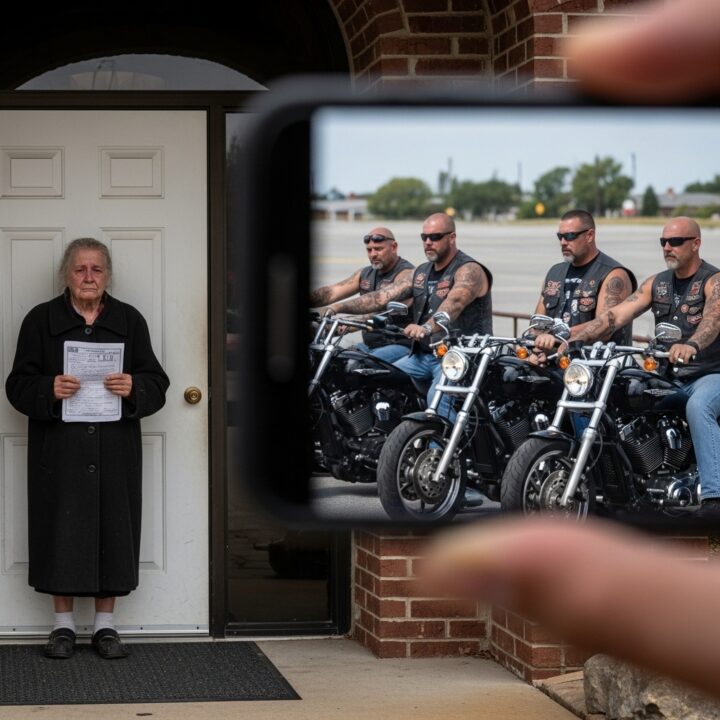
The chapel doors swung open again, and the first biker stepped inside.
He was tall, late forties maybe, hair streaked with gray, arms marked with old tattoos that looked earned rather than displayed. He removed his helmet and held it respectfully at his side. He didn’t look around like he owned the place. He looked like he was checking himself.
The murmurs began immediately.
“Who invited them?”
“This is a funeral.”
“Are we safe?”
The biker walked down the aisle with slow, deliberate steps. To some, it looked threatening—a leather-clad man advancing in a place of quiet grief. To others, it felt like an intrusion waiting to happen.
A second biker followed. Then a third.
The man in the suit stepped forward again, voice tight. “Excuse me, you can’t—”
The biker stopped. “We’re here to pay respects.”
The tone was calm. Flat. Unapologetic.
A woman near the front clenched her purse. Someone reached for their phone. The air thickened with that familiar fear—the kind that forms when assumptions outrun facts.
Security was signaled. An usher hovered. The word police floated in a whisper.
The bikers didn’t argue. Didn’t raise their voices. They stood where they were, still as fence posts, eyes forward, posture disciplined.
Outside, the poor woman watched through the glass, heart racing. She felt suddenly smaller, like her presence had caused this, like trouble followed her everywhere.
She turned away, ashamed.
Inside, tension climbed the walls.
Security approached the lead biker. “You need to step outside.”
The biker nodded once. He pulled out his phone—not fast, not slow—and typed a short message.
No one knew to whom.
No one knew why.
The security guard stiffened. “Sir?”
The biker looked up. “One minute.”
That minute stretched.
People shifted in their seats. A child asked a question that was shushed too loudly. Grief curdled into irritation, then fear.
Outside, the woman sat on the cold steps, shoulders hunched, listening to the muffled voices inside. Her hands trembled harder now. She wondered if she had ruined something sacred just by showing up the way she was.
Then she heard it.
More engines.
Not revving.
Not aggressive.
Just arriving.
Her head snapped up.
Motorcycles filled the lot in clean lines, riders dismounting in quiet coordination. No shouting. No swagger. Just presence.
She stood slowly, unsure whether to move away or stay.
Inside the chapel, heads turned as the sound filtered through the walls. The usher looked panicked. Someone muttered, “This is getting out of hand.”
The bikers inside didn’t move.
They waited.
And for the first time since she’d arrived, the woman on the steps felt like something might finally shift.
The chapel doors opened again.
This time, the sound entered first—boots on stone, engines settling outside, a familiar voice saying, “It’s okay.”
An older man stepped forward from the group of bikers. He wore the same vest, the same calm expression, but his eyes were wet.
He walked straight to the casket.
The room fell silent.
No one stopped him.
He rested his hand gently on the polished wood and bowed his head. The other bikers followed, standing behind him in a respectful line. No one blocked aisles now. No one whispered.
Authority changed sides without a single raised voice.
The man turned and spoke softly. “She should be here.”
Confusion rippled.
He gestured toward the door.
Outside, the woman stood frozen, unsure if she’d heard correctly.
The man repeated it, louder this time. “She belongs here.”
Every eye turned.
The woman stepped inside hesitantly, cheeks burning, expecting to be corrected again. But no one stopped her. The aisle seemed suddenly longer, heavier.
She reached the casket and broke.
Not loudly.
Not dramatically.
Just a quiet sound, the kind that comes from years of being unseen.
The bikers closed ranks around her—not to intimidate, but to shield. Their backs formed a barrier from the stares, the judgments, the late-arriving shame.
No one called security now.
No one reached for a phone.
It came out slowly.
The woman had been the deceased man’s first wife. The one who stayed when there was nothing. The one who worked double shifts and ate less so he could start his business. The one who left quietly when he asked, years later, ashamed that success had made her inconvenient.
The bikers were men he had mentored through a community program. Riders he helped sober up, get jobs, stay alive. He never spoke about the woman who saved him before all that.
She had come not to claim anything.
Just to say goodbye.
The bikers didn’t explain all this in a speech. They didn’t need to. The truth arrived through presence, not performance.
When the service ended, they stepped back. Let family move first. Let others pass.
One by one, people avoided her eyes.
No apologies were spoken aloud.
They didn’t need to be.
Outside, as the bikers mounted up, the woman stood alone again—but different now. Straighter. Seen.
The lead biker paused beside her. “You did right,” he said quietly.
She nodded, tears finally falling freely.
As the engines faded, the parking lot returned to normal. Cars pulled out. Conversations resumed.
But something remained.
A small image, hard to forget:
A poor woman standing at a grave, protected not by wealth or status, but by the quiet courage of people who refused to let dignity be denied.
No one made a speech.
No one claimed credit.
The lesson stayed anyway.