The Day I Drove My Bike Into a Jewelry Store — And the Town Thought We Were Robbing It
I drove my motorcycle straight through the front glass of a jewelry store at 6:18 p.m., and within seconds the whole street was screaming, “They’re robbing the place!” — but the girl inside wasn’t afraid of us.
It was a Friday evening in downtown Springfield, Ohio.
The sun had just dipped low enough to turn storefront windows into mirrors. People were heading home. Restaurants were filling up. It was normal.
Until I heard the pounding.
Not from outside.
From inside the jewelry store.
A muffled scream.
Then a crash that didn’t match anything you’d expect from a quiet shop that sells engagement rings and anniversary bracelets.
The front door was locked.
Lights were on.
But the blinds were half-pulled.
Through the reflection of the glass, I caught movement.
A young woman — early twenties — backing away.
A man in a fitted blazer stepping toward her.
His hand gripping her wrist.
Her mouth moving, but the glass swallowed her voice.
Two pedestrians paused beside me.
“Couple arguing,” one of them muttered.
“It’s private,” the other said, already turning away.
That word — private — has covered more damage than any crime.
The girl slammed against a display counter.
I saw her try the door.
Locked.
He pulled her back.
She looked up.
And she saw me.
That moment — that split second of eye contact — wasn’t panic.
It was pleading.
Not loud. Not dramatic. Just desperate.
I didn’t rev the engine.
I didn’t shout.
I made a decision.
And I aimed.
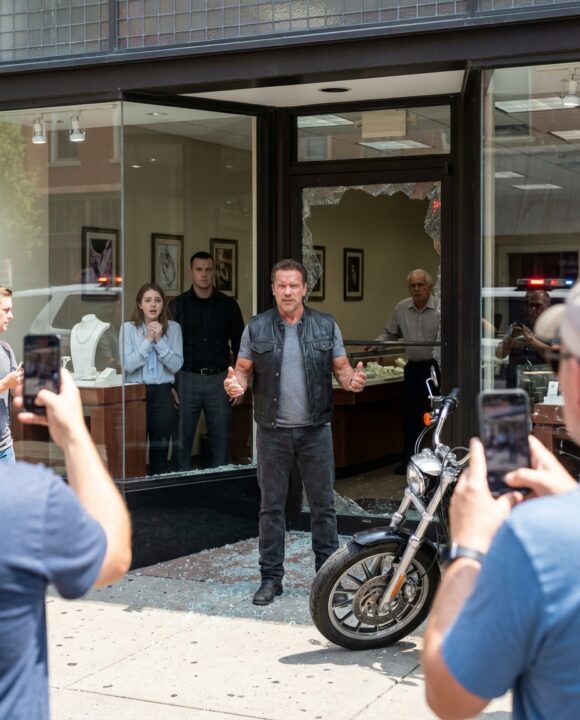
Glass shattered louder than any gunshot.
The bike slid halfway through the store before I cut it.
People screamed behind me.
Alarms started blaring.
Before anyone could process it, fourteen more bikes pulled up along the curb.
And the whole town decided we were thieves.
The first thing I saw inside wasn’t jewelry.
It was fear.
The girl had collapsed against the counter, breathing hard, mascara streaking down her face.
The man spun toward me.
“You’re insane!” he shouted. “Get out!”
To anyone watching from the sidewalk, this was a robbery in progress.
Bikers storming a high-end jewelry store.
Shattered glass.
Alarms screaming.
Engines idling outside.
People were already filming.
“Call the police!”
“They’re looting it!”
But none of my brothers touched a single display case.
They spread out.
Blocking exits.
Not for customers.
For him.
The man tried to grab the girl again.
I stepped between them.
He sneered. “This is my store.”
I didn’t respond.
Because technically, he wasn’t lying.
The sign above the door read: Henderson Fine Jewelry.
Family owned for thirty years.
But here’s what the crowd didn’t know.
The girl’s last name was Henderson too.
I had seen her two weeks earlier outside a diner, whispering into her phone, shaking.
I had seen bruises then too.
She told me she couldn’t leave because her father wouldn’t believe her.
Said her boyfriend worked in the store.
Said her father trusted him more than her.
“Dad thinks he’s helping the business,” she’d said.
“Dad says I’m dramatic.”
So when I saw the same boyfriend dragging her across polished marble floors —
I didn’t hesitate.
The boyfriend lunged toward me.
Not with a weapon.
With rage.
“You think you’re some hero?”
Behind him, the girl tried the back door.
Locked from the inside.
The alarms kept screaming.
Outside, the crowd grew thicker.
Someone threw a bottle at the broken glass.
Police sirens echoed in the distance.
To everyone else, this looked like organized crime.
To us, it was intervention.
The boyfriend looked toward the counter where the silent alarm button had been triggered.
He realized the police were coming.
His confidence cracked.
“You just ruined my life,” he hissed at the girl.
No one touched him yet.
No punches.
No chaos.
Just presence.
And then the front door opened from the inside office.
An older man stepped out.
Gray hair. Expensive suit.
The store owner.
The father.
He froze when he saw the glass.
Saw us.
And saw his daughter trembling behind me.
His first words weren’t to her.
They were to me.
“What have you done to my store?”
And that’s when I knew this wasn’t just about a locked door.
It was about a man who had never really looked.
If you’d like, I can continue with Part 3 and 4 next — escalating tension with police arrival and the father’s realization — keeping the emotional arc: Shock → Anger → Tension → Revelation → Silence.
The sirens arrived before understanding did.
Blue and red lights reflected off broken glass and diamond displays, turning the entire store into a flashing crime scene.
Outside, someone shouted, “They’re robbing Henderson’s!”
Inside, no one moved toward the jewelry.
We moved toward her.
The father stood frozen near his office door, staring at the damage to his storefront like that was the real injury.
“My inventory—” he began.
“Look at your daughter,” I said.
He didn’t.
Not yet.
The boyfriend took advantage of that distraction. He stepped backward toward the hallway that led to the stockroom.
His confidence was gone now. Replaced by calculation.
“You’re all going to jail,” he snapped at us.
The police rushed in through the broken front. Hands near their belts. Voices sharp.
“Everyone step back!”
To them, it looked like an organized smash-and-grab.
Fifteen bikers. Destroyed glass. Store alarms.
I raised both hands immediately.
“We’re not taking anything,” I said calmly.
Behind me, my brothers did the same.
No resistance.
No shouting.
The father finally saw the girl clearly.
Her hands were shaking.
Her sleeve had ridden up just enough.
And there it was.
Not dramatic.
Not theatrical.
Just a bruise that didn’t belong to a fall.
The father’s expression flickered — confusion first.
Then something worse.
The boyfriend moved suddenly toward the back exit.
One of my guys stepped sideways, blocking the path without touching him.
The police caught the movement.
“Sir, step away from him!”
They didn’t know who was who yet.
And honestly, neither did the crowd outside.
The father finally looked at his daughter.
“Emily?” he said.
She didn’t answer.
She just shook her head once.
The officer nearest me asked, “Why did you drive into the building?”
I didn’t look at him.
I looked at the father.
“She couldn’t unlock the door,” I said.
The store owner blinked.
“It was locked for closing.”
“It was locked from the inside.”
That distinction landed.
The father turned toward the boyfriend.
“Is that true?”
The boyfriend laughed once. Too fast.
“This is insane. They’re manipulating you.”
Manipulating.
That word again.
The same word that had kept her silent before.
The officer radioed something in.
More units arriving.
The father looked at the broken glass again — then at his daughter’s shaking hands — then back at the man he had trusted with his business.
And for the first time since we crashed in, he looked uncertain.
The police separated everyone.
Statements.
Questions.
The crowd outside kept filming.
“They’re covering up the robbery.”
“They’re threatening the owner.”
No one saw the detail that mattered most:
The way the boyfriend’s composure cracked when the officer asked for the keys to the back storage door.
He hesitated.
That hesitation spoke louder than sirens.
And just before the officer moved to search the hallway—
I heard it.
Low.
Familiar.
More engines.
You hear reinforcements before you see them.
Not aggressive.
Not roaring.
Controlled.
Eight more motorcycles rolled slowly down Main Street and parked in a clean line behind the squad cars.
No revving.
No shouting.
Just presence.
The crowd shifted immediately.
“Oh great. Backup.”
“They’re escalating.”
The officers stiffened, hands instinctively resting near their belts.
But the new arrivals didn’t storm forward.
They removed their helmets calmly and stood on the sidewalk.
Watching.
Waiting.
Not one of them stepped into the store.
Not one of them raised their voice.
That restraint confused everyone more than aggression would have.
Inside, the officer returned from the back hallway.
He held something small in an evidence bag.
A set of keys.
And something else.
A second phone.
Not the boyfriend’s registered number.
A hidden one.
The father stared at the bag.
“What is that?” he asked.
The officer didn’t answer immediately.
Instead, he asked the girl quietly, “Is this the room?”
She nodded.
The boyfriend finally snapped.
“This is ridiculous! You’re taking their side?”
The father flinched at that.
Because suddenly there were sides.
The police placed the boyfriend in cuffs without spectacle.
No struggle.
Just procedure.
The crowd outside gasped.
The narrative shifted in real time.
From robbery.
To rescue.
The father turned to me.
His eyes were no longer angry.
They were searching.
“Why didn’t she tell me?” he asked.
I held his gaze.
“She did.”
That landed harder than the crash.
He stepped back as if the words had weight.
The girl finally spoke.
“I tried.”
Three words.
Soft.
Devastating.
The street grew quiet.
The engines idled low.
The extra bikers remained exactly where they stood — not interfering, not celebrating.
Just forming a silent boundary between chaos and safety.
The officers escorted the boyfriend out.
The cameras kept rolling.
But no one was shouting robbery anymore.
Now they were whispering.
The father looked at the shattered storefront again.
Then at his daughter.
And for the first time, he moved toward her.
Slowly.
Carefully.
As if afraid she might step away.
She didn’t.
The police asked for formal statements.
Insurance questions began.
Damage reports.
Procedure.
But the real damage wasn’t in the glass.
It was in the years of dismissal.
In the trust misplaced.
As we walked back toward our bikes, the father called out.
“Why would you risk this?”
I paused.
Didn’t turn fully around.
“Because she asked for help,” I said.
And in the reflection of the broken window behind him, I saw something rare.
Not pride.
Not gratitude.
Understanding.
And that was louder than any engine.
By 7:06 p.m., the street had returned to something that looked almost normal.
The flashing lights were still there, but quieter now. Officers were taking statements. A tow truck had arrived for my bike. The broken glass glittered across the sidewalk like spilled diamonds.
People were still filming.
But no one was yelling “robbery” anymore.
The boyfriend sat in the back of a cruiser, staring straight ahead. No more speeches. No more confidence. Just the slow reality of consequences settling in.
Inside the store, the father stood beside the counter he had built twenty years earlier. The counter that had just been splintered by my front tire.
He ran his hand over the crack in the glass display, then over his face.
His daughter stood a few feet away. Not hiding. Not shaking like before. Just quiet.
That kind of quiet that comes after being believed.
The officer approached me again. “You understand you could be liable for the damage.”
“Yes, sir.”
He studied me for a second. “You didn’t take anything.”
“No.”
He nodded once and walked away.
No applause.
No handshake.
Just acknowledgment.
The father stepped toward me slowly.
“I should’ve listened,” he said.
It wasn’t loud. It wasn’t dramatic.
It was raw.
I didn’t offer him comfort.
Some realizations need to sit.
“She told you,” I said gently. “You just thought you knew better.”
He didn’t argue.
That was the loudest part.
The girl — Emily — finally walked up beside him. She didn’t look at me. She looked at her father.
He hesitated before reaching for her.
Then he did.
Carefully.
Like someone handling something fragile he had almost lost.
She let him.
And that moment — not the crash, not the sirens — was the thing that would stay with me.
My brothers were already back on their bikes.
Engines low.
No celebration.
No revving.
This wasn’t victory.
It was correction.
I walked over to the tow truck driver and gave him my insurance information without complaint. The glass, the repairs — that was my responsibility.
The father watched me sign the paperwork.
“You didn’t have to do it that way,” he said quietly.
I looked at the shattered storefront again.
“She didn’t have time,” I replied.
That was the truth.
We mounted up.
As we pulled away from Main Street, I checked the mirror once.
The father and daughter were standing side by side inside the broken doorway.
Not perfect.
Not healed.
But together.
And sometimes, that’s the only kind of justice that matters.
We didn’t ride fast.
We didn’t talk much.
There’s no glory in breaking a window.
But there is weight in breaking denial.
If you want to read more stories about misunderstood bikers and the moments that redefine them, follow the page.