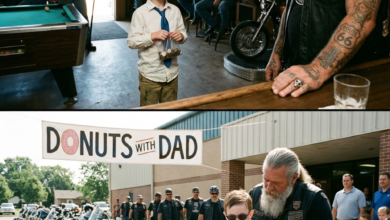
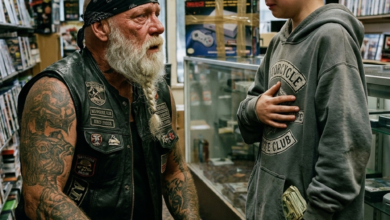
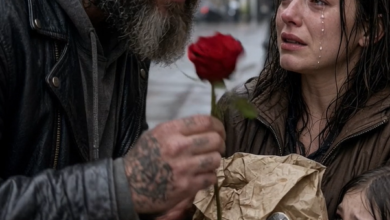
A Biker Wrote “HELP” In Red Lipstick On A Stranger’s Car Window At A Red Light — The Driver Called Him A Lunatic, But The Woman In The Passenger Seat Nodded
Part 2
Hank Mulder had a temper once.
He didn’t anymore. But he had.
Thirty years ago, he was the kind of man who solved problems with his fists. Bar fights in Mountain Home. A broken hand from a parking-lot argument in Twin Falls. A night in the Ada County jail in 1993 that he still didn’t like to talk about.
Then he met Joanne.
She was a social worker. She was five-foot-two. She was the first person in his life who wasn’t afraid of him. On their third date, a drunk at a bar in Garden City grabbed her arm, and Hank was halfway out of his chair with his fist cocked when she put her hand flat on his chest and said, “Don’t.”
He stopped.
She walked over, took the drunk’s hand off her arm like she was removing a leaf, said something to him Hank couldn’t hear, and the drunk sat down and apologized.
Then she came back and finished her beer.
“Fists don’t fix anything,” she told him later. “Fists just make the next part harder.”
He married her a year later.
In 2011, Joanne took a job as an overnight advocate at Willow House.
Willow House is a domestic violence shelter. Nobody outside of a handful of people knows where it is. Not the address. Not the street. Not even the part of town. That’s the point. Women go there because somebody is looking for them.
Joanne worked from ten at night until seven in the morning, three nights a week, sometimes four. She answered the crisis line. She did intakes. She sat with women at three in the morning who’d just walked out of their lives with a toddler on one hip and a garbage bag of clothes on the other.
She came home tired. She came home quiet.
She never told Hank names. Never told him details.
But sometimes she’d come home at seven in the morning and sit down at the kitchen table and just hold her coffee without drinking it for a long time. Hank learned not to ask.
In 2020, the hand signal started going around.
A women’s organization in Canada created it during the pandemic, when women were locked down at home with the people hurting them and couldn’t make a phone call without being overheard. A silent signal. Something you could do on a video call. In a car. In a grocery store. Anywhere somebody might see.
Palm out. Thumb in. Fingers closed.
Help me. I can’t say it.
Joanne learned it. Then she taught it to the women at Willow House. Then the staff. Then the volunteers.
Then, one night in March of 2021, she came to the Snake River Riders’ monthly meeting at their clubhouse off Chinden Boulevard and asked for five minutes.
Thirty bikers, most of them over fifty, sat in folding chairs and watched Hank’s tiny wife stand up at the front of the room.
She taught them the signal. She made them all do it.
Then she said one more thing. Hank remembered every word.
“If you ever see it, and you will someday, you are going to want to do something stupid. You are going to want to rip the guy out of the car. Don’t. You’ll get yourself arrested and he’ll get away and she’ll pay for it later.”
She looked at Hank. Right at him.
“Call 911. Stay calm. Stay visible. And find a way to let her know you saw her.”
She paused.
“Because the worst thing for a woman in that situation isn’t the fear. It’s believing nobody’s ever going to notice.”
Hank went home that night and practiced the signal in the bathroom mirror.
Every time he stopped at a red light for the next four years, he looked into the cars around him.
He looked at hands.
Part 3
The lipstick was called Cherry Bomb. He found that out later.
Bright red. Waxy. It went on the glass thick.
He didn’t write HELP the normal way.
He wrote it backward.
Joanne had told him that, too, one night at the kitchen table. Years ago. Something one of the women at Willow House had said. If you write on a window from the outside, they can’t read it from the inside. It’s backwards.
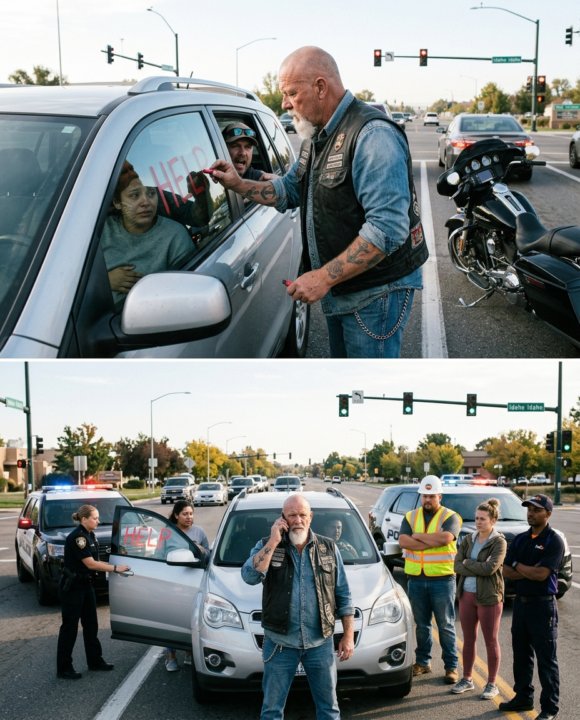
So Hank stood on the passenger side of that silver Equinox, in the middle of a six-lane road, with traffic piling up behind him, and wrote four letters in red lipstick in mirror image. Big. Clear. So she could read them from her seat.
The P first, facing the wrong way. Then the L. Then the E. Then the H, last.
From inside the car, it read perfectly.
HELP.
From the driver’s seat, at an angle, it just looked like a crazy old biker smearing red gunk on his window.
The driver’s window came down.
“Hey! HEY! What the hell are you doing, man? Get away from my car!”
Hank didn’t look at him.
“Are you out of your mind? You psycho! That’s my car! Get off it!”
Hank capped the lipstick. He put it back in his vest pocket.
He took one step back from the passenger window.
And he looked at the woman.
Just looked at her.
She was staring at the four red letters on the glass in front of her face.
Her lips were moving. Silently. Reading them.
Then she looked up at Hank.
Her eyes were full.
And she nodded.
Once.
Very small. Barely a movement. If you hadn’t been looking for it, you’d never have seen it.
Hank saw it.
“You’re a lunatic!” the driver was screaming now. “You’re a goddamn lunatic! I’m calling the cops on YOU!”
The light turned green.
The man jammed his sunglasses up on his head. His face was red. He threw the Equinox into drive.
Hank walked around the front of the car.
He stood in front of the hood.
Directly in front of it. Feet planted. Arms at his sides.
And took out his phone.
The man laid on the horn.
Behind him, every car in two lanes laid on their horns too. They didn’t know what was happening. They just knew the light was green and some crazy biker was standing in the road.
Hank dialed 911.
He put it on speaker.
“Ada County 911, what’s your emergency?”
“My name is Hank Mulder,” Hank said. Loud. Steady. Looking straight through the windshield at the man. “I’m at Fairview and Cole, eastbound. There’s a woman in the passenger seat of a silver Chevy Equinox who just gave me the signal for help. The hand signal. Domestic violence. She’s pregnant. I’m standing in front of the car so it can’t leave. Please send someone now.”
The dispatcher didn’t hesitate. “Sir, officers are on the way. Stay on the line. Are you safe?”
“I’m fine.”
The Equinox rolled forward.
Six inches. It bumped Hank’s knees.
He didn’t move.
The man revved the engine. The Equinox lurched another few inches. The bumper pressed hard against Hank’s shins. It hurt.
Hank stood there.
“He’s pushing the car into me,” Hank told the dispatcher. Calm. “I’m not moving.”
Then the driver’s door of a cement truck two lanes over opened.
A big man in a hard hat and a reflective vest climbed down and walked across the lane through honking traffic and stood next to Hank in front of the Equinox.
He didn’t say anything. He didn’t know what was going on. He just looked at Hank, then at the woman in the passenger seat, then at the man behind the wheel.
He crossed his arms.
Then a woman got out of a minivan behind them. Forties. Yoga pants. She walked up and stood on Hank’s other side.
Then a FedEx driver.
Four people standing in front of a silver Equinox in the middle of Fairview Avenue.
The man behind the wheel stopped revving.
He looked at the four of them.
He looked at the passenger window. At the red letters.
Then he looked at the woman beside him.
And Hank watched something terrible cross his face.
Understanding.
He reached for her.
She flinched toward the door.
And then the sirens came.
Part 4
Talia Moreno had practiced it a hundred times.
In the bathroom mirror. In the dark, under the covers, while Derek slept. In the kitchen while she washed dishes, her back to the living room where he watched TV.
Palm out. Thumb in. Fingers down.
She’d watched the video on the smart TV in the living room one afternoon a week earlier while Derek was at work. He’d taken her phone months ago. He’d changed the Wi-Fi password. But the TV still had YouTube, and she’d been flipping through cooking channels to pass the hours, and before one of the videos, a thirty-second public service ad came on.
A woman sitting in a car. A man beside her talking. The woman’s hand coming up, below the window.
Thumb in. Fingers down.
If you see this signal, someone needs help.
Talia had watched it standing frozen in the middle of the living room.
Then she’d watched it again. Then again.
Then she turned off the TV and went into the bathroom and locked the door and practiced until her hand ached.
She was twenty-six. She’d grown up in Ogden, Utah. She met Derek at a church picnic when she was twenty-three. He was charming. He was older. He listened to her. He said she was the most beautiful woman he’d ever seen.
They married eight months later.
It started small. He didn’t like her friends. He didn’t like her working at the bakery. He didn’t like her texting her sister. He started checking her phone. Then keeping it.
When she got pregnant last spring, it got worse.
In June, he told her he’d gotten a job in Boise. They were moving. He packed everything in a weekend. He didn’t tell her family. He changed her phone number.
The house he rented in Boise was a small gray ranch on a quiet street off Ustick Road. Her sister didn’t know the address. Nobody did.
The front door had a deadbolt that needed a key on both sides. Derek carried the only key.
The windows were painted shut. He’d done it himself, the first week.
When he left for work at seven every morning, he locked her in.
When he came home at six every night, he unlocked the door.
She hadn’t been outside, alone, in three months.
She’d been outside with him maybe four times. To the grocery store, where he held her arm the whole time and did all the talking. To the gas station. Once to the pharmacy.
She’d thought about running every one of those times.
She hadn’t. She had no money. No phone. No ID. He kept her driver’s license, her Social Security card, and her birth certificate in his wallet. He told her if she ever tried to leave, nobody would believe her. He told her he’d find her. He told her the baby was his and he’d take it.
That Tuesday was the first prenatal appointment he’d allowed her to keep in two months.
Her twenty-four-week checkup. At a women’s clinic on Emerald Street. He’d canceled the last two. But the clinic had called the house phone, which he’d forgotten to disconnect, and left a voicemail saying they’d need to involve a social worker if she missed another appointment.
So he let her go.
He drove. Of course he drove.
She sat in the passenger seat with her hands in her lap and her heart pounding so hard she thought he’d hear it.
She’d decided that morning, brushing her teeth.
If she saw anybody, anybody at all, she’d try.
At the light on Fairview Avenue, a motorcycle pulled up beside her window.
An old man. White beard. Leather vest. He looked over at her.
He had kind eyes.
She did it.
Twice.
Then she looked away, sure she’d made a mistake. Sure he hadn’t seen. Sure he’d ride away when the light changed, like everybody always did.
Then he climbed off his motorcycle.
And walked to her window.
And wrote four letters on the glass.
Backwards.
So she could read them.
HELP.
Talia sat in that passenger seat and read those four red letters and understood, for the first time in three months, that somebody had seen her.
She nodded.
Then the old man walked around the front of the car and stood there.
And didn’t move.
Part 5
Two Boise Police cruisers came from opposite directions and boxed in the Equinox.
Officer Diane Holcomb got there first. Twelve years on the force. She’d been through the department’s domestic violence training. She knew the signal.
She saw the red letters on the passenger window before she was even out of her car.
She went to Talia’s side. Opened the door. Crouched down.
“Ma’am. My name is Diane. Are you safe?”
Talia looked at Derek.
Derek was yelling. That the biker was crazy. That he’d attacked his car. That his wife was confused, emotional, pregnant, hormonal. That this was harassment.
Officer Holcomb didn’t look at him. She looked at Talia.
“Ma’am. I need you to tell me. Are you safe?”
Talia started to cry.
She shook her head.
Officer Holcomb helped her out of the car. Walked her twenty feet away, to the curb, out of Derek’s line of sight. Sat with her on the edge of a planter outside a mattress store.
The second officer took Derek out of the driver’s seat.
He fought. Not a lot. Enough. They put him on the hood of the Equinox, right under the red letters, and cuffed him.
When they emptied his pockets, they found his wallet.
Inside it, behind his own license, there was a second driver’s license.
A Utah license. TALIA ANN MORENO.
Folded behind that, a Social Security card with her name on it.
And folded behind that, so many times it was soft as cloth, a birth certificate.
The officer held them up. He looked at Derek.
“Why do you have your wife’s identification in your wallet?”
Derek didn’t answer.
He didn’t have to.
Hank stood on the curb and watched all of it.
He was shaking. His shins hurt where the bumper had pressed into them. He’d have bruises for a week.
The cement truck driver was standing next to him. The woman from the minivan. The FedEx driver.
Nobody said anything.
After a while, Officer Holcomb walked over.
“You’re the one who wrote that?” she said. She nodded at the passenger window.
“Yes, ma’am.”
“Backwards.”
“So she could read it.”
Officer Holcomb looked at him for a long time.
“How did you know the signal?”
Hank told her about Joanne.
Officer Holcomb’s eyebrows went up.
“Willow House?”
Hank nodded.
She was quiet a moment. Then she said, “That’s where we’re taking her.”
What came out over the next few hours, in pieces, at the police station, Hank only heard parts of later. From Joanne. And only what Talia said Joanne could share.
Three months locked in that gray house off Ustick Road.
Windows painted shut. A deadbolt with no key on the inside.
No phone. No money. No ID.
Bruises on her upper arms the officers photographed. Old and new.
Twenty-four weeks pregnant.
And a thirty-second video on a smart TV, one week earlier, that she’d watched over and over until her hand knew it by heart.
“She told me she almost didn’t do it,” Joanne said, weeks later, at their kitchen table. “She told me she was sure nobody would see. She said she’d decided she’d do it anyway, so that someday, when her baby asked her, she could say she tried.”
Joanne wrapped both hands around her coffee mug.
“Then she said she looked out the window and saw an old biker with kind eyes.”
Hank looked down at the table.
“She said she could tell he’d seen her before he even moved,” Joanne said. “She said it was the way he looked at her. Like he’d been looking for it.”
She reached across the table and took his hand.
“You had been, hadn’t you.”
Hank nodded.
“Four years,” he said. “Every red light.”
Part 6
Joanne was on shift that night at Willow House when the intake call came in.
Pregnant. Twenty-six. Brought in by Boise PD. No belongings.
She didn’t know until she opened the door.
Talia was sitting in the back of a police car in the gray sweatshirt, holding a plastic grocery bag with three things in it the officers had given her from the evidence log once they’d photographed them. Her driver’s license. Her Social Security card. Her birth certificate.
Joanne walked her in through the back door at eleven-thirty at night.
Gave her a room. A toothbrush. Clean pajamas. A phone she could use to call her sister in Ogden.
Talia called her sister. They talked for two hours. Joanne could hear them both crying through the door.
Then, a little after two in the morning, Talia came out of her room and found Joanne at the front desk.
“Can I ask you something?” she said.
“Of course.”
“The man on the motorcycle,” Talia said. “The old man. Do you know who he is? I want to thank him.”
Joanne looked at her for a long moment.
“I do,” she said. “He’s my husband.”
Talia stood there in the hallway.
Then she sat down on the floor right where she was and laughed and cried at the same time.
Hank never saw her again.
That’s how it works at Willow House. That’s how it has to work. The women who go through that door need to disappear for a while.
But in January, three months after the red light, Joanne came home from a shift and set her phone on the kitchen table in front of him without a word.
On the screen was a photograph.
A newborn baby. Pink. Wrinkled. Wrapped in a hospital blanket. A full head of black hair.
Under the photo, a message Talia had asked Joanne to show him.
Her name is Nova Hope. Seven pounds, one ounce. Born January 9th. We’re safe. We’re going home to Utah to be with my sister.
Her middle name is for the four letters on my window.
Tell him thank you. Tell him I saw him too.
Hank sat at that kitchen table for a long time.
Then he got up and went out to the garage and sat on his Road King with the engine off and didn’t come back inside until dark.
The story got out.
Not from Hank. Not from Joanne. From the woman in the minivan, who’d filmed the end of it on her phone. Four strangers standing in front of an Equinox. Red letters on a passenger window. An old biker with his phone on speaker.
She posted it with a caption. I didn’t know what was happening. I just knew I had to stand with him.
It went everywhere. Four million views in a week.
When people figured out what it was, the signal, the lipstick, the backward letters, it went everywhere again.
Willow House, with Talia’s permission, posted a short statement. No names. No details. Just the story, and a picture of a hand.
Palm out. Thumb in. Fingers down.
If you see this, call 911. And let them know you saw.
That post was shared two million times.
That year, the national domestic violence hotline and every shelter in Idaho reported something they’d never seen before.
Calls from people asking about the hand signal. Calls from teachers. Nurses. Bus drivers. Grocery clerks. Truck drivers.
People who wanted to learn it.
People who wanted to know what to do if they ever saw it.
Part 7
The Snake River Riders made it official that spring.
Every member carries a tube of red lipstick in his vest pocket.
They chip in for it at the clubhouse. A big box of Cherry Bomb. Joanne picked the color. Bright enough to see from across a parking lot.
Thirty-four bikers. Mostly over fifty. Mostly gray. Every one with a tube of red lipstick in his chest pocket next to his reading glasses.
They teach the signal everywhere they go. Charity rides. Bike nights. Toy runs. They hand out little cards with a drawing of a hand on one side and the hotline number on the other.
Other clubs started doing it. In Twin Falls. In Spokane. In Salt Lake City. In Ogden.
The cement truck driver joined the club. His name is Ray Delacruz. He rides a Street Glide now. He says he’d never sat on a motorcycle before that morning.
Hank still rides the same route to the parts store.
East on Fairview Avenue.
When the light at Cole Road turns red, he rolls to a stop.
And he looks.
At the cars beside him. At the passenger seats. At the hands resting in laps.
He doesn’t know if he’ll ever see it again.
He looks anyway.
Last week, Joanne came home from a shift with an envelope.
No return address. A postmark from Ogden, Utah.
Inside was a card. Handmade. Construction paper.
On the front, somebody had traced a tiny hand. A baby’s hand. Ten months old. Pressed flat on the paper and outlined in red marker.
Under it, in careful adult handwriting:
Nova says hi.
Inside, one more line.
Somebody saw us. Now we’re watching too.
Hank stuck it on the refrigerator.
Next to the tube of Cherry Bomb that Joanne had put in his vest pocket that Tuesday morning in October.
He never gave it back.
She never asked for it.
👉 If this story stayed with you, follow our page for more stories from the road — and learn the signal tonight. Palm out. Thumb in. Fingers down. Someone may need you to see it. 🏍️✋