The Girl Who Wouldn’t Blow Out Her Birthday Candles — Until a Biker Quietly Asked, “Where’s Your Dad?”
No one noticed the silence at first—until a little girl stood frozen before her birthday cake, candles shaking, eyes fixed on an empty chair no one dared mention.
The party was supposed to be simple. A rented room at a neighborhood family restaurant in suburban Ohio, pastel balloons drooping slightly from the heat, a grocery-store cake with pink frosting already starting to sweat. Parents crowded the walls, phones half-raised, waiting for the moment.
But the moment didn’t come.
The girl—six, maybe seven—kept her hands clenched at her sides. Her lips trembled. The candles burned lower. Wax dripped onto the cake like time running out.
“Come on, sweetie,” someone whispered too loudly.
“Make a wish,” another adult added, smiling in a way that didn’t reach their eyes.
She didn’t move.
There was a wrongness in the room, a tension no one wanted to name. Kids shifted in their chairs. A few adults exchanged looks, unsure whether to laugh it off or step in.
Her mother stood near the wall, arms crossed tight against her chest, jaw clenched. She looked like someone holding herself together with effort, like one wrong word might split her open.
The empty chair beside the cake—clearly meant for someone important—sat untouched.
And then the front door opened.
The room seemed to stiffen as a man walked in wearing a worn leather vest over a plain gray shirt. Heavy boots. Sunburned hands. A biker, unmistakable.
Conversations faltered. A few parents straightened. Someone whispered, “What’s he doing here?”
The man paused just inside the doorway, scanning the room quietly.
And then his eyes landed on the little girl who still hadn’t blown out her candles.
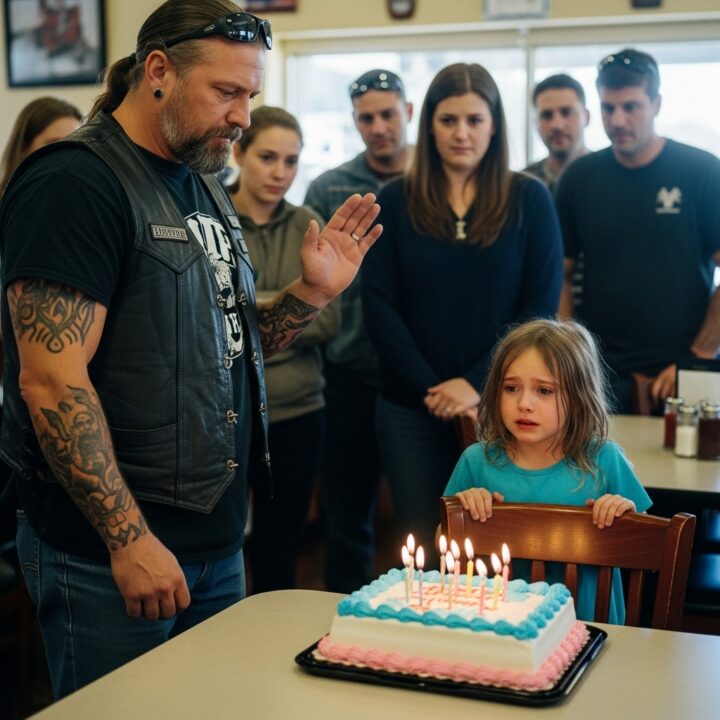
The biker moved forward slowly, deliberately. No swagger. No grin. Just measured steps, like someone trained not to rush into unfamiliar spaces.
A mother near the cake leaned back instinctively, pulling her child closer. Another adult frowned.
“Hey—this is a private party,” someone said, voice sharp.
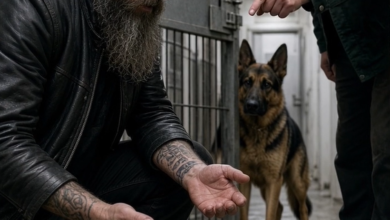
The biker didn’t respond. He stopped a few feet from the table and crouched slightly so he wasn’t towering over the girl. His voice was low, steady.
“You don’t have to blow them out yet,” he said.
That alone was enough to set nerves on edge.
“What are you doing?” a man snapped.
“Sir, step back,” another added.
The biker raised one hand—not in surrender, not in threat—just a small, calming gesture.
“I’m not here to cause trouble,” he said.
But the words didn’t land.
Leather vest. Heavy boots. A stranger approaching a child. In a world trained to fear first and ask later, everything about him read as danger.
Someone reached for their phone. Another adult stepped between the biker and the table.
“You need to leave,” the father of another child said. “Now.”
The biker didn’t argue. He didn’t raise his voice. He simply shifted his gaze back to the girl, careful not to move closer.
Her eyes had finally lifted to his.
They were red. Wet. Too tired for someone her age.
He hesitated, then asked softly, almost as if the question might break if spoken too loudly:
“Where’s your dad?”
The room went still.
Her lower lip quivered. She didn’t answer.
That’s when the mother reacted.
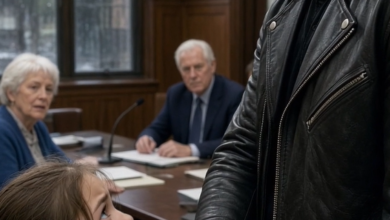
“Don’t talk to her,” she said, voice tight with anger and fear. “You have no right.”
“I’m sorry,” the biker replied immediately. “I didn’t mean—”
Security was already being waved over from the front. Someone mentioned calling the police. The word “threat” floated through the air like smoke.
The biker straightened slowly, hands visible, posture calm—but the misunderstanding had already hardened.
Security arrived first—two men in black polos, hands resting near their radios. One of them positioned himself squarely between the biker and the table.
“Sir, you need to step outside,” he said.
The biker nodded once. No protest. No resistance.
But before turning away, he glanced back at the cake.
The candles were nearly out now.
The girl’s shoulders were shaking. Silent sobs. A child breaking in a room full of adults who didn’t know how to fix it.
The biker reached into his pocket.
That small movement triggered everything.
“Hey!” someone shouted.
“Watch his hands!”
Security stiffened. A phone camera lifted higher.
But instead of a weapon, the biker pulled out his phone.
He typed quickly. One message. Maybe two.
Then he pressed call.
He didn’t explain who he was calling. He didn’t argue his case. He didn’t try to justify himself.
He just said one sentence, quietly but clearly:
“She’s here.”
And then he ended the call.
The silence that followed was heavy, suffocating.
Security hesitated, uncertain. The crowd murmured, confused now instead of angry.
The mother stared at the biker, something shifting behind her eyes—fear mixing with something else. Recognition, maybe. Or dread.
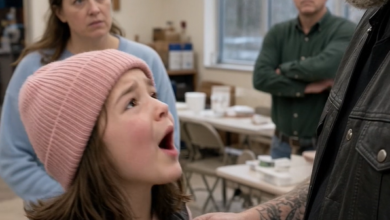
The little girl wiped her face with her sleeve and whispered, barely audible:
“Is he coming?”
No one answered.
The biker didn’t move. He just stood there, waiting.
They heard it before they saw it.
The low rumble of engines outside. Not loud. Not aggressive. Controlled. Familiar.
One engine became two. Then several.
The sound rolled through the walls of the restaurant like distant thunder.
Heads turned. Conversations stopped.
Through the front windows, a line of motorcycles came into view—parked neatly, deliberately, as if following an unspoken order. Men and women dismounted calmly, leather vests marked with patches worn smooth by time.
No one rushed inside.
One man entered first—older, gray at the temples, posture straight despite a limp. He didn’t look at the crowd. He walked directly toward the biker.
They didn’t hug. Didn’t clap each other on the back.
The older man simply said, “You called.”
The biker nodded.
The older man turned then—toward the cake, the child, the mother.
His voice carried without effort.
“We’re here for Lily,” he said. “And for her father.”
The mother’s breath hitched.
Security stepped back, unsure now. The crowd had gone quiet—the kind of quiet that follows a sudden shift in gravity.
Another biker entered, holding a folded jacket. Another carried a small box. No one blocked them.
Power had changed hands without a single raised fist.
The truth didn’t come in a speech.
It came in fragments.
Lily’s father had been a biker. A quiet one. Disciplined. A man who followed rules most people didn’t know existed.
Three weeks earlier, he’d been killed by a drunk driver on his way home from a night shift. He never made it to Lily’s birthday.
The empty chair was his.
The biker who’d first walked in? He was the man Lily’s father had ridden with for years. The one who’d promised, quietly, “If anything ever happens, I’ll show up.”
No matter what.
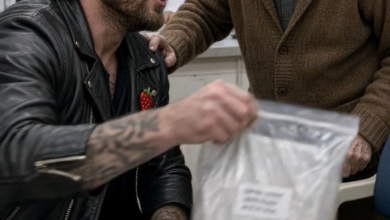
The jacket placed gently over the chair belonged to Lily’s father. The small box held a patch he’d earned years ago—something he’d wanted to give her when she was older.
No one spoke.
The girl looked at the biker, eyes wide.
“You came,” she whispered.
He nodded once.
“Your dad asked me to.”
He stepped back then. Let the family have their space. Let the moment belong to them.
The candles had burned out completely.
The older biker relit them carefully, shielding the flame with his hand.
“Whenever you’re ready,” he said.
Lily took a breath. A deep one.
And this time, she blew out the candles.
No applause followed. No cheers.
Just quiet respect, heavy and real.
The bikers left the same way they arrived—calmly, without claiming credit. The first biker paused at the door, glanced back once to make sure Lily was smiling.
Then he was gone.
Outside, engines started softly.
Inside, a room full of people sat with the uncomfortable weight of their assumptions.
And the empty chair no longer felt empty at all.