Part 2: The Little Girl Tore My Club’s $286,000 Charity Check into Pieces Before We Could Hand It Over—Then One Name Revealed Who Had Stolen Her Mother’s Treatment Fund
Part 2 — The Money We Raised One Mile at a Time
Iron Mercy had never raised $286,000 before.
Our club handled smaller needs: motel rooms after house fires, wheelchair ramps, fuel cards for hospital trips, funeral expenses, and grocery money left anonymously beneath doors.
Miles for Small Hearts changed that scale.
The campaign began after Bear’s granddaughter needed pediatric heart surgery in Cincinnati. Insurance covered the procedure, but his daughter nearly lost her job traveling between Beckford and the hospital.
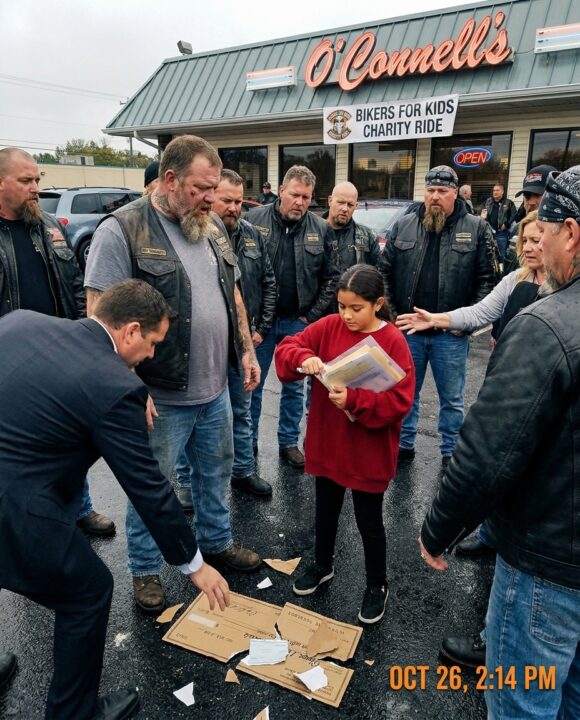
Other families inside the cardiac unit faced the same pressure.
A treatment could be covered while transportation, food, lodging, sibling care, parking, and missed wages broke the household around it.
Bear proposed a single charity ride.
Marisol turned it into seven months of work.
Every donation entered a public ledger. Two members counted cash, bank deposits required dual approval, and an independent bookkeeper reviewed monthly reports.
That bookkeeper was Calvin “Ledger” Reed.
Ledger had ridden with Iron Mercy for fourteen years. He was fifty-one, quiet, divorced, and more comfortable beside spreadsheets than crowds.
He volunteered at tax clinics and helped elderly riders complete disability forms. When a club brother died, Ledger often spent weeks untangling insurance documents for the widow.
Nobody questioned his integrity.
That was precisely why Mercy Harbor wanted him.
Ledger told us Marcus approached him during a regional nonprofit conference. Mercy Harbor claimed established hospital relationships and promised ninety-two cents of every dollar would reach patient services.
Ledger requested evidence.
Marcus provided years of audits, tax filings, hospital references, insurance certificates, board biographies, and testimonials from families.
Ledger verified the registration number through a public database.
He called references.
Every answer appeared legitimate.
The fraud was built from real organizations whose identities had been copied, altered, or temporarily redirected.
One hospital letter came from a retired administrator whose email account had been compromised. A tax document belonged to a dissolved charity with a similar name.
Several testimonials described real children, but the families never authorized their stories.
Ledger believed the records because each false piece leaned against something true.
His deeper mistake began afterward.
Marcus offered him paid consulting work helping Mercy Harbor understand biker-led fundraising. Ledger accepted $3,000 and disclosed the arrangement to nobody.
He told himself the payment compensated evenings spent reviewing grant procedures.
It also created leverage.
Marcus asked Ledger to meet families supposedly applying for assistance. Elena and Mia were among them.
At the Highway Lantern Motel, Ledger reviewed their identification, treatment estimates, and fundraiser account.
He never physically transferred the money.
Marcus handled that.
Yet Ledger’s presence made Mercy Harbor look trustworthy.
Elena recognized his voice during the ceremony, although Mia recognized his face first.
“I thought we were helping them,” Ledger said outside Murphy’s Diner.
Mia remained behind me.
“You watched Mom sign.”
“Yes.”
“You said the money would be safe.”
“I believed that.”
“Did you check?”
Ledger’s mouth opened.
No answer came.
He checked documents provided by Marcus. He did not independently confirm the destination account with Elena’s hospital, despite Mercy Harbor claiming direct payment.
He did not question why Marcus rushed the transfer.
After the funds vanished, Ledger received a message saying Elena had withdrawn from the program and requested privacy.
He accepted it.
Three days later, Mercy Harbor paid his consulting fee.
Ledger told himself the timing was unfortunate.
He never contacted Elena.
That was the first silence that bought the next lie.
Marcus later invited Ledger onto Mercy Harbor’s advisory board. Ledger declined the title but continued reviewing documents.
The fraud ring copied his electronic signature from one contract and placed it across hospital references, grant approvals, and Iron Mercy verification letters.
When our club searched for a recipient organization, Mercy Harbor appeared repeatedly endorsed by a person we trusted.
Ledger recommended it without revealing his earlier payment.
Mia’s photograph did not prove he joined the scheme.
It proved he had hidden a conflict capable of guiding $286,000 toward the same criminals who stole Elena’s fund.
Bear wanted Ledger’s vest immediately.
Marisol stopped him.
“We preserve records first.”
Ledger surrendered his laptop, phone, financial files, and account credentials to police. He gave written consent for our independent auditor to examine club records.
Then he removed his treasurer patch.
“I should’ve told you.”
I looked toward Elena.
“You should’ve told her.”
Ledger lowered his head.
The destroyed check lay inside an evidence envelope. Although Mia tore the paper, the money remained in Iron Mercy’s bank account because the instrument had not been deposited.
She had saved everything.
Yet the club was not safe.
Our auditor found nine smaller grants sent during the previous year to organizations sharing addresses, board members, or service providers with Mercy Harbor.
The total reached $74,600.
Some payments funded legitimate family assistance.
Others disappeared.
Ledger had approved all nine.
Iron Mercy’s clean public ledger had recorded every dollar.
The destinations were dirty.
Club members gathered that night.
Several argued Ledger had been deceived and deserved support. Others believed taking the consulting fee made him part of the fraud, whether knowingly or not.
Brotherhood split along the difference between betrayal and weakness.
Ledger refused to defend himself.
“Freeze every account I touched,” he said.
Doing that would also freeze rent, transportation, and treatment support for families expecting payments the following morning.
Marcus understood this vulnerability.
He sent me a message.
If Iron Mercy publicly accused Mercy Harbor, he would report the club for financial misconduct and reveal confidential medical files obtained from applicants.
The threat placed children’s privacy against our reputation.
I showed the message to Mia.
She studied it.
Then she asked a question none of us had considered.
“How does he know which files scare you?”
Somebody inside Iron Mercy had given Marcus access to our emergency-aid applications.
Ledger denied it.
Our digital records showed his password had been used overnight from the clubhouse office.
The security camera covering that hallway had been disconnected.
Only four people possessed keys.
One was me.
One was Marisol.
One was Ledger.
The fourth belonged to Bear.
Part 3 — The Brother Whose Key Opened the Clubhouse Office
Bear reacted exactly as Marcus expected.
He threw his key onto the table, demanded police search his home, and accused Ledger of redirecting suspicion toward him.
Ledger remained seated.
“I didn’t say your name.”
“You didn’t have to.”
Bear had more at stake than pride.
His granddaughter’s cardiac records appeared among the files Marcus threatened to release. So did employment details from Bear’s daughter and financial documents showing how close the family came to eviction.
If the information became public, strangers would reduce a child’s survival to numbers, debts, and adult mistakes.
Bear wanted to find Marcus personally.
I blocked the clubhouse door.
“Police handle him.”
“He has my grandbaby’s files.”
“And if you touch him, he gets to become the victim.”
Bear shoved my shoulder.
I did not move.
Leather creaked around us as members rose, unsure whether they were preparing to restrain Bear or defend him.
Marisol stepped between us.
“The girl is watching.”
Mia stood beside Elena near the bulletin board.
Bear saw her.
His fists opened.
That moment saved more than a fight. It reminded forty angry adults that their decisions were forming a child’s understanding of power.
Police searched the office.
Bear’s key had been copied months earlier. Tiny machining marks showed it was a duplicate made from an impression rather than an authorized blank.
The disconnected camera contained fingerprints from a contract cleaner.
The cleaner admitted Marcus paid him to disable it during three scheduled nights.
He did not enter the records room.
Another person did.
Security footage from the parking lot showed a silver minivan arriving after midnight. Its license plate belonged to the wife of Iron Mercy’s former vice president, Thomas “Saint” Kelley.
Saint had died from a stroke nine months earlier.
His widow, Paula, still possessed his old clubhouse key.
When officers visited her home, she confessed.
Marcus approached Paula after Saint’s death, claiming Mercy Harbor could help manage outstanding medical debt and preserve her house.
She gave him financial records.
He learned Saint once handled Iron Mercy’s emergency applications.
Marcus persuaded Paula that the club was hiding insurance money owed to her. He asked to review files proving it.
Paula entered the clubhouse twice.
On the third visit, Marcus’s associate copied folders and photographed medical applications.
She believed she was gathering evidence against men who cheated her.
Marcus used her grief as a key.
When Paula learned the truth, she brought investigators a prepaid phone, payment receipts, and recordings of every instruction Marcus gave her.
She also revealed where Mercy Harbor stored physical records.
A rented office above a closed pharmacy outside Dayton contained boxes representing hundreds of families.
Investigators obtained a warrant.
The office was empty.
Somebody had removed the files hours earlier.
Marcus knew police were coming.
Our auditor then uncovered a transfer request scheduled from Iron Mercy’s main account. The bank stopped it, but the request used correct credentials and a verification code sent to Ledger’s phone.
Ledger checked his device.
The authentication message had arrived while police held it as evidence.
Someone inside the investigation had accessed the phone.
The apparent case against Ledger became stronger and stranger simultaneously.
Officers separated everyone.
Mia sat inside Murphy’s Diner with a cup of cocoa while adults moved through interviews. She tore the paper wrapper from a straw into tiny squares.
“You always tear things?” I asked.
“When I need to see inside.”
She opened one of Mercy Harbor’s original envelopes.
The inner security pattern contained repeating numbers.
Most adults saw random printing.
Mia recognized the last four digits because she had stared at her mother’s transfer receipt every night after the money vanished.
The envelope’s security pattern repeated part of an account number.
Marcus’s organization reused discarded banking paper when printing correspondence.
Elena’s stolen funds had passed through that account.
Our $74,600 in missing grants had too.
The bank identified the account holder.
It did not belong to Marcus.
It belonged to Miles for Small Hearts, our own campaign.
Someone had opened a second account using Iron Mercy’s name, copied incorporation records, and listed Ledger as the authorized manager.
Ledger was not the thief.
He was the mask.
Marcus had built a duplicate version of our charity beside the real one, then moved money between fake nonprofits until each transfer appeared internal.
Investigators traced the verification code. It had been redirected through a cloned mobile account created with Ledger’s stolen identity.
Every piece framed him cleanly.
The fraud ring did not merely steal from Iron Mercy.
It planned to leave us blamed for stealing from sick children.
We believed this discovery would unite the club.
Instead, Ledger admitted one more secret.
Six weeks earlier, he noticed a duplicate account during reconciliation.
He closed the statement.
He told nobody.
“Why?” I asked.
His voice cracked.
“Because I thought I had opened it and forgotten.”
Ledger had begun experiencing memory gaps.
His father died from early-onset dementia. Ledger feared the same thing was happening to him.
He concealed the duplicate account because he believed reporting it might cost his position, license, and independence.
That private fear gave Marcus another month.
During that month, three families lost payments.
One was Elena.
Bear picked up Ledger’s discarded patch.
For a moment, I thought he would throw it into the fire barrel.
Instead, he placed it beside Ledger.
“You needed a doctor, brother.”
Ledger looked at him.
“I needed courage.”
Both were true.
Iron Mercy voted to suspend Ledger from all financial duties permanently while preserving his general membership until the investigation and medical evaluation ended.
Some called the decision too soft.
Others called it abandonment.
Ledger called it fair.
The club survived the vote.
Then Marcus released the medical files anyway.
He posted Bear’s granddaughter first.
Part 4 — What Mia’s Mother Had Hidden in a Motel Bible
The leak spread through anonymous accounts.
Screenshots exposed diagnoses, account balances, addresses, employer names, and private statements families made while applying for aid.
Bear’s granddaughter became the first target because Marcus knew hurting a child would provoke the club.
Bear broke a chair inside the clubhouse.
Then he went home.
He did not ride toward Dayton, threaten Marcus, or ask younger members to do what his patch forbade.
He sat beside his granddaughter while her mother disconnected the internet.
That restraint became the hardest act of brotherhood in the story.
Iron Mercy’s attorneys requested emergency removal of the files. Platforms responded unevenly, and copied images continued circulating.
Families blamed us.
They had trusted our club with details needed for assistance. Whatever sophisticated theft occurred, the records left our office.
I expected the campaign to end.
Elena surprised me.
She stood during the public meeting at Beckford High School and told families our club had made mistakes, but hiding from them would produce another layer of silence for criminals to use.
Then she opened an old Bible taken from the Highway Lantern Motel.
Inside the hollowed pages was a flash drive.
Mia knew nothing about it.
Neither did Marcus.
Before becoming ill, Elena worked as an accounts-payable clerk for a regional home-health supplier. She first encountered Mercy Harbor when invoices arrived for patient transportation services her employer never requested.
She reported the charges.
Her supervisor dismissed them as coding errors.
Elena copied the invoices anyway.
Months later, after her diagnosis, Mercy Harbor approached her fundraiser. She recognized the name but believed the organization had resolved its earlier billing irregularities.
Marcus presented authentic hospital references.
Elena trusted him because she desperately needed the money multiplied into treatment support.
After the theft, she began investigating.
She compared invoices, mailbox registrations, routing records, and names appearing across nonprofit boards. The work continued between treatments and diner shifts.
Elena discovered Mercy Harbor billed legitimate charities for services supposedly provided to families, then approached those same families and charged additional administrative fees.
Money traveled in both directions while services rarely existed.
She stored evidence inside the motel Bible because Marcus’s associate entered her room once and searched her folders.
“Why didn’t you give this to police?” I asked.
“I tried.”
A local investigator received her initial packet but retired unexpectedly. The file became misclassified as an individual online-payment complaint.
Elena feared approaching another agency without stronger proof.
Then her health worsened.
She prepared the flash drive so Mia could deliver it if anything happened.
The files contained photographs, invoices, recorded calls, and the partial license plate of Marcus’s associate.
They also contained a spreadsheet linking Mercy Harbor to twenty-three sham organizations across six states.
One organization stood apart.
The Caroline Dawson Family Assistance Fund.
I had created that fund after my wife died.
For twelve years, I believed it helped families cover hospice travel and end-of-life lodging.
According to Elena’s evidence, somebody diverted a portion of its donations before Iron Mercy assumed direct control.
Marcus’s network had been taking money connected to my wife long before it found Mia.
The first fraudulent consultant was my former attorney, Richard Vale.
Vale prepared Caroline’s fund documents, introduced Ledger to nonprofit accounting work, and later recommended Marcus to several regional charities.
He had attended my wife’s funeral.
He sat at my table.
He knew which memories made me stop asking questions.
Investigators traced Vale’s signature across shell corporations, mailbox rentals, and identity-theft applications.
Marcus was the visible director.
Vale designed the structure.
The man who taught Iron Mercy how to look legitimate had taught criminals how to wear our credibility.
Police arrested Vale at his Columbus office. Marcus disappeared before officers reached his home.
He left behind his suit, silver charity pin, and multiple prepaid phones.
Mia examined a photograph of the abandoned office.
She pointed toward a cardboard box beside the desk.
“That’s Mom’s.”
The box carried a purple marker line Mia drew during their motel meeting. It contained Elena’s original medical records and fundraiser documents.
Marcus had kept them.
Why?
Elena’s illness made her valuable to the fraud ring. They intended to create fundraising pages after her death, using Mia’s photographs and an invented story claiming the child needed housing.
The scam did not end when a patient could no longer complain.
Death improved the marketing.
That discovery broke Hammer’s restraint.
I started my Road King.
Bear and Marisol blocked the garage exit.
“You don’t know where he is,” Bear said.
“I know where he runs.”
Marcus had asked Iron Mercy to reserve a cabin near Red River Gorge for a future board retreat. The reservation remained active under a false name.
I intended to ride there.
Marisol removed my keys.
“You told Bear police handle him.”
“He planned to sell that kid’s face after her mother died.”
“And you think prison cares why you hit him?”
Mia stood behind them.
She held the torn check fragments inside a clear evidence sleeve.
“Mr. Hammer,” she said, “don’t make them use your name too.”
The sentence stopped me.
Marcus transformed trustworthy names into tools—Ledger, Iron Mercy, hospitals, dead children, and grieving families.
If I attacked him, he would use my anger to make himself look hunted.
I sat down.
Police reached the cabin before dawn.
Marcus was not there.
But his laptop was.
Inside it, investigators found scheduled fundraising campaigns, donor lists, stolen patient identities, and a draft page featuring Mia beside Elena’s hospital bed.
The launch date was three weeks away.
Marcus had entered another date beside Elena’s name.
Expected mortality window.
Mia saw only enough to understand.
She did not cry.
She asked whether tearing the check had stopped him.
“Not yet,” I said.
“Then what will?”
Elena answered.
“Everybody telling the truth at once.”
Part 5 — The Check We Rebuilt from the Pieces
Federal investigators coordinated with state agencies, banks, hospitals, and families across six states.
Elena’s flash drive supplied the structure. Paula’s recordings connected Marcus to the clubhouse theft, while Ledger’s devices exposed cloned accounts and falsified credentials.
Mia’s torn check preserved the payee information exactly as presented during the ceremony.
That physical evidence mattered.
Marcus’s attorneys could not claim Iron Mercy independently chose a similarly named organization after the investigation began.
The check showed the destination.
Mia’s destruction had frozen the moment before transfer.
Police found Marcus inside a private medical-transport van crossing into Kentucky. The vehicle carried forged patient documents, cash cards, and equipment used to create false identification.
He surrendered.
No dramatic chase occurred.
No bikers surrounded him.
The law did what our anger could not.
Marcus, Vale, and several associates faced charges involving fraud, identity theft, money laundering, conspiracy, and unlawful disclosure of private information.
Ledger was not charged.
His secret consulting payment remained an ethical failure, and his silence about the duplicate account remained a serious breach.
Iron Mercy did not restore his treasurer role.
A medical evaluation found treatable sleep and medication problems contributing to his memory gaps, not the disease he feared.
Ledger began treatment.
He attended meetings without financial authority, sitting near the back while a new independent committee managed every dollar.
Bear eventually returned his general membership patch.
He did not sew it on for him.
Ledger repaired the stitching himself.
Miles for Small Hearts changed completely.
We did not choose another umbrella charity.
Verified providers, licensed social workers, and independent auditors created a direct-assistance structure with written consent from each family.
No club member saw medical details unrelated to approved expenses.
Funds moved only after multiple confirmations.
Every recipient could review how information would be stored.
Mia attended the first oversight meeting.
She was eleven, so nobody pretended she carried legal responsibility. Yet we gave her one job adults had repeatedly failed to perform.
She read every organization’s name aloud.
If something sounded familiar, everyone stopped.
The original $286,417 remained intact. Additional donations arrived after the fraud became public, but Iron Mercy temporarily refused them until controls were complete.
Elena’s treatment account was reopened through the hospital’s verified assistance office. Money recovered from the fraud covered part of what had been stolen, while a court-supervised victim fund handled the rest.
We did not give her our entire campaign check.
That would have turned one family’s pain into a competition against others.
Elena agreed.
She wanted Mia to see fairness instead of another desperate transfer built around a compelling story.
When the program finally resumed, twenty-eight families received help with travel, temporary housing, meals, medical equipment, and uncovered services verified through providers.
Bear’s granddaughter remained among them, but Bear did not participate in approving her grant.
Ledger approved nothing.
I signed last.
Mia stood beside me.
She carried the fragments of the original check inside a transparent folder. The amount crossed several torn lines, and my signature remained split between two pieces.
“What happens to this?” she asked.
“Whatever you decide.”
“I don’t want it taped like nothing happened.”
Neither did I.
We mounted the pieces with narrow gaps between them. Every tear remained visible.
Beneath the frame, Mia placed a blank card with no slogan.
She said adults would write something too dramatic.
She was right.
The check hangs inside the clubhouse now, not as a trophy but as evidence that broken paper can preserve money while perfect documents can hide theft.
Elena began recovering slowly.
Treatment exhausted her, and some weeks brought setbacks nobody transformed into inspirational posts.
Iron Mercy provided motel transportation and grocery support through the same verified process as every family.
Mia continued school.
She joined an after-school journalism program, where her teacher discovered she remembered visual details with unusual precision.
At thirteen, she wrote an article about nonprofit verification without naming her mother.
At fifteen, she helped establish a youth advisory board for local charities.
She always carried the old plastic folder.
Inside remained the transfer receipt she opened hundreds of times.
One afternoon, she asked why I nearly grabbed her when she tore the check.
“Because I saw seven months of work.”
“What do you see now?”
I looked at the torn organization name.
“Seven months we didn’t lose.”
Mia smiled.
That was the first time she called me Hammer instead of Mr. Dawson.
The club later held a vote concerning Chase, the rider who once released a child’s private funeral video during another crisis. By then, Iron Mercy understood privacy failures differently.
We added a permanent rule.
No story involving a vulnerable family could be shared for fundraising without informed consent, even when sharing might increase donations.
Marcus had built his crimes from stories people thought they were entitled to use.
We would not imitate the smaller version of that theft.
The Brotherhood changed.
Not into saints.
Into men who checked each other.
Bear questioned every rushed decision. Marisol required written records. Ledger spoke openly whenever uncertainty or fear clouded his memory.
I stopped treating skepticism as disloyalty.
Mia had torn more than a check.
She tore the assumption that good intentions made our methods safe.
Part 6 — The Name-Reading Ritual
Every September, Iron Mercy gathers outside Murphy’s Diner before the new Miles for Small Hearts campaign begins.
The motorcycles arrive before sunrise. Engines shut down together, leaving cooling metal, boots, chain wallets, and road coffee to fill the quiet.
We do not begin with a speech.
We begin with names.
Marisol reads every organization, provider, bank, consultant, and responsible officer connected to the program.
Families may listen privately or attend.
Auditors answer questions before bikers vote on a single route.
Mia sits beside the framed check.
She is seventeen now.
Elena’s condition remains stable, though treatment continues to shape their schedules and finances. They no longer live at the Highway Lantern Motel.
A recovered-funds settlement helped them rent a small apartment near the hospital bus line.
Mia kept the motel Bible.
The flash drive inside belongs to investigators, but she placed an empty replacement between its hollow pages.
“That’s where questions go,” she says.
Ledger attends each reading from the back row.
He carries no account passwords and touches no checks. His role is answering historical questions and reminding new members how easily shame becomes silence.
When someone asks why he remains in the club, Bear responds:
“Because accountability isn’t always exile.”
When someone asks why he can never become treasurer again, Ledger answers:
“Because forgiveness isn’t restored access.”
Both sentences live together.
The clubhouse office has new locks, limited permissions, encrypted records, and cameras governed by a privacy policy families helped design.
Technology improved.
The deeper change was cultural.
A prospect can challenge a president’s decision without being called disloyal. A child can interrupt a ceremony without being treated as background noise.
A grieving widow can ask where every dollar goes.
Before each campaign, Mia walks to the framed check and presses one finger against the torn payee line.
Then she asks me:
“Same name?”
I answer only after looking.
“Not the same.”
She asks again.
“Same address?”
“Verified.”
“Same people?”
“Checked.”
Only then does she step away.
The ritual delays us approximately four minutes.
Nobody complains.
Outside, V-twins wait beneath the morning sky. The roads will remain there.
Trust needs longer.
Part 7 — The Check Mia Signed Last
Seven years after Mia tore our check, she graduated from high school.
Elena sat in the front row wearing a blue scarf and holding the same canvas purse she once carried between the motel, diner, and hospital.
Iron Mercy occupied the back seats.
We wore plain clothes because leather cuts beneath graduation banners would turn attention toward us, and the day belonged to students.
Mia received a scholarship to study forensic accounting and nonprofit management.
The scholarship came from a coalition of verified charities created after the Mercy Harbor investigation.
She reviewed its registration herself.
Twice.
After the ceremony, we returned to Murphy’s Diner. Laura served cake beside the parking space where Mia scattered the original check fragments.
A new check waited on the table.
It represented $412,000 raised that year for direct family assistance across Ohio. The money would not transfer as one lump sum, but the ceremonial check showed what the campaign held under independent supervision.
I handed Mia a marker.
“You sign first.”
She shook her head.
“Last.”
Marisol signed. Bear signed. The auditor, hospital liaison, and family representatives followed.
Ledger did not sign because he held no financial authority.
He stood beside Elena.
I added my name.
Mia examined every signature, organization, and printed address before placing hers in the lower corner.
Nobody rushed her.
When she finished, I asked whether the check survived inspection.
“Paper did.”
“And the people?”
She looked toward the club.
“Still checking.”
That answer was better than trust spoken too easily.
Elena approached the framed original carrying a small envelope. Inside was the first receipt from the treatment payment restored through the victim fund.
She placed it behind the torn check.
The stolen money had not returned as a miracle. It came back through years of evidence, court orders, audits, and people refusing to stop asking where it went.
Mia touched the frame.
“Mom used to think I broke everything.”
Elena smiled.
“You broke the right thing.”
Outside, Iron Mercy started the motorcycles for a short ride past the hospital, family housing center, and Highway Lantern Motel.
Mia rode behind me.
She wore a black helmet with no club logo, no charity slogan, and no name anyone could steal.
At the motel, we stopped briefly.
Mia looked toward Room 17.
Then she tapped my shoulder.
“Keep going, Hammer.”
I opened the throttle gently.
The building disappeared behind us while twenty-nine motorcycles followed at a respectful distance.
Inside my vest, I carried no large check.
Only one torn corner Mia had given me.
It contained half my signature and none of the organization’s name.
That was enough.
Leave “MIA” below if you want the next update about the girl who saved every dollar by tearing one check apart.
Follow our page for more unforgettable biker stories about misunderstood children, tested brotherhood, hidden betrayal, and courage powerful enough to stop an entire crowd.