Part 2: My Rescue Pit Bull Wags His Tail Three Slow Times at the Same Ceiling Spot Every Night at 11:11 — A Stranger DM’d Me a Photo That Made Me Sit Down on My Kitchen Floor
I posted my first TikTok video about it in August.
It was thirty seconds long. I had set up my phone on a tripod the night before, aimed at the couch where Atlas was sleeping. I had captioned it: My dog does this every single night at exactly 11:11. I have no idea why. Watch.
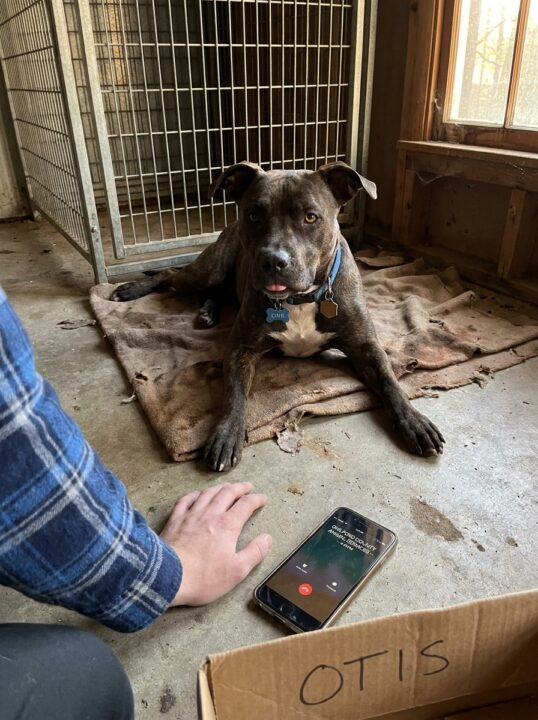
The video showed Atlas asleep on a navy throw pillow with his head tucked into his paws. The corner of the screen showed the time on my kitchen oven clock — 11:09, 11:10. At 11:11, Atlas’s eyelids flickered. His head came up, slowly, deliberately. He looked up at the ceiling above the couch — the ceiling above me where I sit every night with my laptop. His weak-tea eyes were soft and focused. His ears tilted forward.
He stared for eight seconds.
His tail thumped — once, slow, against the cushion. Then again, slow. Then a third time.
He laid his head back down on the pillow.
He went back to sleep.
The video had four hundred views by morning. By the end of the week it had two million. By the end of August it had eleven million. By October it had thirty-four million.
The comments under it became a small ecosystem. People shared their own dogs’ weird rituals. People said it was probably a sound he was hearing — the HVAC, the neighbor’s TV, a cat. People said dogs have an internal clock and he had probably been fed at 11:11 p.m. at some point in his early life.
A woman named Jess Halverson commented on the video on a Wednesday in October.
She wrote: Hi. I’m so sorry to be the person who slides into a TikTok comment section like this. Can you message me. I think I know your dog.
She sent me a picture in DMs.
The picture was a photograph of Atlas, about three years younger, sitting on the lap of a young woman with shoulder-length brown hair and blue eyes and a small star tattoo on her right collarbone. They were on a green couch. The woman was laughing.
I stared at it for a long time.
The dog in the picture had the same scar across his nose that Atlas has. The same heart-shaped white patch on his chest. The same blocky head. The same flopped ear.
It was him.
I wrote back: Yes. That’s my dog.
She wrote back: Can I drive to you? I have something to tell you.
She lived in Asheville. Three hours away. She drove out the following Saturday.
Jess was twenty-eight years old. She had short red hair, freckles, a small silver hoop in her left nostril, and the careful, quiet bearing of someone who had been carrying news for too long.
She came in. I made coffee. We sat at my kitchen table.
Atlas walked over to her without hesitation. He pressed his blocky head into her thigh. His tail did a slow, full-body wiggle. Jess put one hand on his head. She closed her eyes.
She said, “Aubrey. His name was Atlas before he came to you. We didn’t know if Second Wind kept it.”
I said, “They did. They told me they did.”
She said, “Good.”
She took a slow breath.
She said, “His first owner — his first person — was my best friend Marin Nakashima. We grew up together. We met in fourth grade in Asheville. We had been best friends for nineteen years.”
She said, “Marin died on a Tuesday morning in October of 2022. She was twenty-five years old. She was driving to work on I-26 and a tractor-trailer crossed the median. It was not her fault. It was not anybody’s fault on our side.”
I sat very still.
She said, “Atlas was at home that morning when it happened. Marin had adopted him from a shelter as a puppy when she was twenty-two. She had named him Atlas because she said he held up her world.”
She paused.
She said, “After Marin died, her parents flew out from Hawaii. They came to her apartment to clean it out. They could not take Atlas. Marin’s father is allergic. Her mother had just been diagnosed with rheumatoid arthritis. They felt terrible. They surrendered him to Second Wind because Second Wind had the longest waiting list and the best reputation in the area. They knew he would wait but they knew he would be safe.”
She said, “He was at Second Wind nineteen months.”
I said, “Until I came.”
She said, “Until you came.”
I asked her about 11:11.
She lifted her coffee cup. She didn’t drink it. She set it down again.
She said, “Aubrey. Marin made a wish at 11:11 every single night for as long as I knew her. Twenty-one years. We started doing it together at a sleepover in fifth grade. She never stopped.”
She said, “When she got Atlas, she started talking to him about it. She would tell him, ‘Atlas, baby, in a minute it’s gonna be eleven-eleven. We’re gonna make a wish.’ She would sit on her couch and she would look up at the ceiling and she would say her wish out loud. She always said it out loud. She believed wishes worked better that way.”
She said, “When she finished her wish, she would stroke Atlas on the head three times. Three. Always three. She would say, ‘One for the wish, one for me, one for you.'”
She paused.
She said, “I am telling you this and I have not been able to think about it for three years. I am telling you this because of your video.”
I said, “He’s been doing it since the night I brought him home.”
Jess put her face in her hands.
She said, “He’s been making her wish for her, Aubrey.”
She said, “Or he’s been waiting for her to make it.”
I said, “Jess. I — “
She said, “He doesn’t know she’s not coming back.”
She said, “He’s been holding her appointment.”
I sat there at my kitchen table and looked at Atlas, who was lying on his rug by the back door, and I thought about the eight months I had thought I was watching a quirky dog stare at the ceiling.
I had been watching a dog wait for a girl who had died three months before he was old enough to understand what death was.
That night, at 10:55, Jess and I sat on my couch.
I had not asked Atlas to come up. He came up anyway. He climbed onto the cushion between us and laid his head on Jess’s leg.
Jess scratched behind his ear. She did not say anything.
At 11:09, Atlas’s eyelids flickered.
At 11:10, he lifted his head slightly.
At 11:11, on the dot, he raised his head all the way and looked up at the ceiling above the couch.
His weak-tea eyes were soft.
His ears tilted forward.
Jess started to cry. Quietly. The kind of crying you do when you have been holding something for three years and you finally have permission to set it down.
I started to cry too.
Atlas counted his three slow tail wags against the cushion.
Then — and this is the part I have not been able to explain to myself, and Jess has not been able to explain to herself either, and three veterinary behaviorists I have written to since have not been able to explain to anyone — Atlas turned his head slowly to the left and pressed the top of his blocky skull, deliberately, into Jess’s hand.
Three times.
One pressure. Pause. Two pressure. Pause. Three pressure.
Jess made a sound I will never forget.
She said, “He remembers me.”
She said, “Aubrey. He remembers me.”
I said, “Jess.”
She said, “She would do it. She would do this exact motion. After her wish. She would put her hand on his head and he would press up into it three times.”
She said, “She would say, ‘one for the wish, one for me, one for you.'”
She said, “He just did it back to me.”
Atlas laid his head down on the cushion.
He went back to sleep.
Jess slept on my couch that night. We sat up until 3 a.m. drinking the rest of the coffee.
She told me about Marin. About the small studio apartment Marin had decorated with thrifted lamps and dried lavender. About the hospital where Marin had volunteered for two summers reading to chemo patients. About how Marin had wanted to apply to social work programs the year she died. About the way Marin laughed.
She showed me videos of Marin on her phone. Her voice. Her face. Atlas as a puppy, climbing all over her on a green couch.
She showed me a video of Marin at 11:11 on a Friday night, looking up at the ceiling of her apartment, saying, “I wish for everyone in my family to be safe. I wish for Jess to find someone who deserves her. I wish for Atlas to never know how lucky he is to be loved.”
Marin laughed at the end of the video.
She stroked Atlas’s head three times.
One. Two. Three.
The Atlas in the video was twenty-five pounds smaller than the Atlas asleep on my couch. The motion was identical.
Jess looked at me across the kitchen table at 3 a.m.
She said, “Aubrey. He has been keeping the time. For three years. Through nineteen months of a kennel at a rescue. Through transport. Through his new house with you. Every single night. At 11:11. He has been holding her wish.”
She said, “He doesn’t know she stopped.”
She said, “And the worst part — the part that breaks me — is that he has been doing it without anybody making the wish for him. He has been alone in that ritual for three years. He waits. The clock hits. He looks up. He waves his tail three times for the part she did. And then he goes back to sleep.”
She said, “He’s been keeping a promise no one else remembered.”
Jess and I have changed one thing.
Every night now, at 11:10, whichever of us is in the house — sometimes me alone, sometimes Jess when she drives over for a weekend, sometimes both of us with a glass of wine — sits on the couch with Atlas. We wait. We do not turn off the light. We do not interrupt his ritual.
At 11:11, Atlas lifts his head. He stares at the ceiling for eight seconds. His weak-tea eyes are soft. His ears tilt forward.
And then — only since the night Jess came — one of us says it out loud.
We say a wish. Whoever is there. Out loud. In the room with Atlas. We pick something small. I wish my mother’s biopsy comes back clean. I wish Jess passes her LCSW exam. I wish Marin’s parents have a peaceful Sunday.
We say it the way Marin would have said it.
When we finish, Atlas counts his three slow tail wags against the cushion.
Then we put one hand on his head.
We stroke him three times.
One.
Two.
Three.
He presses up into our hand on the third one.
Then he lays his head down.
He sleeps.
Marin’s parents flew out from Hawaii in December.
Jess set it up. She drove down to my house with them on a Sunday afternoon. They were small, careful people. Mr. Nakashima had Marin’s eyes. Mrs. Nakashima had Marin’s laugh.
They sat on my couch.
Atlas walked into the living room. He stopped. He looked at Mrs. Nakashima. His tail did a slow, full-body wag.
He walked over and put his blocky head in her lap.
She put both of her thin hands on either side of his face.
She did not speak. She just held his face.
At 11:11, Atlas lifted his head and looked up at the ceiling.
Mrs. Nakashima said, very quietly, in Japanese first and then in English: “Marin. Honey. We are with him. He is okay. He is loved.”
Atlas counted his three tail wags.
Mr. Nakashima reached over and stroked his head three times.
Atlas pressed up into his hand on the third one.
Mr. Nakashima — a man in his sixties, in a button-down shirt, holding back a lifetime of grief that had nothing to do with this dog and everything to do with this dog — put his hand over his mouth and cried without making a sound.
Atlas laid his head down.
He went to sleep.
He has not missed a night since.
If you want to see Atlas now — the way he still lifts his head at 11:11 sharp, the way he counts his three tail wags, the small ritual he has been keeping for a girl he loved before he came to me — I’ve shared his most recent video in the comments.