A Biker Walked Toward the Delivery Room — And Was Stopped in Front of the Family
“You can’t go in there.”
The words came fast and sharp, spoken before the biker had even reached the door.
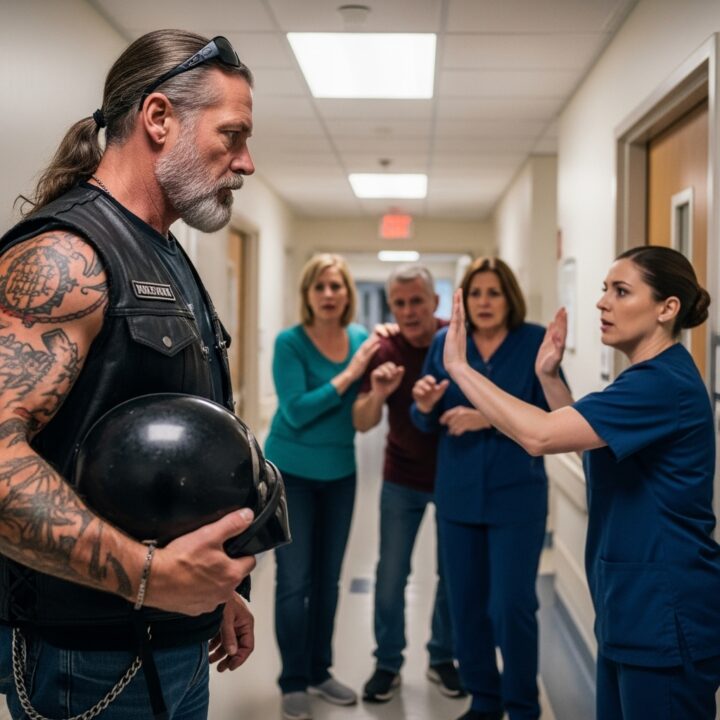
He stopped in the middle of the hospital hallway, one step from the entrance marked Labor & Delivery. Bright fluorescent lights hummed overhead. A nurse stood with one hand raised. A family clustered nearby turned as one.
The biker stood out instantly.
Leather vest. Sleeveless shirt. Tattooed arms. Heavy boots echoing softly on the clean tile floor. His helmet hung from one hand, his other clenched tightly at his side.
To everyone watching, he looked wrong. Out of place. Dangerous in a space meant for new life and careful silence.
“This is a restricted area,” the nurse said again, firmer now.
A man—mid-forties, well dressed, clearly part of the family—stepped forward. “Who are you?” he demanded. “This is our daughter. You need to leave.”
The biker didn’t answer.
He looked past them, toward the closed doors. Toward the sounds muffled behind them—footsteps, voices, the distant cry of a woman in labor.
His jaw tightened. His breathing stayed slow.
“I just need a moment,” he said.
That was enough to ignite the room.
“You’re not family,” the man snapped.
“This is a hospital, not a bar,” someone muttered.
The biker remained where he was, not pushing forward, not stepping back. From the outside, it looked like stubborn intrusion. Like a man forcing himself into a private, fragile moment.
The hallway fell into a heavy silence.
And in that frozen instant, every person present thought the same thing:
He doesn’t belong here.
The judgment settled quickly.
A woman pulled her purse closer. Another nurse glanced toward the security desk down the hall. Someone whispered that the police might need to be called.
The biker felt it all without reacting. He stood still, shoulders squared, eyes fixed on the door as if nothing else mattered.
To the family, his silence felt threatening. It left too much room for imagination.
“Why is he even here?” the woman asked, her voice shaking between fear and anger.
The biker didn’t respond.
That only made it worse.
In a quiet American hospital—where rules were followed, where order meant safety—a man like him carried assumptions before he ever spoke. Violence. Chaos. Disrespect.
A security guard appeared at the end of the hallway, alerted by the raised voices. He stopped short, assessing the situation.
“Sir,” the guard said carefully, “I’m going to have to ask you to step away.”
The biker nodded once. “I understand.”
But he didn’t move.
The family bristled. “You see?” the man said sharply. “He won’t listen.”
The biker finally looked at them. His eyes were tired. Older than they had expected.
“I’m not here to cause trouble,” he said quietly.
No one believed him.
The guard reached for his radio.
The tension thickened, pressing down on the hallway like a held breath.
The situation edged closer to breaking.
“Sir, this is your last warning,” the guard said. “If you don’t step away, I’ll have to escort you out.”
The biker inhaled slowly.
He reached into his vest.
Several people stiffened instantly.
The movement looked exactly like what they feared. The nurse stepped back. The family member raised his voice, panic cutting through anger.
The biker pulled out his phone.
Typed a short message. One line. Then sent it.
“I’ll stay right here,” he said. “Out of the way.”
The guard frowned. “Who did you just contact?”
The biker didn’t answer.
Behind the doors, a sharp cry echoed down the hall. A nurse hurried past, urgency in her steps.
The family’s fear deepened. “This is unbelievable,” the woman whispered. “Why won’t he just leave?”
The biker’s hand tightened around the helmet he held. His knuckles whitened.
“I promised,” he said softly. “I wouldn’t miss it.”
The words landed without context, heavy and confusing.
Before anyone could press him further, a sound rolled through the building.
Low. Distant. Steady.
Engines.
The sound grew louder, unmistakable now.
Motorcycles pulled into the hospital parking lot outside, one after another, engines cutting almost in unison. The vibration carried through the walls, through the floor beneath their feet.
The hallway turned quiet.
Moments later, men appeared—bikers. Not rushing. Not loud. Sleeveless vests. Tattoos. Helmets tucked under arms. Some gray-haired. Some broad and worn by years of road and work.
They stopped several feet behind the first biker.
No confrontation.
No threats.
Just presence.
The security guard stiffened, then hesitated. “What’s going on here?”
One of the bikers stepped forward slightly. “We’re here with him,” he said. “That’s all.”
The family stared, disbelief giving way to confusion.
The original biker finally spoke again. He gestured toward the doors.
“She doesn’t have anyone else,” he said. “Her husband died last year. Her parents don’t speak to her.”
The room went still.
“She showed up at our clubhouse six months ago,” he continued quietly. “Scared. Pregnant. No place to go.”
The woman’s face drained of color.
“We helped her,” the biker said. “Rides to appointments. Groceries. Someone to call when it got hard.”
A nurse stepped out from behind the doors, scanning the hall. “Are you… are you the ones she asked for?” she asked carefully.
The biker nodded.
“She said,” the nurse continued, “‘If anything happens, tell them I want my brothers here.’”
Silence.
The guard lowered his hand from the radio.
The family said nothing.
The doors opened.
Slowly.
The biker didn’t rush forward. He removed his helmet and held it against his chest, stepping only as far as he was invited.
Inside, the room was calm now. A newborn’s cry filled the space, small and steady.
The mother looked up from the bed, exhaustion softening into relief when she saw him.
“You came,” she whispered.
The biker nodded, unable to speak.
He stood back, letting the nurses work, letting the moment belong to her. His brothers remained outside, silent, respectful.
No one clapped.
No one apologized aloud.
They didn’t need to.
Later, as the hallway emptied and the tension faded, the family sat quietly, eyes lowered, understanding settling in slowly.
The biker and his brothers left without ceremony, engines starting softly in the distance.
The hospital returned to its rhythm.
But those who had been there carried something home with them—a discomfort, and a lesson.
That family doesn’t always look the way we expect.
That protection doesn’t always wear a uniform.
And that the people we’re quickest to judge are sometimes the ones standing guard when no one else will.
The image lingered long after the doors closed:
A man in leather, standing outside a delivery room—not to intrude, but to keep a promise.
Sometimes dignity shows up quietly.
And sometimes, brotherhood is the only thing standing between fear and hope.