An Old Man Ordered a Biker to Bury a Brand-New Helmet in His Backyard—The Neighbors Suspected a Hidden Crime, Until Decades of Letters Spilled From Inside
At 2:17 in the morning, my eighty-four-year-old neighbor pointed a shotgun at a tattooed biker and ordered him to bury a brand-new motorcycle helmet—then warned me that calling the police would expose something our town had ignored for fifty-two years.
I had lived beside Walter Mercer for eleven years, long enough to know every ordinary sound that came from his small white house outside Knoxville, Tennessee. I knew the cough of his furnace, the squeal of his back gate and the slow scrape of his cane across the porch whenever he collected the newspaper before sunrise.
That night, I heard a shovel.
The sound came from the far corner of Walter’s backyard, beneath an old sycamore tree where nothing grew except moss and stubborn weeds. Metal struck hard Tennessee clay, paused, then struck again.
When I looked through my kitchen window, a motorcycle stood beside Walter’s shed with its lights off.
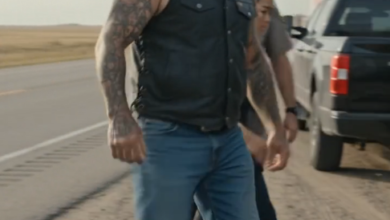
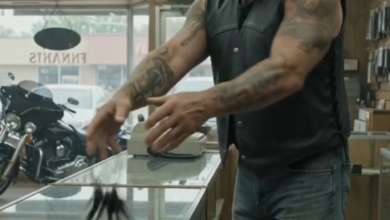
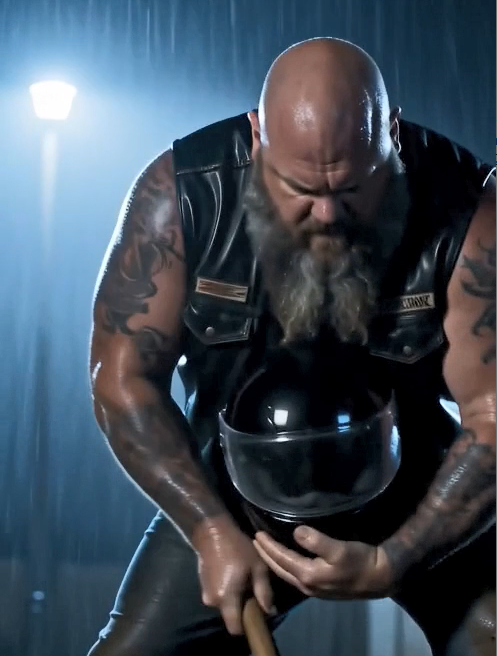
The biker digging the hole was enormous. He looked close to sixty, well over six feet three, with a shaved head, a thick black-and-gray beard and tattooed arms exposed beneath a plain leather vest. His boots were caked with red mud. A long scar pulled one corner of his mouth downward, making him appear angry even when his face was still.
Walter stood behind him in his robe.
He was holding a shotgun.
“Deeper,” Walter said.
The biker leaned on the shovel. “Ground’s fighting back.”
“So did he.”
“Walter—”
“Deeper, Mason.”
On the patio table sat a glossy black motorcycle helmet. It looked untouched, with a clear visor, smooth shell and a price tag still looped through its chin strap.
Walter had never owned a motorcycle.
His wife had died before I moved onto Willow Creek Road. His only child, according to the framed newspaper clipping in his hallway, had disappeared during the Vietnam War. Walter rarely spoke about either of them, and nobody in the neighborhood had ever seen a biker visit his house.
Then the biker lifted the helmet.
Something shifted inside it.
Paper.
A thick stack of it.
I stepped onto my porch and called Walter’s name. Both men froze. The biker’s hand moved toward his leather vest, and for one frightened second, I thought he was reaching for a weapon.
He removed an old military identification tag instead.
“Go back inside, Nora,” Walter said.
“What are you burying?”
“What I should’ve buried years ago.”
The biker lowered the helmet toward the hole.
I took out my phone.
Walter raised the shotgun—not at me, but high enough to make his warning unmistakable. “You call anybody, they’ll dig him up again.”
“Dig who up?”
Neither man answered.
Across the street, porch lights began coming on. Mr. Dorsey stepped outside in his undershirt. The Meltons opened an upstairs window. Someone shouted that the biker had forced Walter into the yard.
The biker did not defend himself.
He climbed into the hole, placed the spotless helmet at the bottom and arranged it with both scarred hands as carefully as if positioning a sleeping child.
Then a folded envelope slipped from beneath the visor.
Walter saw it.
His face changed.
He dropped the shotgun, stumbled into the hole and clawed through the loose dirt with his bare hands. The biker tried to lift him, but Walter fought with a strength I had never seen in him.
“Not that one,” the old man gasped. “He can’t read that one first.”
Sirens began approaching from the county road.
The biker looked toward the red light flickering beyond the trees, then broke the helmet’s visor with the shovel.
Dozens of envelopes spilled into the dirt.
Every one carried the same name.
Every one had been written in Walter’s hand.
And none had ever been mailed.
The biker picked up the oldest envelope, dated June 14, 1971. Walter seized his wrist and whispered, “If they open that letter, they’ll know why my boy never came home.”
The first patrol car entered the driveway before I could ask what he meant.
By sunrise, the biker would be in handcuffs, Walter would deny asking him to dig anything, and our entire neighborhood would believe we had interrupted the burial of evidence.
We were wrong.
The helmet did not hide evidence of a killing.
It held fifty-two years of one father refusing to accept that the war had ended without bringing his son home.
Part 2 — The Man Who Kept Replacing the Helmet
Deputy Aaron Cole arrived first. He was twenty-nine, newly transferred from Nashville and unfamiliar with Walter’s history. All he saw was an elderly man in a muddy robe, an armed biker beside a freshly dug hole and several neighbors shouting contradictory explanations from the road.
Mason did exactly what frightened people never expect an intimidating biker to do.
He knelt.
He placed both hands behind his head, told the deputy there were no weapons on him and waited while handcuffs closed around his wrists. He did not argue when Aaron pushed him toward the patrol car. He only looked back at Walter.
“Get the letters out of the mud,” he said. “Please.”
That single request made the situation appear worse. Aaron called for another unit. Walter insisted that nobody touch the helmet, then refused to explain why. When the second deputy tried to escort him inside, the old man swung his cane and nearly broke the deputy’s thumb.
By 3:00 a.m., yellow tape stretched between the sycamore and the shed.
The neighbors gathered in the road, building a crime out of fragments. Someone said Mason had been visiting Walter for weeks. Someone else had seen him carrying boxes from the garage. Mr. Dorsey claimed Walter’s antique rifle collection was worth forty thousand dollars and suggested the biker had been threatening him into changing his will.
I had supplied the most damaging detail.
I told Aaron about the shotgun.
I told him Walter had said they would “dig him up again.”
And I told him Mason had smashed the visor when the police approached.
Mason heard every word from the back seat of the patrol car. He did not look angry. That would have been easier to bear.
He looked disappointed.
The deputies found no body beneath the helmet. They found no blood, weapon or stolen property. The hole was only four feet deep, and beneath it lay undisturbed clay and the pale roots of the sycamore.
Still, they arrested Mason for trespassing, suspected elder coercion and interfering with potential evidence. Walter’s confusion made his consent difficult to establish. One minute he said he had ordered Mason to dig. The next, he said no biker had visited him at all.
At the county station, Mason gave his full name: Mason Hale, fifty-eight, owner of Hale Transmission and road captain of a veterans’ riding group called the Empty Chair Riders.
He also had a record.
At twenty-six, Mason had served fourteen months for aggravated assault after nearly killing a man outside a bar. He had been sober for twenty-seven years, but police reports do not carry the weight of all the years a person manages not to become his worst day again.
Walter was taken to the hospital after his blood pressure rose dangerously. I followed because no family member could be reached.
In the emergency room, he stared at the mud beneath his fingernails.
“You called them,” he said.
“I thought he was hurting you.”
“Mason?”
“You were holding a shotgun.”
“That wasn’t for him.”
“Then who was it for?”
Walter looked toward the curtained entrance. “Anybody who tried to stop us.”
A nurse asked him the year. He answered correctly. She asked the president. He gave the right name. Then she asked whether he had children.
Walter smiled as if someone had finally asked a pleasant question.
“One boy,” he said. “Tommy’s twenty-two. He’ll be home before Christmas.”
Thomas Mercer would have been seventy-four.
That was when I understood why Mason had allowed himself to be arrested without explaining anything. Walter’s mind had become a house with unlocked doors. Some mornings he lived in the present. Other nights, 1971 walked straight through his kitchen.
The hospital kept him for observation. Near dawn, I returned to Willow Creek Road and found the yard quiet except for rain ticking against the broken helmet.
The deputies had left the letters inside clear evidence bags on Walter’s patio. None appeared opened, but through the plastic I could see dates spanning more than half a century: 1971, 1973, 1980, 1991, 2001, 2012, 2023.
Every envelope was addressed to Sergeant Thomas Edwin Mercer.
Some read Khe Sanh, Vietnam.
Others simply read Wherever You Are.
A cardboard shipping box remained inside Walter’s garage. Its label showed that the helmet had been purchased eighteen months earlier from a motorcycle shop in Maryville. Beneath it were photographs of other helmets—white, red, silver, blue—each from a different decade.
On the back of one Polaroid, Walter had written:
The old one won’t be safe when Tommy gets home. Buy another.
He had replaced the helmet every ten years.
Tommy had talked about buying a motorcycle after the war. Walter had disapproved, calling motorcycles machines for boys who believed death only happened to other families. Their final argument before deployment had been about a used 1968 Harley-Davidson Electra Glide Tommy planned to purchase upon his return.
Walter regretted that argument for the rest of his life.
So he bought the helmet.
When safety standards changed, he bought another.
When the lining dried out, he replaced it again.
When new models offered better protection, he purchased the best one he could afford, because somewhere inside the broken machinery of grief, Walter believed a father should have the correct helmet ready when his twenty-two-year-old son finally walked up the driveway.
The newest one still carried its price tag.
Inside it, he stored the letters.
I drove to the station shortly after six and withdrew my allegation that Mason had threatened him. Deputy Cole told me it was not that simple. Adult Protective Services had already been notified, and Walter’s changing statements required investigation.
“Then let Mason explain,” I said.
“He won’t.”
Mason had answered questions about himself, his record and his motorcycle club. He would say nothing about Walter, Tommy or the letters.
When I asked to speak with him, he refused.
I deserved that.
At 8:40, six motorcycles entered the station parking lot. The riders parked in a straight line, removed their gloves and entered without raising their voices. Their president was a sixty-seven-year-old Black Vietnam veteran named Isaiah “Preacher” Bell, a tall, lean man with silver hair and a prosthetic left hand.
Preacher placed Mason’s bail money on the counter.
Then he told the deputy not to release him.
“He broke the club’s word,” Preacher said.
Mason looked up from the holding bench. “Wasn’t the club’s word.”
“You wore our cut into that yard.”
“Walter asked me.”
“And you said you’d wait.”
“He couldn’t.”
Preacher’s artificial fingers tapped once against the counter. “We were supposed to do it together.”
That was the first time I realized Mason had not acted alone.
The Empty Chair Riders knew about the helmet.
And whatever Walter intended to bury beneath the sycamore had already divided them.
Part 3 — The Letters Nobody Was Allowed to Read
Mason was released before noon, but none of his brothers spoke to him in the parking lot. Preacher returned Mason’s leather vest folded across one arm. Mason took it without putting it on.
In biker circles, a cut is not merely clothing. It is identity, history and permission to be recognized as part of something larger than one man. Seeing Mason carry his vest instead of wearing it felt like watching someone leave his own name behind.
I approached him beside his Harley.
“I was wrong.”
“Yeah.”
“I’m sorry.”
“Tell Walter.”
“I did.”
“He believe you?”
I had no answer.
Mason strapped his vest to the back seat and looked toward the hospital. A tattoo ran across his right forearm: an empty chair beside a pair of combat boots. Beneath it was a date—April 9, 1971—the day Tommy disappeared.
“You knew his son?” I asked.
“No.”
“Then why were you digging?”
“Because he asked.”
“That can’t be the whole reason.”
“For an old man, sometimes it is.”
He started the Harley. The engine struck the quiet with a deep, uneven thunder, then settled into a steady pulse. Before pulling away, Mason told me to keep the letters dry.
Walter came home the following afternoon under a temporary supervision plan. His doctor diagnosed early vascular dementia, worsened by dehydration and a urinary infection. The diagnosis explained his confusion but not the precision with which he had chosen the night, the helmet and Mason.
For two days, Walter refused to speak about the hole.
On the third, he asked me whether Tommy had called.
I told him no.
He nodded as though that was expected, then walked into his garage and touched the empty shelf where the helmet had rested.
“Did Mason finish it?”
“No.”
“Coward.”
“He went to jail for trying.”
“Then he should’ve dug faster.”
Walter sat at a scarred workbench. Above it hung a photograph of Tommy in uniform: narrow face, dark hair, crooked smile, one eyebrow raised as if the photographer had just said something foolish.
Beside it was a picture of Walter’s wife, Evelyn, taken late in her life. Someone had placed an empty chair between them.
“Why did you want the helmet buried?” I asked.
“Because Saturday is the day.”
“What happens Saturday?”
Walter’s eyes sharpened. For a moment, the fog lifted.
“They declare him dead again.”
The Department of Defense had declared Sergeant Thomas Mercer presumed dead in 1978. Yet once a year, on the date of his disappearance, Walter held what he called Tommy’s second funeral. He read the casualty report, polished his son’s medals and waited beside the telephone until midnight.
This year would be different.
Walter was selling the house.
He had hidden the contract beneath the workbench because he knew the neighbors would try to stop him. His medical bills had consumed much of his savings, and the property taxes had risen beyond what he could manage. A developer had offered enough money to pay his debts and move him into a veterans’ assisted-living community.
The sale closed Monday.
The house would be demolished.
Walter wanted the helmet buried before he left, in the exact place where Tommy had planned to build a motorcycle shed after returning from Vietnam.
“You can’t leave those letters under a bulldozer,” I said.
“They aren’t for you.”
“They’ll be destroyed.”
“Good.”
His answer startled me.
Walter had spent fifty-two years preserving the letters from heat, moisture and careless hands. He sealed them in plastic sleeves and stored them inside a fireproof cabinet. Every ten years, he transferred them into a newer helmet.
Now he wanted all of it crushed beneath a housing development.
“Why ask Mason?”
“Because he knows how to put down what won’t stop following you.”
That description fit more than I knew.
Mason had joined the Army at nineteen and served in Somalia. During a convoy ambush, a vehicle behind his was struck. Mason pulled two men from the burning wreck but could not reach his closest friend, Luis Ortega.
After returning home, Mason drank through a marriage, several jobs and every gentle attempt his younger sister made to help him. The bar fight that sent him to prison began when a stranger called a homeless veteran a coward. Mason nearly killed the man, then claimed he remembered none of it.
Preacher visited him in prison.
He did not offer excuses. He brought an empty motorcycle helmet and placed it on the table between them.
“If you get out,” Preacher said, “you carry the men who didn’t.”
The helmet later became the symbol of their riding group. At military funerals where no relatives attended, the Empty Chair Riders filled the pews. They escorted unclaimed veterans to national cemeteries. They repaired wheelchair ramps, searched for missing former soldiers and sat beside hospital beds when families could not arrive.
Walter first contacted them after Evelyn died.
He asked whether they would escort Tommy if his remains were ever recovered.
They promised they would.
During the next nine years, Mason visited every Thursday. He repaired Walter’s gutters, drove him to veterans’ meetings and listened to the same stories repeated with small differences. Sometimes Walter remembered Mason’s name. Sometimes he called him Tommy.
Mason never corrected him harshly.
That explained the boxes neighbors had seen leaving the garage. Mason had been moving Walter’s military records, photographs and tools into storage before the house sale. Nothing had been stolen.
But one question remained.
Why had Preacher said the riders were supposed to bury the helmet together?
The answer arrived Friday evening when eighteen motorcycles stopped along Willow Creek Road. None entered Walter’s driveway. The riders remained on the shoulder, engines idling, while Preacher walked alone to the porch.
Walter met him at the door.
“You’re early,” he said.
“We’re not doing it.”
“Then leave.”
“We’ll escort you Monday. We’ll take the letters to the archive. We’ll plant a marker at the veterans’ cemetery.”
“I didn’t ask for a marker.”
“Walter, that helmet isn’t a body.”
“It’s all the body they gave me.”
Preacher lowered his voice. “Those letters matter.”
“Not to him.”
“To families still waiting.”
Walter turned toward the window where the broken helmet sat on the table.
“You came home,” he said. “Don’t tell me what waiting belongs to.”
Preacher absorbed the blow without moving.
Then Walter said something that made the old veteran’s face collapse.
“You know why Tommy didn’t.”
Preacher’s prosthetic hand tightened.
Outside, eighteen Harley engines continued their low, restless thunder.
For the first time, I saw that the letters were not the only thing Walter had kept buried.
Preacher had been in Tommy’s unit.
And he had never told Walter everything that happened on April 9, 1971.
Part 4 — The Letter Dated After Tommy Disappeared
Walter ordered Preacher off the property. The riders left one at a time, their taillights disappearing through the trees until only Mason remained across the road.
He sat on his silent Harley for nearly an hour.
At sunset, Walter carried the evidence bags to the patio. He asked me to bring a metal washtub, lighter fluid and matches.
“You wanted to bury them yesterday.”
“Changed my mind.”
“You’re going to burn them?”
“Changed my mind.”
That was the problem. Walter’s mind could change three times in a minute, yet some decisions remained immovable for fifty years.
I refused to bring the fuel.
Walter called me a thief, a jailer and finally Evelyn. Then he sank into a chair and covered his face.
“I wrote him angry,” he said.
The oldest envelope was stained red from the backyard mud. Walter opened it carefully, though his hands shook hard enough to tear one corner.
The first letter was written six weeks after Tommy vanished. Walter had accused his son of volunteering for a dangerous patrol to punish him. He wrote that Evelyn had stopped eating and that neighbors avoided the house because they did not know whether to offer hope or condolences.
The second letter apologized.
The third described Tommy’s motorcycle still sitting at the dealership because Walter continued making the payments.
Year by year, the letters documented a life that refused to move without its missing witness. Walter wrote when Nixon resigned, when Evelyn returned to church, when the dealership sold Tommy’s motorcycle to another young man, when Walter retired from the rail yard and when the first gray hair appeared in his beard.
He told Tommy about gasoline prices, football scores and the moon landing he had missed while deployed.
He described Evelyn setting an extra plate at Christmas.
He apologized for selling the motorcycle.
Then he promised to buy another.
The letters became shorter after Evelyn developed cancer. One contained only four words:
Your mother needs you.
Another was written the night she died.
Walter had placed her wedding ring inside it.
I touched the envelope and felt the small hard circle beneath the paper.
“These shouldn’t be destroyed.”
Walter looked toward the sycamore. “He didn’t read them in fifty-two years.”
“He couldn’t.”
“Same result.”
A motorcycle crossed the road. Mason stopped beside the open gate but did not enter.
Walter noticed him.
“Took you long enough.”
“I’m not digging until Preacher talks.”
“I didn’t ask him to talk.”
“I did.”
Mason removed a sealed plastic sleeve from his saddlebag. Inside was an envelope discolored with age. The postmark was blurred, but the date remained visible.
April 21, 1971.
Twelve days after Tommy disappeared.
The handwriting on the front did not belong to Walter.
It was addressed to Evelyn Mercer.
Walter stood so fast that his chair overturned.
“Where did you get that?”
“Preacher.”
“He said there was no letter.”
“He lied.”
Walter reached for it, but Mason held the envelope beyond his grasp.
“Not until he’s here.”
“It belongs to me.”
“Belonged to Evelyn.”
“She was my wife.”
“And Tommy was your son. Didn’t stop you from burying his words.”
Walter struck Mason across the face.
The sound stopped every conversation along the road.
Mason did not lift a hand. A red mark appeared beneath his beard, but his expression remained steady.
“You can hit me again,” he said. “Letter still waits.”
Preacher arrived ten minutes later in an old pickup rather than on his motorcycle. His artificial hand rested in his coat pocket. In the other, he carried a dented metal box.
Inside were Tommy’s identification tags, a broken compass, two photographs and a blood-darkened strip of cloth bearing his name.
Preacher had been twenty years old when he joined Tommy’s reconnaissance team near the Laotian border. Their patrol was ambushed during heavy rain. The radio operator died immediately. Preacher was struck by shrapnel, losing part of his left hand. Tommy dragged him through flooded elephant grass while enemy fire moved closer.
A rescue helicopter attempted to reach them but could not land.
Tommy found a narrow ravine and lowered Preacher into it. Then he moved uphill, firing in the opposite direction to draw the soldiers away.
“He told me to wait ten minutes,” Preacher said.
Walter stared at him. “You left him.”
“I waited forty.”
“You left.”
“The helicopter came back.”
“You left my boy.”
“I couldn’t stand. They pulled me up.”
“Then why did you tell us he disappeared with the patrol?”
“Orders. The location was across a border we weren’t officially operating in. Reports were rewritten. Families got clean sentences for dirty facts.”
Walter’s body began trembling.
“Did you see him die?”
“No.”
“Then he could have lived.”
“Yes.”
One word.
That single word had imprisoned both men.
Tommy might have been captured. He might have escaped. He might have died within minutes. No remains were recovered, and later searches found nothing conclusive.
Before the mission, Tommy had given Preacher a letter for Evelyn. He had made him promise to deliver it only if he failed to return.
Preacher came home wounded and ashamed. He visited the Mercer house twice but never entered. Evelyn stood at the window during his second visit, holding the curtain aside. Preacher could not face her.
He kept the letter.
For fifty-two years.
“I thought it said goodbye,” Preacher whispered. “I thought if I handed it over, I’d be the man who killed your hope.”
Walter snatched the envelope from Mason. The seal opened with a soft crack.
Tommy’s letter was not a farewell.
It was a request.
He told his mother that Walter believed their last argument had been about a motorcycle, but it was never really about the machine. Walter was terrified of losing him and did not know how to say it without sounding angry.
Tommy understood.
He had already decided not to buy the Harley.
Instead, he planned to use his savings to build a small workshop beneath the sycamore, where he and Walter could restore old engines together.
The letter ended with one sentence:
Tell Dad I knew what he meant, even when he said it wrong.
Walter read that line three times.
Then he sat on the ground.
He did not cry loudly. His shoulders simply folded inward, as if the bones holding him upright had finally received permission to stop.
Mason crouched beside him.
For fifty-two years, Walter had written apologies to a son who had already forgiven him.
The letters inside the helmet had never been unanswered.
The answer had been twelve miles away, hidden inside another old man’s metal box.
Part 5 — The Burial the Brotherhood Refused
Walter still wanted the helmet buried.
That surprised everyone except Mason.
Preacher offered to place Tommy’s letter in the county archive, where historians had begun collecting testimony from veterans whose missions were altered or omitted from official records. I suggested sealing Walter’s letters for preservation. The neighbors proposed a memorial bench.
Walter rejected everything.
“People keep trying to turn my boy into something useful,” he said. “A lesson. A plaque. A speech. He was my son before he became your story.”
Mason understood.
The Empty Chair Riders did not.
At a meeting Saturday morning, Preacher called for a vote. Twenty-three members gathered inside a converted tire shop near Alcoa Highway. Some believed the letters belonged to history. Others argued that Walter’s dementia made destruction impossible to consent to. A younger rider suggested making copies before burial.
Mason stood at the back without his cut.
“He didn’t ask us to save paper,” he said. “He asked us to put his waiting in the ground.”
Preacher looked at him. “That letter existed because I decided a grieving father couldn’t handle the truth. You want to make the same decision in reverse?”
“No. Walter read it.”
“Once.”
“Once was enough.”
“You don’t know that.”
“Neither do you.”
The vote failed.
Only seven supported the burial. The rest chose preservation, or at least delay. Preacher informed Mason that if he dug again under the group’s name, he would surrender his road-captain position.
Mason removed the folded vest from a chair and set it before him.
“Already did.”
He left the meeting alone.
That afternoon, rain began falling across Knox County. The developer sent a crew to survey Walter’s property before Monday’s closing. When they found the unfinished hole, they marked the sycamore for removal and placed orange flags along the future drainage line.
One flag stood directly inside Walter’s chosen grave.
Walter tore it out.
The survey supervisor warned him that interfering could delay the sale. Walter needed the money for his care, and the buyer had already granted more time than the contract required.
The old man lifted his shovel.
“Then we finish tonight.”
Mason arrived at dusk with no club vest, no brothers and no expectation of forgiveness. He wore a faded work shirt, jeans and the same muddy boots from the night of his arrest.
This time, Walter carried no shotgun.
I brought coffee and a lantern. Mr. Dorsey brought a pickaxe without admitting he had been wrong. The Meltons moved their pickup to block the road from curious drivers. Even Deputy Aaron Cole returned off duty, partly to ensure Walter understood what was happening and partly because he wanted to repair the damage caused by his first assumptions.
Walter’s doctor spoke with him by video call. Walter correctly explained the house sale, the helmet and the consequences of burying the letters. He authorized me to scan them first—not for publication, but so they would not vanish entirely if his clarity disappeared again.
It was a compromise.
Mason hated it.
Walter called it insurance against his own head.
We spent four hours scanning 186 letters. Most were ordinary, and that made them unbearable. Walter told Tommy when the washing machine broke. He complained about a neighbor’s dog. He described Evelyn learning to drive after forty years of refusing. He enclosed photographs of birthday cakes nobody ate.
One letter, dated 1998, contained a confession.
Walter had received an anonymous telephone call in 1974 from a man claiming to have seen an American prisoner matching Tommy’s description. Walter sent money for information. Then more money. The man disappeared.
Walter never told Evelyn.
He sold her mother’s jewelry to pay him.
That secret explained why Walter had resisted veterans’ groups for decades. He believed he had failed not only Tommy but Evelyn. Hope had not merely kept him alive. At times, it had made him dishonest.
Another letter revealed that Walter had once driven to California after hearing that a homeless veteran resembled Tommy. He found a stranger twenty years older, bought him dinner and returned home without telling anyone where he had gone.
The final letter was written the morning Mason first visited nine years earlier.
Walter told Tommy that a frightening-looking biker had repaired the porch rail for free and eaten three bowls of Evelyn’s chili recipe.
He added:
You would like him, though I won’t tell him that. His head is too big already.
Mason read the sentence twice, then turned away under the pretense of checking the scanner.
By 11:30, the rain had softened. Walter placed Tommy’s unopened copies, Evelyn’s ring and the letter Preacher had hidden inside the helmet. He added one photograph of the sycamore and the workshop that never existed.
Then he removed the newest letter.
“Not this one,” he said.
It had no date.
Walter handed it to Mason.
“For when I forget.”
Mason tucked it inside his shirt without opening it.
We carried the helmet into the yard shortly before midnight. Walter walked between Mason and me. The hole was deeper now, nearly five feet, its walls reinforced with rough boards so the wet clay would not collapse.
Mason climbed down.
He set the helmet at the bottom.
Walter raised one hand.
“Wait.”
The old man removed his son’s identification tags from around his own neck. He had worn them beneath his shirt since Preacher returned the metal box.
For a moment, everyone assumed he would bury those too.
Instead, Walter placed them around Mason’s neck.
“You carry the men who didn’t,” he said.
Mason’s face tightened.
Those were the same words Preacher had spoken to him in prison.
Walter could not have known that.
Unless Preacher had told him years earlier and Walter had remembered precisely when it mattered.
The first shovel of dirt landed across the helmet.
Then headlights appeared along Willow Creek Road.
Not one pair.
Dozens.
The Empty Chair Riders entered without revving their engines. Twenty-three motorcycles rolled slowly onto the grass, followed by Preacher’s pickup. Every rider had attended the vote. Even those who opposed the burial had come.
Preacher walked to the hole carrying Mason’s leather vest.
“The vote stands,” he said.
Mason nodded.
“So does the promise.”
Preacher placed the vest across Mason’s shoulders.
Then every rider took a shovel.
They did not come to overrule Walter.
They came to help him stop waiting alone.
Part 6 — The Empty Chair Beneath the Tree
The burial took less than twenty minutes with twenty-three riders working in silence. No prayers were offered because Walter had not requested them. No one played military music. Nobody recorded video.
When the hole was filled, Mason tamped the final layer of clay with the back of the shovel. Preacher removed the orange survey flag and replaced it with a flat river stone.
The stone carried no rank, date or patriotic inscription.
Walter had scratched only one word into its surface.
HOME.
He stood over it until his legs began shaking. Mason brought a metal folding chair from the shed and placed it beside the sycamore.
Walter sat.
The riders formed a wide half-circle in the wet grass. Their leather vests shone beneath the porch light. Tattoos disappeared into darkness. Rain tapped against shoulders, helmets and the sycamore leaves.
“Start them,” Walter said.
Twenty-three Harley engines came alive one after another.
The sound rolled through the backyard, deep enough to vibrate through the chair legs. Walter closed his eyes. For fifty-two years, he had imagined one motorcycle turning onto Willow Creek Road. Now twenty-three of them surrounded him, and for once, he did not look toward the driveway to see whether another was coming.
After exactly one minute, he raised his hand.
Every engine stopped.
The silence afterward was not empty.
Walter moved into the assisted-living community on Monday. He brought Evelyn’s photograph, Tommy’s medals and the final helmet receipt. He left the framed casualty notice behind.
The new owners preserved the sycamore after learning what rested beneath it. Their revised plan placed a small community garden around the tree. The helmet remained underground, undisturbed.
Mason visited Walter every Thursday.
Some weeks, Walter called him by name. Other weeks, he believed Mason was a mechanic sent to repair Tommy’s motorcycle. Mason answered whichever version of the day required him.
He never corrected Walter when correction offered nothing but fresh pain.
The letter Walter gave him remained sealed for three months. Mason kept it in the inside pocket of his cut, directly over his heart, though he told anyone who asked that the placement was accidental.
One October afternoon, Walter failed to recognize him at all.
Mason sat beside the window for forty minutes while Walter stared toward the parking lot. When a motorcycle passed on the highway, the old man leaned forward.
“Tommy?”
“No,” Mason said gently.
Walter looked at him. “You sure?”
“Yeah.”
“How?”
“Wrong engine.”
Walter accepted that.
Then he touched the tattoo of the empty chair on Mason’s forearm.
“Did he know?”
Mason understood the question without asking which man Walter meant.
“He knew what you meant.”
Walter released a long breath.
“Good.”
That evening, Mason opened the final letter.
It contained only seven lines. Walter wrote that memory had begun stealing names from him, but he did not want Mason to mistake forgetting for abandonment. He asked Mason to visit the sycamore once a year, not to speak to Tommy, but to listen for a father who might no longer remember why the tree mattered.
The final line read:
If I call you son someday, let me.
Mason folded the letter along its original crease.
He returned it to the pocket over his heart.
Part 7 — The Rider Who Finally Came Home
Walter died fourteen months after the helmet was buried.
He passed in his sleep two days before Christmas, with Evelyn’s photograph beside his bed and Tommy’s identification tag looped around one wrist. Mason had returned the tags after the burial, telling Walter that some things could be carried without being taken.
The Empty Chair Riders escorted Walter’s hearse.
The funeral director expected six motorcycles.
Forty-one arrived.
Preacher rode at the front. Mason rode beside the hearse on a black touring Harley with no holiday decorations, no flag and no music. The road was cold enough for ice to collect along the shoulders, but nobody left the formation.
At the veterans’ cemetery, Walter was buried beside Evelyn. Tommy’s name had been added to the back of their marker years earlier, beneath the words Missing in Action.
Mason stood in the rear during the service.
When the folded flag was presented, there was no surviving relative to receive it. The funeral director hesitated until Preacher pointed toward Mason.
Mason shook his head.
Preacher did not argue. He took the flag, carried it across the wet grass and placed it in Mason’s scarred hands.
“Old man decided,” he said.
After the service, the riders returned to Willow Creek Road. The development had spread across most of Walter’s former property, but the sycamore still stood inside the small garden. Children’s bicycles lay near the new houses. Wind chimes moved beneath a porch. Life had arrived without asking permission from the dead.
Mason walked to the river stone.
HOME.
He placed Walter’s last letter beneath it, protected inside a clear sleeve. Then he unfolded a sheet of paper and began writing.
It was addressed to Walter.
Mason described the funeral, the motorcycles and the folded flag. He told Walter that Preacher still carried guilt badly, that Deputy Cole had joined the riders’ veterans outreach program and that the new homeowners’ seven-year-old son liked sitting beneath the sycamore with toy motorcycles.
He finished with the words Walter had once been too angry to say and Tommy had waited too long to hear.
Your boy came home. Just not the way you deserved.
Mason sealed the envelope but did not bury it. He slipped it into his vest beside Walter’s final letter.
Every December after that, he returned with another.
The helmet beneath the tree held letters from a father to his missing son. Mason’s vest now carried letters from a biker to the old man who had trusted him with the burial.
Some promises are completed by bringing someone home.
Others are completed by refusing to leave their empty place unattended.
Mason started his Harley. Before pulling away, he looked once toward the sycamore and touched two fingers to the identification tag hanging beneath his shirt.
“See you Thursday, Walter.”
The engine answered.
Then the rider went home.
Follow our page for more powerful biker stories about misunderstood riders, unfinished promises, and the quiet humanity hidden beneath leather, tattoos and scars.