A Biker With Skull Rings on Every Finger Knelt Before a Sobbing Teenage Girl in a Courthouse Hallway—Then Forty Names on His Vest Changed Her Testimony
The courthouse security guard saw ten silver skulls closing around a sobbing sixteen-year-old girl, but he couldn’t hear what the biker kneeling before her was saying—or why every word made her stop trembling.
I was already down on one knee when the guard reached for his radio.
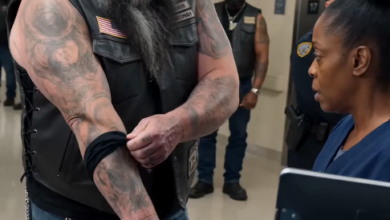
My name is Ray Dawson, though most of the Iron Lanterns call me Hammer. I’m six-foot-four, two hundred eighty-five pounds on a forgiving scale, with a shaved head, a black-and-gray beard, and enough ink on my arms to make courthouse security study me twice. That morning, I wore a plain leather cut, faded jeans, scarred riding boots, and ten silver skull rings—one on every finger.
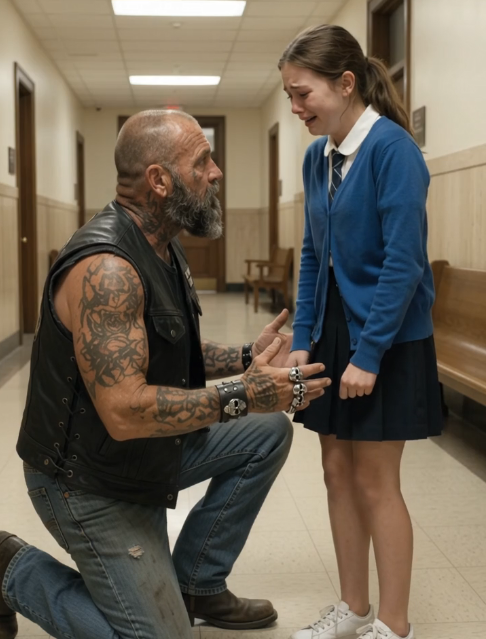
The girl in front of me wore a blue cardigan, a school skirt, and white sneakers that squeaked whenever her knees shook. Her name was Emma Caldwell. She was sixteen.
She had been preparing for this morning for almost a year.
She had failed to speak three times.
Now she sat on the courthouse floor with both arms wrapped around herself, crying so quietly that people continued walking past as though she were merely waiting for somebody.
She wasn’t waiting.
She was trying not to run.
Beyond the courtroom doors sat the man she had accused of attacking her. His parents occupied the front bench behind the defense table. His older brother had already passed Emma twice in the hallway without speaking, slowing just enough to make sure she noticed him staring.
No threat had been spoken.
None was needed.
Emma’s mother stood ten feet away beside the prosecutor, crying into both hands. A victim advocate crouched near the wall, offering breathing exercises Emma could no longer follow. The judge had granted two continuances after earlier attempts ended with Emma unable to finish answering basic questions.
That morning was different.
It was the final scheduled attempt.
If she could not testify, the prosecutor had warned that several of the strongest charges might collapse. The physical evidence established that something had happened, but Emma’s voice was needed to connect the pieces the defense had spent months separating.
She knew that.
So did the defendant.
“Sir,” the security guard called, moving toward me. “Step away from the minor.”
Emma grabbed the edge of my vest.
That stopped him.
She did not know me well. We had met for eleven minutes in a conference room three days earlier, after her advocate contacted our club. But when the guard approached, she held my leather cut as if the rough black fabric were the last fixed object in a room that would not stop moving.
I kept my hands open on my knees so she could see them.
The skull rings made the gesture look wrong.
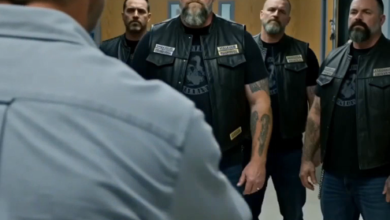
That was the contradiction people noticed first. A huge biker with tattooed knuckles and ten grinning skulls was kneeling inches from a frightened schoolgirl, while five other men in leather waited silently near the elevators.
To strangers, we looked like another problem arriving.
Emma knew why we were there.
The Iron Lanterns had escorted survivors to court for nine years. We did not confront defendants, contact witnesses, interrupt hearings, or crowd courtroom doors. Every visit was approved in advance by an advocate or prosecutor. We passed through security like everyone else, surrendered anything prohibited, obeyed the bailiffs, and sat where the court placed us.
Our job was simpler.
We made sure the person telling the truth never walked through the hallway alone.
Emma looked over my shoulder toward the courtroom. “His brother is still watching.”
“Then don’t look at him.”
“Where do I look?”
I opened my vest.
Along the inside lining were forty embroidered names in different colors. Some were neat. Others slanted awkwardly because they had been sewn by hands still learning. The public could not see them when the vest was closed. Even our newest club members did not know what every name meant.
Emma had noticed them during our first meeting but had been too afraid to ask.
“What are those?” she whispered.
“People who stood where you’re standing.”
“Are they dead?”
I looked at the first name near my heart, then at the thirty-nine stitched beneath it.
“No,” I said. “Fear tried to bury their voices. It didn’t finish the job.”
The guard lowered his radio slightly.
Emma touched none of the names. She only read them silently.
“Did they all testify?”
“They all found a way to tell the truth.”
“What if I can’t?”
“Then you breathe. You take your time. You answer only what you know.”
“What if they call me a liar again?”
“That’s their question. Not your answer.”
She wiped her face, but the tears returned.
“I forgot everything last time.”
“You didn’t forget. Your body thought you were back there.”
Her fingers tightened around the vest.
I leaned closer without touching her. My voice had been ruined by engines, cold mornings, and too many years of swallowing things that should have been said. In that polished hallway, it sounded harsher than I wanted.
But Emma listened.
“Look at my vest,” I told her. “There are forty names inside it. Forty people who believed fear had taken the last word. Today, I’ll stand behind you.”
She shook her head. “I still have to speak alone.”
“No, kid.”
I pointed toward the courtroom.
“You speak with your own voice. But you do not speak alone.”
For five seconds, Emma stared at me.
Then she reached for my right hand and slowly removed the skull ring from my index finger. I let her take it.
She turned the heavy piece of silver in her palm.
“Can I hold this?”
“Until you don’t need it.”
The courtroom door opened.
The bailiff called Emma’s name.
Across the hallway, the defendant’s brother straightened and smiled—not kindly, but with the confidence of someone who had watched her retreat before.
Emma saw him.
Her breathing stopped.
Then she closed her fist around my skull ring, rose from the floor, and walked toward the door while six bikers fell into line behind her.
None of us yet knew that the forty names inside my vest were about to be exposed in open court—or that Emma would ask for a forty-first before the verdict was read.
Part 2 — Why the Iron Lanterns Never Walked Ahead
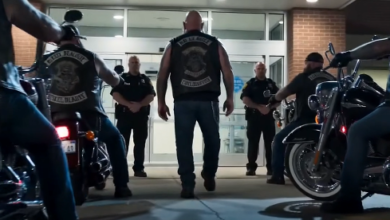
Our motorcycles were parked three blocks from the Maricopa County courthouse because courthouse security had asked us not to crowd the main entrance. We arrived before sunrise, when Phoenix still smelled of wet concrete from the street cleaners and the heat had not yet climbed out of the pavement.
Six Harley engines had rolled into the parking garage together, then gone silent one by one.
We never rode directly to a survivor’s home.
We never posted photographs from an escort.
We never displayed addresses, hearing dates, vehicle plates, or children’s faces. Some people imagined our work as a wall of motorcycles surrounding frightened families, but real protection was rarely that dramatic. Real protection was built from restraint.
The Iron Lanterns had begun nine years earlier with three riders and a borrowed conference room. We were mechanics, veterans, construction workers, nurses, drivers, teachers, and one retired court reporter. None of us pretended to be law enforcement. We did not investigate cases or decide who was guilty.
We responded only when licensed advocates, attorneys, shelters, or recognized victim services requested our presence.
Our rules filled a single laminated page.
No weapons.
No contact with defendants.
No threats.
No speaking for the survivor.
No clothing containing obscene or intimidating messages.
No engines revved near a courthouse.
No promises about verdicts.
And one rule printed at the bottom in heavier type: We walk beside them, never ahead of them.
That distinction mattered because people who had survived violence often spent months or years being told where to stand, what to wear, when to speak, and what version of reality they were permitted to remember. The last thing they needed was another large man taking control under the name of protection.
I knew that because I had once made that mistake.
My younger sister, Laura, was nineteen when her boyfriend broke her jaw. I was twenty-four and angry at the entire world. I rode to her apartment with three friends, ready to solve the problem using the only language I believed violent men understood.
Laura stopped me on the stairs.
“You don’t get to decide what happens next,” she said through wires holding her jaw in place.
I told her I was protecting her.
She told me I was frightening her.
I have remembered that sentence for thirty-two years.
Laura eventually left him, but not because I threatened anyone. She left after a shelter advocate helped her recover her documents, arrange temporary housing, and create a plan that belonged to her. Watching that process forced me to understand that protection without permission can resemble another form of control.
Decades later, a club brother named Marcus invited me to accompany a domestic-violence survivor to a restraining-order hearing. The woman had stopped attending after the respondent’s relatives filled the corridor and photographed her.
We arrived quietly.
We sat behind her.
She finished the hearing.
That was all.
But after court, she said something that remained with me: “For the first time, I could feel someone behind me who wasn’t trying to push me forward or pull me back.”
The Iron Lanterns grew from that sentence.
By the time we met Emma, more than two hundred survivors had requested escorts. Most needed us only once. Some wanted six riders. Others chose one woman from our club because a room full of large men would make things worse.
Emma’s advocate, Lena Brooks, had been careful.
“She freezes when male voices rise,” Lena warned during our initial meeting. “She also panics if people stand too close behind her.”
So we met in a room large enough for distance. Only I entered first. The others waited outside. I removed my sunglasses, kept both hands on the table, and allowed Emma to choose where I sat.
She chose the farthest chair.
For several minutes, she said nothing.
I did not fill the silence.
That surprised her.
Adults had spent months asking questions, repeating questions, correcting dates, testing details, and telling her how important her answers were. Even kind people had turned every conversation into another performance she might fail.
I asked only one thing.
“Do you want us there?”
Emma looked at Lena, then at her mother. Finally, she looked at me.
“Will he see you?”
“Yes.”
“Will you stare at him?”
“No.”
“Why not?”
“Because we’re not going there for him.”
That answer made her study me differently.
During the meeting, she noticed the names inside my vest when I reached for a bottle of water. I closed it before she could see all forty.
The first name was Laura.
The others came later.
Each represented a person we had escorted who had eventually spoken the truth in whatever form the process allowed: testimony, a written statement, a recorded interview, a deposition, or words offered privately to an advocate after years of silence.
They were not trophies.
They were evidence that fear was powerful but not always permanent.
Emma’s name was not among them.
Not yet.
Part 3 — Three Times the Door Had Closed
Emma’s first attempt to testify occurred seven months after the attack.
She entered through the public courthouse entrance because nobody had arranged a protected route. The defendant’s parents were waiting beside the elevators. His mother looked Emma up and down and whispered something to another relative.
Emma heard only three words.
“She looks fine.”
By the time she reached the witness room, her hands were numb. She answered the prosecutor’s questions during preparation, but when she entered the courtroom and saw the defendant, she could not state her full name.
The judge ordered a recess.
Emma became sick in the restroom.
The hearing was continued.
People later described it as the day she refused to testify. Emma described it differently.
“I was trying,” she told me. “My mouth wouldn’t open.”
The second attempt happened ten weeks later. This time, a victim advocate escorted her through a side entrance. The courtroom was cleared of unnecessary spectators, and Emma was allowed to wait in a private room.
She reached the witness chair.
She answered eight questions.
Then the defense attorney asked whether she had continued attending school after the incident. When Emma said yes, he asked whether she had laughed with friends during lunch the following week.
The question was legally permitted as part of the defense strategy, but Emma heard a different accusation: If you laughed once, how injured could you have been?
She began apologizing.
The judge instructed her to answer only the questions. The defense objected to the prosecutor’s attempt to clarify. Voices overlapped. A chair scraped behind her.
Emma looked toward the defendant.
He smiled.
Her testimony ended again.
The third attempt should have been safer. A different prosecutor, Assistant District Attorney Maya Chen, reorganized the evidence and requested specific accommodations. Lena rehearsed the courtroom with Emma while it was empty. She practiced locating the judge, the jury box, the exit, and the glass of water.
Emma carried a smooth stone in her pocket.
She had written four words on an index card: I know what happened.
But on the morning of the hearing, the defendant’s older brother stood near the security checkpoint. He did not approach. He did not speak.
He simply lifted his phone and pretended to photograph the ceiling while Emma walked past.
Security searched the device and found no clear photograph of her. There was not enough to remove him permanently from the building. Yet Emma saw the gesture, and the smooth stone fell from her hand.
She made it as far as the witness-room door.
Then she locked herself inside the bathroom.
The prosecution requested another continuance. The judge granted it reluctantly but warned that the case could not remain suspended indefinitely. Evidence had to be heard while memories, witnesses, and schedules remained intact.
Emma heard only one message.
Next time is your last chance.
That interpretation was not legally exact, but trauma rarely waits for footnotes.
In the weeks before the fourth attempt, the defense filed motions challenging portions of Emma’s earlier statements. The prosecutor believed the central charges could still proceed, but without complete testimony, the case would be narrower and harder to prove.
Meanwhile, the defendant’s family continued posting vague messages online about “false accusations” and “girls who destroy futures.” Emma’s name was not used, but classmates connected the details. One person taped the word LIAR inside her locker.
Her mother transferred her to online classes.
Emma stopped playing soccer.
She stopped singing in the kitchen.
She began sleeping on the floor beside her mother’s bed because the mattress in her own room made her feel trapped.
Lena tried every conventional support available. Maya prepared shorter question sequences. The judge approved additional breaks. A courthouse dog was offered, but Emma worried that if she panicked, the dog would become frightened too.
Then Lena called the Iron Lanterns.
Not because she wanted the defendant intimidated.
Because Emma had said, “I need somebody there who knows what it feels like to look frightening and still be safe.”
Lena remembered seeing our club escort another survivor months earlier. She showed Emma a photograph taken after that hearing: eight bikers standing several feet behind a woman while she spoke privately with her attorney.
Emma pointed at me.
“Him.”
“Why him?” Lena asked.
“He isn’t smiling.”
Most adults would have taken that as an insult. I understood.
Emma did not need cheerfulness. She needed someone who would not pretend the hallway was harmless. She needed a face that acknowledged danger without becoming part of it.
That was why I wore all ten skull rings on the morning of her testimony. Ordinarily, I wore only two. The others stayed in a wooden box in my garage.
Emma had seen the full set in an old club photograph.
“Will you wear them?” she had asked.
“If you want.”
“They look scary.”
“They are.”
“Good.”
She had not wanted me to frighten the defendant. She wanted something visible that looked more frightening than the memory chasing her.
So I wore all ten.
At the security checkpoint, I removed each ring and placed it inside a gray plastic tray. The guard counted them, glanced at my vest, then looked at the five riders behind me.
“What are you gentlemen here for?”
“A witness asked us to come,” I said.
The guard examined the rings again.
“Those all yours?”
“Today they’re hers.”
I did not know how literally those words would become.
Part 4 — The Witness Chair
The bailiff placed us in the second row, directly behind Emma’s mother and the victim advocate. We did not choose the seats. The judge had approved them after confirming our role with the prosecutor and courthouse security.
The defense objected before Emma entered.
Counsel argued that six large men wearing leather could influence the jury or create an intimidating atmosphere. Judge Evelyn Mercer listened, then instructed us to remove our outer vests or sit farther back.
Emma heard the discussion from the doorway.
Her hand closed around my skull ring.
Maya asked for a brief conference at the bench. She explained that the riders were registered support persons, that we had complied with every security request, and that Emma had specifically asked to see my vest while testifying.
Judge Mercer looked toward us.
I recognized her.
Three years earlier, a monsoon had flooded the courthouse’s underground parking level. Several county vehicles had been damaged, including an aging maintenance truck the budget could not replace. Our club repaired the truck without charge after learning it delivered meals and supplies to rural court offices.
Judge Mercer had come to the garage to thank us.
She looked at my face, then the oil-dark scar across my right thumb.
“Mr. Dawson?”
“Yes, Your Honor.”
“You repaired the county emergency truck.”
“With help.”
She turned to defense counsel. “The court will permit the support persons to remain. Their vest fronts must stay closed, and there will be no gestures, communication, or visible reaction during testimony.”
We agreed.
The defendant’s father shook his head loudly enough for the jury to notice. The judge warned everyone in the gallery that any attempt to signal, stare down, photograph, or communicate with the witness would result in removal.
Then Emma entered.
She saw the defendant first.
I watched her shoulders rise.
Next, she found the prosecutor. Then her mother.
Finally, she looked at me.
I touched nothing. I said nothing. I sat with both hands resting on my knees, the empty place on my right index finger visible from the witness chair.
Emma sat.
The clerk administered the oath. Her first answer came out as a whisper.
“Please speak louder,” the judge said gently.
Emma tried again.
“My name is Emma Caldwell.”
Maya began with simple questions: age, school year, family, the route Emma had taken home on the afternoon of the attack. She did not ask for details immediately. She helped Emma establish time and place.
The defense objected twice.
Each time, Emma flinched.
Each time, her fingers tightened around the ring.
Then Maya asked Emma to describe the moment she realized someone was following her near the parking structure.
Emma’s face emptied.
The courtroom disappeared from her eyes.
I had seen that look before in Laura. The body remained in one place while the mind returned somewhere it had never wanted to revisit.
Emma stared at the defense table.
The defendant leaned toward his attorney and whispered.
The judge told him to stop.
Emma’s breathing quickened.
Maya paused. “Would you like a break?”
The defense attorney stood. “Your Honor, the witness has already received multiple continuances.”
A murmur moved through the room.
Judge Mercer silenced it.
Emma looked toward the exit.
This was the exact moment when every earlier attempt had ended.
Her mother began crying.
Lena lowered her head.
The prosecutor waited without pressing.
I could not speak. The court’s conditions prohibited it, and even if they had not, Emma did not need another man telling her what to do.
So I opened my right hand.
Nothing more.
The bare finger reminded her where the ring was.
Emma looked down at her closed fist. She opened it beneath the edge of the witness stand, placed the ring on the table, and rotated the skull until it faced her.
Then she lifted her eyes.
“I don’t want a break,” she said.
Maya nodded. “Tell us only what you remember.”
Emma began again.
Her voice broke several times, but it did not disappear. She described the parking structure, the footsteps, the locked door she could not open, and the stranger who heard her calling afterward. She identified the jacket recovered from the defendant’s car and the message he sent two days later.
No graphic details were needed.
The room understood.
When the defendant’s brother shifted forward in the gallery, two Iron Lanterns noticed. Neither moved. The bailiff stepped beside him before Emma even looked up.
For the first time, the system reacted before Emma had to.
Her direct testimony lasted fifty-three minutes.
Then the defense began cross-examination.
The attorney asked why parts of her first statement differed from the later interview. Emma explained that she had been terrified and confused. He asked why she returned to school. Why she texted friends. Why she did not immediately recognize one detail in a photograph.
The questions came faster.
Emma’s cheeks flushed.
“I already said I don’t know.”
The attorney repeated the question in a different form.
Maya objected.
The judge sustained it.
The attorney moved closer to the witness stand. “Miss Caldwell, isn’t it possible that after discussing this repeatedly with your mother, the prosecutor, counselors, and these men behind you, your memory changed?”
Every person in the room turned toward us.
Emma did not.
She looked at the skull ring.
Then she answered.
“They didn’t tell me what to say.”
“Then why are they here?”
“Because your client brought people to stare at me every time I tried to speak.”
The defense objected.
Judge Mercer overruled it.
Emma leaned toward the microphone.
“They don’t give me a story,” she continued. “They give me somewhere safe to look while I tell mine.”
No one moved.
No one breathed loudly.
Even the defendant stopped whispering.
Part 5 — The Forty Names Were Never a Memorial
After Emma finished testifying, the judge released the jury for lunch. Emma remained in the witness chair until the room emptied because her legs would not support her.
I waited in the hallway.
When she finally emerged, she handed me the skull ring and said, “I didn’t forget.”
“No.”
“I thought I would.”
“You remembered enough.”
Her mother wrapped both arms around her. Emma stood stiffly at first, then collapsed against her shoulder. Lena turned away to give them privacy, while Maya pressed one hand over her mouth.
Nobody celebrated.
Finishing testimony was not a victory lap. Emma still had to live inside the story she had just spoken aloud. Courage did not remove the cost.
She eventually pulled away from her mother and looked at my vest.
“Can I see the names again?”
We moved into the private witness room. I removed the leather cut and laid it across the table, opening the lining beneath the fluorescent lights.
Forty names appeared.
Laura was first.
Beside hers was Denise, a restaurant server whose former husband waited outside every court date until our club began walking with her. Then Marcus Jr., a seventeen-year-old boy who reported violence from a coach and spent months believing nobody would believe a male victim. Hannah had testified through an interpreter. Tasha had delivered her statement from another room. Grace had never entered a criminal courtroom but spoke during a protective-order hearing after remaining silent for eleven years.
Some names belonged to adults.
Some belonged to teenagers.
Two represented survivors who had asked us to use chosen names because their legal identities still required protection. Every stitch had been added only with permission.
Emma ran her finger beside the threads without touching them.
“You said they weren’t dead.”
“They aren’t.”
“Then why do they look like memorial names?”
“Because that’s what people assume when they see a biker vest.”
She glanced at me.
“Why keep them hidden inside?”
“They don’t belong to strangers.”
The names were not awards for our club. They did not prove we had saved forty people. We had not saved them. We had walked through hallways, carried bags, sat in benches, made coffee, checked parking lots, and waited outside locked restroom doors.
They had done the speaking.
After each case ended, we offered nothing except a small piece of cloth and thread. If a survivor wanted a name added, they chose the color and sewed one section themselves. Some completed every letter. Others made only a single stitch while a club member finished the rest.
The forty names did not represent people who had died.
They represented forty voices fear had tried to declare dead.
Laura’s name had been sewn after she left her boyfriend. She had never testified in a criminal trial, but she had spoken during a hearing that secured the protection order allowing her to begin again. Years later, she became a shelter advocate in Nevada.
The phrase I had spoken in the hallway was the version I could fit into a terrified girl’s breathing space. The full truth was longer.
Every person named inside the vest had reached a moment when silence felt safer. None had been weak. Silence had kept many of them alive until speaking became possible.
The names marked the day survival no longer required quiet.
Emma counted them twice.
“Why forty?”
“Because that’s how many asked to be here.”
“Only forty people?”
“We escorted more than two hundred. Most didn’t want names displayed anywhere. We respected that.”
“What happens when there’s no room?”
“I get a bigger vest.”
She almost laughed.
It was the first sound from her that morning that did not contain fear.
Then she pointed to a blank space beneath the final name.
“Can mine go there?”
“Not today.”
Her expression fell. “Why?”
“Because the case isn’t finished.”
“I finished my part.”
“Yes.”
“Then why not?”
I pulled a chair beside her. “Because I don’t want you choosing while you’re still inside the courthouse. A name here is never payment for testifying. You owe us nothing.”
She looked back at the vest.
“What if I still want it later?”
“Then we’ll bring thread.”
The door opened, and Maya entered holding a legal pad.
She had news.
During Emma’s testimony, the defendant’s brother had sent a message to a mutual acquaintance. The recipient immediately forwarded it to investigators.
The message read: She finally talked. Dad said we should have scared her harder last time.
The prosecution could not simply place the message before the jury without authentication and legal review. But it supported the documented pattern of intimidation and gave the judge grounds to bar the brother from the courthouse.
It also explained why he had passed Emma three times that morning.
The defense family had not merely looked hostile.
At least one of them had been trying to make silence happen again.
Judge Mercer held an emergency hearing without the jury. The defendant’s brother claimed he had been joking. His phone was preserved, and he was removed from the building pending further review.
When Emma learned he was gone, she did not smile.
She asked one question.
“Did he do that to the other girls too?”
There were no other known complainants in the case. But investigators had received two previously uncertain reports involving similar conduct. Emma’s completed testimony gave them a clearer pattern to examine.
Her voice had not only filled the gaps in her case.
It might open doors for people still standing behind their own.
Part 6 — The Verdict Did Not Sound Like Thunder
The trial continued for four more days.
We attended each day Emma requested us, though she did not always want all six riders. On the second morning, she asked only for me and a female club member named Dani Ruiz. On the third, she entered with Lena and told us to wait outside.
That mattered more than any dramatic gesture.
She was beginning to choose the size of her own protection.
The jury received photographs, digital records, witness testimony, and forensic evidence. Emma’s account connected those elements, but the case did not rest on emotion alone. Maya had spent months building corroboration because a survivor should never be forced to carry an entire prosecution with her body and memory.
The defense argued reasonable doubt.
The prosecution asked the jury to consider the complete pattern.
After deliberating for nine hours, the jurors returned.
Emma sat between her mother and Lena. I occupied the bench behind them. My skull ring was back on my finger, but I kept my hand open where Emma could see it.
The clerk read the first count.
Guilty.
Emma did not react.
The second count followed.
Guilty.
Then the third.
Guilty.
The defendant’s mother sobbed. His father stared at the floor. The defendant remained motionless while deputies shifted closer.
There was no applause.
No one from our club raised a fist. No engine sounded outside. A guilty verdict did not erase the parking structure, the sleepless nights, or three mornings when Emma had been unable to speak.
It meant only that the truth had been heard and legally answered.
Emma leaned toward her mother.
“Can we go home now?”
Those were her first words after the verdict.
Outside the courtroom, reporters gathered near the elevators. Courthouse staff directed Emma through a private corridor. We walked behind her until she reached the secure exit.
This time, she did not hold my vest.
She walked ahead.
At the parking level, afternoon heat rose from the concrete. Our motorcycles waited in a quiet row, chrome glaring beneath the fluorescent lights. Emma stopped beside my Harley and studied the leather saddlebags.
“Do you have the vest?”
I removed it from the bag.
She opened her backpack and took out a sewing kit wrapped in a white handkerchief. Her mother had purchased it during jury deliberations.
Inside were several colors.
Emma chose blue.
“The same color as your cardigan?” I asked.
“No. The same color as the sky in the picture I kept imagining when I couldn’t breathe.”
She threaded the needle but did not sew her whole name. She made one small stitch beneath the fortieth name, then handed the needle to me.
“You finish it.”
“What name?”
Emma considered the question.
Not her legal surname. Not the nickname her attacker knew. Not a symbol hiding who she was.
“Emma.”
I stitched slowly. My fingers could rebuild a carburetor in darkness, but embroidery defeated me more than once. The letters came out uneven.
She approved.
When the last stitch was tied, the vest held forty-one names.
Emma touched the first one.
“Laura was your sister?”
“Yes.”
“Did she know what she started?”
“She says I take too much credit.”
Emma blinked. “She’s alive?”
“Lives in Reno. Still bossy.”
Emma laughed again, louder this time.
She had assumed Laura was dead because the names looked like memorials. The courthouse guards had assumed the same. Even several club prospects believed the lining honored fallen riders.
That assumption helped keep the deeper meaning private.
The names belonged to people who had lived.
That was the point.
Part 7 — The Forty-First Stitch
Two years later, Emma returned to the courthouse.
She was eighteen and wearing the same blue cardigan, though the sleeves now stopped above her wrists. She had come to support another teenage witness referred through Lena’s office.
This time, Emma did not sit on the floor.
She stood beside the girl and asked, “Do you want us close, or do you want more room?”
The girl asked for room.
Emma gave it.
I watched from near the elevators with my vest closed. Ten skull rings rested on my fingers, but nobody needed to borrow one that morning.
Before entering court, the girl asked Emma why so many bikers had come.
“They don’t make you brave,” Emma said. “They just make it harder for fear to convince you that you’re alone.”
Then she glanced at me.
I pretended not to hear.
The Iron Lanterns still escort survivors, but our numbers are not counted in photographs or roaring arrivals. Some days involve twelve motorcycles. Others involve one old rider carrying coffee through a courthouse metal detector.
The rules remain unchanged.
We do not threaten.
We do not investigate.
We do not speak for anyone.
We walk beside them.
Inside my vest, the names have grown beyond forty-one. A second leather panel now holds twenty-three more, each stitched in a color chosen by the person it represents. Some letters are crooked. Some barely resemble letters at all.
Emma’s blue name remains beneath the first forty.
Whenever I open the vest for somebody afraid to speak, I never tell them those people were fearless. That would be a lie. Every person whose name rests against that leather knew fear intimately.
Their courage was not the absence of trembling.
It was speaking while the trembling remained.
After supporting the new witness, Emma accompanied me to the parking garage. I started the Harley, and the V-twin rumble rolled between the concrete pillars.
She raised her voice over the engine.
“Ray?”
I shut it off.
The garage became still.
“What did you mean that first day when you said I wouldn’t speak alone?”
I looked at the vest hanging from the handlebars, forty-one names hidden against the lining.
“I meant somebody would remember that it cost you something.”
Emma nodded.
Then she walked toward the elevator, carrying no ring and holding no one’s sleeve.
I put on the vest.
Her name rested over my ribs as the engine started again.
Follow our page for more powerful biker stories about quiet guardians, reclaimed voices, and courage appearing where nobody expected to find it.