An 11-Year-Old Girl Poured Gasoline on Her Biker Dad’s Harley in the Front Yard and Lit It on Fire—Neighbors Screamed for 911, Until She Told Him Why She Did It
Part 2 — Four Minutes
Sergeant Brandon Oakes of the Deschutes County Sheriff’s Office walked across my lawn like he owned it.
He was thirty-nine, my late wife’s younger brother. He was clean-cut and broad-shouldered, with a pressed tan uniform and a Sergeant’s chevron. He was the kind of deputy who coached Little League and spoke at Rotary Club lunches about road safety.
The woman with him was from the Oregon Department of Human Services. Her name was Paula Rios, and she had a clipboard and tired eyes.
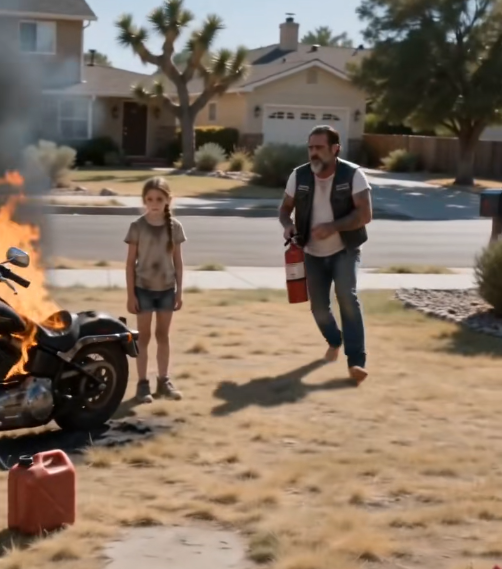
“Boone,” Brandon said quietly, crouching down to Harper’s level. “You okay, sweetheart?”
Harper didn’t answer him. She scooted closer to me on the grass.
“I was on Highway 97 when the call came in,” Brandon said, standing. “Got here as fast as I could.”
The Redmond Fire Department rolled up two minutes after that, sirens howling. Brandon had beaten them by four minutes.
Mrs. Delgado’s grandson had filmed the whole thing on his iPad. By nine p.m., the video had a million views. 11-Year-Old Girl Torches Biker Dad’s Harley. What’s Happening Inside That House?
The comments were brutal.
That kid is crying for help.
Bikers shouldn’t be parents.
Somebody check on that little girl.
Paula Rios sat at my kitchen table with her clipboard while Brandon stood by the fridge with his arms crossed.
“Mr. Wexler,” Paula said gently, “a child doesn’t set a fire like that for no reason. Your brother-in-law tells me you’ve been drinking and riding with Harper’s knowledge. Is that true?”
I looked at Harper on the couch. She was holding the cat and staring at the floor.
“Yes,” I said.
It was true. The night before, I’d had four beers at the clubhouse and ridden home on Highway 126 in the dark. Harper had been at the window, waiting up. She always waited up.
She’d hidden my keys twice that month, once in the freezer and once in her sock drawer. Both times I’d yelled at her and told her to mind her own business. Both times I found the keys and rode anyway.
“Then I think,” Paula said carefully, “Harper should stay somewhere else for a few days. While we sort this out. Voluntarily.”
“She can stay with me,” Brandon said. “My wife has the guest room ready.”
I looked at my daughter.
Maybe this was what I deserved. My little girl had burned my motorcycle in broad daylight because I couldn’t be trusted to stay off it. Maybe she was safer with a sheriff’s sergeant than with a drunk.
I signed the paper.
Harper didn’t cry when Brandon walked her to his cruiser. She just looked back at me through the window. She lifted one hand and touched her own braid. Two tugs.
At 11:47 that night, my phone lit up with a text from Harper’s iPad.
Daddy. I’m in Uncle Brandon’s garage. Mommy’s star is in his truck.
Part 3 — The Star
Four summers ago, our backyard on Southwest Juniper smelled like sunscreen and the cut grass of the high desert.
My wife, Lena, was thirty-four, an ER nurse at St. Charles Redmond. She was laughing, with her dark hair in a messy bun, while she showed seven-year-old Harper how to put stickers on her new purple bike.
They were reflective stars, little silver ones that lit up white when headlights hit them.
“So drivers always see you, Bug,” Lena said, sticking one on each pedal. “Even in the dark.”
She had a matching one on her hospital badge reel. It was a little silver star that dangled from her scrubs on a retractable cord. She’d bought them at the Walmart on Highway 97 because she worked night shifts and sometimes walked home the mile and a half along the shoulder of Highway 126.
“Nobody ever misses that star,” she said, tapping it.
That night, I was grilling. Harper fell asleep on the patio swing. Lena sat beside her and tugged her braid twice, very gently.
“What’s that mean?” I asked.
“It means I’m still here,” Lena said. “So she knows. Even when she’s asleep.”
Her brother, Brandon, came by for burgers. He’d just bought a brand-new white Dodge Ram, lifted, with a big LED light bar across the front. He made me come out to the driveway to admire it.
“Lena, you should let me drive you home after your shifts,” he said. “That road’s dark.”
“I’ve got my star,” she said, and winked at him.
Three years ago, in October, Lena walked home from a night shift along Highway 126 at 2:20 in the morning.
A truck hit her on the shoulder and didn’t stop.
The Oregon State Police never found her badge reel.
They never found the truck.
Part 4 — Paint Transfer
Brandon came to see me the next afternoon at the Redmond Black Butte Diner, out of uniform, with a folder.
“I know what Harper texted you,” he said, sitting down across from me. “My wife saw it on the iPad. Boone, I’m going to be straight with you, because Lena would want me to be.”
He opened the folder.
It was the Oregon State Police investigation report from Lena’s death, three years ago. Hit-and-run, Highway 126, milepost 112. Victim struck from behind on the shoulder. Paint transfer recovered from victim’s clothing: white, consistent with a 2018 to 2020 Ram 1500.
“White Ram,” Brandon said quietly. “I drive a silver Ford. Have since before Lena died.” He tapped the folder. “I was on duty that night. I was the first deputy to arrive. I held my sister’s hand on the side of the road until the ambulance came.”
His voice cracked. He looked away.
“And the star,” he said. “Lena’s badge reel. It’s in my truck because I found it in the weeds the next morning, when I went back to the scene by myself. I couldn’t leave it there. I’ve kept it in my glove box for three years. Harper must’ve seen it.” He wiped his eyes. “She’s eleven, Boone. She’s grieving. She’s angry at everybody, and I’m a cop who didn’t catch the guy.”
Then he slid one more page across the table.
It was a list of registered owners of white 2018 to 2020 Ram 1500 trucks in Deschutes County at the time of Lena’s death. There were forty-one names.
He’d highlighted one in yellow.
Michael “Mick” Dunbar.
Mick has been my road captain for eleven years. He’s my best friend in the club.
“He sold it six weeks after Lena died,” Brandon said. “OSP interviewed him. He said he’d been home all night. Nobody could prove otherwise.” Brandon leaned forward. “Boone, your club was having a party that night. Mick left at two a.m. Drunk. Half your guys saw him.”
I sat there with my coffee going cold.
I remembered that party. I’d been there too.
“I’m not saying it was Mick,” Brandon said. “I’m saying I wonder sometimes. And I’m saying maybe the reason Harper set that bike on fire is that she knows your club is full of men who drink and drive. Including you.”
He stood up and left a twenty on the table.
I drove straight to the clubhouse off Highway 97, the old metal shop with a gravel lot.
Mick was out back, working on his bike.
“Mick,” I said. “Where were you at 2:20 a.m. the night Lena died?”
He looked at me for a long time. Then he set his wrench down.
“Drunk,” he said quietly. “Driving home on 126 in my white Ram. Same as you’d be on any Friday.”
Part 5 — Prineville Collision
Mick didn’t run. He sat on an oil drum in the back lot and told me everything he remembered.
He’d left the clubhouse at 1:55 a.m. that night with at least six beers in him. He drove home on Highway 126, the same road Lena walked. He got home at 2:10.
“I don’t remember seeing her, Boone,” he said, tears running into his beard. “I don’t remember hitting anything. But I don’t remember a lot of that drive. And I’ve woken up every night for three years wondering.”
I didn’t know what to do with that.
So I called a lawyer named Teresa Nakamura, who handles hit-and-run cases out of Bend. She drove up that evening.
“First,” she said, “let’s look at Mick’s truck.”
The white Ram had been sold to a dealer in Bend. It was resold twice and ended up with a rancher outside Madras. Teresa had a retired Oregon State Police crash reconstructionist named Sergeant Dale Pruitt go look at it.
“Original factory bumper,” Dale reported. “Original grille. Original paint. No body work, ever. This truck never hit anybody.”
Mick broke down crying in the clubhouse lot when he heard.
Then Teresa ran a different search. It wasn’t the forty-one registered owners from Brandon’s list. It was every white Ram in Deschutes County that had been sold or traded within thirty days after the crash.
There were three.
One belonged to Brandon Oakes.
Brandon had bought a new white 2019 Ram 1500 with an LED light bar four months before Lena died. Nine days after the crash, he traded it in at a dealership in Bend for a silver Ford F-250.
The Ram wasn’t on Brandon’s list of forty-one owners. He’d made that list himself, as the investigating sergeant.
Then Teresa found the body shop invoice.
Prineville Collision & Paint. October 21. Customer: B. Oakes. Front bumper, grille, passenger-side headlight assembly, LED light bar replacement. Paid in cash: $4,880.
That was the day after Lena died.
And then the money.
When Lena died, she had a $500,000 life insurance policy through St. Charles Health, payable to a trust for Harper. I was trustee. But Lena’s will named a successor trustee and guardian, in case I was ever “unable or unfit.”
Her brother.
Brandon was $186,000 in debt. Teresa found the liens on a failed lake cabin development near Sisters that he’d invested in with two other deputies.
And Brandon’s wife, Kelsey, a quiet woman who taught kindergarten in Redmond, called Teresa’s office that night. She’d seen the bridge video, and Harper’s texts, and her husband’s face.
She had a screenshot of a text Brandon sent her the week Harper burned the bike.
BRANDON: DHS is involved. If they find him unfit, I’m Harper’s guardian and trustee. Half a million. We keep the house.
I put my head in my hands in Teresa’s car.
My wife’s brother had driven home drunk from somewhere at two in the morning, in a lifted white truck with a light bar so bright nobody on that road could have seen anything else. He hit his own sister. He kept driving.
Then he showed up as the first deputy on the scene, held her hand, and took the case.
And he’d kept her little silver star in his glove box for three years.
“We take this to the Oregon State Police,” Teresa said. “Today.”
My phone buzzed.
It was a text from Harper’s iPad.
Daddy. Uncle Brandon took my iPad. He says I can’t text you anymore. He says you’re going to jail.
Part 6 — Breathalyzer
I was halfway to the Oregon State Police office in Bend when the blue lights lit up my mirror on Highway 97.
I was driving my old pickup. I didn’t have a motorcycle anymore.
Brandon Oakes walked up to my window in full uniform with his flashlight.
“License and registration, Boone.”
“I’m stone sober, Brandon.”
“Then you won’t mind blowing for me.”
He held out a portable breath tester.
I blew.
He looked at the screen, sighed, and turned it toward his dashcam.
0.09.
I hadn’t had a drink since the night before Harper burned my bike. Five days.
“Step out of the vehicle, please.”
He arrested me for driving under the influence of intoxicants on the shoulder of Highway 97 while traffic slowed down to watch. At the Deschutes County Jail, they gave me a second test on the jail’s machine. It read 0.00. The booking deputy frowned. Brandon said the portable unit “must have caught residual mouth alcohol from mouthwash.”
They charged me anyway. In Oregon, a DUII arrest goes into the system the moment it happens.
By the next morning, Paula Rios from DHS had filed for emergency temporary custody of Harper. Father arrested for DUII five days after daughter set his motorcycle on fire in a desperate attempt to stop his drinking. The court granted it. Temporary guardian: Sergeant Brandon Oakes.
The Bend Bulletin ran the bridge video next to my booking photo. Biker Dad Arrested for DUI Days After Daughter Torched His Harley.
My club brothers came to see me. Some of them looked away. I couldn’t blame them. Half of them had been in that same clubhouse that night three years ago, and every one of them knew what I’d done the night before Harper burned the bike.
Mick came to the jail every day. He sat across the glass and didn’t say much.
Teresa came on the third day.
“The State Police are interested,” she said. “But Brandon’s a decorated sergeant. A cash body-shop receipt and a traded-in truck aren’t enough. His lawyer will say he hit a deer.” She paused. “And you, Boone, have a DUII arrest and an eleven-year-old who set your bike on fire. It’s not a good look.”
“So what do we do?”
Teresa looked at me through the glass for a long moment.
“Brandon’s being honored next Saturday,” she said. “Deschutes County Fair and Expo Center. The MADD chapter’s annual vigil for victims of impaired driving. He’s receiving their Officer of the Year award for DUII enforcement.” She almost laughed. “He’s speaking. About Lena.”
I closed my eyes.
“Teresa,” I said, “before we go any further, there’s something I have to tell you about the night Lena died.”
Part 7 — The Missed Call
“Lena called me that night,” I said. “At 1:58 a.m.”
Teresa didn’t say anything.
“Her shift ended early. The ER was quiet. Her car was in the shop, so she called me from the nurses’ station to come pick her up.” I stared at the steel table. “I was at the clubhouse party. I’d had eight beers, maybe nine. I saw her name on my phone. And I didn’t answer it.”
My voice broke.
“I didn’t want her to know I was drunk. I figured she’d get a ride from a coworker. I figured I’d call her back. Instead, she walked home along Highway 126 in the dark, with a little silver star on her badge, because her husband was too drunk to drive.”
“Boone—”
“I’ve never told anyone. Not the police. Not Harper. I told Harper her mom died because a stranger was drinking.” I looked up at Teresa. “That was true. But I didn’t tell her that I was drinking too. That if I’d been sober, I’d have been in the car on that road at 2:20 instead of her.”
Teresa was quiet for a long time.
“That’s not why Lena died,” she said finally. “Brandon’s truck is why Lena died.”
“I know that in my head.” I wiped my face. “But my eleven-year-old watched me get drunk and ride home on the same road her mother died on. Over and over. She hid my keys and I yelled at her. She had to burn my bike to make me stop.” I shook my head. “What kind of father does she have, Teresa?”
The guard knocked on the window. Time was up.
Then something happened that I didn’t expect.
That afternoon, Kelsey Oakes, Brandon’s wife, came to the jail. She sat down across from me, pale and trembling, and slid something through the slot.
It was a little silver reflective star on a white retractable badge reel. The cord was frayed. There was a smudge of white paint on the back.
“It was in his glove box,” Kelsey whispered. “In a Ziploc bag. There’s white paint on it. He told me he found it in the weeds.” She swallowed. “Boone, that star was never in the weeds. It’s been in that truck since the night it happened.”
“Why are you giving me this?”
“Because Harper asked me to,” Kelsey said, crying. “Last night. She came into my room and whispered, ‘Aunt Kelsey, Mommy would want Daddy to have her star back.'” She pressed her hand to her mouth. “And because I’ve known something was wrong for three years. He came home at 2:40 that morning, drunk, from Sergeant Holcomb’s retirement party in Bend. He went straight to the garage. I heard him in there until dawn. I told myself it was nothing.”
She looked at me.
“I’m going to the State Police. Today.”
I held my wife’s silver star in my palm.
“Next Saturday,” I said. “The MADD vigil. Can you get Harper there?”
Kelsey nodded slowly.
“Brandon wants her on stage beside him,” she said. “For the photographs.”
Part 8 — The Vigil
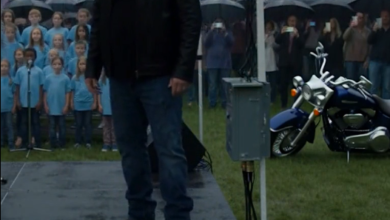
The Deschutes County Fair and Expo Center’s main hall was dark except for candles on Saturday night. Five hundred of them sat on long tables beside framed photos of people killed by impaired drivers in Central Oregon. Families sat in folding chairs, holding each other.
Lena’s photo was on the third table, in her scrubs, laughing.
A camera crew from KTVZ in Bend was set up near the stage. The MADD chapter was livestreaming on Facebook.
Brandon stood at the podium in his dress uniform, holding a glass Officer of the Year award. Harper stood beside him in a white dress, holding a candle. Her face was blank.
I walked in through the back doors with Teresa Nakamura and an Oregon State Police lieutenant named Rachel Voss. Teresa had gotten my charges stayed that morning with the jail’s 0.00 breath result.
Behind me, quietly, came forty men in leather vests. My club.
And behind them, rolling slowly on a dolly pushed by Mick Dunbar, came the black, burned-out skeleton of my Harley-Davidson.
Five hundred heads turned.
Brandon’s face went tight for a second. Then he smiled for the camera.
“Folks, some of you may know my brother-in-law,” he said into the microphone, his voice sad. “Boone Wexler. A man who rides drunk. A man his own daughter had to stop with a can of gasoline.”
I walked to the front of the hall and stood beside the burned bike.
“He’s right,” I said, loud enough to carry. “I drove drunk. I rode home on Highway 126 more times than I can count. My daughter hid my keys twice, and I yelled at her both times. So she burned my bike.” I looked at the club behind me. “I’m not proud of it.”
Then Mick stepped forward.
“I drove drunk too,” he said. “The night Lena died. Home on 126.”
Another brother stepped forward. Then another.
Seven men in leather vests stood in a line beside that burned motorcycle in front of five hundred candles. Each of them said the same thing.
I drove drunk.
The hall was so quiet you could hear the candles flicker.
Brandon cleared his throat into the microphone.
“That’s very brave,” he said, and he sounded almost moved. “But this vigil is about the victims. People like my sister Lena. Walking home on a dark road, minding her own business, wearing that little reflective star on her badge. It was shining right at him, folks. If that drunk had just looked—”
He stopped.
Lieutenant Rachel Voss stepped up beside me.
“Sergeant Oakes,” she said clearly, “you just told five hundred people that Lena Wexler’s reflective star was shining at the driver who hit her. That badge reel isn’t mentioned anywhere in the State Police report. It was never recovered from the scene.”
She held up a clear evidence bag. Inside was a little silver star on a frayed white cord, with a smudge of white paint on the back.
“Your wife turned this over to us yesterday,” Voss said. “From your glove box. Along with a body-shop invoice for a front bumper, grille, headlight and light bar on your white 2019 Ram. The day after Lena died.” She lowered the bag. “The only way you’d know that star was shining at the driver is if you were the driver.”
Five hundred faces turned to the man at the podium.
Brandon’s award slipped out of his hand and shattered on the stage.
And beside him, Harper set her candle down carefully on the podium.
Then she walked down the steps, past the KTVZ camera, past five hundred candles, past her mother’s photo, to the burned skeleton of my Harley.
She stood beside me.
She reached up and tugged her own braid twice.
Then she looked back at her uncle on the stage.
What was she going to say?
Part 9 — The Plaque
“You saw her star, Uncle Brandon,” Harper said quietly. “And you kept driving.”
Lieutenant Voss arrested Sergeant Brandon Oakes on the stage at the Deschutes County Fair and Expo Center in front of five hundred candles and a live camera.
He was indicted for second-degree manslaughter, felony hit-and-run, tampering with evidence, official misconduct, and filing a false police report against me. Kelsey testified. So did the owner of Prineville Collision & Paint, who’d kept a photo of the damaged white Ram on his phone because something about it bothered him for three years.
Brandon pleaded guilty. He was sentenced to twelve years in the Oregon State Penitentiary. His badge and pension were stripped. Lena’s trust stayed with Harper, and the court named me trustee again, with Teresa Nakamura as co-trustee until Harper turns eighteen. I asked for that myself.
My DUII charge was dismissed. DHS closed its case and returned Harper home that same week.
I told Harper the truth about the missed call. I sat on her bed and told her everything. Her mother called me at 1:58 that morning, and I didn’t answer because I was drunk.
She listened to all of it. She didn’t cry.
Then she said, “You picked up the phone now, Daddy.” And she hugged me so hard I couldn’t breathe.
The week after the vigil, I had the burned Harley rolled into the middle of the gravel yard at the clubhouse off Highway 97. I didn’t repair it. I didn’t clean it.
I stood beside it in front of all forty members and told them the whole story again, from beginning to end.
Then Mick called a vote.
Anybody who drinks hands over their keys. No exceptions. Not ever.
Forty hands went up.
We bolted the burned bike to a concrete pad right there in the yard as a permanent monument. Big Lou welded a steel plaque to the front of it. It has one line, in Harper’s words.
“I don’t want you to ride anymore.”
There’s a key box on the wall beside it now, with forty hooks.
In the six years since, the club hasn’t had a single alcohol-related crash. Not one.
Harper is seventeen now. She drives herself to school in my old pickup and wants to be an ER nurse like her mom.
Every October 20th, the anniversary of the night Lena died, Harper drives out to the clubhouse alone. She brings a bucket of soapy water and a soft rag. She cleans that burned Harley carefully, every inch of the scorched tank and twisted handlebars, while forty grown men stand quietly along the fence and watch her.
This year, when she finished, she reached into her pocket and pulled out something small.
It was a little silver reflective star sticker, the same kind her mother put on her pedals.
She pressed it gently onto the blackened gas tank, right in the center.
Then she turned around and found me at the fence.
She reached up and tugged her braid twice.
I tugged my beard twice back, because I don’t have a braid.
She laughed and walked over, and we stood there together in the late October light, looking at the burned bike with a tiny star shining on it.
“Daddy,” she said. “Do you ever miss riding?”
I looked at the star. At the plaque. At the forty keys hanging on their hooks in the box on the wall.
“Every day,” I said. “But I’d rather be here.”
If Boone and Harper’s story stayed with you, follow our page. We’ve got a lot more biker stories coming, and some of them hit even harder than this one.