A Child Was Forced to Confess — Then a Biker Walked Into the Principal’s Office
The boy signed the confession with shaking hands, not because he was guilty, but because every adult in the room had already decided he was.
The principal’s office smelled faintly of coffee and disinfectant, the kind of smell that tried to feel safe. A framed mission statement hung crooked on the wall. The clock ticked louder than it should have.
The boy sat in a chair that felt too big for him, feet barely touching the floor. His backpack rested on his knees like a shield he didn’t know how to use. He was eleven. Thin. Quiet. The kind of child teachers called “easy” because he didn’t make noise.
Across the desk, the principal folded her hands.
“This will all be over quickly,” she said, voice smooth. “Just sign.”
A school counselor stood to the side, eyes down. A teacher hovered near the door, arms crossed. The boy’s homeroom teacher avoided looking at him altogether.
The paper in front of him accused him of stealing a phone from another student’s locker.
A phone he had never touched.
A phone everyone else had already decided he took.
“If you don’t sign,” the counselor added gently, “this could get much worse.”
The boy swallowed. His throat burned. Fear crawled up his spine, thick and heavy.
“But I didn’t—” he started.
The principal sighed. Not angry. Worse. Tired.
“We’ve reviewed the situation,” she said. “Witnesses. Patterns. This is your chance to take responsibility.”
The boy glanced toward the window. Outside, kids laughed on the playground, unaware that his entire school life was collapsing quietly.
He picked up the pen.
That’s when the door opened.
And a biker walked in.
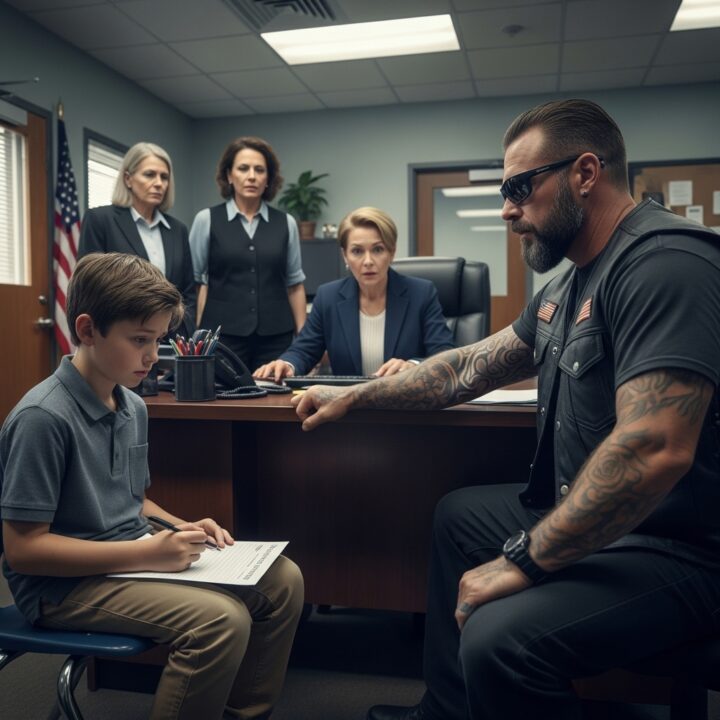
The biker didn’t belong there.
He was tall, broad, wearing a sleeveless black vest. Tattoos ran down his arms like old stories written into skin. His boots made a solid sound against the office floor. He took off his helmet and held it under one arm.
Silence hit the room hard.
The principal straightened instantly. The teacher near the door tensed. The counselor looked up, startled.
“Sir,” the principal said sharply, “you can’t be in here.”
The biker didn’t raise his voice. He didn’t argue.
He looked at the boy.
Really looked at him.
The boy froze, pen still hovering over the paper. His hands shook harder now.
“Who are you?” the principal demanded.
The biker stepped closer to the desk.
“I’m here about him,” he said, nodding toward the boy.
The teacher moved defensively.
“This is a school matter.”
The biker set his helmet down slowly on a chair.
The sound was small.
But it felt heavy, deliberate, impossible to ignore.
A voice from the hallway whispered, “Is that a biker?”
Someone else muttered, “Call security.”
The principal’s tone sharpened.
“You’re intimidating my staff.”
The biker didn’t react.
He rested one hand on the desk, near the confession form. His fingers didn’t touch it, but their presence alone felt like pressure.
“Why is he signing that?” he asked.
The counselor stepped in quickly.
“Sir, this is confidential.”
The biker’s jaw tightened.
“So is a child being forced to lie,” he said quietly.
The room stiffened.
To everyone else, it looked bad.
A biker confronting school officials.
A man who looked dangerous questioning authority.
Every instinct in the room screamed threat.
The tension thickened fast.
The principal stood.
“I’m asking you to leave now.”
The teacher blocked the door slightly, positioning himself between the biker and the boy. The counselor reached for her phone.
“Security is on their way,” she said.
The boy’s breathing became shallow. His vision blurred. The pen slipped from his fingers and clattered to the floor. A quiet, broken sound escaped him, the sound kids make when they’re trying not to cry in front of adults.
The biker noticed immediately.
“Hey,” he said softly, not to the adults, but to the boy. “You okay?”
The boy shook his head.
The principal raised her voice.
“Sir, you are disrupting a disciplinary process.”
The biker reached into his vest.
Several adults flinched.
Instead of anything threatening, he pulled out his phone.
He typed once.
Then twice.
Then he made a call.
“Yeah,” he said calmly. “I’m here. Principal’s office. He’s being pressured.”
He listened.
No one spoke.
The room felt like a wire pulled too tight, waiting to snap.
The principal crossed her arms.
“You have no authority here.”
The biker ended the call and slipped the phone away.
He looked at the boy.
“Don’t sign,” he said. Just two words. Certain. Steady.
The boy froze.
Security footsteps echoed in the hallway.
The sound came first.
Boots.
More than one pair.
Then voices—calm, familiar, controlled.
Two more bikers appeared in the doorway. Then a woman in plain clothes. Then a man with a worn leather briefcase.
No shouting. No aggression. Just presence.
The security guard stopped short.
The woman spoke first.
“Good afternoon,” she said. “I’m with child advocacy.”
The man with the briefcase set it on the desk and opened it.
Inside were printed emails.
Time stamps.
Screenshots.
The principal’s face tightened.
The biker who had arrived first stepped back slightly, giving space.
The man with the briefcase spoke evenly.
“The phone reported stolen was logged on the school’s Wi-Fi this morning,” he said. “From a staff device.”
Silence dropped hard.
The teacher near the door swallowed.
The woman continued.
“The student was pressured to confess because it was faster than investigating.”
The counselor’s phone lowered slowly.
The principal opened her mouth, then closed it again.
Power shifted in the room—not with force, but with fact.
The boy stared at the desk, confused.
The biker crouched slightly so he was eye-level with him.
“You didn’t do it,” he said. Not a question.
The boy’s lip trembled.
“No,” he whispered.
The truth unraveled quietly.
The phone had been taken by another student and briefly handled by a substitute teacher who panicked when it went missing. The system flagged the wrong locker. The school chose the easiest explanation.
The confession form was removed from the desk.
The principal didn’t apologize.
She didn’t need to.
The silence said enough.
The boy’s shoulders slumped as the weight lifted. He wiped his face with his sleeve, embarrassed.
The biker stood.
He didn’t look at the principal.
He didn’t look at the staff.
He looked at the boy.
“You did good,” he said. “You held on.”
The boy nodded.
The biker picked up his helmet.
Someone finally asked, “Who are you?”
He paused at the door.
“I’m his uncle,” he said. “And I don’t like bullies.”
Then he left.
The hallway felt different afterward. Smaller. Quieter.
The boy walked out holding nothing but his backpack. No confession. No shame.
Behind him, adults stood still, forced to sit with what they had almost done.
And as the biker’s engine started outside—low, steady, already fading—the school returned to its routine, pretending it had never come that close to breaking a child.
But the boy would remember.
And so would they.