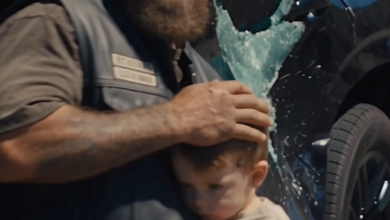
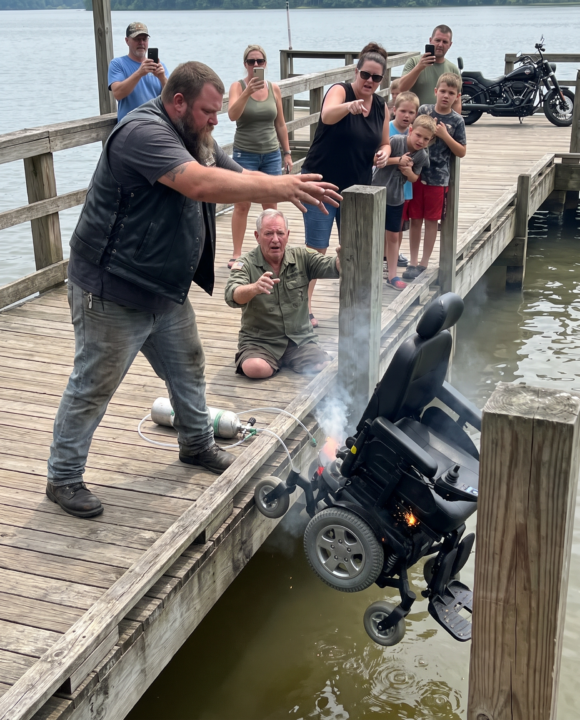
Part 2: A Biker Threw a Disabled Veteran’s Smoking Wheelchair Into Chickamauga Lake While Strangers Filmed Him — The Next Morning, Forty Harleys Returned With a New Chair Bearing the Soldier’s Forgotten Unit Insignia
Part 2 — The Smell Hammer Never Forgot
The sheriff’s deputies kept us at Riverbend Landing until nearly four that afternoon. The county fire team blocked the accessible dock, a hazardous-materials officer sampled the water, and two rescue divers eventually secured the wheelchair beneath a containment tarp before moving it into a steel recovery bin.
Walt sat beneath the diner awning in a borrowed manual chair.
He hated it.
His shoulders had deteriorated after years of compensating for his missing legs, so pushing himself more than twenty feet left him breathless. Every time somebody offered assistance, he planted both hands on the rims and told them he had survived worse machinery than a wheelchair.
Hammer waited beside his Harley.
Deputy Lena Ortiz questioned him three times. His answers never changed.
“I heard the cell pop.”
“I smelled electrolyte.”
“I saw vapor.”
“I moved the man.”
When she asked why he had thrown the chair into public water, Hammer looked toward the children who had been standing behind Walt.
“Only empty direction.”
The hazardous-materials officer later confirmed that several cells inside the battery had entered thermal runaway. The damaged pack contained enough stored energy to ignite the chair’s seat, the oxygen-cylinder regulator, or the dry wood beneath it.
Water had not magically made the battery harmless. It had cooled the pack long enough to stop the immediate spread and moved the reaction away from people.
The officer called Hammer’s decision crude.
Then he called it effective.
That did not repair the chair.
It did not erase the video.
By 5:00 p.m., a cropped version had passed two million views. Hammer’s face appeared beneath words like COWARD, BULLY, and FAKE VETERAN. Nobody included the underwater flash because the person who uploaded the most popular clip had stopped filming at impact.
The Iron Saints saw it before Hammer returned to their clubhouse.
Moses Carter called him first. Moses was a sixty-one-year-old Black Army veteran, retired paramedic, and the only man in the club who could tell Hammer he had done something reckless without preparing for a fight.
“You throw a veteran’s chair in a lake?”
“Yep.”
“You want to add context?”
“Battery was cooking.”
“Internet missed that part.”
“Internet misses breakfast.”
Moses did not laugh.
The Iron Saints had spent fourteen years building trust with veterans’ shelters, children’s hospitals, and recovery programs around Chattanooga. One ugly video could close every door they had pushed open.
Moses told Hammer to stay away from the clubhouse until the officers completed their report.
Hammer agreed.
That worried him more than an argument would have.
I learned the rest from Doc Ellison, an Iron Saints member who returned to the diner after sunset. Doc was not a physician. He had been an Army medic and later worked as a rehabilitation-equipment technician.
He examined the scorched chair after the fire team recovered it.
The battery was not original.
Someone had installed a cheaper rebuilt pack inside a casing bearing the authorized manufacturer’s label. Two temperature sensors had been bypassed, and one wire had been protected with household electrical tape.
Walt had paid a mobile repairman $1,300 three months earlier.
The man had disappeared.
Doc photographed everything.
Then he found a tiny blue paint mark beneath the chair frame.
He recognized it.
Two months before the incident, Walt had attended an adaptive-fishing event organized by the Iron Saints. Doc had noticed the chair losing power on the ramp and marked one loose bolt with blue paint after tightening it.
Walt did not remember the bikers.
They had removed their cuts for the event because some patients found club insignia intimidating.
Doc remembered Walt.
More important, he remembered Helen Mercer.
She had called their workshop before her death.
Helen knew the chair would eventually need repairs her husband could not afford. She asked whether the Iron Saints could help when that day came, but she imposed one condition.
Do not let Walter believe he is charity.
She mailed Doc a folder containing the chair specifications, medical seating measurements, insurance denials, and a photograph of Walt as a young combat engineer. In the picture, he stood beside a damaged bridge with fourteen muddy soldiers.
One of those men was Thomas Dawson.
Hammer’s father.
Doc had not told Hammer when the folder arrived. Ray and his father had been estranged for years before Thomas died, and Doc did not want to reopen the wound until the club had a concrete way to help.
They had quietly begun searching for a suitable replacement chair.
Nothing affordable matched Walt’s seating needs.
Then Hammer walked onto the dock.
He did not recognize Walt’s face at first. Fifty-one years had changed the young soldier in Helen’s photograph.
But he recognized the unit insignia taped inside the veteran’s tackle box after it spilled open.
That was why Hammer had gone silent when Walt demanded answers.
He had just saved a stranger.
Then he realized the stranger had once saved his father.
At 7:20 p.m., Walt asked me to drive him home. His accessible van could carry the borrowed manual chair, but he could not transfer without assistance.
Hammer heard us discussing it.
He removed his gloves.
“I can lift him.”
Walt stared at the blood dried in Hammer’s beard.
“You’ve lifted enough.”
Hammer nodded once and stepped back.
He watched two firefighters struggle through the transfer. He did not interfere, even when Walt’s shirt caught beneath the safety belt and his face tightened from pain.
Sometimes restraint costs more than action.
Before I closed the van door, Hammer approached and placed Helen’s water-damaged photograph in Walt’s lap. He had dried it between two diner napkins and covered it with the clear sleeve from his motorcycle registration.
Walt examined the improvised protection.
“You knew someone from my unit.”
Hammer looked at the photograph.
“My old man.”
“Name?”
“Thomas Dawson.”
Walt’s hands stopped moving.
Tommy Dawson had been the youngest driver assigned to Walt’s engineer team, nineteen years old and terrified of deep water. During a night operation near a damaged crossing, an armored vehicle rolled down an embankment and trapped Thomas beneath its frame.
Walt went after him.
The rescue cost Walt both legs.
Thomas survived.
He came home, had a son, lost himself to alcohol, and never told that son why an old combat-engineer insignia remained bolted beneath his motorcycle saddlebag.
Walt looked toward Hammer through the van door.
“I carried your father.”
Hammer shook his head.
“You carried both of us.”
Then he closed the door.
Part 3 — The Twelve Seconds Everyone Saw
I barely slept that night.
The video kept appearing on my phone. Each upload carried a different accusation, but the same twelve seconds played repeatedly: Hammer lifting Walt, the veteran’s arm striking the biker’s chest, the chair rolling toward the edge, and Walt shouting about his wife.
Context moved slowly.
Anger had better wheels.
At 6:12 the next morning, I returned to Riverbend Landing to meet the county inspector. Hammer’s Harley was already parked behind the bait shop.
He sat on the curb with two coffees.
One was black.
Walt drank his coffee black.
“You expecting him?” I asked.
“Hope ain’t expectation.”
Hammer handed me the second cup and walked toward the dock closure. Beneath his cut, his right shoulder sat lower than the left. Walt had not injured him by punching his mouth.
The lift had done it.
Hammer had torn something while pulling the veteran sideways from the chair. He refused a hospital because the club’s medical reserve contained only $3,840, and they might need every dollar before morning ended.
Moses arrived in his pickup.
He brought the rest of the Iron Saints’ officers with him—Doc Ellison, Colt Reyes, and June “Switch” Harlan, a fifty-three-year-old machinist who rode a pearl-gray Heritage Classic and handled the club’s accounts.
They did not greet Hammer.
Moses placed his phone on the hood. The viral video had reached six million views. Three veterans’ organizations had asked whether the Iron Saints condoned humiliating disabled people, and a hospital had canceled their scheduled toy run.
“We issue a statement,” Moses said. “We explain the battery. We release Doc’s photographs.”
Hammer shook his head.
“Not before Walt sees them.”
“He already thinks you destroyed his chair.”
“Was his chair.”
“It was also a bomb under an oxygen tank.”
“Still his story.”
Moses stepped closer. “The club may lose fourteen years of work because you won’t defend yourself.”
Hammer’s chain wallet clicked when he shifted his weight.
“Then we lose it.”
Colt swore and walked away.
Switch opened a folder. She had located a rehabilitation supplier in Knoxville with a demonstration power chair close to Walt’s measurements. The supplier would release it for $15,600 after applying every discount Doc could negotiate.
The Iron Saints had $17,240 in their clubhouse roof fund.
Rain had been entering the back room for nine months. The next storm could ruin their tools, donated medical equipment, and motorcycle lifts.
Switch asked for a vote.
Moses said the club should establish a public fundraiser first. Colt wanted to wait for the repairman’s insurance. Doc believed Walt needed powered mobility immediately, but taking nearly the entire roof fund could cripple their workshop.
Everyone looked at Hammer.
He did not command the club by giving speeches. He was president because, when a decision became ugly, he stood where the consequences would land.
“Buy it,” he said.
Moses folded his arms. “Easy to spend a brother’s dry roof.”
Hammer removed the president patch from his cut and placed it on the truck hood.
“Then don’t spend it for me.”
The small stitched rectangle lay beside the phone displaying his face beneath the word MONSTER.
No one spoke.
Hammer turned toward his motorcycle.
Moses caught his vest.
“You walk away every time staying gets difficult.”
Hammer stopped.
That sentence had not come from Moses.
It had come from Thomas Dawson.
Before dying, Hammer’s father had written it in a letter Ray never answered. Thomas described the bridge operation, Walt’s sacrifice, and the shame that followed him home. He admitted that he had drowned his guilt in whiskey while another man learned to live without legs.
Ray had kept the letter inside his saddlebag.
He had never finished reading it.
Moses had.
The club voted again.
Four hands rose.
Unanimous.
Switch called Knoxville. The supplier agreed to open on Sunday if someone arrived before nine. Colt took the club’s cargo trailer. Doc gathered Walt’s seating measurements from Helen’s folder.
Hammer went to retrieve the only object he had inherited from his father.
Meanwhile, Walt awakened in a house no longer designed for him.
His power chair had allowed him to transfer between the bedroom, bathroom, kitchen, and van without another person. The borrowed manual chair was too wide for the hallway and too low for his transfer board.
He spent the night in his recliner.
At 5:40 a.m., he tried to reach the bathroom alone.
The chair rolled backward.
Walt fell.
His neighbor found him on the floor forty minutes later, furious and humiliated but not seriously injured. An ambulance took him to Erlanger Hospital for examination.
The same viral video played on a television in the emergency waiting room.
Walt demanded that the nurse turn it off.
Then he asked to see the full recording.
A teenager at the lake had captured forty-seven seconds rather than twelve. His version showed the white vapor, Hammer clearing the oxygen tube, the underwater flash, and the biker shielding a little girl when hot fragments struck the surface.
The teenager’s mother uploaded it at Walt’s request.
The second video began spreading.
People who had called Hammer a monster changed their captions without apologizing. News stations added words like HERO and QUICK-THINKING BIKER.
Hammer disliked that version too.
“He had six million enemies yesterday,” Colt told me. “Today he’s got six million people who think he can’t make a mistake. Same cage. Different paint.”
At 10:35 a.m., Deputy Ortiz announced that no charges would be filed. The county did cite the mobile repair company whose bypassed sensors caused the failure.
That should have been the ending.
The veteran was alive. The biker had been vindicated. The dangerous chair had been recovered.
But Walt still had no independent mobility.
The hospital could not release him until a suitable chair or home-care plan existed. Insurance estimated six to twelve weeks for replacement approval.
Hammer stood outside the emergency department carrying his father’s unopened letter and the old red-and-gold unit insignia from his Harley.
He had one day to repair a debt older than he was.
Then Switch called from Knoxville.
The demonstration chair had been sold twenty minutes before Colt arrived.
Another buyer had paid full price.
The Iron Saints’ roof money could no longer solve the problem.
Moses looked at Hammer’s damaged shoulder and the empty trailer behind Colt’s truck.
“What now, President?”
Hammer put the patch back on his vest.
“Now we build.”
Part 4 — The Wheelchair Hidden Behind the Clubhouse Wall
The Iron Saints’ clubhouse occupied a former transmission shop off Rossville Boulevard. It smelled of gear oil, welding smoke, wet leather, and coffee strong enough to dissolve a spoon.
Behind the main workshop stood a locked storage room.
Only Doc carried the key.
Inside were wheelchairs, walkers, transfer benches, prosthetic components, oxygen carriers, and adaptive controls collected from families who no longer needed them. The club repaired what it could and quietly distributed the equipment through rehabilitation therapists.
In the rear corner sat a power wheelchair covered with a gray sheet.
Doc removed it.
The chair was nearly new.
Its frame supported the correct weight. The seat width matched Walt’s measurements, and the control system could be moved to accommodate the limited rotation in his right shoulder.
The batteries were missing.
So was the reason Doc had never offered it.
The wheelchair had belonged to Staff Sergeant Daniel Ruiz, a thirty-nine-year-old Afghanistan veteran who died from cancer before he could use it. His mother donated the chair on the condition that its first recipient be another combat veteran who refused to think of himself as helpless.
Doc had been saving it for Walt.
Helen Mercer had already approved the chair.
Two weeks before she died, she visited the clubhouse without her husband. She sat in the seat, ran one hand across the controls, and asked whether they could preserve a narrow metal plate from Walt’s old unit.
Doc promised.
Then Helen left him an envelope addressed to Ray Dawson.
Doc handed it to Hammer.
The biker did not open it immediately.
First, he inspected the chair.
He made lists.
Batteries. Cushion. Headrest bracket. Oxygen rack. Transfer-board hooks. Fishing-rod carrier. Weather cover. Anti-tip wheels. New wiring harness.
The club separated into teams.
Switch called every supplier within two hundred miles. Colt drove to Dalton for two certified lithium batteries. Moses contacted a rehabilitation therapist who agreed to evaluate the setup at dawn.
June opened the roof-fund ledger.
They would need almost all of it anyway.
Word spread quietly. A motorcycle dealer donated a charger. A welder from another club brought aluminum tubing. Daniel Ruiz’s mother, Elena, arrived carrying the unused pressure-relief cushion her son had selected.
Nobody filmed.
At noon, rain began leaking through the clubhouse roof.
Buckets appeared between the workbenches.
The symbolism irritated Hammer.
“Roof’s got bad timing,” Colt said.
“Roof’s been warning us nine months.”
That was the first time anyone laughed.
Then Hammer opened Helen’s envelope.
Her handwriting leaned sharply to the right.
Ray, you do not know Walter, but your father did. Tommy visited us once after coming home. He stood on our porch for almost an hour and could not make himself knock. Walter saw him through the curtain and went outside. Neither man spoke about the bridge. They sat beside each other until dark.
Helen explained that Thomas had returned every year on the operation’s anniversary. Sometimes he brought beer. Walt never drank it, but he let Thomas leave two cans on the porch.
After Thomas stopped coming, Walt assumed he had died.
He did not know Thomas had a son.
Helen had discovered Ray through a newspaper photograph of an Iron Saints veterans’ ride. The old unit insignia beneath his Harley saddlebag confirmed the connection.
She never told Walt.
She believed the men should meet without being forced to inherit the guilt between their fathers.
Her final paragraph changed Hammer’s expression.
If his chair fails before you meet him, Walter will act as if the machine is replaceable. It is not. I chose every measurement with him. More importantly, it became the last promise I could keep: that after I was gone, he would still move under his own power. If you help him, do not give him a monument to me. Give him a road forward.
Hammer folded the letter.
No speech followed.
He picked up a wrench.
For the next seventeen hours, the Iron Saints built the chair.
Doc rewired the control module. Colt fabricated an oxygen-cylinder bracket that could release during emergency transfer. Switch installed a marine-grade battery enclosure with independent temperature alarms.
Moses modified the right armrest so Helen’s photograph could remain beneath a clear waterproof panel.
Hammer worked on the unit insignia.
The emblem from Thomas’s Harley was too worn to mount directly. Half the red enamel had disappeared, and one edge had been bent during a motorcycle crash years earlier.
Hammer flattened the metal carefully.
Then he placed it on a sheet of aluminum and traced its outline.
Elena Ruiz watched him cut the new plate.
“You could use a machine,” she said.
“Machine didn’t owe him.”
“You didn’t owe him either.”
Hammer continued filing the edge.
“My father did.”
Elena understood inherited debt. Her son had apologized for surviving battles that other men did not. She placed one hand on the chair Daniel would never use.
“Don’t make this punishment.”
Hammer looked at her.
“Meaning?”
“Your father received fifty-one years because Walter moved toward danger. If you turn this chair into payment, Walter becomes a bill.”
The file stopped.
Elena tapped the new insignia.
“Make it an introduction.”
Hammer changed the design.
Instead of copying only Walt’s unit emblem, he added a small blank strip beneath it. No names. No dates. Space for the veteran to decide what belonged there.
Near midnight, the rebuilt battery system failed its first load test.
One connector overheated.
Everyone stared at the temperature reading.
Nobody wanted another smoking chair.
Doc replaced the wiring harness. The second test showed voltage instability. Colt discovered corrosion inside the borrowed charger. The dealer had donated equipment stored too long in a damp warehouse.
At 2:18 a.m., Moses suggested postponing delivery.
Hammer did not argue.
Safety came first.
That was new.
Years earlier, he would have forced machinery past warning signs because stopping felt like weakness. Prison, sobriety, and the death of his father had taught him that urgency could disguise pride.
They opened the new charger meant for the clubhouse’s diagnostic equipment.
It was their only one.
They installed it on Walt’s chair.
At 4:47 a.m., the system passed.
At 5:30, rehabilitation therapist Karen Liu adjusted the cushion angles from Helen’s notes. At 6:15, Doc tested the emergency release while Moses timed him.
Eight seconds.
Too slow.
They rebuilt it.
Five seconds.
Hammer tested it with his injured shoulder and failed.
He changed the handle until one hand could release both the oxygen cylinder and seat belt.
Three seconds.
Good.
The chair was ready at 7:26 Sunday morning.
Forty Iron Saints stood outside in wet cuts. The clubhouse roof leaked behind them, and their treasury held less than nine hundred dollars.
Moses asked whether Hammer wanted to lead.
Ray looked at Thomas Dawson’s old insignia mounted beneath the new armrest.
“No.”
“Why?”
“Walt leads this one.”
The chair traveled in the cargo trailer.
The motorcycles followed it toward the lake.
Part 5 — The Soldier Behind Thomas Dawson’s Compass
Walt checked himself out of the hospital against advice at 7:40 Sunday morning.
His neighbor drove him to Riverbend Landing in the borrowed manual chair. He claimed he wanted his fishing rod, but the rod was already inside my office.
He wanted to see whether Hammer would return.
At 8:03, the first Harley rounded the curve above the lake.
The V-twin rumble arrived before the motorcycles became visible. Forty riders descended between the trees in two close columns, their headlights pale beneath the morning clouds.
No one revved an engine.
No one waved.
They parked along the gravel shoulder and shut the motorcycles off together.
The sudden silence carried across the water.
Colt opened the cargo trailer.
Hammer and Moses rolled out the new chair, but they stopped twenty feet from Walt. Ray’s beard had been washed clean of blood. His right arm remained close to his body, and fresh medical tape covered two fingers.
Walt studied the chair without moving.
The frame was matte black. A waterproof compartment protected Helen’s photograph beneath the armrest. A fishing-rod holder extended along the left side, and a small emergency handle sat below the oxygen bracket.
The red-and-gold combat-engineer insignia gleamed near the wheel.
Behind the seat hung Thomas Dawson’s field compass.
Walt recognized the dent in its brass cover.
He had made that dent with a rifle butt while breaking the jammed clasp on Thomas’s safety harness during the bridge rescue.
“Where did you get that?” he asked.
“My father kept it.”
Walt’s eyes remained on the compass. “Tommy alive?”
“No.”
“When?”
“Eleven years ago.”
Walt lowered his head.
For half a century, he had imagined Thomas living somewhere beyond reach—driving trucks, raising children, perhaps leaving two beers on another veteran’s porch. The truth arrived without ceremony beside a lake.
Hammer did not fill the silence.
Finally, Walt looked at the chair.
“You buy this overnight?”
“Daniel Ruiz did.”
Elena Ruiz stepped forward and introduced herself. She explained that the chair had belonged to her son but had never carried him. Walt listened with both hands locked around the rims of the borrowed chair.
“I’m sorry,” he said.
“So am I,” Elena answered. “That’s why it should move.”
Doc explained the modifications, the certified batteries, the temperature alarm, the manual emergency release, and the seating adjustments copied from Helen’s records.
Walt looked up sharply.
“You knew my wife?”
Doc handed him the folder.
Inside were Helen’s notes, warranty documents, medical measurements, and one photograph taken at the Iron Saints clubhouse. Helen sat in Daniel’s chair with a mischievous half-smile, holding a paper sign.
WALTER WILL COMPLAIN ABOUT THE COLOR.
The chair had originally been blue.
The club painted it black.
Walt laughed once.
It broke halfway through.
He pressed Helen’s photograph against his chest and turned toward Hammer.
“You knew about this yesterday?”
“No.”
“When?”
“After.”
“So throwing my chair wasn’t part of some plan?”
“No.”
“You just decided for me.”
“Battery decided.”
“You could’ve explained.”
“Did.”
“You said move.”
Hammer considered that.
“Was short on time.”
Walt rolled closer.
“You broke my hand off the wheel.”
“Yep.”
“You threw the last thing she gave me into the lake.”
“Yep.”
“And you expect this to replace it?”
“No.”
The answer stopped Walt.
Hammer crouched despite the pain in his shoulder.
“Nothing replaces it. Chair was hers. This one’s yours.”
He handed Walt the blank metal strip beneath the unit insignia.
“What goes here?”
Walt examined it.
“Names?”
“If you want.”
“Dates?”
“If you want.”
“My wife?”
“If you want.”
Walt looked toward Thomas’s compass.
Then he shook his head.
“Leave it blank.”
Hammer nodded.
Walt later told me that blank space was the first gift anyone had offered without instructing him how to feel about it.
Karen Liu supervised the transfer. Hammer stayed several steps away until Walt called him forward.
“My shoulder won’t hold me,” Walt said.
“Mine ain’t great either.”
“Then don’t drop me.”
“Wasn’t planning a second video.”
The riders laughed softly.
Hammer locked his left arm beneath Walt’s chest while Moses supported his hips. Together they moved him into the new seat.
The cushion settled.
Walt adjusted the controller and drove forward six feet.
He turned.
He reversed.
He approached the dock ramp, stopped at its top, and tested the brake. The chair held.
Then an alarm sounded.
Everyone froze.
A red light blinked near the battery compartment.
Doc dropped to one knee. Switch reached for the emergency release. Hammer pulled Walt’s seat belt free and prepared to lift him.
The alarm stopped.
Karen examined the display.
The warning came from a loose temperature-sensor plug, not heat. It had shifted during transport.
Doc reseated it and ran the diagnostics twice.
Walt watched every movement.
Yesterday, he would have told them to ignore it.
Now he waited.
Only after the system passed did he roll onto the dock.
At the place where his old chair had entered the lake, Walt stopped and looked through the boards at the dark water below.
“You saved my life,” he said.
Hammer stood behind him.
“Saved some kids too.”
“Still angry.”
“Allowed.”
“May stay angry.”
“Your schedule.”
Walt turned the chair.
“Tommy ever tell you what happened at the bridge?”
“Pieces.”
“He froze.”
Hammer’s face tightened.
Walt continued before Ray could defend his father.
“Everybody froze. I was his sergeant. I just froze in a direction that looked useful.”
He explained that Thomas had climbed back into the overturned vehicle after escaping because another soldier remained trapped. The embankment collapsed during the second attempt. Walt went after both men and lost his legs when the bridge support shifted.
Thomas had not been a coward.
He had been nineteen.
He survived because Walt carried him, but Walt survived the first impact because Thomas held a beam off his chest until help arrived.
They had saved each other.
Thomas spent the rest of his life telling only half the story.
So had Walt.
Hammer removed his father’s letter from his vest. The final pages remained sealed along a fold he had never opened.
He handed it to Walt.
The veteran read silently.
Thomas had written that he returned to Walt’s porch each year because sitting beside the man was the only hour he did not feel required to deserve survival. He apologized for stopping after Ray entered prison.
He believed his son’s mistakes proved he had poisoned another life.
Walt closed the letter.
“Your father was wrong.”
“About which part?”
“You.”
Hammer looked away.
Walt placed Thomas’s compass in Ray’s scarred palm.
“This belongs to you.”
Hammer closed Walt’s fingers around it again.
“Chair needs one honest thing.”
Walt hung the compass behind the seat.
Then he drove toward the end of the dock, carrying two dead men’s unfinished conversation with him.
Part 6 — Every Second Saturday at Riverbend Landing
The Iron Saints did not repair their clubhouse roof that summer.
Instead, members spread tarps above the workshop and placed buckets beneath the worst leaks. Local roofers eventually heard what happened and donated labor, although Hammer insisted the club purchase every piece of lumber.
The original viral video disappeared beneath the longer recording.
For several weeks, strangers drove to Riverbend Landing hoping to photograph Hammer and Walt together. Most left disappointed.
Hammer avoided cameras.
Walt charged ten dollars per interview question and donated the money to Daniel Ruiz’s mother. That reduced the crowd faster than any sign could have.
The mobile repairman who installed the counterfeit battery was charged with fraud and reckless endangerment after investigators found seven other veterans using altered packs. Three showed signs of dangerous overheating.
Doc inspected them all.
No one was billed.
Riverbend Landing added a fire-resistant charging area away from the wooden dock. The county installed emergency guidance for mobility-device battery failures, and Switch taught our staff how to recognize heat, odor, swelling, popping sounds, and vapor without turning the training into a story about heroes.
“Warning signs first,” she said. “Names later.”
Walt returned every second Saturday.
He arrived at 8:00, ordered black coffee, and inspected the blank metal strip beneath his unit insignia. It remained empty.
The new chair carried scratches within a month. Catfish slime marked the fishing-rod holder. A wheel cover cracked when Walt misjudged the bait-shop doorway.
He brought it to Hammer’s workshop.
“You promised repairs?” Walt asked.
“Never promised.”
“Your dead father did.”
“Old man keeps spending my time.”
Hammer repaired the cover.
Walt began staying at the shop. He labeled donated equipment, insulted Colt’s welding, and taught younger veterans how to transfer without apologizing for taking space.
Daniel Ruiz’s mother visited monthly.
Sometimes she sat in the chair’s former storage corner and listened to Walt complain about its turning radius. She said Daniel would have liked him.
Walt answered that Daniel clearly had good judgment.
Hammer and Walt never discussed forgiveness.
They discussed battery temperatures, fishing line, coffee, old engines, and whether Thomas Dawson had been the worst card player in the United States Army.
That was enough.
On the anniversary of the bridge operation, Walt placed two unopened beers beside Thomas’s compass. Hammer sat next to him on the dock until sunset.
Neither man drank.
Before leaving, Walt handed one can to Ray.
“For your father.”
Hammer placed it inside his saddlebag.
The second remained beside Walt.
“For me,” he said.
The lake went dark around them.
No cameras were raised.
Part 7 — The Blank Plate Beneath the Insignia
One year after the wheelchair went into Chickamauga Lake, Riverbend Landing hosted its first Roll and Ride fishing morning.
The name embarrassed Hammer.
Walt chose it.
Twenty-three disabled veterans arrived with wheelchairs, scooters, prosthetic limbs, canes, and enough criticism of the event’s organization to prove they felt welcome.
The Iron Saints handled equipment inspections. Riverbend staff carried breakfast to the dock. Elena Ruiz distributed fishing licenses purchased from a small fund bearing Daniel’s name.
Nobody made the veterans pose beside the motorcycles.
Near noon, a young Marine named Caleb noticed the blank strip beneath Walt’s unit insignia.
“You forget to engrave it?”
“No.”
“What belongs there?”
Walt looked toward Hammer, who was repairing a loose rod holder with a wrench between his teeth.
“Something might, someday.”
Caleb did not understand.
He would later.
After lunch, Walt drove to the exact board where Hammer had torn his hand from the smoking chair. The lake below looked ordinary. Boats crossed the distant channel. A child dropped bread for ducks.
Walt removed Thomas Dawson’s compass from behind his seat.
For a moment, I thought he intended to throw it into the water.
Instead, he gave it to Hammer.
“Your turn to carry him.”
Hammer accepted it.
Walt then produced a small engraved plate from his medication bag. He had finally decided what should occupy the blank space.
It carried no soldier’s name.
No date.
No declaration about courage.
Just three words:
WE BOTH RETURNED.
Hammer installed it beneath the old combat-engineer insignia.
His hands shook once.
Then they steadied.
At sunset, Walt drove up the accessible path beside Hammer’s slowly moving Harley. Forty Iron Saints followed at walking speed, engines idling low enough that the veteran could hear the lake beside them.
The chair bore scratches now.
The black paint had faded near the footrest. Helen’s photograph remained dry beneath the armrest, Daniel’s cushion carried Walt’s weight, Thomas’s compass rested in Hammer’s saddlebag, and the old unit insignia caught the last red light above the water.
People turned to watch.
This time, nobody mistook the sound.
Drop HAMMER in the comments and follow the page if you want the next chapter about the riders who rebuilt a veteran’s road.