A Young Mother Was Denied the Bus Because Her Baby Was Crying — Then a Biker Knocked and Said One Sentence
The bus doors closed with a sharp hiss. Not slowly. Not politely.
They closed while the baby was still crying.
The young mother stood frozen on the curb, one hand gripping the stroller handle, the other pressed awkwardly against her baby’s back as if touch alone could fix everything. Her son’s face was red, breath hitching between sobs. The crying wasn’t loud anymore. It was desperate. Thin. The kind that comes after exhaustion has already set in.
“I’m sorry,” she said quickly, words tumbling over each other. “He’s just tired. We’ll sit in the back. I promise.”
The bus driver didn’t look at her.
“Can’t take you like that,” he said flatly. “You’re disturbing the other passengers.”
Inside the bus, people stared. A woman near the front shook her head. Someone farther back sighed loudly, annoyed. A man muttered, “Thank God,” when the doors sealed.
The engine revved.
The mother stepped back instinctively as the bus pulled away, tears blurring the numbers on the route sign. Her phone buzzed in her pocket—another missed call from work. She was already late. Again.
The baby cried harder, startled by the sudden movement, small fists clenched tight.
Around them, the city kept moving. Shoes slapped against pavement. A couple laughed as they passed. No one slowed.
Then, from behind her, an engine cut off.
A motorcycle rolled to a stop near the bus stop.
A biker took off his helmet.
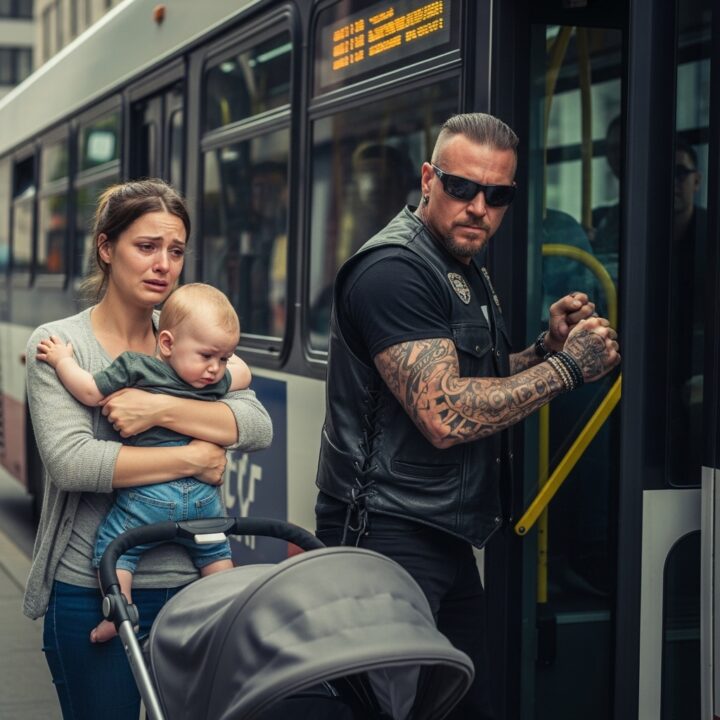
He was impossible to miss.
Mid-forties. Tall. Broad shoulders. Sleeveless black shirt stretched across tattooed arms. Leather vest hanging open. Dark sunglasses pushed up onto his head. He looked like the last person anyone expected to care about a crying baby.
The mother stiffened.
She pulled the stroller a half-step closer to her body, heart racing. Today had already taught her that people didn’t have much patience left.
The biker looked at the retreating bus, then at her.
“What happened?” he asked.
She shook her head quickly. “It’s fine. It’s my fault. He wouldn’t stop crying.”
The biker frowned—not angry, but focused. He turned back toward the bus, which had stopped at the red light just ahead.
Before she could say anything, he started walking after it.
“Sir—” she called out, panic rising. “Please don’t.”
From the sidewalk, it looked bad immediately.
A biker marching toward a city bus. People nearby slowed, phones already coming out. Someone whispered, “This is going to be ugly.”
The biker reached the bus and knocked—hard—on the door.
Passengers jumped. The driver looked up sharply.
“What are you doing?” the driver snapped through the glass.
The biker stood squarely in front of the door, arms relaxed at his sides, blocking it from pulling away.
From inside, he looked threatening. Confrontational. Exactly the kind of person drivers were trained to avoid.
“Move,” the driver barked. “I’m calling this in.”
The biker didn’t shout back. Didn’t explain.
He leaned slightly toward the door and said something short.
One sentence.
The driver’s face changed.
Whatever the biker said, it wasn’t loud.
No one on the sidewalk could hear it.
But the bus didn’t move.
Traffic honked behind it. The red light turned green, then yellow again. The driver glanced toward the rearview mirror, then back at the biker.
Passengers started murmuring.
“What’s going on?”
“Is he threatening him?”
“This is ridiculous.”
A woman stood up. “Sir, you need to leave that man alone.”
The mother stood helplessly by the bus stop, baby crying against her chest now as she lifted him out of the stroller, rocking back and forth. Every instinct screamed that this was about to get worse. That the biker would be blamed. That she would be blamed too.
The biker took out his phone.
A man on the bus pointed. “See? He’s calling someone.”
The biker typed a short message. Slipped the phone back into his pocket.
The driver reached for his radio. “Control, I’ve got a situation—”
The biker shook his head once. Calm. Controlled.
“You don’t need to,” he said.
The driver hesitated.
Silence stretched tight.
Then, from behind the bus stop, engines began to rumble.
Not revving.
Not aggressive.
Steady.
The mother looked up, confused.
Motorcycles were pulling in along the curb. One. Two. Three. Riders dismounted quietly, spacing themselves out, not crowding the bus, not blocking traffic. Men and women. Different ages. Some in leather, some in plain jackets.
No one spoke loudly.
The bus felt very small now.
The sound of engines faded, replaced by a strange stillness.
The driver looked out at the group, then back at the biker standing closest to the door.
“What did you say?” he asked, voice lower now.
The biker finally raised his voice just enough for others to hear.
“I said,” he repeated, “she’s not a disturbance. She’s a mother. And if you leave her here, you leave all of us too.”
No threats.
No insults.
Just certainty.
One of the bikers—a woman in her late thirties—stepped forward slightly. “We’re not in a hurry,” she said pleasantly. “Are you?”
Passengers went quiet.
A man near the front cleared his throat. “Just let her on.”
Someone else nodded. “Yeah. It’s a baby.”
The driver exhaled, long and slow.
He opened the door.
The hiss sounded different this time.
The mother froze, not trusting it. The biker turned toward her and nodded once. Not smiling. Not rushing.
“Go,” he said softly.
She stepped forward, heart pounding, lifting the stroller with shaking hands. The biker took it without comment, carrying it onto the bus and setting it down gently near the back.
No one complained.
The baby’s crying began to fade, exhaustion winning out as the rocking and warmth did their work.
The mother sat down, tears finally spilling over, silent and unstoppable.
The biker stepped back off the bus.
The doors closed again.
This time, no one objected.
The bus pulled away.
The bikers didn’t cheer. Didn’t linger.
They mounted their motorcycles one by one, engines humming softly as they rode off in different directions.
Someone at the bus stop exhaled. “I thought he was going to start a fight.”
The mother didn’t hear that part.
She was focused on her son’s breathing evening out against her chest, the tiny fingers loosening their grip. The city passed by outside the window, unchanged—but she felt like something had shifted.
At the next stop, the driver glanced at her in the mirror.
“Sorry about earlier,” he said quietly.
She nodded. That was enough.
She never learned the biker’s name.
She never saw him again.
But weeks later, when her son cried on another bus, another day, and a stranger shifted over to make room without being asked—she thought about that moment.
About how help doesn’t always arrive gently.
Sometimes it knocks once.
Says one sentence.
And stands its ground.
And then it leaves,
before anyone can call it a hero.