He Was Told the Ambulance Wasn’t for Him — Until a Biker Stopped It Cold
The ambulance door slid shut while the old man was still speaking, and in that moment he understood how quietly help can decide you’re not worth the siren.
Rain misted the street, turning red lights into long, trembling streaks on the asphalt.
The old man stood hunched on the curb, one hand pressed against his chest, the other gripping a folded paper bag like it might anchor him to the world.
“Sir,” the paramedic said, already half-turned away, “this isn’t an emergency.”
The word landed heavy.
Not loud.
Final.
People passed by. Some slowed. Some didn’t.
A woman frowned, then looked away.
A man shook his head like this was someone else’s problem wearing a stranger’s face.
The old man tried again.
“I just need… a minute,” he said, voice thin, breath uneven.
“I feel… wrong.”
The paramedic checked his watch. The driver leaned forward, impatient.
“We’ve got a real call waiting.”
Real.
The door closed. The latch clicked.
The engine revved.
The old man took a step back, dizzy, rain soaking into his shoes. He was suddenly very aware of how alone a curb can feel.
That’s when the sound cut through the drizzle.
Low.
Steady.
Closer than it should’ve been.
A motorcycle rolled into the lane ahead of the ambulance and stopped.
Dead center.
The rider didn’t remove his helmet.
Traffic slowed.
Someone shouted.
And the ambulance braked hard.
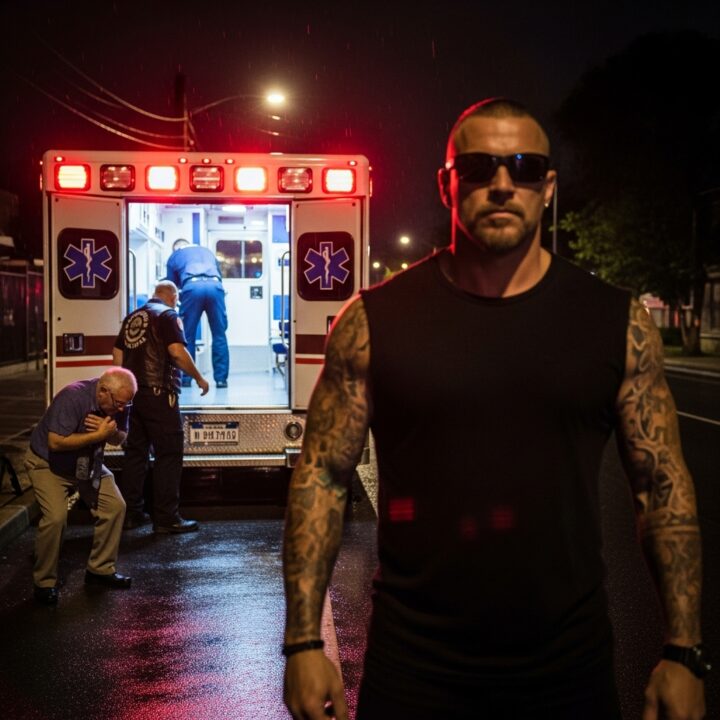
The biker dismounted slowly, deliberately, like he had all the time in the world.
Black jacket. Sleeveless beneath it.
Arms marked with old tattoos, not loud ones—earned ones.
Dark visor still down.
From the inside of the ambulance, it looked like a threat.
“What the hell is he doing?” the driver barked.
The biker stepped forward, palm raised—not in surrender, not in greeting.
“Don’t move,” he said.
Two words. Calm. Controlled.
And instantly, everything went sideways.
A passerby yelled, “Hey! Get out of the road!”
Another voice shouted, “Call the cops!”
The paramedic shoved the door open.
“You need to move your bike,” he snapped. “You’re interfering with emergency services.”
The biker didn’t argue.
Didn’t explain.
He turned his helmet slightly—toward the old man on the curb.
“You okay?” he asked.
The old man tried to answer, but his knees buckled. He caught himself on a parking meter, breath ragged. Fear crept in—not dramatic, just cold and precise.
The paramedic cursed under his breath.
“This is exactly why we can’t waste time.”
The biker took one step closer to the ambulance.
From the outside, it looked aggressive.
Like intimidation.
Like a man with a bike and a chip on his shoulder blocking lifesaving work.
Phones came out.
A security guard from a nearby building jogged over.
“Sir, you need to step back,” the guard said.
The biker didn’t move.
He reached into his jacket.
The crowd stiffened.
Someone gasped.
In a city that judges fast, a biker reaching inside his jacket only means one thing.
But what he pulled out wasn’t a weapon.
It was his phone.
He unlocked it. Typed. Paused.
The paramedic scoffed.
“Unbelievable.”
The biker raised the phone to his ear.
“I need you,” he said quietly.
No names.
No explanations.
Just that.
Sirens wailed somewhere far off—not for them.
The rain picked up, tapping helmets, hoods, shoulders.
The old man sagged against the curb now, sweat mixing with rain, his paper bag torn open. Inside: medication bottles. An envelope marked Cardiology.
The paramedic noticed it.
His jaw tightened.
“This is getting out of hand,” he said, louder now, for the crowd.
“We’re leaving.”
The driver eased his foot toward the gas.
The biker stepped half a pace closer—still not touching anything, still not raising his voice.
“Wait,” he said.
A police cruiser slowed at the corner.
A guard radioed in something urgent.
The biker stood alone between authority and consequence, a single human body acting like a pause button.
The old man whispered, “Please…”
No one knew who the biker had called.
No one knew why he wasn’t afraid.
He lowered his phone and slipped it back into his jacket.
The paramedic shook his head.
“If he collapses, that’s on you.”
The biker met his eyes.
Steady. Unblinking.
“It already is,” he said.
That sentence changed the air.
Then—faint at first, barely believable—the sound came.
Engines.
Not one.
More than one.
Approaching.
Ordered. Controlled.
Heads turned.
The driver froze.
The rain couldn’t hide it now.
Something was coming down that street.
And everyone—paramedics, police, bystanders—felt the same thought land at once:
Whatever happens next,
this is no longer a simple call.
The sound arrived before the sight.
Low.
Measured.
Unmistakably close.
Engines.
Not screaming. Not revving.
Just rolling—slow and deliberate—through the rain-slicked street.
Heads turned.
From the far end of the block, headlights appeared. One. Then two. Then many.
Motorcycles lined up in a quiet, disciplined column, easing forward like they had rehearsed restraint instead of force.
The biker who had stopped the ambulance didn’t turn around.
He didn’t need to.
The first bike pulled in beside him. Then another. Then another.
Riders dismounted calmly. Men and women. Different ages. Different builds.
Sleeveless jackets. Tattoos softened by time. Helmets tucked under arms.
No one shouted.
No one rushed.
The police cruiser stopped completely now.
The security guard lowered his radio.
The paramedic felt it before he named it—the shift.
The moment when authority realizes it’s no longer alone.
A woman in her early 50s stepped forward. European accent, faint but steady.
“Who’s the patient?” she asked.
The old man lifted his head weakly.
She knelt immediately, rain soaking into her jeans, fingers already checking his pulse with practiced calm.
Another biker handed her a flashlight.
Another opened a small medical pouch—not flashy, not heroic.
Just ready.
The paramedic stiffened.
“Ma’am, you can’t—”
The woman didn’t look up.
“History of cardiac issues?” she asked the old man.
He nodded faintly.
She glanced at the paramedic now.
“You should recheck his vitals.”
It wasn’t an order.
It wasn’t defiance.
It was certainty.
The paramedic hesitated—then crouched beside the man again.
This time, his expression changed.
The numbers weren’t right.
The driver leaned out, quieter now.
“We… we might need to reassess.”
No one smiled.
No one said I told you so.
The bikers simply stood there, forming a loose, respectful perimeter—not blocking, not threatening.
Just present.
The rain softened.
The street listened.
The ambulance doors opened again.
This time, they stayed open.
The old man was helped inside—carefully, steadily—his paper bag placed beside him like it mattered.
The paramedic adjusted the oxygen mask, movements slower now, more attentive.
Before the doors closed, the old man reached out.
He caught the biker’s wrist.
“Thank you,” he whispered. “I didn’t want to be… difficult.”
The biker shook his head once.
“You weren’t,” he said.
Not loud. Not soft. Just true.
The doors shut.
The siren came on—finally—and this time, it sounded earned.
As the ambulance pulled away, the street returned to itself.
Phones lowered.
People exhaled.
The bikers didn’t linger.
Helmets went back on.
Engines started low and respectful.
One by one, they left.
No statements.
No explanations.
The police cruiser pulled off without a word.
Only one thing remained on the wet pavement where the biker had stood.
A pair of gloves.
Worn thin at the fingertips.
Left behind without ceremony.
A passerby picked them up, unsure what to do with them.
By morning, the curb would look ordinary again.
Traffic would move.
People would forget.
But somewhere in a hospital room, an old man would be alive because someone refused to accept “not urgent” as an answer.
And somewhere on that street, the silence would remember.