He Slammed His Hand on the Coffin and Shouted — And the Funeral Turned Against Him
He placed his hand on the coffin and shouted loud enough to shake the chapel walls — and for a split second, grief turned into fury.
The funeral home in rural Kentucky smelled faintly of lilies and floor polish. Rain tapped softly against stained-glass windows. A dozen folding chairs sat half-filled with people who looked unsure why they were there.
The obituary had been short.
Name: Unknown.
Status: Unclaimed veteran.
The county had arranged the burial. A chaplain read from a folded paper. Two volunteers from the VFW stood stiffly near the back.
There was no family seated in the front row.
No trembling widow.
No son holding folded tissues.
Just a plain wooden coffin beneath a small American flag.
The chaplain cleared his throat. “We gather today to honor a man who served…”
The door opened quietly.
Boots against hardwood.
Heads turned.
A man in a sleeveless leather vest stepped inside.
Mid-40s. Broad shoulders. Weathered face. Tattoos tracing down both forearms. Rain clinging to his beard.
He didn’t remove his vest.
Didn’t bow his head.
He walked straight down the center aisle.
Some assumed he was another late attendee.
But his pace didn’t slow.
He reached the front.
Stood beside the coffin.
Placed one hand flat against the polished wood.
And then—
He shouted.
“His name wasn’t Unknown.”
Gasps scattered across the room.
The chaplain froze mid-sentence.
One elderly woman clutched her purse tighter.
“How dare you,” someone whispered.
The biker’s jaw tightened.
“His name was Thomas R. Callahan.”
The funeral director stepped forward quickly. “Sir, this is inappropriate.”
From every angle, it looked like disrespect.
Like a man hijacking a sacred moment.
Like someone insulting the dead.
But the biker didn’t look angry at the coffin.
He looked angry at the silence around it.
And in his other hand, partially hidden against his thigh—
Was something wrapped in cloth.
No one noticed it yet.
They were too busy deciding he didn’t belong there.
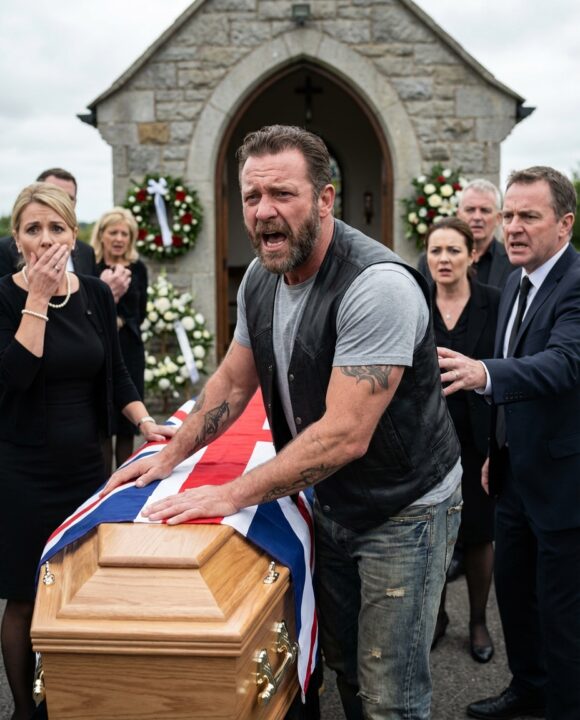
“Sir, I’m going to have to ask you to step away,” the funeral director said firmly.
The biker didn’t move his hand from the coffin.
“He served in Fallujah,” he said quietly, but his voice carried.
The two VFW volunteers exchanged uncertain glances.
The chaplain tried to regain control. “We are here to provide dignity.”
“And you will,” the biker replied evenly. “With his name.”
Murmurs grew sharper.
“This isn’t about you,” someone muttered.
A man in a gray suit stepped forward. “This was arranged by the county. If you have information, you should have brought it earlier.”
The biker’s eyes flicked briefly toward the coffin’s small placard.
Unidentified male. Estimated age: 60–65.
He exhaled slowly.
“He had a dog tag,” he said.
The room stiffened.
“There were no identifying items recovered,” the funeral director insisted.
The biker’s gaze hardened.
“There were.”
The gray-suited man scoffed. “You’re disrupting a service for attention.”
That word — attention — echoed wrong.
The biker finally removed his hand from the coffin.
Reached into his vest pocket.
Several people flinched instinctively.
Security was not present.
But someone whispered, “Call the police.”
He pulled out a folded piece of cloth.
Unwrapped it slowly.
Inside lay a bronze medal.
Weathered.
Scratched.
But unmistakable.
A Purple Heart.
The VFW volunteers inhaled sharply.
The chaplain’s voice faltered.
“Where did you get that?” the funeral director demanded.
The biker didn’t answer immediately.
Instead, he turned the medal so the engraving caught the chapel light.
T.R. Callahan.
The same name he had shouted.
The room felt smaller now.
More fragile.
“You’re saying this is him?” one of the volunteers asked quietly.
The biker nodded once.
“He was reported missing in 2008.”
“That’s impossible,” the gray-suited man snapped. “The county verified—”
“Verified what?” the biker cut in.
“That no one claimed him.”
Silence.
No one claimed him.
Not the same as no one knew him.
The biker placed the Purple Heart gently on top of the coffin.
The metallic sound was soft.
But it felt heavier than the earlier shout.
From the back of the chapel, someone finally dialed the sheriff’s office.
Because whether he was right or wrong—
He had just turned a quiet burial into a confrontation.
By the time the deputy arrived, the chapel air had thickened with tension.
Rain continued tapping against the windows like impatient fingers.
The deputy stepped inside, hat tucked under his arm. “What seems to be the issue?”
The funeral director gestured toward the biker. “He’s disrupting the service.”
The deputy looked at the Purple Heart resting on the coffin.
Then at the biker.
“Is that authentic?” he asked.
“Yes, sir,” the biker replied calmly.
“And you’re claiming the deceased has been misidentified?”
“Yes, sir.”
“How do you know?”
The room leaned forward.
Waiting.
The biker swallowed once.
“Because I served with him.”
That shifted something.
Not enough to settle it.
But enough to slow it.
The deputy glanced at the VFW volunteers.
They studied the medal carefully.
“It looks real,” one said.
The gray-suited county representative spoke sharply. “We cannot delay burial based on speculation.”
The biker’s jaw tightened.
“It’s not speculation.”
“Then what is it?”
He hesitated.
For the first time since entering the chapel.
Then he reached into his pocket again.
Pulled out his phone.
Typed a single message.
Sent it.
The deputy frowned. “Who are you contacting?”
The biker didn’t answer.
He looked at the coffin.
At the folded American flag.
At the medal resting there like a forgotten sentence.
“He didn’t die unknown,” the biker said quietly. “He just died alone.”
That line lingered.
The rain softened.
Minutes stretched.
The gray-suited man folded his arms impatiently. “If you have evidence, present it. Otherwise, this burial proceeds.”
The biker stood still.
Calm.
Unmoving.
As if he had all the time in the world.
Because outside the chapel—
Engines had just begun to gather.
Low.
Measured.
Approaching the gravel lot.
The deputy turned his head slightly toward the sound.
The county representative stiffened.
The VFW volunteers glanced at each other.
And the biker didn’t smile.
He just waited.
Because sometimes the truth doesn’t arrive in words.
It arrives in witnesses.
The engines didn’t roar.
They rolled in steady and disciplined, like something practiced.
Low thunder across wet gravel.
Not chaotic.
Not wild.
Measured.
The deputy stepped toward the chapel doors.
Through the rain-streaked glass, headlights flickered into view — one, then another, then several more.
The county representative muttered, “You’ve got to be kidding me.”
The biker inside didn’t turn around.
He already knew.
Boots hit gravel.
Doors opened.
No shouting.
No revving.
Just controlled movement.
The chapel door opened again.
Four men entered.
All wearing leather vests.
Different ages — late 30s to mid-60s.
Clean jeans.
Polished boots.
Not rowdy.
Not reckless.
They removed their caps before stepping fully inside.
That small gesture changed something.
The air shifted.
The deputy’s shoulders lowered slightly.
The oldest of the group — white hair, straight posture — carried a weathered metal box.
He nodded once to the biker at the front.
No handshake.
No hug.
Just recognition.
The gray-suited county official stepped forward. “This is highly inappropriate—”
The older biker opened the metal box without asking permission.
Inside were documents.
Military discharge papers.
Photographs.
A folded flag with a handwritten name stitched into the corner.
The deputy moved closer.
The chaplain leaned forward.
The older biker spoke calmly. “Staff Sergeant Thomas Raymond Callahan. United States Marine Corps.”
The name landed heavily.
The room went quiet.
Rain still tapped against the windows, but inside — silence.
The older biker slid a photo from the box and handed it to the deputy.
Three young Marines standing in desert camouflage.
One of them unmistakable.
Even twenty years younger.
The deputy looked from the photo to the coffin.
Then to the Purple Heart resting on top.
The VFW volunteers stepped closer now.
Studying the discharge papers.
The engraved medal.
The signature from 2009.
The county representative swallowed hard.
“This… this wasn’t in the file,” he muttered.
“No,” the older biker replied. “Because someone removed it.”
A subtle shift.
No accusations shouted.
No threats made.
Just facts placed carefully on a table that had been too quiet for too long.
The deputy cleared his throat.
“Director… I think we need to pause this service.”
The funeral director nodded slowly.
The chaplain lowered his folded paper.
The county representative looked smaller now.
The biker who had first stepped inside finally moved.
He reached for the Purple Heart on the coffin.
Lifted it gently.
Held it over the folded flag.
His voice, when he spoke again, was no longer loud.
It was steady.
“He saved my life,” he said.
No dramatic flourish.
No speech.
Just that.
The men who had entered stood behind him, hands clasped in front of them.
A formation.
Respectful.
Unmovable.
No one in the chapel dared call them disruptive now.
No one reached for a phone.
The deputy turned to the county representative. “We’re going to verify this before burial proceeds.”
The balance of power had shifted — not through force, but through presence.
Through documentation.
Through quiet solidarity.
The rain outside began to ease.
Inside the chapel, something heavier than anger settled.
Recognition.
And shame.
The truth unfolded without drama.
A clerical error.
A stolen wallet years earlier.
A missing line item in a database that labeled him “unidentified.”
Thomas Raymond Callahan had no immediate family left.
But he had brothers.
Just not the kind listed on paper.
The Marine Corps liaison confirmed the service record within the hour.
The Purple Heart was verified.
The funeral director adjusted the placard.
The temporary printed card reading “Unknown” was removed.
Replaced with his name.
Full.
Clear.
Earned.
No applause followed.
Just a collective stillness.
The gray-suited county official avoided eye contact.
The deputy removed his hat.
The VFW volunteers stood straighter.
The biker who had shouted earlier stepped back from the coffin.
He didn’t smile.
Didn’t look victorious.
He simply exhaled — as if something heavy had finally been set down.
The chaplain began again.
“This time,” he said softly, “we gather to honor Staff Sergeant Thomas Raymond Callahan.”
The words carried weight now.
When the folded American flag was presented, it was not handed to a widow.
There wasn’t one.
Instead, the oldest biker stepped forward.
Took it carefully.
Held it to his chest.
The man who had first burst into the chapel remained quiet.
His anger had burned out.
What remained was something quieter.
Something almost tender.
After the service, people lingered awkwardly.
Some avoided the bikers.
Some approached hesitantly.
One of the VFW volunteers extended his hand.
“I’m sorry,” he said simply.
The biker nodded once.
No lecture.
No scolding.
Just a firm handshake.
Outside, the rain had stopped completely.
The bikes were lined neatly in the gravel lot.
Engines still cool.
As the men prepared to leave, the deputy stepped closer.
“You did the right thing,” he said.
The biker shook his head slightly.
“No,” he replied. “We did what should’ve already been done.”
He mounted his motorcycle.
No triumphant rev.
No dramatic exit.
Just a slow ignition.
Before pulling away, he looked once more toward the chapel doors.
The new placard was visible from the entrance.
Thomas R. Callahan.
Not Unknown.
Not forgotten.
The engines rolled out one by one.
Orderly.
Disciplined.
And within minutes, the gravel lot was quiet again.
Inside the chapel, the scent of lilies remained.
But the silence felt different now.
He hadn’t come to disrupt a funeral.
He had come to correct a mistake.
And when the last motorcycle disappeared down the rural highway, the only sound left behind was wind moving gently through the American flag above the entrance —
No longer covering a nameless man.
But honoring one who had finally been seen.