He Saluted an Empty Bus Seat — Students Laughed Until They Learned Who It Was For
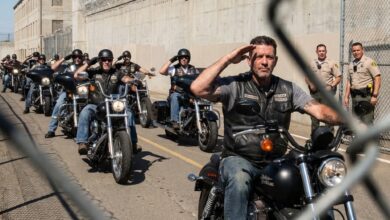
I stood rigid on the curb and gave a full military salute to an empty bus seat while teenagers laughed behind me. They thought I’d lost my mind. I knew exactly who I was honoring.
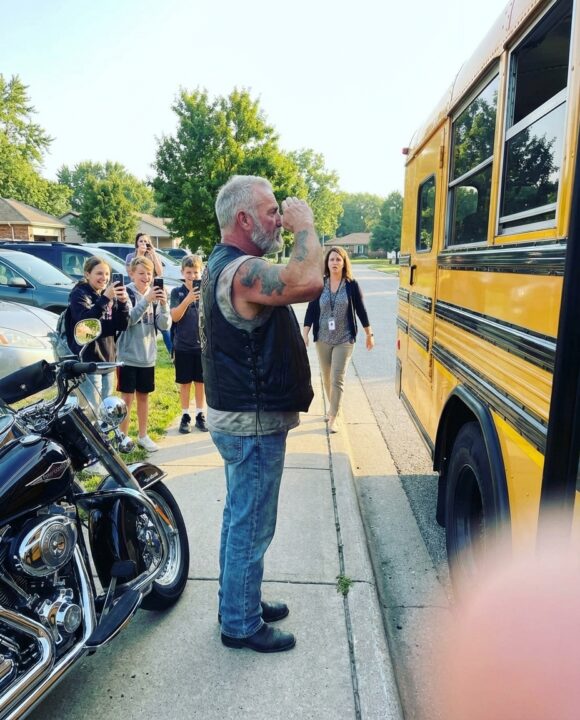
It was 7:42 a.m., a gray Tuesday morning in Dayton, Ohio. The kind of early hour when the world moves on autopilot—coffee steaming in travel mugs, engines idling, parents checking their phones before work.
The school bus stop sat at the corner of Maple and Third. A patch of cracked sidewalk. A leaning street sign. Fallen leaves collecting near the curb.
Ordinary place. Ordinary morning.
But the air felt wrong.
A group of middle schoolers clustered near the pole, backpacks slung low, voices loud in that careless way only kids can manage before first period. One girl scrolled her phone. A boy kicked at gravel. Someone laughed too hard at nothing.
Parents lingered in parked cars, windows half down, engines humming softly.
I stood a few yards away.
Leather vest. Boots dusty. Hands still.
Watching.
The bus came into view with a low diesel growl. Yellow frame reflecting the dull sky. It slowed, brakes hissing, door folding open.
Kids lined up.
Normal rhythm.
But halfway down the row of windows—
One seat stayed empty.
Back left. Window side.
No backpack pressed against the glass. No bored face staring out. Just fabric and space.
And something tightened in my chest.
I stepped forward.
Heels together. Spine straight.
My hand rose without hesitation—a gesture older than the road, older than grief.
I saluted.
Full form. No shortcuts.
Behind me, the laughter started.
“Dude, what is he doing?”
“Is that guy serious?”
Phones lifted. A snicker. A whisper: “Freak.”
The bus driver hesitated, eyes flicking toward me through the mirror.
I didn’t move.
Didn’t blink.
Didn’t explain.
Because some moments don’t belong to noise.
They belong to memory.
The bus pulled away slowly.
And I held the salute until the empty seat disappeared from view.
The bus hadn’t even turned the corner before the comments started.
“Yo, that was weird.”
“Is he military or something?”
“Or just crazy?”
I lowered my hand slowly. Let the moment settle in my bones.
Teenagers aren’t cruel on purpose. Not usually. They just haven’t met enough grief to recognize it.
A boy with a red hoodie stepped closer, curiosity louder than fear. “Who were you saluting?”
I didn’t answer right away.
Didn’t trust my voice.
One of the parents rolled down her window. “Sir, are you okay?”
Concern wrapped in caution.
Leather makes people careful.
“I’m fine,” I said quietly.
A man across the street shook his head. “You can’t just scare kids like that.”
Scare them.
Like stillness was a threat.
Like respect needed context.
A phone camera hovered near my shoulder. Recording. Waiting for a reaction.
I stayed calm.
Hands loose at my sides. Breathing even. Control learned from years of swallowing storms.
“It’s just an empty seat,” someone said.
Just.
That word again.
I looked toward the corner where the bus had vanished. Exhaust still hanging faintly in the air.
Not just.
Never just.
A teacher on morning duty approached carefully. “Sir, do you need assistance?”
I shook my head. “No, ma’am.”
“Then maybe don’t… perform.”
Perform.
Like grief was theater.
Like memory was spectacle.
A few students laughed again, softer now but still sharp.
I could feel the space widening around me—a quiet exile built from misunderstanding.
I reached into my vest pocket slowly.
Not dramatic.
Not defensive.
Just deliberate.
A folded piece of paper worn soft at the edges.
I didn’t open it.
Didn’t show it.
Just held it for a moment like weight matters even when unseen.
A patrol car cruised past slower than traffic required. The officer glanced at me, then the students, then kept moving.
Suspicion travels fast when context lags behind.
I slipped the paper back into my pocket.
The red-hoodie kid tried again. “Seriously. Who was it?”
I met his eyes.
“A friend,” I said.
He frowned. “There was nobody there.”
I nodded once.
“I know.”
And that only made it worse.
Whispers followed as I stepped back toward my bike.
To them, I was a man saluting nothing.
To me—
I was standing in front of someone who once stood when it mattered most.
The corner didn’t return to normal after that.
It pretended to.
Cars pulled away. Parents checked the time. Students drifted into their separate conversations. But the air stayed thick—like something unfinished was still standing there.
I leaned lightly against my bike, helmet resting on the seat, eyes on the stretch of road where the bus had disappeared. The morning felt louder now. A lawnmower somewhere. A dog barking two houses down. The distant hum of traffic waking up.
Behind me, voices lingered.
“That guy’s not right.”
“Why would you salute nothing?”
“Attention seeker.”
I let it pass. I’ve heard worse. Judgment is easy when you don’t carry the same memories.
The teacher stayed nearby, arms folded—not hostile, just cautious. Responsible for the kids. Responsible for order.
“Sir,” she said gently, “we’ve had concerns about strangers at bus stops.”
Strangers.
The word didn’t sting. It just fit.
“I understand,” I replied.
“Parents get nervous.”
“They should.”
That seemed to catch her off guard.
A father who hadn’t left yet stepped closer. “Look, man… whatever you’re dealing with, maybe do it somewhere else.”
Somewhere else.
Like grief had designated zones.
Like respect required permission.
I nodded slowly. No argument. No defense.
Just weight.
The kid in the red hoodie watched me carefully now, curiosity pushing past discomfort. He wasn’t laughing anymore.
My phone buzzed once in my pocket.
I glanced down.
One message.
No name on the preview.
Just: You there?
I typed back with steady thumbs.
Yeah. Corner of Maple.
A pause.
Then:
On our way.
I slipped the phone away.
The father noticed. “Calling someone?”
I met his eyes. “Yes, sir.”
He waited, expecting more.
I didn’t give it.
Because some explanations arrive on their own.
Minutes stretched. The teacher checked her watch. The father exhaled sharply and stepped back. Students whispered softer now.
The space around me felt tense but balanced—like a wire pulled tight but not yet snapping.
Then, faintly—
From beyond the low roofs and maple trees—
A familiar sound rolled in.
Low. Steady. Mechanical.
Growing closer.
At first, it blended with morning traffic.
A distant hum weaving through ordinary noise.
Then it layered.
One engine. Then another. Then several moving together in a slow, disciplined rhythm.
Heads turned.
The red-hoodie kid stepped off the curb for a better look.
Parents paused mid-sentence. The teacher straightened.
Motorcycles emerged at the end of the street—sunlight catching chrome, exhaust trailing lightly in the cool air.
They didn’t roar.
Didn’t rev.
Didn’t perform.
They approached with quiet precision, rolling two by two before easing toward the curb.
Engines cut one after another.
Silence followed—different from before.
Not awkward.
Anchored.
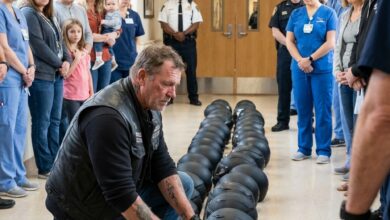
Men and women dismounted. Different ages. Different builds. Leather worn soft with years. Movements measured, respectful.
No patches flashing. No loud gestures.
Just presence.
They walked toward me without urgency. Without spectacle.
The teacher took a cautious step forward. “Is everything alright?”
One rider—gray-haired, calm-eyed—nodded politely. “Yes, ma’am.”
No tension in his voice.
Just certainty.
Another rider stopped beside me and rested a hand briefly on my shoulder—a wordless check-in between people who’ve stood through storms together.
Parents watched, unsure. Students stared openly now.
The group didn’t crowd. Didn’t surround. They formed a loose line facing the road where the bus had gone.
Then, in quiet unison—
They removed their gloves.
Helmets tucked under arms.
Spines straight.
And they stood.
Not defiant.
Not theatrical.
Reverent.
The teacher’s expression shifted first. Confusion softening into recognition that something deeper was happening.
The father lowered his arms.
No one laughed.
The corner grew still—a pause wide enough for meaning to enter.
I reached into my pocket again.
This time, I unfolded the paper.
A photo.
Edges worn. Colors fading.
A teenage boy grinning wide, arm slung around my son’s shoulders. Both of them holding beat-up skateboards. Both laughing like nothing bad could ever find them.
I held it at my side, not for display—just grounding.
The engines were silent.
But the moment spoke louder than noise ever could.
No one asked us to speak.
That was the first kindness of the morning.
The street stayed quiet—a stillness that felt earned, not forced. Even the breeze seemed to slow as it moved through the maple leaves overhead.
I held the photo a little tighter.
The red-hoodie kid noticed first. He stepped closer, careful now. “Is that… him?”
I nodded.
The teacher came nearer, her voice softer than before. “One of your family?”
“Not by blood,” I said. “By choice.”
I turned the photo so they could see it. Two boys. My son on the right—awkward grin, helmet hair, elbows too sharp for his frame. And beside him, a taller kid with a crooked smile and eyes that looked straight at the world.
“His name was Caleb,” I said. “Back-left seat. Window side.”
The father who’d told me to move somewhere else lowered his gaze. The students leaned in, quiet as church.
“Last month,” I continued, “some kids cornered my son behind the rec center. Shoving. Laughing. Phones out.”
My throat tightened. I swallowed it down. Some memories still carry their own weather.
“Caleb stepped in. Didn’t throw a punch. Didn’t make a scene. Just stood between them and said, ‘Not today.’”
I could still hear it—three words strong enough to change a direction.
“They backed off. He walked my boy home. Didn’t tell anyone. Didn’t want credit.”
The teacher pressed a hand to her mouth. “Oh…”
“Two weeks later,” I said, “a driver ran a red light.”
No drama in the sentence. Just fact. Loss doesn’t need decoration.
The father closed his eyes briefly. The red-hoodie kid stared at the pavement.
“My son kept that seat empty this week,” I went on. “Told the driver Caleb liked the window. Said it felt wrong to sit there.”
I looked down the road again.
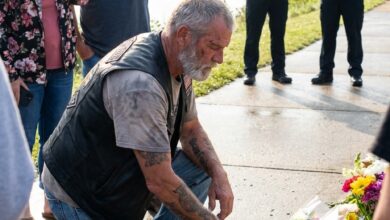
“So I came to say thank you.”
One of the riders beside me straightened. Then another. Without a word, they raised their hands.
A line of quiet salutes.
Not flashy. Not rehearsed. A gesture carried by memory, not performance.
Parents followed—some clumsy, some unsure. The teacher bowed her head. Even the red-hoodie kid stood still, hands at his sides, eyes lifted toward the empty space where the bus had been.
No speeches.
No cameras raised now.
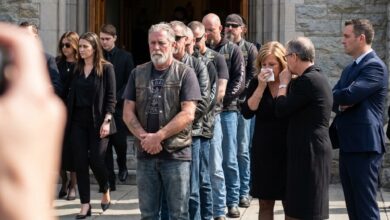
Just people understanding too late—and still meaning it.
I lowered my hand last.
Folded the photo carefully.
Slipped it back into my pocket like you place something sacred where it won’t bend.
Engines started low and respectful—thunder held on a leash.
We rolled out without escort, without applause, without needing either.
At the end of the block, I glanced once more at the corner.
A simple bus stop. Cracked sidewalk. Leaning sign.
But it didn’t feel ordinary anymore.
Because sometimes the strongest shield isn’t steel or leather—
It’s a kid who says not today.
And a father who never forgets.
If you want to read more powerful biker stories like this, follow the page.