He Dialed the Wrong Number for Help — And a Biker Answered on the Other End
He didn’t mean to call that number for help, but the wrong call became the only thing standing between a child and the dark.
It was after midnight in a quiet American suburb where streetlights flickered more than they worked. Houses slept. Dogs were still. The kind of night that makes every sound feel louder than it should.
In a small bedroom, a boy no older than nine sat on the floor with his back against the bed, knees pulled tight to his chest. His phone shook in his hands. The screen was cracked. The battery low.
He had already tried calling his mom.
Straight to voicemail.
He tried his aunt.
No answer.
Outside his door, something heavy moved. A voice slurred words he didn’t understand. A bottle clinked against the wall.
Fear doesn’t always scream. Sometimes it whispers and waits.
The boy punched in numbers without thinking. Not 911. Not anyone he knew.
He just needed someone to answer.
The call connected.
“Yeah?” a man’s voice said. Deep. Rough. Distracted.
The boy froze.
“I—I’m sorry,” he whispered. “I think I called the wrong number.”
Silence.
Then the man said, “You sound scared, kid.”
And on the other end of the line, a biker sat up straight.
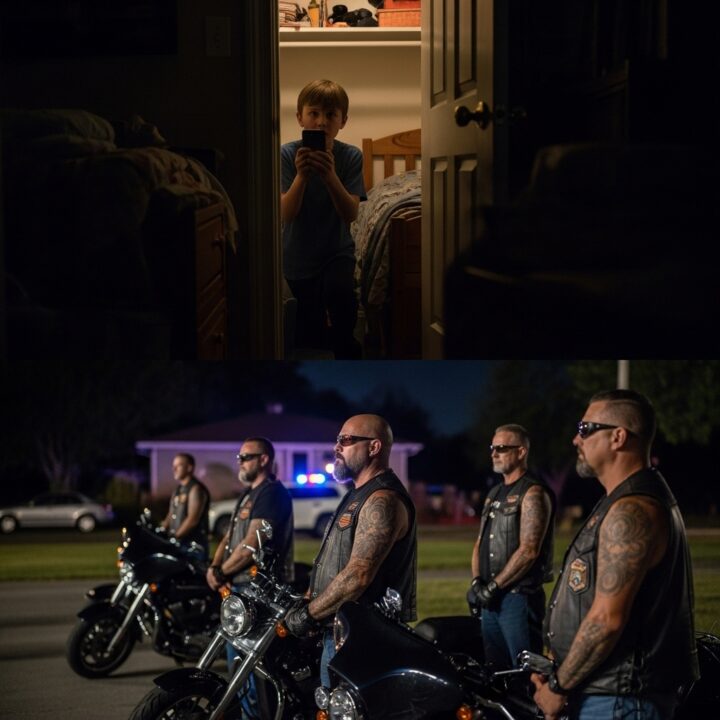
The biker was parked outside a twenty-four-hour diner off a state highway, helmet resting on the tank, coffee cooling beside him. Late forties. Leather vest. Sleeves short despite the night air. A man most people would cross the street to avoid.
He could have hung up.
Anyone would have.
Instead, he stepped away from the bike and leaned against the wall, lowering his voice. “Where are you?”
“I don’t know,” the boy said. “My house. I think.”
That answer tightened something in the biker’s chest.
“What’s your name?”
A pause. “Evan.”
“Okay, Evan,” he said calmly. “You didn’t do anything wrong. You hear me?”
The boy nodded even though the man couldn’t see it.
In the background, the biker heard another sound through the phone. Not words. Movement. Something unsteady.
“Is someone with you?” the biker asked.
The boy swallowed. “My mom’s boyfriend. He’s mad.”
The biker didn’t react. Didn’t curse. Didn’t raise his voice. Panic doesn’t help when someone else is drowning.
“Can you lock your door?”
“It doesn’t lock.”
That did it.
The biker turned, phone still to his ear, and motioned to two men by the bikes nearby. They watched him closely. When he spoke, it sounded like trouble.
“We’re leaving,” he said.
A woman at the diner window frowned. A passerby whispered. A group of bikers pulling out late at night doesn’t read as rescue to most people.
One of the men asked quietly, “What’s going on?”
“Kid needs help,” the biker said. That was all.
They mounted up.
The biker stayed on the line the entire ride.
“Evan,” he said, voice steady over the engine noise, “I need you to listen to me. Can you get somewhere safe?”
The boy crawled into the closet, pulling coats over himself. His breathing was loud now. Too fast.
“I hear him,” Evan whispered. “He’s yelling.”
The biker slowed the convoy at a stoplight, thumb tapping the tank as he listened. Every second stretched thin as wire.
“Evan,” he said, “you’re doing great. You’re not alone. Not right now.”
On the other end of the call, the boy whimpered. A door slammed. Something hit the wall.
The biker signaled with two fingers. One of the riders pulled out a phone. Another took the lead, heading toward the address the biker was quietly extracting piece by piece.
“What street sign can you see from your window?” the biker asked.
“I—I can’t see outside.”
“That’s okay. Is there anything with writing on it? A bill? A letter?”
Rustling. “There’s a pizza box.”
The biker exhaled slowly. He asked for the name on it. The number. He relayed it in short bursts.
Sirens wailed somewhere far off.
The boy gasped. “He’s at the door.”
The biker stopped the bikes under a streetlight and spoke clearly. “Evan, put the phone on the floor. Stay quiet. Don’t hang up.”
Then he did something that made the riders stare.
He sent one short message.
And waited.
The sound came before the sight.
Engines.
Not roaring.
Controlled. Measured.
Police cruisers turned onto the street first, lights washing the houses blue and red. The bikers followed, pulling back respectfully, engines cutting one by one.
Neighbors opened doors. Phones appeared. A line of bikers behind police cars doesn’t look like help at first glance.
Officers moved fast.
Inside the house, shouting escalated. Then stopped.
A small figure was carried out wrapped in a blanket. Evan’s face was pale, eyes wide, phone still clutched in his hand.
He didn’t let go of it until an officer gently took it.
The biker stood back by his bike, helmet under his arm, not moving. He didn’t speak to the police unless spoken to. Didn’t step forward.
From a distance, a neighbor whispered, “What are they doing here?”
Another muttered, “Figures.”
The officer walked over.
“Are you the one on the phone?” he asked.
The biker nodded once.
“Kid wouldn’t hang up,” the officer said quietly. “Said you told him not to.”
The biker shrugged. “He needed someone to stay.”
The officer looked at the line of bikes, then back at the man. “You did good.”
The biker didn’t respond.
The truth came out later, the way it always does—without drama.
The biker was a former EMT who rode to clear his head at night. He answered unknown numbers because sometimes the worst emergencies don’t come labeled.
The other riders were veterans, mechanics, fathers. They didn’t intervene. They didn’t touch anything. They waited because that’s what discipline looks like when no one is watching.
Evan spent the night at the hospital. His mother arrived at dawn, shaking, sobbing, holding her son like she might never let go again.
She asked who helped him.
The officer gestured toward the parking lot.
The biker was already gone.
All that remained was the quiet street, the fading light, and a phone with a number saved under one new name.
“Answered.”
Weeks later, Evan dialed it again.
This time, he wasn’t scared.
“Hey,” he said. “It’s me.”
The biker smiled to himself, helmet resting nearby. “I know, kid.”
No speeches were given.
No medals handed out.
Just a boy who slept through the night again.
And a man who answered a call he was never meant to receive.
Sometimes courage doesn’t show up in uniform.
Sometimes it answers by accident.