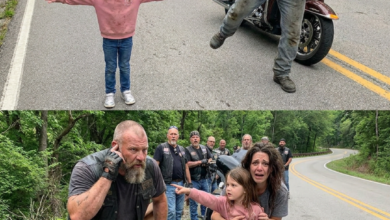
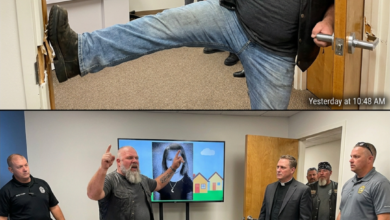
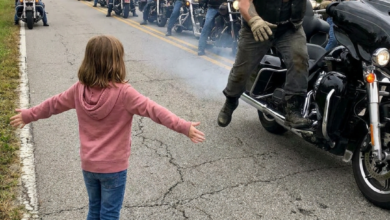
When Bikers Lay Down Across a City Park — And the Police Thought It Was a Protest
When thirty grown men in leather vests lay down across the grass of Riverside City Park at noon, people thought we were staging some kind of radical protest.
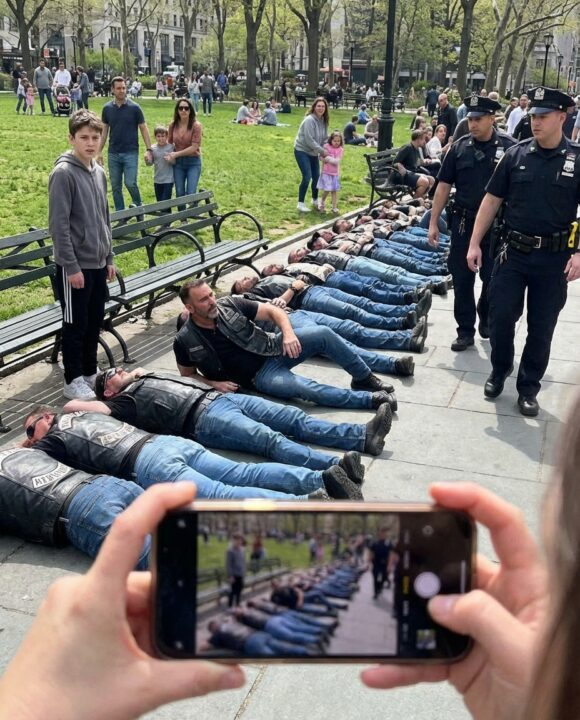
It was a bright Saturday in late September. Families had spread picnic blankets under maple trees. A street musician played near the fountain. Kids chased each other around the benches.
And then we showed up.
Engines low and steady.
Not loud.
Not aggressive.
But unmistakable.
I cut my bike near the east entrance, right beside the old iron bench under the oak tree. The same bench that had been there since I was seventeen.
No speeches.
No signs.
No chanting.
I took off my helmet, set it beside me, and lay down flat on the grass.
Arms at my sides.
Eyes open to the sky.
One by one, the others followed.
Leather against green grass.
Boots still on.
Silence.
Within seconds, confusion turned into fear.
“What are they doing?” a woman whispered.
A man pulled his daughter closer.
Someone said, “Is this some kind of extremist thing?”
From a distance, it looked unsettling.
A formation.
Deliberate.
Thirty bikers lying still in a public park like fallen soldiers.
No one saw the boy being led away twenty minutes earlier.
No one heard the officer tell him he couldn’t “camp” on a park bench.
They just saw us.
And they were already dialing 911.
The first patrol car rolled in at 12:18 p.m.
Sirens off.
Lights flashing.
An officer stepped out, hand near his belt.
“What’s going on here?” he called out.
None of us moved.
That made it worse.
From the outside, it probably looked coordinated. Maybe even threatening. A silent occupation of public space.
“Sir, you need to stand up,” the officer said, approaching me.
I didn’t.
I kept my eyes on the sky.
Clouds drifting slow above the oak branches.
The same angle I used to stare at when I had nowhere else to go.
“Are you protesting something?” he asked.
I didn’t answer.
Because this wasn’t about politics.
It was about a boy with dirt on his sneakers and a backpack that looked too light to carry anything useful.
I’d seen him around for a week.
Sleeping on that iron bench near the fountain.
Not bothering anyone.
Just existing quietly in a space that tolerated everything—except him.
Earlier that morning, two officers had walked him out of the park.
“Loitering,” someone said.
“Public camping ordinance.”
He couldn’t have been older than twelve.
The officer stepped closer to me.
“You’re creating a disturbance.”
Behind him, more police arrived.
Families were packing up their picnic blankets now.
Parents whispering.
Phones pointed at us.
From their perspective, it was obvious.
Thirty bikers occupying city property in synchronized silence.
A statement.
An act of intimidation.
Something dangerous brewing.
One officer leaned down near my shoulder.
“If you don’t get up, we’ll have to remove you.”
I finally turned my head and looked at him.
“Why?”
“Because you’re obstructing public space.”
Public space.
The words landed heavy.
“So was he,” I said quietly.
The officer frowned. “Who?”
I didn’t elaborate.
Instead, I reached into my vest pocket slowly.
The officers stiffened immediately.
Hands closer to holsters.
Crowd murmuring.
I pulled out my phone.
Typed four words.
“They took the kid.”
Sent.
I didn’t say to who.
Didn’t explain further.
The tension tightened like a wire about to snap.
Because now it wasn’t just a strange gathering.
It was thirty bikers refusing to comply.
And the city park felt a lot smaller than it had twenty minutes ago.
The officer repeated himself.
“Stand up. Now.”
I stayed flat on my back.
Because I knew what was coming next—
And it wasn’t just more police.
The officer’s shadow fell across my face.
“You’re interfering with a public space,” he said, louder now. “If you don’t comply, we’ll remove you.”
Behind him, two more cruisers rolled in. Not sirens. Just presence. The kind meant to send a message.
Families had cleared the grass by now. Blankets folded. Coolers shut. Kids pulled close. The park that had been laughter and music twenty minutes earlier was now tight with suspicion.
From the outside, we looked like a coordinated occupation. Thirty men in leather, boots still laced, lying flat as if rehearsed.
Someone whispered, “This is how riots start.”
Another voice said, “They’re making a point.”
They weren’t wrong.
We were.
But not the one they thought.
The officer crouched near my shoulder. “Last warning.”
I turned my head just enough to look at him.
“How long,” I asked quietly, “does someone have to be in a park before you call it camping?”
He frowned. “That’s not the issue.”
“It is,” I said.
Because earlier that morning, I had watched two officers escort a skinny kid off that very bench. Backpack too small. Hoodie sleeves frayed. Hair cut uneven like he’d done it himself.
He hadn’t argued.
Just stood up and followed instructions.
I knew that walk.
The walk of someone who’s learned not to fight gravity.
“Public sleeping is prohibited,” the officer said now.
“Is public lying down?” I asked.
He didn’t answer.
Instead, he stood up and signaled to the others.
Two officers moved closer to the line of bikers.
I could feel the tension ripple through my guys—not panic, not aggression, just readiness. Discipline.
If they grabbed one of us wrong, this could spiral.
And that was the line I refused to cross.
I wasn’t here to fight.
I was here to mirror.
To make them see what they had done.
My phone buzzed in my vest pocket.
Once.
Then again.
I didn’t reach for it.
Not yet.
The officer stepped forward.
“On three, we’re assisting you up.”
I finally sat up slowly.
Not in surrender.
In timing.
And that’s when I heard it.
Not sirens.
Not shouting.
Footsteps.
A voice from behind the fountain.
Small.
“Why are they on the ground?”
Every head turned.
And I knew we were seconds away from something that would either make sense—
Or make headlines.
The boy stood near the path, backpack slung over one shoulder.
Same frayed hoodie.
Same dirt on his sneakers.
He had circled back.
Maybe curiosity.
Maybe nowhere else to go.
The officers stiffened when they saw him.
“Hey,” one called out. “You can’t be here.”
The words felt heavier now.
Because thirty men were still on the ground.
And the visual wasn’t abstract anymore.
The kid looked at us. “Are they in trouble?”
I stood up fully then.
Brushed grass from my vest.
“No,” I said. “We’re just resting.”
A few of my guys rose slowly too—not charging, not confronting. Just present.
The officer turned to me. “You’re using this to make a scene.”
“No,” I replied. “You already did.”
That landed.
Not loud.
But clean.
The boy shifted awkwardly.
“I wasn’t doing anything,” he muttered.
I walked toward the old iron bench under the oak tree.
The same one I’d slept on when I was eighteen.
Six months.
Winter through early spring.
After my mom died and my uncle sold the house.
No job. No plan. Just a backpack and pride too big to ask for help.
I touched the back of the bench lightly.
“You know how long I slept here?” I asked the officer quietly.
He didn’t answer.
“Six months.”
The crowd murmured.
Because now the narrative was bending.
Not breaking.
Bending.
The officer glanced at the boy.
“You can’t encourage vagrancy.”
“I’m not encouraging it,” I said. “I’m remembering it.”
My phone buzzed again.
This time, I looked.
“Community outreach en route.”
Right on time.
From the west entrance of the park, a white van rolled in.
City outreach program logo on the side.
Two social workers stepped out.
One of them I recognized—Maria. She’d helped two of our guys years back get their GEDs after they got out of county.
The officers looked confused.
“This is unnecessary,” one muttered.
“Is it?” Maria replied, calm but firm.
She approached the boy first.
Knelt down to his level.
Spoke softly.
Not about rules.
About options.
Shelter beds.
Temporary housing.
A hot meal tonight.
The presence shifted again.
Families who had stayed to watch were no longer afraid.
They were listening.
The boy looked between me and Maria.
“Are you all gonna leave?” he asked.
“Yeah,” I said.
“But not because they told us to.”
We hadn’t protested.
We hadn’t shouted.
We had simply laid down where he wasn’t allowed to.
And made the contrast impossible to ignore.
The officer sighed.
Not defeated.
Just recalibrating.
“Next time,” he said quietly to me, “talk to us first.”
“Next time,” I replied, “look before you move someone.”
No hostility.
Just truth.
Maria guided the boy toward the van.
He hesitated, then turned back to the bench.
“You slept there?” he asked.
“Yeah.”
“Did you get out?”
I nodded.
“Eventually.”
He gave a small, uncertain smile.
And climbed into the van.
The park exhaled.
So did I.
Thirty bikes stood waiting.
Engines quiet.
No one cheered.
No one declared victory.
Because this wasn’t about winning.
It was about being seen.
And sometimes the loudest protest is silence on grass.
We didn’t leave in a rush.
That was important.
If we had roared out of that park like a parade, it would’ve looked like triumph. Like we had scored something.
We hadn’t.
We had just paused long enough to make someone look twice.
One by one, my guys picked up their helmets. Grass clung to leather. A few of them brushed it off absentmindedly, like the afternoon had been nothing more than a stop along the ride.
But it wasn’t nothing.
The officer who had threatened to remove us stood near the fountain now, watching the outreach van pull away. He didn’t glare at me anymore.
He just nodded once.
Small.
Measured.
The kind of nod that says, I see it now.
Families drifted back into the park slowly. A little girl asked her mom why the “motorcycle men” were sleeping. Her mother didn’t shush her this time. She just said, “They were making a point.”
That was enough.
I walked back to the iron bench under the oak tree.
Ran my hand along the cold metal.
The paint had chipped more since my nights there. Someone had carved initials into the side. The city had tried to sand them down once, but you can still see the marks if you know where to look.
Some things don’t disappear just because you repaint them.
I remembered the sound of sprinklers turning on at dawn.
The way the grass felt colder at 4 a.m.
The way people avoided eye contact in the morning jog.
I remembered the weight of invisibility.
That kid carried the same weight.
And today, for a few minutes, thirty grown men chose to share it.
I wasn’t proud of those six months on that bench.
But I wasn’t ashamed anymore either.
Because I knew something the park didn’t.
The difference between loitering and surviving is often just perspective.
One of my guys, Rico, walked up beside me.
“You good?” he asked.
“Yeah.”
“You think it worked?”
I watched the van disappear at the intersection.
“Doesn’t have to fix everything,” I said. “Just has to interrupt something.”
He nodded.
That was always our rule.
We don’t escalate.
We interrupt.
When we finally started the engines, it wasn’t loud.
Not dramatic.
Just steady.
The sound rolled across the park like a low reminder.
Not of threat.
Of presence.
As we rode out, I caught a glimpse in my mirror.
The officer had taken a seat on that same bench.
Just sitting there.
Looking at it differently.
Maybe imagining what it would feel like to sleep there.
Maybe not.
Either way, it had shifted.
And that’s enough for one afternoon.
People will always see leather before they see history.
They’ll always assume the worst before asking the reason.
But sometimes, if you lie down long enough in plain sight, you force a city to look at what it’s stepping over.
That bench is still there.
The oak tree still throws shade at noon.
And if I ever see another kid being moved along like he’s breaking the grass just by existing—
We’ll lie down again.
Not to fight.
Not to shout.
Just to remind.
If you want to read more real stories about bikers who are misunderstood before they’re understood, follow this page.