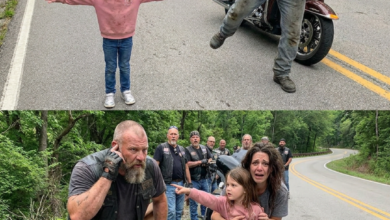
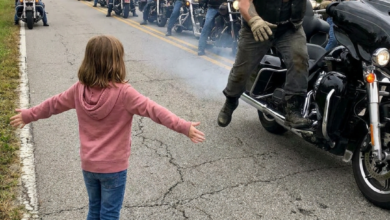
He Hurled His Helmet at the ER Door — Security Thought He’d Snapped Until a Forgotten Debt Walked In
He ripped off his helmet and slammed it against the emergency room doors, the crack echoing through the lobby—while a woman’s stretcher sat unmoving and a nurse whispered, “We have no beds left.”
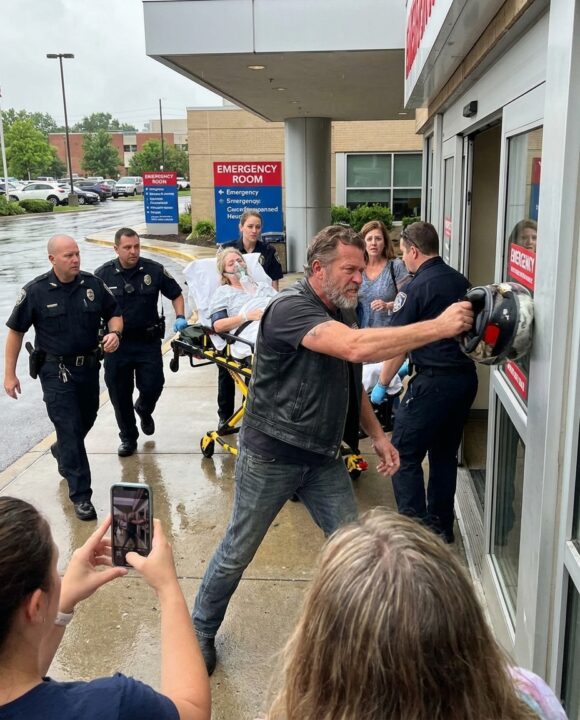
It was 9:17 p.m. on a wet Thursday in late October, the kind of cold that crept through denim and settled in the bones. Rain streaked the glass façade of Mercy General Hospital in Cedar Falls, turning the fluorescent lights inside into blurred halos. A wheelchair squeaked across the tiles. Someone coughed too hard. A child cried and wouldn’t stop.
Near the sliding entrance, a middle-aged woman lay half-conscious on a gurney, her oxygen mask fogging with shallow breaths. Her name was Elena Morales. Fifty-two. Elementary school librarian. Asthma patient. Her chest rose in uneven, fragile rhythms that made every second feel borrowed.
A triage nurse stood beside her, voice low, eyes apologetic. “I’m so sorry. We’re at capacity. We’re trying to transfer—”
“Transfer where?” Elena’s sister snapped, fingers trembling around a damp insurance card. “She can’t even sit up.”
Behind them, the waiting room pulsed with restless, airless tension. People stared at phones. A man muttered about wait times. A teenager filmed quietly, lens tilted toward the scene like it was content instead of crisis. Two orderlies pushed past without meeting anyone’s eyes.
And then there was him.
Tall. Broad-shouldered. Rain dripping from the edge of a matte-black helmet. A faded leather vest clung to his back, darkened by water. No club patches on the front. No flashy insignia. Just a small stitched name above the pocket: “Mason.”
He stood still at first, taking it in. The stalled stretcher. The strained voices. The way Elena’s hand searched weakly for something to hold.
When the nurse repeated, “No beds,” something changed in the air.
Mason stepped forward. Slow. Measured. He looked at Elena. Then at the sealed ER doors. Then back at the staff who had already turned away.
His jaw tightened.
And in one sudden motion, he tore off his helmet and hurled it against the metal frame.
The bang ricocheted through the lobby. Conversations died mid-sentence. A security guard’s head snapped toward the noise. A mother pulled her child closer.
For a split second, nobody moved.
Rain kept falling.
The biker didn’t shout. Didn’t curse. He just stood there—breathing hard, fists clenched—like a man holding back something far louder than anger.
No one knew who he was.
No one knew why he cared.
They only saw a biker… losing control at the hospital door.
“Sir! Step back!” Security moved fast—two guards in navy jackets, palms raised, voices firm but edged with nerves. One reached for his radio. The other positioned himself between Mason and the entrance like a human barrier.
Mason didn’t resist.
He didn’t argue.
He simply pointed—steady, unshaking—at the woman on the gurney.
“She can’t breathe,” he said quietly.
The guard frowned. “We’re handling it.”
“No,” Mason replied, voice low, controlled. “You’re delaying it.”
That was enough.
A few heads turned sharply. Someone whispered, “He’s threatening them.” Another voice: “Call the cops.” A man near the vending machines muttered, “Typical biker drama.”
Phones lifted.
Cameras zoomed.
A young nurse stepped forward, flustered. “Sir, you can’t intimidate staff. Please wait your turn.”
“My turn?” Mason’s eyes flicked toward Elena’s oxygen mask, fogging faster now. “She doesn’t have a turn.”
To the crowd, it sounded like confrontation. Like escalation. Like a man pushing his weight around because he thought he could.
One guard placed a firm hand near Mason’s shoulder. “You need to calm down.”
Mason exhaled slowly. A long, disciplined breath. The kind learned through years of forcing emotion to heel. He raised both hands—not in surrender, but in restraint.
“I’m calm,” he said.
But calm didn’t look calm when wrapped in leather and road dust.
Elena’s sister rushed forward. “Please,” she begged the staff, ignoring Mason completely. “She’s getting worse.”
A monitor beeped irregularly. A nurse checked it, then glanced toward the hallway—hesitation written all over her face.
“Sir,” the second guard pressed, “you’re causing a disturbance.”
Mason stepped sideways, moving closer to the gurney. Protective, not aggressive—but perception tilted everything. The first guard shifted his stance. The radio crackled. Somewhere outside, faint sirens wailed in the distance.
A woman in the waiting area hissed, “He’s going to block the doctors.”
Another voice: “This is why people don’t like biker gangs.”
Mason heard it.
He ignored it.
He crouched beside the stretcher instead, lowering himself to Elena’s eye level. His movements were careful, deliberate, unexpectedly gentle.
“Elena,” he said softly.
Her eyelids fluttered.
“I’m here.”
The sister blinked. “You know her?”
Mason didn’t answer.
He reached for the thin hospital blanket slipping from her shoulder and pulled it up with quiet precision. A small gesture. Almost invisible. Intimate in its simplicity.
Security misread it instantly.
“Step away from the patient!”
Hands moved toward restraints. A nurse gasped. The crowd leaned back as tension spiked like static before lightning.
Mason rose slowly, palms open again. He looked at the guards, not defiant—just resolute.
“I’m not leaving,” he said.
Three words.
Flat. Certain. Final.
To everyone else, it sounded like a threat.
To him, it was a promise.
The automatic doors slid open with a mechanical sigh as another ambulance crew rushed in, rain blowing across the tile. Paramedics maneuvered past the standoff, urgency overriding curiosity.
Still, no bed opened.
Still, Elena waited.
And the biker stood his ground—silent, soaked, misjudged by every pair of eyes in the room.
No speech.
No defense.
Just presence.
Just refusal to step aside while time slipped through failing lungs.
Security tightened the circle. Someone mentioned trespassing. Another guard reached for zip ties, just in case.
Mason didn’t flinch.
Didn’t explain.
Didn’t plead.
He simply stayed—like a wall between helplessness and consequence.
Outside, thunder rolled low across the Iowa sky.
Inside, suspicion thickened.
And the man in the leather vest became, in the public eye, the most dangerous person in the room.
The air inside Mercy General felt tight enough to fracture.
Elena’s breathing turned ragged, each inhale a shallow scrape. The oxygen monitor flashed uneven numbers, soft alarms chirping like nervous birds. Her sister clutched the rail of the gurney, knuckles pale, whispering prayers that tangled with panic.
A nurse hurried past, then slowed, then stopped—caught between policy and conscience.
“We’re trying,” she said, though it sounded like hope running on fumes.
Security closed in another step around Mason. The circle tightened. Radios hissed. A supervisor appeared from the corridor, tie loosened, patience thinner than the fluorescent light above.
“Sir, last warning,” he said. “You’re interfering with hospital operations.”
Mason didn’t argue.
Didn’t posture.
Didn’t raise his voice.
He just looked past them—toward Elena—eyes steady, jaw set with quiet, immovable resolve.
“I’m not interfering,” he said softly. “I’m staying.”
To the supervisor, it sounded like defiance.
To the crowd, it looked like escalation.
Phones kept recording. A murmur spread. Words like “unstable” and “threat” drifted through the waiting area. A child asked his mother if the man was going to jail.
Mason reached slowly into his vest pocket.
Every guard tensed.
“Hands where we can see them!”
He paused. Nodded once. Then carefully pulled out a phone—screen cracked, edges worn. He stepped aside, not away, and typed with deliberate thumbs.
One message. Short. Precise.
He lifted the phone to his ear.
No introductions.
No explanations.
Just a low voice, steady as steel.
“Mercy General. ER entrance. Now.”
He listened.
Eyes never leaving the gurney.
“Yeah,” he added after a beat. “It’s her.”
He ended the call.
No one knew who he had reached.
No one asked.
They were too busy assuming.
The supervisor scoffed. “Calling backup won’t help you.”
Mason slipped the phone back into his pocket. “Not for me.”
Elena’s hand twitched weakly. Her sister leaned close, voice breaking. “Stay with me. Please stay.”
Time stretched thin. Every second felt like glass bending under pressure.
Rain hammered harder against the windows. Thunder rolled again, closer now. The automatic doors opened and shut with hollow sighs as stretchers passed, none stopping here.
Security waited for the next move.
The crowd waited for a mistake.
Staff waited for a bed that didn’t exist.
And Mason stood in the center of it all—silent, grounded, carrying a certainty no one else could see.
Minutes crawled.
No sirens.
No announcements.
Just the suffocating hum of a system overwhelmed.
Then—
From somewhere beyond the storm—
A low, distant vibration.
So faint it could’ve been thunder.
So steady it wasn’t.
Mason lifted his head.
He didn’t smile.
But the tension in his shoulders eased—just slightly.
Like a man who knew the wait was almost over.
The sound came first.
Not loud. Not chaotic.
Just a deep, synchronized rumble rolling beneath the storm like distant drums.
Conversations faltered. A few people near the entrance turned their heads. The security supervisor frowned, distracted despite himself.
The vibration grew—measured, controlled, unmistakable.
Engines.
More than one.
Outside the glass, headlights cut through the rain in clean white lines. One beam. Then another. Then a row of them, forming a quiet procession along the curb.
No revving.
No theatrics.
Just arrival.
The automatic doors slid open as wind pushed rain across the tile. Cold air swept in, carrying the scent of asphalt and wet metal.
Bootsteps followed.
Firm. Even. Unhurried.
Five riders entered first. Helmets off. Water dripping from leather shoulders. Their vests bore the same small patch over the heart—simple lettering, nothing flashy. Faces lined with age, not arrogance. Eyes alert, not hostile.
They didn’t spread out.
They didn’t speak.
They simply stood—forming a calm, solid presence behind Mason.
The lobby shifted.
Whispers faded.
Phones lowered.
There was something about the way they held themselves—disciplined stillness, like people used to chaos but not ruled by it.
A nurse glanced at security. “Who are they?”
The supervisor straightened. “Sir, if this is intimidation—”
“It’s not,” came a voice from the doorway.
Older. Measured. Familiar to some.
A man in a soaked overcoat stepped inside, removing his glasses to wipe away the rain. Late sixties. Silver hair slicked back. Hospital ID badge swinging against his chest.
Several staff froze.
“Dr. Halvorsen?” someone breathed.
Head of Emergency Medicine.
He scanned the room once—Elena on the gurney, the tight ring of guards, the semicircle of riders, Mason at the center.
Then his eyes settled on the biker.
A pause.
Recognition.
Not casual. Not vague.
Personal. Immediate. Undeniable.
“Mason,” he said quietly.
The name moved through the room like a ripple.
Security hesitated.
The supervisor blinked. “Doctor, we were just—”
“I know what you were doing,” Halvorsen replied gently. “And he knows what he’s doing.”
Silence thickened.
Rain tapped the glass.
The riders remained still—no crossed arms, no threats—just a collective presence that shifted the balance without a single raised voice.
Halvorsen walked to the gurney. Checked Elena’s vitals himself. His expression sharpened.
“Prep Trauma Two,” he ordered. “Now.”
A nurse stammered. “But we’re full—”
“Not anymore.”
Movement exploded into motion. Curtains drawn back. A team assembled. Equipment wheeled fast but controlled.
Elena’s sister stared, stunned. “Wait—what changed?”
Halvorsen didn’t answer immediately.
He looked once more at Mason.
Gratitude flickered there. Old and unspoken.
“Let’s move,” he said.
The gurney rolled.
Doors swung wide.
Staff parted instinctively.
No applause.
No spectacle.
Just a quiet corridor opening where resistance had stood minutes earlier.
The crowd watched in stillness as Elena disappeared into treatment.
Security lowered their hands.
No one mentioned trespassing now.
No one reached for restraints.
Because power had shifted—not through force, but through recognition earned long ago.
Mason stepped back, giving space. Rainwater pooled beneath his boots. His expression didn’t change.
One of the riders gave him a small nod.
He returned it.
Nothing more.
Around them, the waiting room felt different.
Quieter.
Heavier.
Like everyone had just witnessed something they didn’t fully understand—
But would never quite forget.
The doors to Trauma Two swung shut with a soft hydraulic hush.
And just like that, the noise drained from the lobby.
No one spoke.
The fluorescent lights hummed. Rain traced slow paths down the glass. A paper coffee cup rolled in a small circle near the vending machines before tipping over and settling still.
Mason remained where he was, a few steps back from the hallway, water dripping steadily from the edge of his vest. His hands rested loosely at his sides. No clenched fists now. No visible strain.
Just a man returning to stillness.
Elena’s sister approached him carefully, eyes red, voice unsteady. “You… you knew someone?”
Mason shook his head once. “Not someone.”
A pause.
“Family.”
She frowned, confused. Mason didn’t explain. He rarely did.
Across the lobby, staff moved with quieter steps. Conversations stayed low. A few people who had filmed earlier slowly lowered their phones, expressions shifting from suspicion to something heavier.
Regret, maybe.
Near the entrance, Dr. Halvorsen finished speaking with a nurse, then walked toward Mason. Up close, the years showed more clearly—fine lines at the corners of his eyes, a stiffness in his left shoulder when he moved.
They stood facing each other.
No grand reunion. No dramatic embrace.
Just recognition carried through time.
“I heard your voice,” Halvorsen said. “Even over the storm.”
Mason gave a small nod. “Didn’t think you’d remember.”
“I remember the smell of gasoline,” the doctor replied quietly. “And a hand dragging me through fire.”
The words settled between them.
Twenty-three years earlier. Route 61. A pileup in freezing rain. A compact car overturned, flames crawling fast along leaking fuel. A young resident trapped inside—seatbelt jammed, door crushed inward.
Traffic had stalled.
People watched.
One rider had stopped.
Helmet off. Jacket wrapped around his arm. He’d gone in without asking names. Without waiting for sirens. He’d pulled the doctor free seconds before the engine ignited.
Then he’d left before reporters arrived.
No statements.
No credit.
Just a scorched sleeve and a quiet ride into the night.
Halvorsen looked at Mason now with a debt that had never faded.
“When I got your message,” he said, “I cleared the only room we could.”
Mason’s eyes flicked toward the hallway. “She’ll be okay?”
“She’s in the right place.”
Relief didn’t explode. It didn’t need to. It moved through Mason slowly, like warmth returning to cold hands.
Around them, a few onlookers turned away, ashamed of earlier whispers. One guard adjusted his cap, avoiding eye contact. Another murmured, “Sorry,” barely audible.
Mason didn’t react.
He wasn’t here for apologies.
One of the riders approached, holding out a dry towel. Mason took it with a quiet thanks. He wiped rain from his face, then glanced once more toward the treatment wing.
Through a narrow window, silhouettes moved with urgent precision.
Life being fought for.
Time being bought.
Halvorsen extended a hand. Mason hesitated, then shook it—firm, brief, unceremonious.
“No reports?” the doctor asked gently.
Mason managed the faintest smile. “You know me.”
He turned toward the exit.
Bootsteps soft on tile.
The riders followed without formation, without signal. Just shared understanding.
At the sliding doors, Mason paused. Reached into his pocket. Pulled out something small.
Elena’s library card.
He’d found it on the gurney when the chaos peaked.
He handed it to her sister. “She’ll want that.”
The woman clutched it like something sacred. “Thank you.”
Mason nodded once.
Then stepped back into the rain.
Engines started one by one—a low chorus fading into the night.
Inside, people stood quieter than before.
Not because they’d been told anything.
But because they’d seen enough.
And near the entrance, a shallow dent marked the metal frame where a helmet had struck—
A small scar.
A silent reminder of how quickly judgment can outrun truth.
If you want to read more powerful biker stories like this, follow the page.