A Biker Snatched a Microphone From a Little Girl on a School Stage—Then the Man Trying to Remove Him Looked Behind the Curtain
The biker reached my daughter before the principal did, tore the microphone from her hand, and turned his enormous back to the audience while three hundred people shouted at him to get away from her.
I was already out of my seat.
My handbag hit the floor. Somewhere behind me, a chair fell over. The man beside the aisle stood with both arms out, trying to stop anyone else from running toward the stage.
But all I could see was Mae.
Nine years old. Blue dress. One white sock sliding toward her ankle. Her speech trembled in her empty hand.
She looked at the man who had taken her microphone and said, “I wasn’t telling them.”
He flinched.
That was the part I remembered later. Not his size, although he was enormous. Not the tattoos climbing from his wrists or the gray-black beard that covered half his chest.
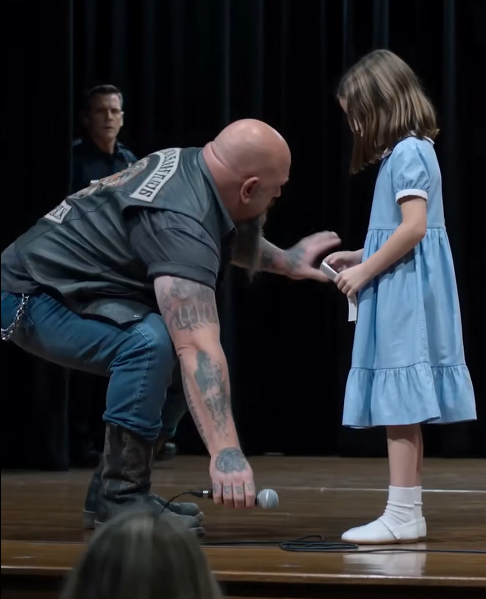
He flinched as though my daughter had struck him.
My name is Anna Whitmore. I was thirty-four, a school secretary in a town outside Knoxville, and until that evening I believed I understood most of the things that frightened my child.
I knew which classroom door she preferred because the other one stuck.
I knew she rehearsed her first sentence before asking a cashier a question.
I knew the difference between her being quiet and her being unable to get a word past the place where it sometimes caught.
I did not know why a man in a leather vest had just ruined the moment she had spent six weeks preparing for.
“Ray!” she said.
So she knew his name.
That made me run faster.
The principal, Mrs. Hensley, reached the stage from the opposite side. Behind her came our school resource officer, one hand raised, his expression tight with concentration.
The biker had set the microphone down beyond Mae’s reach. He held one arm across the space between her and the black curtain, directing her away without grabbing her.
“Come this way,” he said.
“You don’t touch her,” I shouted.
He turned toward me.
“Take her off the stage.”
It sounded like an order.
I hated him for it.
The officer stepped between us.
“Sir, move back.”
The biker raised both hands, but he kept looking toward the curtain. A student volunteer stood beside the sound table, pale and motionless.
“Is it off?” the biker asked him.
The boy nodded.
“All of it?”
“I think—”
“Don’t touch anything else.”
That frightened me more than the shouting.
Behind us, the auditorium lights remained bright. Parents were standing. Phones had appeared above heads. Somebody called the biker a bully, and somebody else shouted that children weren’t safe anywhere anymore.
Mae pressed her speech against my stomach.
She was trying to hide the words.
I wrapped an arm around her.
The paper had taken weeks. We had practiced in the kitchen, in the car, in the empty office after school. She had circled one sentence in blue pencil because it was the sentence she wanted everyone to remember.
Now it was folded against my coat.
The officer asked the biker to step down with him.
He obeyed, slowly.
As they passed the edge of the stage, the officer glanced toward the place the man had been watching.
He stopped.
“What happened to that cable?”
The student volunteer started crying.
The biker shut his eyes for one second.
A strange smell reached us then, faint beneath the warm dust of the curtains and the perfume of the woman who had followed me onto the stage.
Something hot.
Something that did not belong in a room full of children.
Mae looked past me.
“I told you I wouldn’t say it,” she whispered.
Ray opened his eyes.
“Sweetheart, this wasn’t about that.”
Then the custodian stepped behind the curtain, looked down without touching anything, and told the principal to clear the stage immediately.
Part 2 — The Man She Wanted in the Third Row
Six weeks earlier, Mae had brought home a permission slip for the spring speaking showcase.
I left it on the kitchen counter because I assumed she would decide against it after supper. That was an unkind assumption, though I made it in the protective language parents use with themselves.
I didn’t want her disappointed.
I didn’t want children imitating the way certain sounds took her longer.
I didn’t want to watch her searching the audience for me while I sat there unable to lend her a word.
Mae found the form beside the fruit bowl.
“You didn’t sign it.”
“I was going to ask if you were sure.”
“I’m sure.”
“You don’t have to do this because your friends are.”
“I’m not.”
She stood waiting while I found a pen.
She was accustomed to waiting for other people to believe her.
Mae had stuttered since she was small. Some days her speech moved easily. Other days, a sentence she knew perfectly would become difficult to begin. She worked with a speech-language pathologist, and we tried to follow her lead about what helped.
My instincts did not always help.
I finished sentences.
I answered questions addressed to her.
I told myself I was easing the strain, then wondered why she sometimes stopped trying to speak when I was beside her.
Her father, Ben, had been better at waiting.
He could sit through a long silence without putting concern all over his face. When she found the word, he simply continued the conversation.
Ben died in a highway collision two years before the showcase.
People often assumed Mae’s speech difficulties began afterward. They hadn’t. Grief had taken enough from her without strangers making it the explanation for everything.
What changed was that she lost the person who never looked frightened by her pauses.
At school, she did well in written work. She liked science, disliked group presentations, and had a talent for noticing adults who thought nobody was watching them.
That was how she met Ray.
On Thursday afternoons, I worked late entering attendance records. Mae waited at the public library two blocks from school, where a staff member I knew supervised the children’s homework table.
Ray attended an adult reading program there.
I did not know that then.
What I knew was that a large man sometimes arrived on a Harley, removed his helmet outside, and carried a canvas bag into the building. The first time I saw him near the children’s section, I asked the librarian whether he was supposed to be there.
She answered more gently than I deserved.
“He has an appointment, Anna.”
I nodded as though that was what I had meant.
Ray was fifty-six. He ran a repair shop and could identify a failing engine by a sound I would have described only as expensive. He had employees, customers, a mortgage, and the kind of competence people assume extends into every room.
Reading was different.
He had left school early, worked young, and spent decades arranging his life around what he could remember, recognize, or ask somebody else to read without making it obvious.
Then his grandson asked him to read a bedtime story.
Ray told him his glasses were in the truck.
The child offered to get them.
Eventually, he ran out of places to put the excuse.
The library program was his answer.
His lessons happened in a meeting room beside the homework area. One afternoon, a scheduling mistake left him waiting at a table with a short book open in front of him.
Mae was nearby.
She told me later that he tried one word several times and then covered it with his hand.
She recognized the gesture.
“That one’s stubborn,” she said.
Ray looked up.
“Yeah.”
“You can take your time.”
He stared at her long enough that she thought she had offended him.
Then he moved his hand.
Their friendship grew in small pieces, always in the library, around staff and other people coming and going. She showed him a drawing. He asked about a book she liked. Sometimes they both waited for the same tutor to finish helping someone else.
He never asked her to read his work for him.
She never treated him as a project.
They understood something about being watched while a simple thing became difficult.
When Mae chose her showcase topic, she called it “What Waiting Can Do.”
I assumed it was about her father.
Some of it was.
But one Thursday, she came home with a question.
“Can Ray come?”
“The motorcycle man?”
She gave me a look.
“His name is Ray.”
I said guests needed to be registered through the school. She brought him the information the next week.
He agreed to come.
Then she asked for a particular favor.
“Third row. Near the side.”
“Why there?”
“So I know where to look.”
He nodded.
I saw his name on the visitor list and recognized it from the library. I spoke with the librarian, confirmed who he was, and decided that if Mae wanted him there, I would not make her defend the invitation.
But I still watched him when he arrived.
That evening, he wore clean boots and a plain black leather vest. He signed in, accepted a visitor badge, and found the seat Mae had chosen.
He did not wave across the room.
He waited until she noticed him.
Then he lifted one hand.
She smiled before she looked for me.
I remembered that later with a complicated ache.
Part 3 — The Sound Nobody Wanted to Hear
The showcase began late.
A projector wouldn’t connect. Two younger children needed the restroom at the same time. A parent asked whether the aisle lights could be lowered because they were affecting her video.
It was the sort of evening in which adults solved twenty small problems and became impatient with the twenty-first.
The regular sound equipment had failed during rehearsal.
A borrowed powered unit had been brought in that afternoon. It belonged to someone who knew someone on the parent committee. There were cables behind the curtain, a table with controls, and a student volunteer named Jonah doing his best to follow instructions from adults who kept leaving him in charge.
Jonah was sixteen.
He knew how to adjust volume.
That was not the same as knowing whether everything he had been handed was safe.
Nobody had clearly owned that question.
The first students spoke.
There were stories about a dog, a grandmother, a trip to the coast. A boy forgot the middle of his presentation and invented a different ending. Everybody laughed kindly.
Mae sat with her class near the front, holding her paper by the edges.
I watched her thumb move over the blue circle around her favorite sentence.
Then she turned toward the third row.
Ray leaned forward slightly and gave her a small nod.
At the sound table, Jonah adjusted something. A low hum came through the speakers.
It faded.
The next child spoke.
Behind the curtain, a cable shifted as an adult moved a piece of scenery left over from the school play. From my seat, I couldn’t see that happen. I learned it afterward from people who had been standing there.
Ray could see more from the side aisle.
He noticed the movement first.
Then the irregular sound.
He had worked around powered equipment for decades, enough to know that some changes were reasons to stop using something and ask a qualified person to inspect it.
He did not know the exact fault.
He did not have a magical ability to look at a cable and count down a child’s life.
What he had was a growing certainty that continuing was a bad bet.
He stood and tried to get Jonah’s attention.
A teacher near the aisle asked him to sit so the next family could see.
Ray pointed toward the side of the stage.
“Something’s wrong over there.”
She glanced at the sound table.
“They’re handling it.”
Mae’s name was called.
The auditorium applauded.
My daughter stood, smoothed her dress with both hands, and walked up the steps.
Ray moved into the aisle.
At the time, I thought he was finding a better place to record her.
He wasn’t holding a phone.
Mae accepted the microphone and faced the audience. The cable lay in a loose curve near her shoes before disappearing toward the curtain.
She looked at her paper.
“My speech is about—”
The first difficult sound caught.
I leaned forward without meaning to.
Mae’s eyes found Ray.
Then he saw the damaged section near the equipment move again. There was a sharp, brief crackle from the side of the stage, followed by a smell he would later describe simply as wrong.
He shouted toward Jonah.
“Shut it down.”
Several people thought he was shouting at Mae.
That misunderstanding began before he ever reached her.
She stiffened.
Ray was already moving up the side steps.
Jonah reacted to the urgency and cut the power at the accessible supply point he had been shown. The speakers fell silent.
Almost in the same motion, Ray reached Mae and pulled the microphone from her hand before she could bring it back toward her mouth.
From the audience, it looked viciously simple.
A child trying to speak. A grown man deciding she couldn’t.
I ran.
People shouted.
Mae said she hadn’t been telling.
And every adult on that stage began acting on a different piece of the truth.
The principal saw an unapproved interruption.
The officer saw a large man take something from a child.
I saw my daughter’s face.
Ray saw the cable and equipment behind her.
Jonah saw every adult turn toward him and believed, immediately, that he had done something terrible.
When the custodian told everyone to leave the stage, Mrs. Hensley moved quickly. Teachers guided the children into the side corridor. Parents were asked to remain seated until the stage area was clear.
Some listened.
Some demanded explanations.
Mae clung to her speech.
I took her into the music room, where the nurse checked on her and asked calm, ordinary questions. Mae said her hand didn’t hurt. She had felt frightened, but she did not report an electrical shock.
The nurse stayed attentive anyway.
No one treated “probably fine” as the end of checking.
Through the window in the classroom door, I could see Ray standing with the officer.
He had taken off his visitor badge and was turning it between two fingers.
I wanted him gone.
I wanted him to come explain.
Those feelings existed together.
Mrs. Hensley entered several minutes later.
She pulled out a chair.
“Anna, we’re stopping the program for tonight.”
“Because of him?”
She hesitated.
“Because there may have been a serious electrical fault.”
I looked at Mae.
She was staring at the microphone-shaped mark where her fingers had wrinkled the paper.
“What fault?”
“The stage equipment has been isolated. We have people coming to inspect it.”
I hated the carefulness of her answer. I needed something definite enough to place my anger against.
Then the custodian appeared in the doorway.
He spoke quietly to the principal, but I heard the words damaged power lead, exposed conductor, and connected equipment.
The paper in Mae’s hand stopped moving.
I looked through the glass again.
Ray was still standing where the officer had asked him to stand.
For the first time, I noticed his hands were shaking.
Part 4 — The Thing She Thought He Was Protecting
The next morning, the school called families with an initial explanation.
The event had been stopped because of an electrical hazard involving the borrowed sound setup. It would not be used again. The equipment and the relevant power supply were being assessed by qualified professionals.
There would be a fuller account when that work was complete.
People wanted the fuller account immediately.
By breakfast, a clip of Ray taking the microphone was circulating among parents. It started after he shouted for the power to be cut. It ended before anyone moved behind the curtain.
The caption said he had humiliated a little girl.
Some comments said worse.
I had not posted it.
I had also not answered the mother who sent it to me with the words, You need to press charges.
My daughter sat across the table, pulling the crust from toast she wasn’t eating.
“Did he think I changed my speech?” she asked.
“What?”
She looked down.
“Ray.”
I put my phone away.
“Mae, what did you mean last night? When you told him you weren’t telling?”
She began folding the edge of her napkin.
For a moment, I was frightened in a different way. Secrets between children and adults deserve questions, and I had no intention of letting gratitude replace them.
“What weren’t you telling?”
She looked at me.
“About his reading.”
The answer was so far from what I expected that I said nothing.
Mae explained the library lessons. The word he had covered. The book for his grandson. The way he sometimes laughed before anyone else could notice that he was embarrassed.
“He didn’t tell me not to tell,” she said. “I asked if I could put him in my speech.”
“What did he say?”
“He said he’d rather I didn’t use his name.”
“And you agreed?”
She nodded.
“I told him I could say it without making it about him.”
I looked at the speech on the table.
I had read it several times, but now certain lines rearranged themselves.
Some people need more time for words to come out.
Some people need more time for words to make sense.
Waiting is a way of saying I still want to hear you.
I had assumed every sentence belonged to her.
Mae rubbed her thumb over the blue circle.
“When he said shut it down, I thought he heard the part about reading.”
There it was.
The injury beneath the interruption.
She thought she had betrayed a friend in front of everyone, and he had climbed onto the stage to stop her.
I moved my chair closer.
“Sweetheart, I don’t think that’s what happened.”
“Then why didn’t he tell me?”
The answer was that he had tried, but there had been shouting and uniforms and my own voice cutting across his.
I had helped make a room in which nobody could hear him.
That did not make my fear wrong.
It made the next conversation necessary.
I called the librarian first. She confirmed the broad outline without handing me Ray’s private history as though it belonged to anyone who asked. He was a participant in the program. Mae’s interactions with him had happened openly. The invitation had been something my daughter cared about.
Then I called Ray.
He answered with the noise of a workshop behind him.
“Anna.”
“I need to ask you something.”
“Of course.”
I told him what Mae believed.
For several seconds, all I heard was the distant sound of a compressor.
“Oh, sweetheart,” he said, but he wasn’t speaking to me.
He asked whether she wanted to see him.
I said I would ask.
He did not arrive at our house uninvited. He did not send a long message directly to her. We arranged to meet at the library with me present, in the same ordinary space where their friendship had begun.
Meanwhile, the inspection produced an explanation.
The microphone cable had been damaged, but this was not a case of an ordinary audio wire somehow becoming a lethal power source on its own. There were serious faults in the powered equipment and its associated cabling and protective arrangements. The damaged microphone connection was part of an unsafe system.
The professionals did not offer us a theatrical countdown.
They said the equipment presented a shock hazard and should not have been operating.
We had been close enough without inventing the exact number of seconds.
Ray’s warning and Jonah’s response had ended its use before Mae continued. The microphone was removed as the system went silent.
The thought of what might have happened arrived differently from fear in the moment.
During the event, I had something to do.
Afterward, I stood in our laundry room holding one of Mae’s socks and began shaking so hard I had to sit on the floor.
That was when I called Ray again.
“I’m sorry,” I said.
He knew what I meant.
“You were looking at your daughter.”
“I called you—”
“I heard.”
“I’m sorry.”
He accepted it without making me list every word.
Then he said something I wasn’t prepared for.
“I scared her. I owe her something, too.”
The library meeting happened Thursday.
Mae sat beside me with the speech folded in her lap. Ray took the chair across from us and left his hands where she could see them.
He looked tired.
No leather vest this time. Just a work shirt and jeans, as though he had decided clothing should have less to explain.
“I didn’t hear anything in your speech that made me angry,” he told her.
Mae watched him closely.
“I was trying to stop the equipment. I wasn’t trying to stop you.”
She looked down.
“You shouted.”
“I did.”
“Everybody shouted.”
“Yes.”
She pressed the paper flat with her palm.
“I thought you didn’t want to hear it.”
Ray’s face changed.
He leaned forward, then stopped himself from coming too close.
“Mae, hearing it was why I came.”
She began crying.
Not loudly.
The tears slid down while she looked at the paper, and Ray stayed in his chair instead of reaching for a resolution she hadn’t offered.
He waited for her to believe him.
Part 5 — What an Apology Had to Do
Mae asked whether she had been hurt.
She had heard adults use words like danger and lucky. She wanted to know whether something could have happened to her without her noticing.
I answered with what the nurse and subsequent checks had told us. She had not shown signs of an electrical injury, and the adults had taken her concerns seriously. She could tell me if anything worried her.
Ray did not answer medical questions for me.
He sat quietly while she asked.
Then she turned back to him.
“Were you scared?”
“Yes.”
“Of the wire?”
“Of what I thought might happen.”
She considered that.
“I was scared of you.”
His eyes dropped for a moment.
“I know.”
It was the right answer.
He did not say she shouldn’t have been. He did not tell her she would understand when she was older. He let his appearance and his action remain part of what she had experienced, even though his reason was different.
“I’m sorry I frightened you,” he said.
Mae nodded.
It wasn’t forgiveness delivered on schedule. It was a child hearing an adult name the part that belonged to him.
She no longer had to defend being afraid.
At school, the principal called a meeting with the parents of the children who had been near the stage. I attended with a notebook because I worked there and knew how easy it was for a room full of verbal assurances to become a memory nobody shared.
There were questions about the borrowed equipment.
Who accepted it?
Who inspected it?
Who moved the scenery?
Why had Jonah been left with responsibilities beyond his training?
Mrs. Hensley did not have a satisfying answer for every question.
To her credit, she did not manufacture one.
The equipment had arrived through a familiar chain of people trying to help. A last-minute solution had been accepted because the program was starting, and several adults had assumed someone else had verified it.
Everybody had been busy. Nobody had been clearly responsible.
The district arranged proper inspection and replacement. Event procedures changed. Adults were assigned specific responsibilities for equipment approval and stage setup. Students could help with appropriate tasks, but they would not be used to fill gaps in adult accountability.
Those changes mattered more than a statement about how grateful everyone was.
Jonah’s mother cried during the meeting.
Her son had spent three nights believing he nearly killed Mae.
I went to sit beside her afterward.
“He listened,” I said.
She wiped her face.
“He should’ve known.”
“He’s sixteen.”
“So is the boy who—”
“He listened when someone told him to stop the equipment. The adults need to answer for the rest.”
I believed that.
It was possible to take the incident seriously without choosing the youngest person nearby to carry it.
Ray asked permission to speak with Jonah, too.
They met at school with the principal present.
Jonah apologized before Ray sat down.
Ray told him to wait.
“You heard me.”
“Yes.”
“You shut it down.”
“I didn’t know if—”
“You did the thing you were told to do. Don’t let anybody turn that into you being the person who should’ve known everything.”
Jonah stared at his hands.
Then he asked Ray how he had noticed.
Ray described the sounds, the movement, and the damaged area he could see from his seat. He was careful about what he had known and what he had suspected.
He did not make instinct sound like a substitute for inspection.
He had seen enough to stop, not enough to diagnose.
At the repair shop, the incident caused trouble of its own.
A few customers recognized Ray from the video. Most asked questions. One canceled work without asking any.
Travis, a younger member of Ray’s riding club, wanted to post the inspection findings alongside the original clip and let people watch how wrong they had been.
Ray agreed that the facts should be corrected.
He did not agree that Mae’s frightened face needed to remain attached to them.
That led to an argument.
Travis worked at the shop. His income could be affected by people believing Ray attacked a child. He wasn’t defending an abstract reputation. He was looking at his next paycheck.
Ray listened.
Then he asked him to help write a statement that described the hazard without sharing Mae’s name, image, or private conversations.
The school issued its own factual correction.
The people handling the equipment findings retained the material they needed. The social media audience did not receive everything merely because it wanted an ending.
Some parents deleted the clip.
Some replaced it with the correction.
Others became suddenly enthusiastic about Ray.
That was uncomfortable in a different way.
One woman suggested a school assembly honoring him.
Another wanted Mae to present a certificate.
A local page asked whether we could recreate the moment she thanked him.
My daughter became a proposed photograph before she had decided whether she wanted to speak again.
I said no.
Ray said no, too.
Mrs. Hensley supported us.
The woman who had first sent me the video called to apologize. She said she had only wanted to protect Mae.
“I know,” I told her.
We both sat with how easily protection had become certainty.
At home, Mae stopped practicing.
The speech stayed in a drawer.
For a week, I didn’t mention it.
Then I mentioned it badly.
“You know, you could still do it.”
She kept coloring.
“There’s no pressure.”
She looked up.
“Then why do people keep asking?”
I closed my mouth.
She returned to the drawing.
That evening, I sat on the porch after she went to bed and thought about all the times I had mistaken encouragement for giving someone a choice.
Ray sent a message asking how she was.
I told him she was tired of being asked whether she would speak.
He replied, Then I’ll ask about her drawing next time.
That was the first plan I liked.
Part 6 — The Words He Couldn’t Borrow
Two weeks after the showcase, I arrived at the library early.
Mae was still working on homework. Ray’s tutoring session had just ended, and he sat at a table putting papers into his canvas bag.
For the first time, I noticed how carefully he kept them in order.
Numbered pages.
A short book.
A card with an appointment written in large print.
Things that had been present all along and invisible because I had decided what a man like him would be carrying.
He looked up.
“How’s the office?”
“Still full of people who need things yesterday.”
“That sounds familiar.”
I sat after asking.
There was an apology I had not yet made.
“I knew you came here,” I said. “I didn’t understand why.”
“You weren’t supposed to.”
“No. But I assumed some things.”
He gave a small shrug.
“Most people do.”
“That doesn’t make it all right.”
“No.”
He let the answer remain plain.
I asked whether he wanted to tell me how he had started.
He considered it, then described leaving school, work, the years of getting by, and the grandson who offered to fetch his glasses.
He did not tell it as a triumphant confession.
Some days, he said, he regretted signing up because learning in front of another person was harder than pretending alone.
“Mae makes it less embarrassing,” he said.
“How?”
“She doesn’t make a face when I need time.”
I looked toward my daughter.
She was bent over a worksheet, chewing the inside of her cheek.
I wondered how often my loving face had looked like a deadline.
Ray tapped the book in front of him.
“She told me once that people start helping so hard you can’t hear yourself think.”
I laughed despite myself.
“That sounds like her.”
“I’ve done it.”
“Me too.”
He nodded.
There was relief in sitting with someone who could admit a mistake without trying to become innocent by the end of the sentence.
Before leaving, he asked if I would give Mae something.
It was a folded note.
He had written it with his tutor’s help, he said. The words were his.
I asked if he wanted me to read it first.
“Yes.”
Inside, in uneven handwriting, were three sentences.
I came to hear you.
I will listen another day if you want.
You do not have to be ready for me.
I read them twice.
“You can give it to her,” I said.
He did.
Mae unfolded it, moving her eyes slowly across the lines. Then she looked at him.
“You wrote this?”
“Yes.”
“All of it?”
“Had help checking it.”
She nodded, apparently satisfied that help did not cancel ownership.
“I’m keeping it.”
He smiled.
It was the first time I saw his shoulders settle since the stage.
The school offered the students a choice about finishing the showcase. Some wanted a new date. Some preferred to record their presentations privately. Others were done with the whole thing.
Mae chose nothing for a while.
We let her.
Life supplied other subjects.
A class pet escaped its enclosure and was found behind a cabinet. The cafeteria changed pizza brands, causing more organized outrage than most policy decisions. Mae lost a library book under the back seat of my car and accused me of moving it.
I had moved it.
I apologized.
Ordinary days returned in pieces.
Then, one evening while I washed dishes, she stood beside the refrigerator holding her speech.
“I want to finish.”
I dried my hands.
“All right.”
“But not like before.”
“What do you want?”
She asked for a smaller room.
No announcements about bravery.
No surprise visitors.
A microphone she could look at beforehand, or no microphone if she changed her mind.
She wanted Jonah there because he had looked so unhappy when she saw him in the hallway.
And she wanted Ray in the third row.
Near the side.
I wrote the list down.
The school agreed to an afternoon gathering in the music room, with the equipment decisions handled properly and no need for a stage.
Ray accepted the invitation.
Then Mae added one thing I hadn’t expected.
“Can he read his note?”
I looked at her.
“You’ll have to ask him.”
She did, at the library.
Ray looked at the little paper between them.
For a moment, I saw the old movement begin: the hand sliding over the words, the instinct to cover what might expose him.
Then he stopped.
“Can I practice?”
Mae smiled.
“Of course.”
She had not asked him to be ready immediately, either.
Part 7 — The Third Row
There were twenty-three chairs in the music room.
Mae counted them.
Then she asked if two could be moved because they blocked the door. Mrs. Hensley moved them without turning it into a lesson about leadership.
I loved her for that.
The gathering was small: a few classmates, their families, two teachers, Jonah, the librarian, and Ray.
He sat exactly where Mae wanted.
Third row.
Near the side.
He wore his leather vest again. I was glad. I didn’t want him learning that he needed a different costume to be welcome after we misunderstood him.
The microphone was available, but Mae decided not to use it.
The room was small enough.
She stood beside a table with her speech and a glass of water.
Nobody announced what she had overcome.
Her teacher simply said, “Mae, whenever you’re ready.”
My daughter looked at me.
I smiled and tried to make it a face with no clock in it.
Then she began.
“My speech is about what waiting can do.”
The first difficult sound came in the second paragraph.
I felt my body prepare to help.
I kept my mouth closed.
Mae looked at her paper, took the time she needed, and continued.
The sentence belonged to her when it arrived.
She spoke about her father waiting while she ordered her own food. About teachers who listened without looking toward the next raised hand. About a person at the library working hard on something other people thought should be easy.
She did not name Ray.
She didn’t need to.
Then she reached the sentence circled in blue.
“Waiting is a way of saying I still want to hear you.”
Ray lowered his eyes.
Beside him, the librarian folded her hands.
Mae finished.
There was applause, warm and brief. Nobody leapt up demanding an encore of courage. She sat beside me and whispered that she wanted water.
I handed it over.
Her teacher asked whether Ray still wanted to read.
He stood.
For a second, I thought he might change his mind.
He unfolded the note, smoothing it with the same care Mae had given her speech.
“I came,” he began.
He paused.
Nobody filled the space.
“To hear you.”
Mae watched him without concern arranged across her face.
He read the next sentence more slowly.
“I will listen another day if you want.”
At the final line, he lost his place.
His thumb moved down the paper.
I heard a chair shift, then settle.
He found it.
“You do not have to be ready for me.”
That was all.
He sat down.
Two people had finished something in the same room.
Afterward, Jonah helped collect chairs. Mae thanked him for stopping the equipment that night. He said he was glad she finished her speech.
They spoke about a science project.
The conversation moved on.
Ray stood near the door while I put Mae’s papers into her folder.
“I owe you,” I began.
He shook his head.
“I know you don’t want—”
“Anna.”
I stopped.
He looked toward Mae, who was showing the librarian something she had drawn in the margin.
“She helped me before any of this happened.”
I had no answer.
Perhaps I had been looking for a clean arrangement: rescuer, rescued child, grateful mother. Something I could understand and repay.
What stood in front of me was more ordinary and more difficult to measure.
A man who noticed a hazard.
A child who noticed his shame.
Each had interrupted something that might have hurt the other.
Only one interruption had been loud.
Months later, I kept a copy of Mae’s speech in the drawer beside my bed. Ray’s note stayed with her, folded into the cover of a book she liked.
The school replaced what needed replacing and changed what needed changing. People stopped discussing the video.
Ray still went to the library.
Mae still had days when words took time.
One afternoon, I arrived to find them at separate tables near the window. Mae was finishing homework. Ray was reading a short book aloud to his grandson, who leaned against his arm.
He paused over a word.
The boy waited.
Across the room, Mae looked up, saw that no help was needed, and returned to her page.
I waited by the door.
Follow our page for more biker stories about unexpected kindness, second chances, and the people who notice what everyone else almost misses.