STRANGERS SHAMED A BOY FOR DRENCHING A BIKER—THEN HE POINTED TO THE MAN’S FACE AND SAID, “HE WON’T WAKE UP.”
PART 1
A NINE-YEAR-OLD BOY EMPTIED A BUCKET OF ICE WATER OVER A MOTIONLESS BIKER—AND HIS MOTHER WAS THE FIRST TO APOLOGIZE.
Megan Carter heard the shouting from the drinking fountain.
It was a Saturday afternoon in July, in Springfield, Missouri. The bank sign across the road had flashed 104 degrees. Her son, Noah, had been beside her a minute earlier, complaining that the fountain water tasted like pennies.
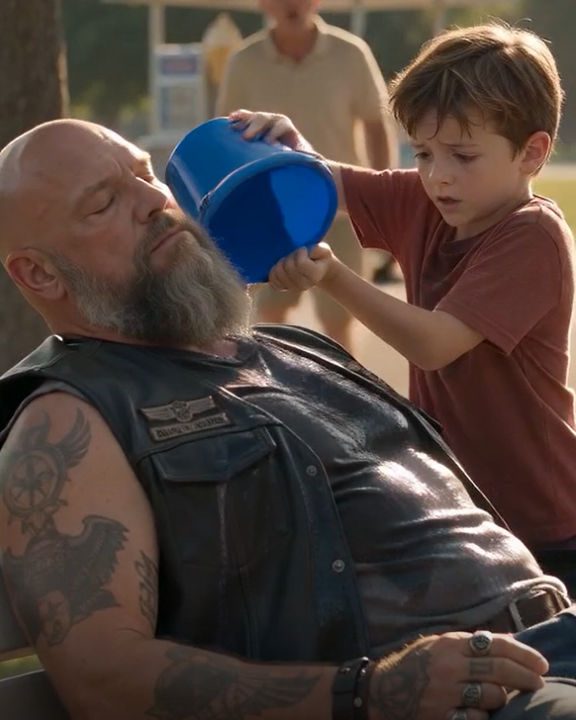
Now he stood beside a park bench with a blue bucket tipped in both hands.
Water ran off a stranger’s black leather vest.
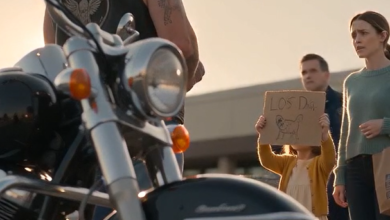
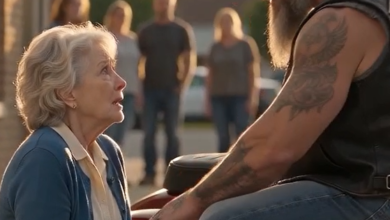
The man was enormous. Shaved head. Gray beard. Tattoos covering both forearms. His motorcycle sat beyond the path, chrome flashing in the sun.
He did not sit up.
“What is wrong with you?” a man shouted.
Megan recognized Paul Henson, a volunteer helping with a neighborhood event near the pavilion. He had a phone in his hand, pointed toward Noah.
“That’s somebody’s father,” Paul said. “You think this is funny?”
Megan hurried across the grass.
“Noah!”
Her son’s face was white.
“He won’t wake up.”
“You cannot throw things on people.”
Behind Paul, a woman shook her head. Somebody muttered that parents didn’t teach respect anymore.
Megan felt every word land.
There had been three school calls that month. Talking over instructions. Leaving his chair. Answering before questions were finished.
She had spent the morning promising herself they would have one ordinary day.
“I’m so sorry,” she told the man on the bench.
He didn’t answer.
Didn’t flinch.
Didn’t lift a hand to wipe his face.
His head rested sideways, away from the water. A worn glove lay beneath one boot. The winged compass on his vest had darkened with moisture.
Megan waited for anger.
Nothing came.
Paul moved his phone closer.
“I watched him do it. He walked right up with that bucket.”
Noah set the bucket down.
“Call somebody.”
“We’re going to find this man’s friends,” Megan said.
“No. Call now.”
Paul gave an impatient laugh.
“Now he’s scared of getting in trouble.”
Megan reached toward her son’s shoulder, then stopped. Noah wasn’t looking at the phone. He wasn’t watching the crowd.
He was watching the stranger breathe.
A young woman in an ice-cream stand doorway held another bucket. A phone was pressed against her ear.
“He asked me for help,” she called.
Paul talked over her.
“Then why didn’t he come get his mother?”
Noah bent beside the bench.
“Sir? Can you hear me?”
The question sounded different from his usual chatter. Slower. Deliberate. He waited, then looked up at Megan with an expression she couldn’t place.
Not guilt.
Fear.
She finally looked properly at the stranger.
His face was flushed. His chest moved, but his eyes stayed closed. Up close, the heat coming off him felt wrong.
Megan knelt.
“Noah, move back a little.”
Her son obeyed immediately.
She touched the exposed skin beside the man’s collar.
Then she pulled her hand away.
Her apology stopped halfway through a word.
Megan reached for her phone as Noah drew a breath to tell the crowd what he had been trying to do.
Part 2
“Call 911,” Noah said. “I think he’s having heatstroke.”
Megan stopped reaching for the answer that would make her son the problem.
The woman at the ice-cream stand raised her phone.
“I’m already connected.”
“Tell them he won’t wake up.”
“I did.”
Paul lowered his own phone a few inches.
“You don’t know that.”
“No,” Megan said. “But somebody who does needs to come.”
She knelt close enough to see the man’s breathing. Following the dispatcher’s questions relayed through the young woman, she called to him again.
No answer.
Noah picked up the second bucket when it arrived.
Megan nearly stopped him from habit.
Then the caller said the dispatcher wanted them to keep cooling the man while help came.
Adults took over beside Noah. They brought cold water and wet towels from the stand, kept his face clear, and worked where the dispatcher directed. Someone held a large umbrella over the bench.
Nobody tried to make him drink.
The blue bucket lay on its side.
A paper napkin stuck to its wet rim.
Megan noticed it with the strange clarity that sometimes arrived when everything else became too large to hold.
“What’s his name?” she asked.
Nobody knew.
Beyond the path, his cruiser leaned on its stand. A pair of worn gloves hung from the handlebar. The engine had been off long enough that its faint ticking had stopped.
A woman offered to look through his things.
“Wait for the responders,” Megan said.
She had no expertise. She was simply finished pretending certainty belonged to whoever sounded most annoyed.
Noah stood beside the umbrella, hands shaking.
“Was I supposed to do something else?”
Megan looked at him.
“You got help.”
“But he isn’t waking up.”
“Stay beside me.”
The young woman introduced herself as Tessa, mostly because the dispatcher asked who was speaking. She worked at the stand during college breaks.
Noah had run to her asking for ice and water.
“He said a man was really sick,” she told Megan. “Then he told me to call.”
“Before he took the bucket?”
“Yes.”
Paul looked away.
Megan remembered his words.
I saw the whole thing.
The ambulance arrived through the service entrance several minutes later. Two responders crossed the grass with equipment, and the little ring of spectators finally opened.
One knelt where Megan had been.
The other asked questions.
When had anyone last seen the man awake? Had he fallen? Had anyone spoken to him before he lay down?
Megan could answer almost none of them.
Noah could answer one.
“I said, ‘Sir, are you okay?’ before I got the water. I said it loud.”
The responder looked directly at him.
“Thank you for telling me.”
There was no praise yet. No promise.
They were busy.
Megan pulled Noah close when the stretcher came. He resisted just enough to keep watching the man’s face.
“Mom?”
“I know.”
“What if I was too late?”
She had no honest answer that would comfort him.
The responders lifted the stranger, still working, and moved toward the ambulance.
As they passed, a small laminated card slipped from the edge of his open vest.
Megan caught it before it hit the wet path.
On the front was a name.
On the back was a child’s crooked drawing.
Part 3
RYAN MITCHELL.
Beneath it, in smaller print, was an emergency contact.
Megan handed the card to a responder before the ambulance doors closed.
She barely saw the drawing: a motorcycle, three stick figures, and a sun with uneven rays.
The man had somebody.
Somebody was about to get a phone call.
Noah watched the ambulance leave.
“Should we go too?”
“We need to let them work.”
“Then how will we know?”
Megan looked at the wet bench.
She didn’t know that either.
Tessa brought them water in clean cups and asked whether Noah wanted to sit inside the stand’s shaded doorway.
He shook his head.
Paul approached while Megan was helping him dry his hands.
“I didn’t realize it was serious.”
“Neither did I.”
“He came running up so fast. You have to understand how it looked.”
Megan could understand.
That was what made it difficult.
She had looked at her son, remembered three school calls, and decided she knew which kind of afternoon they were having.
“I do understand,” she said. “I also heard you call him cruel.”
Paul slipped his phone into his pocket.
“I was trying to stop a child from hurting somebody.”
“Then why were you filming instead of asking?”
He said the recording was for documentation.
Megan wanted to argue. Noah was staring at the seam of his shorts, twisting a loose thread around one finger.
She took him home.
In the car, he asked whether pouring the water had made the man angry inside, even if his face couldn’t show it.
Megan pulled into a parking space before answering.
“You were trying to help.”
“That doesn’t always count.”
The sentence hurt.
She had used versions of it herself. Intention didn’t erase a spilled drink, an interrupted lesson, a classmate’s ruined drawing.
But intention was not the same as irrelevance.
“This time it counts,” she said. “And we’ll tell the people treating him exactly what happened.”
That evening, she called the hospital and left her contact information. She explained that Noah had helped at the park and was worried.
The person answering could not give her medical details.
Megan didn’t ask again.
She left the number.
Near bedtime, her sister sent her a link.
Paul had posted a short clip to the neighborhood event page.
It began with water flying from the bucket.
It ended before Megan touched the man’s skin.
The caption asked what had happened to teaching children respect.
Noah’s face was clear.
Megan watched once.
Then she closed the phone.
Her son sat on the bedroom floor, building a garage from plastic blocks. He had placed the tiny motorcycle inside but left the roof off.
“Can ambulances take helmets?” he asked.
“Yes.”
“His was under the bench.”
She hadn’t noticed.
Noah had.
Megan called the event organizer and asked that the clip be removed. She sent a written account and Tessa’s number.
She did not post her son arguing with strangers to prove he deserved protection.
Before sleep, Noah asked whether grown-ups could be wrong even when several of them agreed.
“Yes,” Megan said.
“Even you?”
She sat beside him.
“Especially when I think I already know the answer.”
He leaned against her without looking up.
“I wasn’t trying to be bad.”
“I know that now.”
“I wanted you to know before.”
Megan held him closer. She could not repair the afternoon by telling him he had been brave. First she had to admit how lonely she’d let him feel.
The next morning, an unfamiliar number called.
“Ms. Carter? This is Ryan Mitchell’s sister.”
Megan gripped the counter.
“He wanted me to find the boy with the bucket.”
Part 4
His sister’s name was Beth.
She spoke carefully, as if she had spent the night learning which words she could get through without stopping.
“He’s awake.”
Megan sat down.
Across the kitchen, Noah was pouring cereal so slowly that individual pieces clicked against the bowl.
“He’s awake?” Megan repeated.
Noah stopped pouring.
Beth said Ryan remained in the hospital. He was tired, undergoing monitoring, and not ready for a roomful of visitors.
But he had asked about a child.
“The people from the ambulance told us somebody started helping before they arrived.”
Megan looked at her son.
“We’d like to tell him thank you,” Beth said.
Noah put the cereal box down.
“Can I say sorry about his clothes?”
Megan closed her eyes.
Beth heard him.
“Oh, honey. He can wash clothes.”
The call did not turn the morning into a celebration.
Noah still wanted to know whether Ryan’s brain was okay.
Beth said the doctors were watching his recovery and that she would not promise things before they knew.
It was the answer Megan trusted most.
Three days after the park, they met Ryan with his permission, shortly before he went home.
He looked smaller sitting upright in a hospital chair, though his shoulders still filled it. Without the leather vest, the tattoos on his arms seemed less like warnings and more like things somebody had chosen carefully.
His gray beard had been combed.
A paper bag of belongings rested beside his shoes.
“Noah?”
The boy nodded.
“I’m Ryan. My friends call me Bear.”
“Are you mad?”
Ryan leaned forward slightly.
“No.”
“Because of the water.”
“I know.”
He waited.
Noah finally looked at him.
“Did it work?”
Ryan rubbed one hand over the other.
“They told me getting cooled early mattered.”
“Did I fix it?”
“You helped. Then the ambulance people helped. Then the hospital people.”
Noah considered that.
“A lot of people.”
“Yep.”
Megan appreciated the answer. It gave her son a place in what had happened without making him responsible for everything that followed.
Ryan told them what he could remember.
He had been on the road for roughly six hours, with stops that had not been long enough. By the time he reached Springfield, he had a headache and felt clumsy taking off his helmet.
He had mistaken those warnings for ordinary tiredness.
“I sat down to straighten myself out.”
“Were you sleeping?” Noah asked.
“No, buddy.”
Later, with Beth beside him, Ryan showed Megan a note summarizing his care. His recorded core temperature had reached 106.7 degrees Fahrenheit.
Forty-one point five Celsius.
Megan looked toward the small boy studying the wheels of the hospital chair.
The wet vest. The empty bucket.
How close she’d come to pulling him away.
A clinician who stopped by spoke about the importance of prompt cooling and emergency treatment. She did not claim anyone could know exactly what would have happened otherwise.
Ryan would need rest and follow-up.
Going home was not the same as being ready to ride.
Before they left, he asked Noah where he’d learned to recognize trouble.
“At school.”
Megan looked up.
Noah named the teacher who had called her twice about him.
Part 5
“Ms. Brooks?”
Noah nodded.
Megan felt an uncomfortable little shift inside herself.
She had spent the past month imagining Ellen Brooks mostly as a voice on the other end of the phone.
He left his seat again.
He needs to wait until directions are finished.
We know he’s capable.
All true, perhaps.
None of it had told her what he was learning.
Ryan asked whether the teacher had shown them a video.
“Some,” Noah said. “Then she told us about her grandpa.”
Megan had never heard that part.
“He got sick outside. She said people thought he was just tired.”
Noah picked at the edge of his visitor sticker.
“He died.”
The room went quiet.
“That’s why you remembered?” Megan asked.
Her son shrugged.
“She looked sad when she said it.”
Ryan lowered his eyes.
There it was.
Not a perfect student suddenly revealing a secret talent.
A child remembering another person’s grief.
Megan called Ellen that afternoon, after asking Noah whether he minded if she explained what had happened.
Ellen listened without interrupting.
When Megan finished, she said, “Our Noah?”
Megan’s fingers tightened around the phone.
Then Ellen caught herself.
“That sounded terrible. I’m sorry.”
“Yes,” Megan said. “It did.”
Ellen exhaled.
“He had his head down for part of that lesson. I thought he wasn’t listening.”
“He remembered your grandfather.”
For several seconds, Megan heard only the faint noise of papers moving.
“I didn’t know,” Ellen said.
“Neither did I.”
They spoke longer than they ever had during a behavior call.
Ellen had included a short safety lesson during summer school with materials supplied by a visiting emergency responder. Her personal story had lasted less than a minute.
She had not expected it to become the part a child carried into a park.
“He still needs help staying with the class,” Ellen said carefully.
“I know.”
“But I need to stop treating quietness as my only evidence that he’s learning.”
Ellen described the drawing Noah had made during the lesson. She had seen the pencil moving and assumed he was somewhere else.
“What did he draw?” Megan asked.
“A bench and a phone.”
Neither of them spoke for a moment.
The evidence had been on his desk.
Ellen promised to ask children to show what they’d understood before deciding they had understood nothing. Megan promised to ask Noah what happened before beginning with what he’d done wrong.
Neither promise required pretending he never needed correction.
Megan wrote that sentence down afterward.
Not to use against her.
To remember they had both said something honest.
Ryan called a week later. His voice was stronger, though he was still following instructions to rest.
He wanted to thank the class.
Megan pictured a loud surprise arrival and immediately began explaining Noah’s discomfort when too many people watched him.
Ryan let her finish.
“Then we ask him.”
When she did, Noah thought for a long time.
“Could everybody learn it?”
“What?”
“The part about getting help.”
Ryan liked that better than a speech.
He asked whether his riding group could help pay for a practical session led by someone qualified to teach it. Ellen could help organize it and share why the lesson mattered.
No engines outside classroom windows.
No surprise.
Everything arranged with the school and parents.
Megan began to relax.
Then the principal called.
Someone had sent the original clip to the school, questioning whether Noah should receive any recognition at all.
Attached was a note claiming adults had already been helping before he arrived.
Megan knew the name at the bottom before the principal said it.
Part 6
Paul had described Noah as a child who had inserted himself into an emergency for attention.
Megan read the message twice.
The first time, she felt anger.
The second time, she saw how carefully it had been written.
No direct accusation that could be disproved by a single photograph.
Just concern.
Concern about rewarding impulsiveness. Concern about copying dangerous behavior. Concern that a dramatic video might obscure the responsible adults.
The principal asked for a conversation, not a verdict.
Megan appreciated that distinction.
She brought Tessa’s written account, the timing of the emergency call, and Ryan’s permission to share his own account of the hospitalization.
Noah stayed with his aunt.
He did not need another roomful of adults examining whether he was the kind of child who could do something good.
Tessa joined the meeting by phone.
“He asked me to call before he carried the bucket out,” she said.
The principal made a note.
“Did anyone send him to you?”
“No.”
“Had anyone told you there was a sick person on the bench?”
“No.”
Paul said he had become involved seconds later.
Then the event organizer, Marisol Vega, opened a longer recording on her laptop.
A volunteer had been filming the scheduled performances from the pavilion. The bench was visible at the edge of the wide frame.
Marisol had preserved the original after Megan’s removal request prompted her to check what had happened.
The video was ordinary and awkward.
Children walked through the foreground. A microphone blocked part of the bench. Somebody laughed close to the camera.
But the sound was clear enough.
Noah approached Ryan.
He spoke.
He waited.
Then he turned toward Paul.
“Something’s wrong with that man.”
Paul’s recorded answer came through the laptop speakers.
“Leave him alone. Let him sleep.”
Megan stared at the screen.
She had not known her son tried another adult before running to the stand.
Onscreen, Noah hesitated.
Then he ran.
The recording continued through his return, the first splash, and Paul’s raised phone.
Nobody in the room spoke for several seconds.
Marisol stopped the recording.
“The equipment was there to record a community event,” she said. “We used our page to shame a child instead.”
She included herself. She had approved the post without checking it.
Megan appreciated the admission, but asked for something practical: a process requiring a second review before any identifiable child appeared on the page.
Marisol wrote it down.
An apology could matter.
So could making the next mistake harder to repeat.
Paul finally said he had thought the man was drunk.
Ryan was not at the meeting. Megan was glad he didn’t have to sit there and listen to a stranger explain why his appearance had made checking on him seem unnecessary.
“You could have thought that and still asked if he was okay,” she said.
Paul looked toward the principal.
“I made a mistake.”
“Then why send a second version after you knew?”
He had no quick answer.
Marisol removed his access to the event’s social accounts. The committee issued a correction without reposting Noah’s face, and Paul was asked to step down from his volunteer leadership role.
The school did not turn the meeting into a trial of a nine-year-old.
When Megan told Noah the class session could go ahead, he asked whether Ms. Brooks would be there.
“Yes.”
“Will she tell the grandpa part?”
“Only if she wants to.”
He nodded.
Then he took a folded paper from his backpack.
“I made something for her.”
Part 7
It was a drawing of a bench beneath a tree.
Beside it stood three people: a small boy, a teacher, and a man with a beard almost as long as his legs.
Above them, Noah had written a sentence in uneven letters.
I heard you.
Megan sat on the edge of his bed.
“Can I ask why you drew Ms. Brooks at the park?”
“She wasn’t at the park.”
“I know.”
“But she kind of was.”
Megan looked at the picture again.
For weeks, adults had argued about what the boy had done with his hands.
Here was what had been happening inside his head.
The school visit took place six weeks after the emergency.
Ryan arrived in a car with Beth. His motorcycle stayed home. He was improving, but he was not interested in making his recovery look faster for an audience.
Six members of his riding group arrived separately and checked in at the office.
They wore black leather vests with the same winged compass.
Megan watched a secretary glance toward the visitors, then smile when one politely asked where to leave a box of supplies.
Nobody filled the parking lot with revving engines.
Nobody needed to.
The session took place in the multipurpose room with an emergency responder named Dana Lewis leading the practical instruction. Ellen assisted, using the same classroom voice Noah knew.
The riders took seats beside the children.
That was Ryan’s idea.
“We could use the lesson too.”
Noah sat near the aisle so he could stand when he needed to without blocking anyone.
Megan noticed Ellen had arranged that before they arrived.
During the session, Dana used age-appropriate scenarios and practice equipment. The children practiced finding an adult, communicating clearly, and giving useful information when asking for emergency help.
Nobody practiced on an injured classmate.
Nobody was asked to recreate the park.
When it was Ellen’s turn to speak, she held Noah’s drawing against her notes.
“I told you about my grandfather because I wanted you to remember that someone can look tired when something is seriously wrong.”
She paused.
“I didn’t realize how carefully one of you was listening.”
Noah looked down.
Ellen moved closer, leaving him room.
“I owe you an apology. Sometimes I noticed how you moved before I noticed what you understood.”
Megan felt her own throat tighten.
The apology did not erase every difficult school day.
It gave the next one somewhere better to begin.
Ryan stood only when Noah nodded that he was ready.
He handed him a framed certificate signed by the riding group.
It said thank you.
Not perfect student.
Not fearless hero.
Thank you for noticing. Thank you for getting help.
Noah traced one corner of the frame.
“I was scared.”
Ryan crouched until their eyes were level.
“Me too, once they told me.”
Across the room, Ellen pressed the drawing against her chest.
Megan thought the afternoon had reached its ending.
Then Noah looked toward the doorway.
Paul stood there beside Marisol, waiting because Megan had agreed to a brief, private apology afterward.
Noah put the certificate down.
“Can he learn the lesson too?”
Part 8
Megan looked at her son.
“Do you want him to stay?”
“For the lesson.”
She nodded to Marisol.
Paul took a chair near the back.
He didn’t make a speech. When the session ended, he waited until the other children had left before approaching Noah with Megan beside him.
“I called you cruel,” he said. “I was wrong.”
Noah held the certificate against his stomach.
“And you put the video up.”
“Yes.”
“People at my cousin’s house saw it.”
Paul swallowed.
“I took it down. The event page has a correction.”
“Does everybody see the correction?”
Megan closed her eyes briefly.
There were questions adults could not fix with the right tone.
“Probably not everybody,” Paul said.
Noah nodded without smiling.
“Okay.”
He did not offer forgiveness for the adults’ comfort.
Megan did not ask him to.
The school later invited Noah to help with a student safety group. He wanted to call himself the ambassador because it sounded like somebody who got a special badge.
Ellen agreed he could have a badge.
She also made sure he wasn’t the only child trusted with responsibility.
There were quiet children, restless children, careful readers, and children who remembered things best after practicing them.
Noah helped set out supplies.
Sometimes he talked too much.
Sometimes he forgot.
One Tuesday, Megan received another call about him leaving his seat.
For half a second, disappointment returned with all its old weight.
Then Ellen said, “We’ve figured out a movement break that may help. I wanted to compare notes.”
Megan sat down.
They compared notes.
Ryan came to the group’s first family evening after he was ready for longer outings. He carried the blue bucket, washed clean, with a bag of classroom supplies inside.
Tessa had saved it.
Noah looked embarrassed.
“You don’t have to keep bringing that.”
Ryan considered him.
“Want me to stop?”
“Maybe.”
“Then I will.”
He set the supplies on the table and took the bucket back to his car.
Megan liked him most for that.
He did not require her son to remain the boy from the emergency forever.
Over dinner afterward, Noah asked about the drawing on Ryan’s emergency card.
“My granddaughter,” Ryan said.
“She makes the sun crooked.”
“Runs in the family.”
He showed them a newer picture on his phone. The little girl stood beside the parked cruiser wearing a helmet too large to be useful and a grin too wide to miss.
“She knows about you,” he told Noah.
“What did you say?”
“That somebody paid attention.”
Outside, the evening had cooled. Ryan paused beside the motorcycle and checked his route before putting on his gloves.
He had changed how he rode in the heat.
Megan had changed something too.
A month earlier, she’d seen a bucket and begun apologizing.
Now, when her son hurried toward her with a sentence coming apart in his mouth, she tried to hear the whole thing before deciding what it meant.
People deserved that much, whether they wore a leather vest or brought home another behavior note.
For more stories about the people we nearly misunderstand, follow this page.
This time, everybody listened.