A Child Was Crying for His Mother in a Shopping Mall — The Only One Who Stopped Was a Biker
The scream cut through the mall like broken glass. Not loud. Not dramatic. Just raw.
A child’s voice cracking from panic.
Near the center fountain, a boy no older than six stood frozen, tears streaking down his face, small hands clenched into fists as if holding on to something invisible. His backpack hung crooked on one shoulder. His shoes were mismatched. He kept calling out the same word, over and over.
“Mom… Mom…”
Shoppers slowed for half a second—then kept walking.
Some glanced around, annoyed. Others assumed someone else was handling it. A woman muttered, “Security will deal with it.” A man shook his head and pulled his daughter closer, like fear was contagious.
The boy’s cries grew sharper. His chest heaved. His eyes darted wildly, searching every adult face and finding none that stayed.
A kiosk worker leaned out. “Hey, kid, where’s your mom?”
The boy shook his head harder, panic rising.
People started filming.
That was when the crowd parted slightly.
Heavy boots echoed on polished tile.
A man stepped forward—tall, broad, wearing a sleeveless black shirt, leather vest folded over his arm. Tattoos ran down his forearms. Sunglasses hung from his collar. His face was calm, unreadable.
A biker.
He stopped directly in front of the crying child.
And the mall went very quiet.
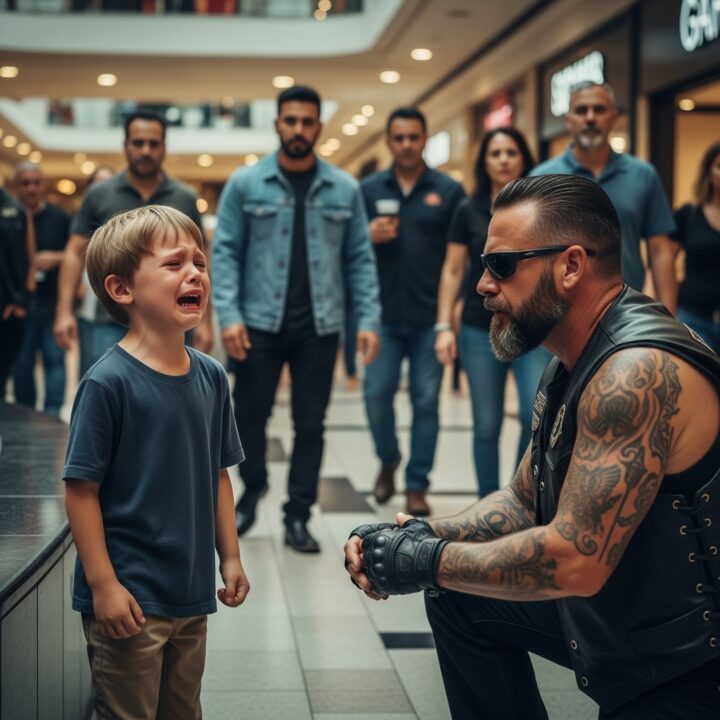
The biker knelt down slowly, keeping his hands visible.
“You okay, kid?” he asked, voice low and steady.
The boy flinched.
Several heads snapped up.
A woman gasped. “Hey—don’t touch him.”
Another voice followed. “Someone call security.”
The biker didn’t react. He didn’t reach for the child. He stayed where he was, grounded, like he understood fear didn’t disappear just because you meant well.
“Where’s your mom?” he asked gently.
The boy sobbed harder, shaking his head.
The crowd closed in—not to help, but to watch.
Whispers spread fast.
“Why is he talking to the kid?”
“That guy looks sketchy.”
“Doesn’t he know that’s not appropriate?”
A mall security guard started pushing through from a distance.
The biker took off his vest and laid it on the floor beside him, creating space. He pulled a small pack of tissues from his pocket and slid it across the tile instead of handing it directly.
The boy stared at it. Hesitated. Then grabbed one.
That was when someone shouted, “Sir, step away from the child.”
The biker looked up.
“I’m not touching him,” he said calmly. “He’s lost.”
A man pulled out his phone. Another woman grabbed her purse tighter.
The biker stayed kneeling, unmoving, like standing up too fast might make things worse.
From the outside, it looked wrong.
A biker isolating a crying child.
Security approaching.
Phones recording.
The tension tightened like a wire.
The security guard arrived, hand already near his radio.
“Sir, I’m going to need you to stand up.”
The boy panicked. He lunged forward, wrapping his arms around the biker’s neck.
The crowd reacted instantly.
“Get him away from the kid!”
“What did you do to him?”
“Someone call the police!”
The biker froze.
Slowly, carefully, he raised both hands so everyone could see them.
“It’s okay,” he murmured to the child. “I’m here. You’re safe.”
The guard looked torn. The boy was clinging hard now, face buried in the biker’s shoulder, sobbing uncontrollably.
The biker didn’t move.
He reached into his pocket—not quickly, not hidden—and pulled out his phone.
The guard tensed. “Sir—”
The biker held the phone up. “I’m calling someone who can help.”
He made the call. Spoke quietly. Just a few words.
“Yeah. Mall. Center fountain. Kid’s lost.”
He ended the call.
The crowd buzzed louder now.
“No one knows who he called.”
“Why didn’t he give the kid to security?”
“This is getting out of hand.”
The boy clung tighter.
The biker didn’t pull him away.
He simply waited.
Footsteps came first.
Quick. Purposeful.
Then a voice—high, broken, frantic.
“Ethan!”
A woman burst through the crowd, hair disheveled, eyes wild with fear.
The boy lifted his head.
“Mom!”
He released the biker instantly and ran straight into her arms.
She dropped to her knees, crying, holding him so tight her hands shook. “I couldn’t find you. I turned around for one second—”
The security guard exhaled sharply.
The woman looked up at the biker, confusion on her face.
“He stayed with him,” the guard said quietly. “Didn’t touch him. Didn’t leave.”
The crowd shifted.
Phones lowered.
The woman stood, still holding her son’s hand, and faced the biker.
“Thank you,” she said, voice breaking. “Everyone walked past him.”
The biker nodded once.
Behind her, more people arrived—men and women, some wearing similar vests, some in plain clothes. They didn’t crowd. They didn’t speak loudly.
They just stood nearby.
The presence changed the air.
No threats. No noise.
Just order.
The truth came out quietly.
The biker volunteered with a missing persons support group. Former search-and-rescue. He’d learned one thing early: panic spreads faster than help.
He didn’t wait for praise. Didn’t offer his name.
When the woman tried to shake his hand, he gently declined.
“Just glad he’s okay,” he said.
The boy waved shyly from behind his mother’s leg.
The biker picked up his vest. Slipped his sunglasses back on.
As he walked away, the mall noise returned—but softer somehow.
People stood still, uncomfortable with what they’d assumed.
No speeches were given.
No lessons spoken aloud.
Just a quiet realization hanging in the air:
Sometimes, the person who looks most dangerous
is the only one brave enough to stop.