A Ten-Year-Old Handcuffed Himself to a Stranger’s Harley and Wouldn’t Release It — Then His Mother Woke from Surgery and Asked for the Biker by Name
Part 2 — The Name Missing From Caleb’s Funeral
I followed Hammer and Jonah upstairs because the incident still required a report, although by then I understood that no crime had occurred in the parking garage.
The elevator ride lasted less than a minute.
Hammer spent every second looking at the floor.
Jonah stood beside him holding the open handcuffs. The boy had stopped crying, but he kept one finger hooked through the short chain as if the steel object might still prevent the biker from disappearing.
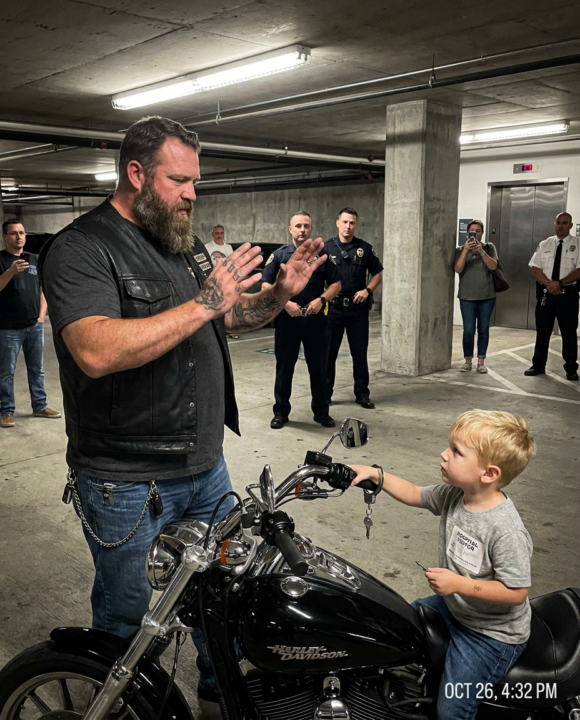
When the doors opened on the neurological intensive-care floor, Hammer did not step out.
“Room 612,” Jonah said.
“I heard the nurse.”
“You have to move.”
Hammer’s boots remained planted.
The smell of disinfectant drifted into the elevator. A monitor sounded somewhere beyond the nurses’ station. Beneath those clean hospital noises, I could hear Hammer’s leather vest creak each time he breathed.
He had ridden through thunderstorms.
He had served time in prison.
He had faced three armed officers beside his motorcycle without losing control.
A hospital room frightened him.
Jonah reached for the emergency stop button.
Hammer caught his hand.
“No more hostage situations today.”
It was the first hint of humor I heard from him.
Jonah did not smile.
“Promise you won’t run.”
Hammer considered the words.
“I promise I’ll walk.”
The boy accepted that.
Sarah Brooks was thirty-seven, pale beneath the hospital lights, with a white bandage disappearing into her dark hair. Tubes crossed one arm. A monitor tracked her pulse in quick green peaks.
When Hammer entered, the peaks rose.
A nurse warned everyone to keep the visit calm.
Sarah looked at the biker’s beard, tattoos, and scarred hands. Then she studied his eyes for several seconds.
“You got older,” she whispered.
“So did you.”
“You came to the funeral.”
Hammer’s face tightened.
“Across the road.”
“I saw your bike.”
Jonah looked up.
“You knew him?”
Sarah’s eyes moved toward her son.
“I knew who he was.”
Hammer remained close to the door. Jonah guided him toward the bed, but the biker stopped when he reached the footrail.
Sarah extended her hand.
He did not take it.
Her fingers stayed open.
Five years earlier, Hammer had attended Caleb’s funeral from the parking lot of a shuttered gas station opposite the church. He wore no club vest and stood beside a gray Harley while police officers carried his son’s flag-draped coffin through the doors.
He never crossed the street.
Sarah had recognized him from an old photograph Caleb kept inside a locked toolbox. She considered inviting him into the church, but grief and anger held her in place.
Caleb had never forgiven his father.
At least, that was what everyone believed.
Hammer’s life with Caleb had begun badly and fractured worse. He became a father at nineteen, a widower at twenty-eight, and a man addicted to pain pills after a steel beam crushed two vertebrae in his back.
He worked.
He hurt.
He swallowed pills.
Then he swallowed more.
By the time Caleb was fourteen, Hammer’s moods filled their small house like gasoline fumes. He never struck his son, but violence did not need direct contact to shape a child. Hammer broke doors. He punched walls. He disappeared for days and returned smelling of whiskey, oil, and shame.
Caleb learned to cook for himself.
At sixteen, he found Hammer unconscious beside the garage workbench. He called an ambulance and stayed until his father began breathing.
Hammer promised treatment.
He lasted nineteen days.
The final break came two years later. Caleb was helping him finish a 1976 Harley Shovelhead they called Mercy. The motorcycle was built from mismatched parts, including a blue fuel tank Caleb found at a salvage yard.
Hammer sold Caleb’s college tools for drug money.
Caleb discovered the empty cabinet the morning he was due to start police academy training.
He packed one bag.
Before leaving, he placed his new handcuffs on the workbench and told Hammer, “You keep locking yourself inside this life. I can’t stay chained to it.”
Hammer threw the cuffs into Caleb’s truck.
“Then don’t come back.”
Those were their last spoken words.
Caleb changed his surname to Brooks, the name of the uncle who gave him a room. Hammer entered rehabilitation three months later, relapsed once, assaulted a dealer who came to his home, and went to prison for twenty-two months.
He became sober inside.
Moses Carter, an old welding partner, visited every other Sunday. On Hammer’s release day, Moses brought the unfinished Harley on a trailer.
He expected Hammer to finish it.
Hammer covered it with a tarp.
He could not complete the bike without Caleb, and he did not believe he had the right to contact the son he had driven away.
The Iron Saints formed during Hammer’s second year of sobriety. They were welders, mechanics, veterans, paramedics, and men who understood that staying repaired required daily work.
Hammer became the one others called at three in the morning.
He never called Caleb.
Yet he followed his son’s life from a distance. He clipped newspaper articles about Caleb joining Metro Police. He attended an award ceremony from the back row. He learned of Jonah’s birth through an obituary written years later.
After Caleb died, Hammer began leaving grocery-store gift cards in Sarah’s mailbox.
No return address.
No signature.
Sarah knew.
She never spent them.
“I was angry for Caleb,” she told him from the hospital bed. “Then I found the box.”
Hammer finally took her hand.
“What box?”
“The one he hid under the garage floor.”
Inside it were eleven unsent letters addressed to Ray Dawson.
Caleb had written one every year.
And the final letter was meant for Jonah.
Part 3 — The Motorcycle That Wasn’t Hammer’s to Sell
Sarah’s aneurysm had been discovered six weeks earlier after she collapsed at the diner where she managed the morning shift.
Doctors wanted to operate immediately.
Her insurance covered most of the procedure, but “most” still left $38,600 in deductibles, out-of-network surgical monitoring, and previous imaging bills. Sarah had already refinanced her home after Caleb’s death.
She postponed the operation.
Then she postponed it again.
Jonah heard only that his mother needed more tests. Sarah did not tell him she sometimes saw two of everything or that numbness had begun moving down the left side of her face.
Her sister Rachel created an online fundraiser.
It raised $4,112.
Hammer learned about it through Colt Reyes, an Iron Saints member whose wife worked with Rachel. Colt recognized Sarah’s name from an old newspaper article about Caleb’s death and brought his phone to Hammer’s welding shop.
Hammer stared at the fundraiser for a long time.
Then he walked into the back room.
Beneath a canvas cover stood the unfinished blue Shovelhead named Mercy.
For seventeen years, Hammer had carried it from garage to garage. He replaced rusted bolts, drained old fuel, and turned the engine by hand each winter to keep it from seizing.
He never completed the wiring.
Caleb’s fingerprints remained beneath the clear coat on the blue tank. A crooked line of weld showed where the eighteen-year-old had attached a bracket, ignored Hammer’s criticism, and refused to redo it.
“It holds,” Caleb had said.
It still did.
Hammer called an auction house in Kentucky and asked what the machine might bring if restored. The estimated price was close to Sarah’s medical balance.
Moses overheard the call.
“No.”
Hammer pulled the tarp from the motorcycle.
“Wasn’t asking.”
“That bike is all you have left of the boy.”
“His wife needs surgery.”
“She doesn’t know you.”
“She knows enough.”
Moses stood between Hammer and the bike.
The Iron Saints had never questioned Hammer’s right to make decisions about his property. Brotherhood did not mean ownership. But Mercy was different. Every man in the club had spent hours searching for obsolete parts, polishing corroded metal, or simply sitting near the covered machine during Hammer’s worst nights.
Moses believed selling it would destroy him.
Hammer believed keeping it would make him a coward.
The argument split the club.
Colt and Doc offered to use the club’s emergency fund. The treasury held only $9,000, and draining it would leave nothing for two members already facing rent problems.
Hammer refused.
Moses proposed contacting Sarah openly and organizing a public benefit ride. Hammer refused that too.
“She needs surgery, not a parade.”
They nearly came to blows when Moses removed the blue fuel tank and hid it.
Hammer stood in the center of the clubhouse with his fists closed. Every old instinct told him to force the location from his friend.
Instead, he opened his hands.
“You got until morning.”
Moses returned the tank at midnight.
By sunrise, Mercy was on a trailer headed toward Bowling Green. The auction house agreed to advance most of the expected sale price after an anonymous collector guaranteed the bid.
Hammer rode the black Road King behind the trailer for sixty-seven miles.
Then he turned around.
He could not watch the sale.
The final bid was $41,000.
After fees, he received enough to cover Sarah’s balance and leave a small amount for her recovery. He transferred the money before the surgical team’s deadline and signed the form “Ray Dawson.”
“Do not give her my name,” he told the hospital clerk.
The clerk promised confidentiality.
What Hammer did not know was that Jonah had awakened in the waiting room and heard his aunt arguing with the billing department. He followed Rachel to the office, where the signed form lay faceup beneath a glass partition.
Jonah read the name.
He had seen it once before.
Two nights after Sarah collapsed, Jonah had searched the garage for an extension cord and found Caleb’s hidden metal box. Inside were photographs, newspaper clippings about Iron Saints charity rides, and the eleven unsent letters.
One envelope was labeled FOR JONAH, IF I WAIT TOO LONG.
The boy opened it.
Caleb’s letter did not describe Hammer as a monster. It described a broken father who had finally become the man his son once needed, and a proud son who watched from a distance because forgiveness felt harder each year.
Caleb wrote that Hammer had attended Jonah’s first baseball game while pretending to repair a motorcycle across the street.
He wrote that the anonymous grocery cards came from him.
He wrote that Jonah’s stubbornness belonged to both of them.
At the bottom of the letter, Caleb included a photograph of the blue Shovelhead and one sentence:
If you ever meet the man beside this motorcycle, tell him I kept the cuffs because I always planned to bring them back.
Jonah placed those cuffs in his mother’s overnight bag.
He did not know why.
Perhaps children understand unfinished business better than adults.
After Hammer paid the bill, Jonah recognized his name, followed him through the hospital, and saw the black Harley in the parking garage.
“Are you Ray Dawson?” he asked.
Hammer stopped.
Jonah showed him Caleb’s photograph.
Hammer went pale.
Then he put on his helmet.
“I’m nobody you need.”
Jonah pulled out the handcuffs.
The first cuff closed around his wrist before Hammer understood his intention. The second locked around the Harley’s handlebar with a hard metallic click.
Hammer stared at his dead son’s badge number.
“Where did you get those?”
“Dad saved them for you.”
“Unlock yourself.”
“Come meet Mom.”
“No.”
Jonah sat on the concrete.
Hammer could have used the spare universal cuff key he carried in his roadside medical kit. Caleb had taught him years earlier that standard police cuffs were easy to open with the correct tool.
He did not use it.
He sat beside his grandson.
For seventeen minutes, they waited in silence.
Then someone called the police.
Part 4 — What Caleb Wrote but Never Mailed
Sarah asked me to remain in the hospital room while she read Caleb’s letters. She wanted a witness because pain medication blurred her thoughts and because Hammer still looked ready to escape.
Jonah sat beside his mother.
Hammer stood at the window.
The first letter was dated eleven months after Hammer entered prison.
Caleb wrote that he had attended a recovery-family meeting but left before giving his name. He admitted reading every apology Hammer sent, then burning each envelope after memorizing it.
“I wanted you to hurt,” Caleb wrote. “Then I hated myself because I still wanted you to get better.”
Hammer listened without moving.
The second letter described Caleb’s police academy graduation. He saw Hammer across the auditorium wearing a borrowed jacket over his tattoos.
The third was about Sarah.
Caleb wrote that she laughed too loudly in restaurants, drove with the fuel light on, and had made him believe a home could be quiet without feeling empty.
The fourth letter announced Jonah’s birth.
“I almost called you from the hospital,” it said. “Then I imagined you holding him, and I got scared I would forgive you too quickly.”
Hammer pressed two fingers against the glass.
Sarah skipped several years, not because they were unimportant but because every page hurt the man standing near the window.
The tenth letter had been written after Hammer’s motorcycle club escorted a bullied teenager to school. Caleb saw the story online.
“You became the man I kept asking for,” Caleb wrote. “I don’t know whether to be proud or furious that strangers got him.”
Hammer finally turned around.
His face had changed.
Not softer.
Older.
The eleventh letter was dated three days before Caleb died.
Caleb had planned to visit Hammer’s welding shop the following Sunday. He intended to return the academy handcuffs and ask whether they could finish Mercy together.
He never made that visit.
The truck struck him on Wednesday.
Hammer sat down.
Jonah removed the cuffs from his hoodie pocket and placed them across the biker’s knees. The steel clicked against his silver skull ring.
“Dad brought them back,” the boy said.
Hammer closed both hands around the chain.
Sarah reached for the final envelope marked with Jonah’s name. The boy had already read it, but the last page remained folded because he had been afraid to open it alone.
Sarah unfolded it now.
Caleb wrote directly to his son.
He explained that people sometimes wait for the perfect words until time takes every word away. He did not ask Jonah to forgive Hammer. He asked the boy to meet him without inheriting Caleb’s anger.
Then came a detail none of them expected.
The blue motorcycle did not belong solely to Hammer.
Caleb had purchased the salvage-yard frame with money from his first summer job. Hammer bought the engine. Every other piece had been paid for equally.
Mercy was theirs.
Caleb’s letter included a handwritten title transferring his share to Jonah.
Hammer had sold property partly owned by his grandson.
The room went quiet.
Hammer looked at Jonah.
“I didn’t know.”
“Are you in trouble?” Jonah asked.
“Probably.”
For the first time, Sarah smiled.
Jonah considered the matter with the seriousness of a judge.
“What did you sell it for?”
“Forty-one thousand.”
“How much was Mom’s surgery?”
“Thirty-eight six.”
“So you owe me twenty-four hundred.”
Hammer blinked.
Sarah laughed once, then winced and held her head. The monitor accelerated. A nurse stepped forward, but Sarah raised one hand.
Jonah continued.
“And half a motorcycle.”
“Fair.”
“What if I want it back?”
“It’s gone.”
That was when Moses appeared in the doorway.
Behind him stood Colt, Doc, and six members of the Iron Saints. They had removed their sunglasses and held their helmets against their chests.
Moses carried a blue motorcycle fuel tank.
Hammer rose too fast.
Pain crossed his face.
“What did you do?”
Moses placed the tank on the visitor’s chair.
The anonymous collector who guaranteed the auction bid was not a collector. It was a limited company created that week by the Iron Saints.
The club members had pooled savings, sold spare parts, taken extra shifts, and borrowed the remainder from Moses’s sister. They bought Mercy because Hammer would never accept their money directly.
The auction house kept its fee. Hammer still received the surgical funds.
But the motorcycle had never left the brotherhood.
It waited on a trailer downstairs.
Hammer looked from one rider to another.
“You lied to me.”
“Yep,” Moses said.
“You went behind my back.”
“Yep.”
“You spent money you didn’t have.”
“Also yep.”
Hammer gripped the bedrail.
Moses stepped closer.
“You taught us not to let a brother throw away the last bridge home.”
Hammer’s eyes glistened, but he did not cry.
Not yet.
Jonah lifted the handcuffs.
“Now you owe all of us.”
Hammer looked at his grandson.
“What do you want?”
Jonah pointed toward the elevator.
“Finish the motorcycle.”
Part 5 — Why Sarah Needed Hammer to Stay
The financial payment was not the only reason Sarah had asked Jonah to find Hammer.
Before surgery, she opened Caleb’s metal box and read every letter. One smaller envelope remained sealed beneath the others, addressed to her.
Caleb had written it shortly after Jonah’s birth.
“If something happens to me,” it began, “Ray will stay away because he’ll think that is what I wanted. It isn’t.”
Caleb admitted he had followed Hammer’s recovery for years. He knew about the prison sentence, the relapses, the welding shop, and the Iron Saints.
He knew Hammer never missed the anniversary of his mother’s death.
He knew the grocery cards came every December.
Caleb’s anger remained real, but so did his love.
He had not contacted Hammer because reconciliation would require admitting that both of them had changed. Anger had become familiar. Familiar pain can feel safer than uncertain peace.
Caleb asked Sarah to find Hammer if he died.
She tried once.
After the funeral, Sarah crossed the road toward the shuttered gas station where Hammer had been standing. His Harley was already disappearing into traffic.
She kept the letters.
Five years passed.
Bills grew. Grief settled into household routines. Jonah learned to tie a necktie from a video because Caleb was no longer there to teach him. Sarah saw Hammer’s charity rides online and sometimes enlarged the photographs to study the grandfather her son did not know.
Still, she waited.
Then the doctors found the aneurysm.
On the night before surgery, Sarah understood that waiting was another way families disappeared. She told Rachel to contact Hammer if she did not survive.
Rachel already had.
That was how Hammer learned about the fundraiser.
He did not reply to Sarah. He paid the surgical balance instead.
Sarah wanted him in her room because she needed to say what Caleb had lost the chance to say. She also needed to ask one question.
“Why did you stay away from Jonah?”
Hammer looked at the boy.
“Because Caleb told me not to come back.”
“When he was eighteen.”
“He meant it.”
“For how long?”
Hammer did not answer.
Sarah’s voice remained weak, but the question carried weight.
“You served twenty-two months for what you did. How many years did you sentence yourself to?”
The biker lowered his head.
Jonah reached for the cuffs again, but Sarah stopped him.
“No more holding people by force.”
“I didn’t hurt him.”
“I know.”
“He would’ve left.”
Sarah looked at Hammer.
“Would you?”
Before that morning, the honest answer was yes.
Hammer had learned to help strangers because strangers could accept kindness without reopening his oldest wounds. He could build a ramp, pay a bill, or escort a child to school, then ride away before gratitude demanded intimacy.
Family was different.
Family knew what he had been.
“I don’t know how to be his grandfather,” Hammer said.
Jonah shrugged.
“I don’t know how to have one.”
That answer left no excuse.
Hammer walked toward the bed and finally took Sarah’s hand with both of his. His calloused palms enclosed her fingers carefully, avoiding the IV line.
“I’m sorry,” he said.
Not a speech.
Two words.
Sarah squeezed once.
“I know.”
She did not tell him everything was forgiven. Some damage should not be erased merely because the person responsible changes. Caleb had grown up frightened and lonely. Hammer’s sobriety could not rewrite that childhood.
But forgiveness did not require pretending.
It required deciding what happened next.
Sarah asked Hammer to open the bedside drawer. Inside was a small velvet pouch containing Caleb’s wedding ring and a police challenge coin.
“Those belong to Jonah when he’s older,” she said. “Until then, I need someone stubborn enough not to lose them.”
Hammer accepted the pouch.
Jonah watched.
“What do I get now?”
Hammer removed the silver skull ring from his hand.
“This is worth about twelve dollars.”
Jonah placed it on his thumb. It was still too large.
“I’ll take it.”
The hospital discharged Sarah nine days later. Hammer arrived in an old pickup because motorcycles were not useful for transporting someone recovering from brain surgery.
He had installed a grab handle beside the passenger door.
He had also placed a plastic bucket beneath the seat in case she became sick, two bottles of water within reach, and a folded blanket behind her head.
Sarah noticed everything.
She said nothing.
At her house, Hammer repaired the loose porch rail before carrying in her bag. Jonah followed him into the garage and pulled the tarp from the returned motorcycle.
Mercy stood beneath it.
The blue tank was detached. The wiring remained unfinished. Caleb’s crooked bracket still held.
Jonah touched it.
“Dad made this?”
“At eighteen.”
“Was he good?”
Hammer considered lying.
“He was impatient.”
Jonah smiled.
“Mom says that about me.”
Hammer handed him a wrench.
The boy took it.
That afternoon, a grandfather and grandson began finishing the motorcycle a dead man had spent seventeen years trying to bring home.
Part 6 — Thursday Evenings in Caleb’s Garage
Every Thursday after that, Hammer rode from Lebanon Pike to Sarah’s house.
The black Road King announced him before he turned onto the street. Jonah would hear the V-twin rumble, abandon his homework, and lift the garage door before Hammer reached the driveway.
They worked on Mercy for eleven months.
Hammer never rushed him.
He taught Jonah how to label wires with masking tape, how to keep bolts arranged in the order they were removed, and how to recognize a stripped thread before forcing it.
Some evenings they completed nothing.
They sat on overturned buckets while Hammer told stories about Caleb—the good ones and the difficult ones. He described the day Caleb welded his first clean seam and the night he found his father unconscious beside the workbench.
Jonah needed both versions.
Sarah sometimes listened from the doorway. Her hair grew back around the surgical scar. The numbness in her face faded, though headaches still forced her to rest.
The Iron Saints visited in pairs because the entire club overwhelmed the neighbors. Moses brought the blue tank. Colt rewired the lights. Doc taught Jonah basic first aid and made him promise never to use handcuffs near a moving motorcycle again.
Jonah promised.
Mostly.
The old cuffs hung from a nail above the workbench. Beneath them, Hammer mounted Caleb’s final letter inside a simple steel frame.
He positioned it with the written side facing the wall.
“Why hide it?” Jonah asked.
“Not everybody needs to read it.”
“Then why display it?”
Hammer touched the frame.
“Because I know what’s there.”
On the anniversary of Caleb’s death, Hammer and Jonah rode in the pickup to the stretch of Interstate 40 where the collision occurred. They placed a small roadside marker beside the guardrail.
Hammer had avoided that place for five years.
Jonah brought the silver skull ring, now tied to a cord around his neck. Hammer brought Caleb’s challenge coin.
They stood without speaking while trucks moved past in waves of hot air and diesel noise.
Then Jonah asked the question Hammer feared most.
“Would Dad have forgiven you?”
Hammer stared down the highway.
“I don’t know.”
Jonah nodded.
It was an honest answer.
Before leaving, the boy pressed Caleb’s challenge coin into the soil beneath the marker, then changed his mind and dug it back out.
“Not yet,” he said.
Hammer understood.
Some things were not ready to be left behind.
Mercy’s engine started for the first time on a cold Thursday in November. The sound filled Caleb’s garage, rough at first, then steady.
Sarah came outside barefoot.
Moses raised both hands.
Jonah shouted loud enough for three neighboring houses to hear.
Hammer stood beside the blue tank with one palm pressed over his mouth.
The engine kept running.
So did he.
Part 7 — The Second Set of Handcuffs
Jonah turned eleven three weeks after Mercy started.
The Iron Saints held his birthday gathering at Hammer’s welding shop. There were no balloons, because Hammer claimed balloons were “rubber ambushes,” but Moses brought a cake shaped like a motorcycle helmet.
Mercy stood in the center bay.
The blue paint had been polished, yet Caleb’s crooked bracket remained untouched. Hammer had refused to replace it.
“It holds,” he said.
Those had been Caleb’s words.
Sarah arrived carrying a narrow wooden box. She placed it in Jonah’s hands and told him the gift came from Hammer.
Inside was a new set of handcuffs.
They were not police equipment. Hammer had welded them from light aluminum, too weak to restrain anyone and too large to close around a child’s wrist. One cuff was engraved JONAH.
The other read HAMMER.
A short chain connected them.
Jonah laughed.
“What are these for?”
“Reminder.”
“Of what?”
“Ask before taking a man hostage.”
Jonah fastened one cuff around Mercy’s handlebar. Then he offered the other to Hammer.
The biker studied it.
Around them, the Iron Saints became quiet. Sarah leaned against the workbench where Caleb’s letter faced the wall.
Hammer closed the second cuff around his own wrist.
This time, no police came.
No one was trapped.
Jonah rolled the motorcycle toward the open bay while Hammer walked beside him. Outside, late-afternoon light stretched across the pavement, catching the scars on the biker’s hands and the blue tank Caleb had chosen at eighteen.
Mercy legally belonged half to Jonah.
Hammer signed over the other half that day.
The boy could not ride it until he was older, so they created rules. No starting the engine alone. No touching the controls without an adult. No selling the crooked bracket, regardless of what any collector offered.
The final rule came from Jonah.
“No disappearing.”
Hammer did not joke.
“Agreed.”
Sarah watched them push the Harley back inside. Eleven months earlier, the same child had used steel cuffs because he believed force was the only way to keep someone from leaving.
Now the garage door remained open.
Hammer stayed anyway.
Before sunset, Jonah removed the aluminum cuffs and hung them beside Caleb’s academy pair. Old steel above. New aluminum below. One set represented everything the family had failed to say.
The other represented time still available.
Hammer started his Road King and prepared to ride home. Jonah stood in the driveway holding the skull ring against his chest.
“Thursday?” he asked.
“Thursday.”
“You promise?”
Hammer lowered his sunglasses.
“Kid, you couldn’t get rid of me now.”
The Harley rolled toward Lebanon Pike, its taillight shrinking beneath the streetlamps. Jonah watched until the V-twin rumble faded, then returned to the garage where Mercy waited.
The door stayed open.
Drop HAMMER in the comments for another chapter, and follow the page for more unforgettable stories about bikers whose quiet actions change families.