An Elderly Man Was Knocked Down in Line — A Biker Stepped In and Held His Ground
The old man hit the floor before anyone realized the line had turned cruel.
It happened fast. Too fast for apologies. Too fast for someone to pretend it was an accident.
One moment he was standing there—thin coat, hunched shoulders, hands wrapped around a paper number like it mattered—and the next, he was on the cold tile, glasses skidding away, breath knocked out of him.
The line barely moved.
A few people gasped. Most just stared. Someone muttered, “He should’ve been paying attention.”
The old man tried to push himself up. His hands shook. His knees didn’t respond. Fear crept across his face, not loud or dramatic, just quiet and humiliating.
“I’m okay,” he said automatically. The lie came easy. It always did.
The man who had shoved him stood a few steps ahead, irritated, checking his watch like nothing had happened. “He was holding everyone up,” he said. “Some of us have places to be.”
No one argued.
The old man’s cane lay just out of reach.
That’s when a shadow fell across the floor.
Heavy boots.
A leather vest.
Someone stepped out of line.
A biker.
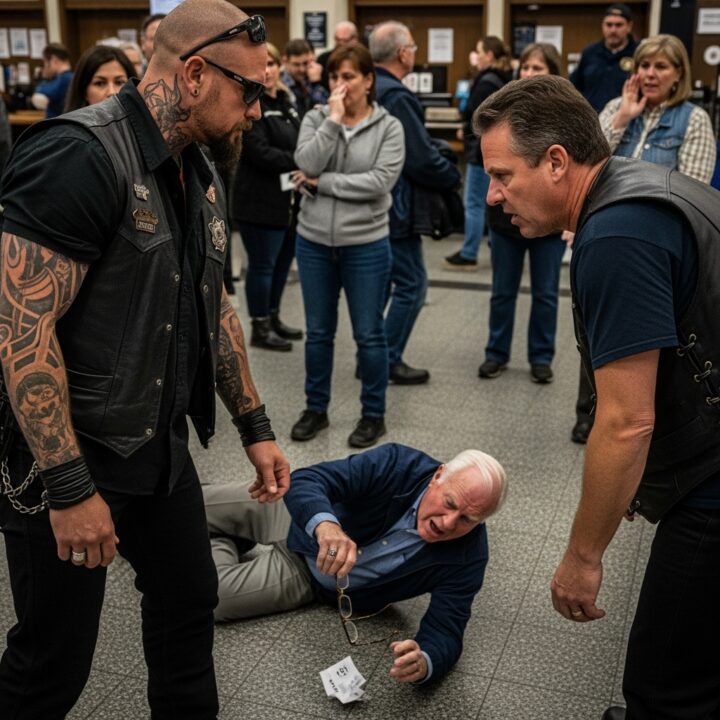
The biker didn’t rush. He didn’t shout.
He simply placed himself between the old man and the rest of the line.
Sleeveless shirt. Tattooed arms. Broad shoulders filling the narrow space. His face unreadable, jaw set, eyes calm in a way that made people uneasy.
“Give him a minute,” the biker said.
His voice was low. Controlled. Too controlled for comfort.
The man who had shoved the old man scoffed. “Mind your business.”
The biker didn’t move.
From the outside, it looked wrong. A large, intimidating stranger blocking a public line, refusing to step aside. Murmurs rippled through the crowd.
Someone whispered, “This is going to get ugly.”
Another said, “Why is a guy like that even here?”
The biker bent down—not all the way, just enough—to help the old man sit up. His movement was careful, deliberate. He handed him the cane.
The old man looked up, startled. “Thank you,” he whispered, embarrassed by the attention.
The biker nodded once and stayed where he was, standing now like a wall.
That’s when the tension spiked.
“Sir,” a woman snapped, “you can’t just block everyone.”
A security guard glanced over from the desk, already suspicious.
From their angle, it didn’t look like protection.
It looked like a threat waiting to happen.
The old man tried to stand again. His legs buckled slightly. The biker adjusted his stance, widening his feet, steadying him with one hand.
That single touch made things worse.
“He’s grabbing him now,” someone said sharply.
“Call security.”
The guard stepped closer. “Sir, I’m going to need you to step aside.”
The biker looked at him. Met his eyes.
“He fell,” the biker said. “I’m making sure he doesn’t fall again.”
“That’s not your job,” the guard replied.
The old man’s breathing grew shallow. Attention pressed down on him like weight. He wished—desperately—that he could disappear.
The man who had shoved him crossed his arms. “This is ridiculous. You people always make a scene.”
The biker didn’t respond.
Instead, he reached into his vest pocket.
Several people stiffened.
The guard’s hand hovered near his radio.
Phones tilted upward. Judgment arrived before understanding.
The biker pulled out his phone, typed one message, and slipped it back into his pocket.
“That’s it?” the guard asked. “You think texting someone fixes this?”
The biker said nothing.
He stayed right where he was.
The waiting stretched thin. Every second hummed with the risk of escalation.
Footsteps echoed from the entrance.
Then more.
Measured. Heavy. Familiar.
Three bikers walked in together. Not loud. Not aggressive. Sleeves short. Vests worn. Tattoos visible but unshowy.
They didn’t rush the line.
They simply stopped behind the first biker.
No words exchanged.
No signals.
Just presence.
The room changed immediately.
The guard paused. The murmurs died down. The man who had shoved the old man took an unconscious step back.
One of the bikers glanced at the old man. “You good, sir?”
The old man nodded slowly, still holding his cane, eyes wide.
The first biker finally stepped aside—just enough to let the old man move forward if he wanted.
No one complained now.
The line adjusted itself without being asked.
The power had shifted—not through force, but through quiet solidarity.
The guard cleared his throat. “Sir,” he said to the biker, voice softer, “you didn’t have to do that.”
The biker shrugged. “Someone did.”
That was all.
The old man reached the counter, helped by a clerk who suddenly couldn’t be kinder. His hands still shook, but his back was straighter now. Dignity reclaimed inch by inch.
The man who had shoved him stared at the floor. No apology came. Shame doesn’t always speak.
The bikers didn’t stay.
They stepped out of line and walked toward the exit together. No one stopped them. No one thanked them loudly.
As the door closed behind them, the room felt different. Quieter. Slower.
The old man finished his business and turned once, looking toward the exit that had swallowed the bikers.
He smiled faintly.
Later, someone would say, “They overreacted.”
But no one believed it.
Because everyone there had felt it—the moment when a fragile person stopped being invisible.
And that feeling stayed.
A paper number folded carefully back into an old man’s pocket.
A line that learned how to wait.
And the empty space where fear used to stand.