An Elderly Man Was Forced Out of a Nursing Home — When a Biker Came Back, the Entire Street Changed
They rolled his suitcase onto the sidewalk and told him visiting hours were over—then a biker stopped mid-ride and turned back.
The nursing home sat on a quiet American street, trimmed hedges and a flag that barely moved in the heat. It looked peaceful from a distance. Orderly. Respectable.
On the sidewalk out front, it wasn’t.
An old man stood hunched beside a single suitcase. Cardboard-thin jacket. Hands spotted and shaking as he tried to zip a pocket that wouldn’t close. His walker leaned awkwardly against the curb, one rubber tip worn down to metal.
A staff member hovered by the door, arms crossed. Not cruel. Just finished.
“We explained the policy,” she said, more to the air than to him. “You were notified.”
The old man nodded like he understood. He always nodded. Confusion had learned to imitate agreement.
Cars passed. A neighbor peeked through blinds. No one stopped.
The old man looked up at the building once, then back down at the suitcase, as if hoping the right order of actions might fix everything.
That’s when the motorcycle slowed.
The biker had already passed the driveway before something pulled at him—an instinct, maybe. He braked, glanced in the mirror, and saw the scene.
He turned the bike around.
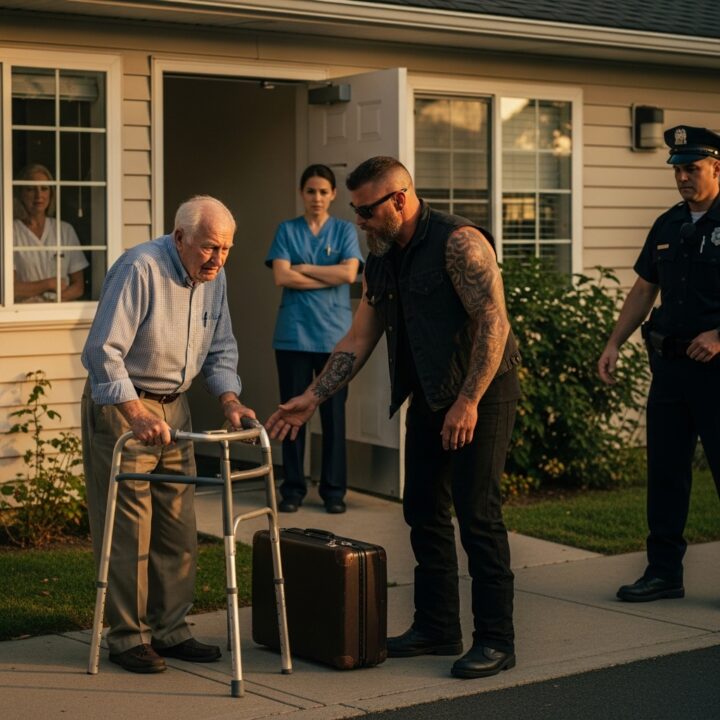
The engine cut off. The biker dismounted. Sleeveless shirt. Weathered arms marked with old tattoos. Sunglasses hiding his eyes. He didn’t rush. He walked toward the old man with measured, deliberate steps.
The staff member stiffened.
“Sir,” she said quickly, “this is private property.”
The biker nodded once and crouched near the suitcase. He didn’t touch the old man. He spoke softly. “You got somewhere to go?”
The old man blinked. His mouth opened. Closed. “My room,” he said, pointing weakly at the building behind him.
A neighbor stepped outside, phone already raised. Another whispered from across the street. A biker confronting staff didn’t look like help. It looked like trouble.
“We’ve already called transportation,” the staff member added, voice tightening. “You need to step away.”
The biker stood. Taller now. Broader. His silence read as defiance.
Someone said the word police.
The biker didn’t argue. He glanced at the old man’s shoes—one lace broken, taped together. He picked up the suitcase and felt how light it was. Too light for a life.
When he set it back down, a murmur moved through the small crowd. Assumptions snapped into place: intimidation, interference, threat.
The old man reached out and lightly touched the biker’s forearm. “Am I in trouble?” he asked.
The biker shook his head. “No, sir.”
No one else was convinced.
A security car pulled up, lights not flashing but present enough to matter. The officer stepped out, already scanning the biker’s tattoos, his stance, his hands.
“Sir,” the officer said, neutral but firm, “I’m going to need you to back away.”
The old man’s breathing quickened. Fear layered over confusion, thin and sharp. He tried to gather his suitcase, failed, and nearly fell.
The biker caught it before it tipped. The officer’s posture changed.
“That’s enough,” he said.
The biker raised both hands, open palms. “I’m not leaving him here.”
“That’s not your decision.”
The biker reached into his vest pocket.
The officer tensed. The crowd leaned in.
He pulled out his phone.
Typed one short message. No rush. No explanation.
He slipped the phone away and said one sentence—quiet, certain, impossible to mishear:
“Give me ten minutes.”
The officer shook his head. The staff member crossed her arms tighter. The old man stared at the ground.
Time slowed to something brittle.
Sound came first.
Engines. Not one. Several. Rolling in slow, then cutting off down the block. Boots on pavement. Voices low and familiar.
Heads turned.
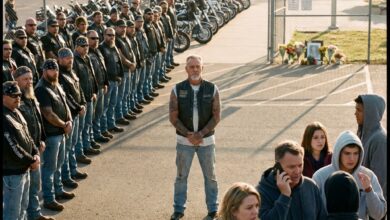
Motorcycles lined the curb—neatly, respectfully. Riders dismounted without urgency. Men and women. Different ages. Sleeves short. Tattoos visible. Helmets tucked under arms.
They didn’t surround anyone. They stood along the sidewalk, forming space instead of pressure.
The officer took a step back without realizing it.
An older woman from the group approached the old man, knelt to his eye level. “What’s your name, sweetheart?”
He told her. She smiled like she’d known it all along.
Another rider spoke quietly to the officer, handing over paperwork. Not arguments. Facts.
The street went silent. Windows opened. Neighbors stepped out.
Power shifted—not with force, but with presence.
The truth unfolded gently.
The biker had been a courier for years—medical runs, emergency transport, the unglamorous middle of care systems. The old man was a veteran whose benefits paperwork had been mishandled. An accounting problem dressed up as policy.
The group behind the biker weren’t muscle. They were advocates. Nurses. Caseworkers. Riders who made sure people didn’t disappear between forms and budgets.
Calls were made. Names were spoken. The officer listened. The staff member’s posture softened, embarrassment creeping in where certainty had been.
The old man was offered a chair. Water. Time.
No speeches followed. No victory claimed.
The biker knelt again and retied the broken lace with practiced fingers. “You’re not going anywhere tonight,” he said.
The old man nodded, tears gathering but not falling. Relief didn’t look loud on him. It looked like rest.
As the sun dipped lower, the street returned to its rhythm—cars passing slower now, neighbors lingering longer.
The biker mounted his bike last. He didn’t look back for approval. He didn’t wait for thanks.
He rode off quietly.
On the sidewalk, the suitcase stayed where it was—but upright now, handle fixed, no longer abandoned.
And the street remembered something it had almost forgotten:
Sometimes justice doesn’t arrive with sirens or speeches—
it arrives when someone turns around
and refuses to keep riding past.