Every Morning, a Biker Left Coffee at an “Empty” House — Until I Learned Who It Was For
I almost called the police the third time I saw him.
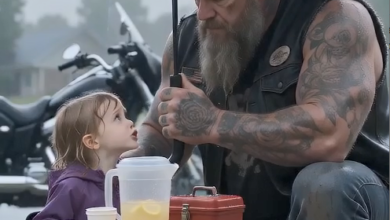
Not because he looked dangerous — though the bike was loud enough to wake half the street, and the jacket had that worn-in look of someone who’d lived through things they didn’t talk about. No. I almost called because of the cup. A white paper cup, still steaming, placed on the porch railing of the house next door like someone was expected home any minute. Like there was nothing strange about it at all.
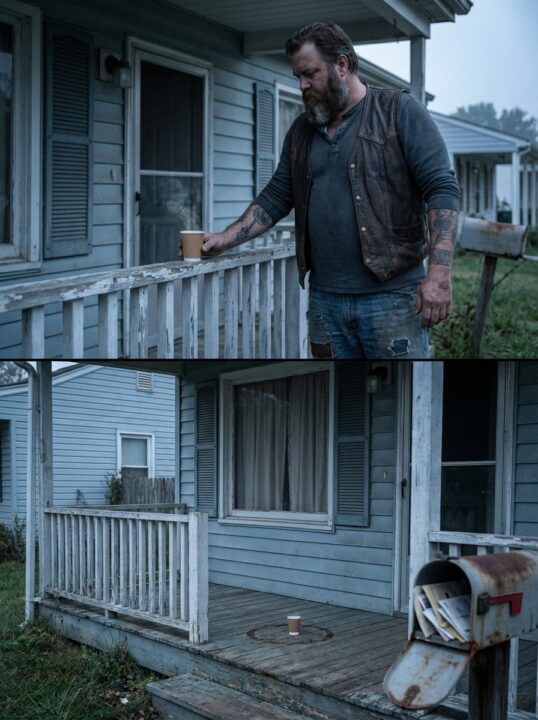
The house had been empty for years. Longer than I’d lived on Caldwell Street, anyway. The shutters were faded. The flower beds had gone to weeds. The mailbox still had a name on it — M. Harte — though the letters were barely readable, half-eaten by rust.
And yet every morning, 6:47, like clockwork: the rumble of the engine, the slight scrape of boots on pavement, the soft knock of the cup being set down.
He never knocked on the door.
He never looked around to see if anyone was watching.
He just placed it there. And left.
The first time, I thought he had the wrong house. The second time, I figured he was eccentric. But the third time — the third time I stood at my kitchen window in yesterday’s clothes, coffee in hand, watching him tuck the cup exactly between the two wooden posts like he’d done it ten thousand times before — I thought: who keeps doing something like this for a house with no one in it?
That question kept me up longer than it should have.
I’m not someone who gets involved in other people’s business. I want to say that upfront.
I moved to Caldwell Street two years ago after the divorce. Small house, manageable mortgage, good school district — Emma was seven, just starting second grade, and I needed everything to feel manageable for a while. The neighborhood was quiet. Old oak trees. Neighbors who waved but didn’t pry. Exactly what I needed.
My mornings ran tight. Up at six, lunches packed by six-fifteen, Emma out the door by seven-ten, me at my desk by eight. I worked from home three days a week doing medical billing, which sounds boring because it was, but it paid consistently, and consistent was what I was building toward.
The house next door — the Harte house — I’d noticed the first week. A neighbor down the street, Pat, mentioned it when she brought over a welcome casserole. “Nobody’s touched that place in years,” she said, with that particular tone people use when they want you to ask more but don’t want to be the one to volunteer it.
I didn’t ask.
I had enough going on. Emma was adjusting. I was adjusting. The toaster broke. The gutters needed cleaning. Life.
But then November came, and the biker appeared.
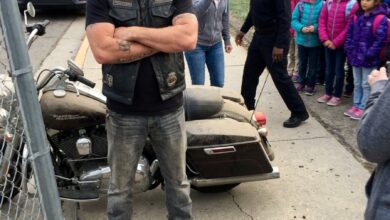
He showed up on a Tuesday — I remember because Emma had a fever and I’d kept her home, which meant I was at the window with tea instead of rushing to pack lunches. Dark jacket, dark helmet, a bike that sounded more expensive than my car. He pulled to the curb slowly, like he knew exactly where he was going but wasn’t in a hurry to get there.
He killed the engine.
He sat for a moment.
Then he reached into the left saddlebag, pulled out a white cup — the kind from a coffee shop, not a gas station — walked up the front path, and set it on the railing.
He stood there for maybe ten seconds. I couldn’t see his face.
Then he got back on the bike and rode away.
I asked Pat about it the following Saturday.
She was raking leaves at the edge of her driveway when I walked over, casual as I could manage. Mentioned I’d seen someone stopping at the old house. A biker. Cup of coffee.
She stopped raking.
“That’s Marcus,” she said. Just that. Like the name explained something.
When I pressed her, she went quiet in a way that felt careful. She told me Marcus had known the woman who lived there. Margaret Harte. That Margaret had passed, oh, it’s been a while now. That the house was tied up in some estate dispute, no family nearby to sort it out.
“But why the coffee?” I asked.
Pat looked at the house for a long moment. “Margaret loved her morning coffee,” she said. “Strong, no sugar. She’d sit on that porch every day before the neighborhood woke up.”
She didn’t say anything else. Just went back to raking.
That should have been enough for me. But it wasn’t.
Because the next morning, I watched more closely. And I noticed something I’d missed before. When Marcus set the cup down, he paused — just a breath, really — and adjusted it slightly. Moving it two inches to the left. To a spot that caught the morning light between the posts.
The exact spot where, I realized later when I looked at old Google Street View images, a wooden rocking chair used to sit.
He wasn’t leaving coffee on a porch.
He was leaving it in her chair.
I started waking up earlier.
I told myself it was for work. But at 6:40 I’d be at the window, coffee in hand, watching for him.
Some things you can’t stop paying attention to once you start.
The first small thing I noticed: he always came from the east. Never the same route — some mornings he came down Caldwell, some mornings he turned off Birch — but always from the east. Always the direction that faced the sunrise.
The second: the cups weren’t random. One morning, Emma was up early and stood beside me watching. “Mama, that says Lena’s,” she said, pointing. A local coffee shop two miles away. I knew the place — a small, old-school diner that opened at five-thirty for the early crowd. He wasn’t stopping at a drive-through. He was going somewhere specific. Her place.
The third: he was never on his phone. Not before, not after. He’d sit on the bike for those few seconds in complete stillness. No scrolling, no checking the time. Just sitting. Like those seconds were the whole point of the morning.
The fourth thing took me longer to notice. Two weeks in, there was a bad rainstorm. I assumed he wouldn’t come. But at 6:47 he pulled up, slower than usual. He reached into the saddlebag, and along with the cup, he pulled out a small piece of folded plastic — the kind of bag you’d use to protect something — and wrapped it around the cup before placing it on the railing. He’d thought about the rain.
That detail cracked something open in me.
Then there was the morning Emma ran out without her backpack and I went after her, and I passed close to the porch. Close enough to see the cup clearly. And written on the side in black marker, in someone’s handwriting — not a barista’s, it was too deliberate — were two words:
Good morning.
I stood there on the sidewalk long enough that Emma called back, “Mom, come on.”
I went inside and didn’t know what to do with what I was feeling.
Because by then I’d started to understand something. This wasn’t grief in the dramatic sense. No flowers, no crying at the curb, no performative mourning. This was just a man who had found the smallest possible way to keep a habit alive — her habit — because it was the only way he knew how to keep her somewhere in the world.
I finally talked to him on a Thursday, three weeks after I’d started watching.
I didn’t plan it. I’d taken Emma to school early for a field trip and came back to find him still at the curb, hands in his pockets, looking at the house. He wasn’t moving toward his bike. He was just standing there.
I almost kept walking. But something about the way he stood — not sad exactly, just present — made me stop.
“You knew her?” I asked.
He looked over. He was older than I’d expected up close. Sixties, maybe. Strong-looking but with tired eyes. He nodded once.
“Margaret.”
I asked how long he’d been coming by. He thought about it, like the number mattered.
“Four years this December.”
Four years. Every single morning. I did the math involuntarily — over fourteen hundred cups of coffee.
He told me they’d met at Lena’s Diner. He’d been a regular for years; she’d started coming after her husband passed, because she couldn’t stand quiet mornings alone. “She said coffee alone wasn’t coffee,” he said. “It needed to be somewhere that other people were.”
They became friends the slow way — the only real way. Sitting nearby, then together. Sharing sections of the newspaper. He learned she took hers strong, no sugar. She learned he took his black with one ice cube, which she thought was ridiculous.
They were friends for six years before she got sick.
He paused there. Didn’t explain what kind of sick. He didn’t need to.
“She’d sit on that porch every morning before anyone else was up,” he said. “Said it was the only quiet hour she could find.”
He looked at the railing. “I couldn’t keep going to Lena’s after. It didn’t feel right without her at the table.”
So instead, he came here.
Every day.
At the exact time she would have been sitting there.
I asked him about the handwriting on the cup.
He looked at me — not surprised I’d seen it, but something shifted in his expression. Like he’d been waiting for someone to ask, or maybe dreading it.
“She used to write that on my cup,” he said. “When I came in before she got there, the staff would save her seat. And she’d leave a note on my cup so I’d see it when I arrived.”
Good morning.
Two words. Written every day for six years.
I felt the back of my throat tighten.
“She wrote it?” I asked.
“In her handwriting. I copied it as close as I could.” He shook his head slightly. “It doesn’t look the same. Mine’s too even. Hers had this little lift on the G.”
He wasn’t telling me this for sympathy. He said it the way you say something true and ordinary. The way you say the weather changed, or the traffic was bad.
Then he told me the part I hadn’t known.
He’d never told Margaret how much those mornings meant to him. Not directly. He was that kind of person — showed up, didn’t say. And then her diagnosis came fast, and the last few months were hard, and there were people around — her daughter, her church friends — and he’d felt like the outside of something.
“I never said it to her,” he said. “I kept thinking there’d be more time.”
He went quiet.
The thing about grief that no one tells you: sometimes it isn’t about what you lost. It’s about what you never said while you had it.
I didn’t know what to offer him. There was nothing to offer. So I just stood there with him for a minute, the two of us looking at the old rocking chair spot, where a cup of coffee sat cooling in the morning light.
Then he said: “I think she knew anyway.”
And maybe that’s the part that broke me completely — because I believe he’s right. And I believe he needed to keep coming back until he believed it too.
Emma asked me that evening why I was quiet at dinner.
I told her I’d heard a story today. A sad one but also a good one.
She thought about that for a while, the way kids do when they’re deciding if the explanation is enough. Then she said, “Were they friends?”
“Really good ones,” I said.
She nodded like that settled something. “Then it’s a good story.”
She went back to her pasta.
Later, after she was asleep, I stood at the kitchen window for a while. The porch next door was dark. The cup was gone — it always disappeared by noon, though I’d never figured out how or why, and I’d decided to stop wondering.
Some things are allowed to stay a little mysterious.
I thought about writing two words on a sticky note and putting it on my own front door in the morning. Just to see how it felt.
Good morning.
Such a small thing. The smallest thing.
But the kind of small thing that, if you do it enough — if you mean it enough — outlasts everything else.
I left the window.
Turned off the kitchen light.
And somewhere two miles east, I imagined Marcus making coffee at Lena’s counter before the neighborhood woke up, buying two cups — one with an ice cube — then riding west into the sunrise.
Still showing up.
Still not saying.
Still there.