A Teacher Was Humiliated During a Parent Meeting — When a Biker Stood Up, the Entire Room Tensed
The insult hung in the air longer than it should have, and when no one stopped it, the teacher realized she was completely alone.
It was an ordinary parent-teacher meeting in a public elementary school somewhere in the American Midwest. Fluorescent lights hummed overhead. Folding chairs scraped against the tile floor. Coffee cups cooled untouched on a table near the wall.
Mrs. Eleanor Brooks stood at the front of the classroom, hands clasped, shoulders slightly tense. Mid-40s. Calm voice. The kind of teacher who stayed late, bought supplies with her own money, remembered every child’s name.
She was explaining a grading policy when a man in the second row interrupted her.
“That’s ridiculous,” he said loudly. “My son isn’t failing. You just don’t know how to teach.”
A few parents shifted uncomfortably.
Mrs. Brooks smiled politely, the way educators are trained to do. “I understand your concern, Mr. Carter. Let’s—”
He cut her off.
“No, you don’t. You sit up there acting superior, but you’re just a glorified babysitter.”
The word landed hard.
A hush fell over the room.
Someone coughed. Someone else stared at their phone. No one spoke up. No one defended her.
Mrs. Brooks felt her face warm. Her fingers tightened slightly, but she kept her posture straight.
“Please,” she said quietly, “let’s keep this respectful.”
Mr. Carter laughed.
“Respect is earned,” he said. “Maybe if you actually did your job—”
A chair creaked near the back of the room.
Slowly, deliberately, a man stood up.
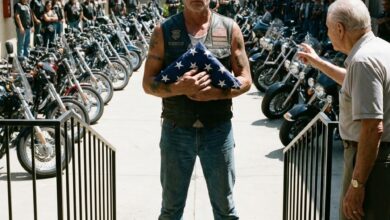
Leather vest. Short sleeves. Tattooed forearms folded at his sides.
The biker had been sitting silently the entire time.
And suddenly, every eye turned toward him.

The biker didn’t raise his voice.
That made it worse.
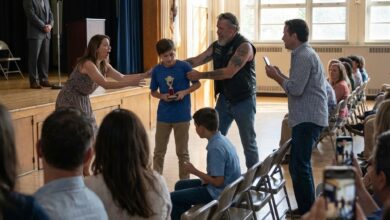
He stepped into the aisle, tall and broad, boots heavy against the tile floor. Dark sunglasses rested on his head. His expression was unreadable.
To the room, it looked like confrontation was coming.
“Hey,” someone whispered.
“What’s he doing?”
Mrs. Brooks’ heart sank.
The last thing she needed was a fight breaking out because of her.
Mr. Carter scoffed. “You got something to say, tough guy?”
The biker took another step forward.
Several parents stiffened. A woman near the door reached for her phone. Someone murmured about security.
From the outside, it looked exactly like a stereotype playing out—a biker about to intimidate a parent in a school classroom.
The biker stopped two rows away from Mr. Carter.
He didn’t point.
Didn’t threaten.
Didn’t touch anyone.
He simply stood there.
The silence grew uncomfortable, thick enough to press against the walls.
Mrs. Brooks glanced at the principal sitting near the window. He avoided her eyes.
The biker finally spoke, voice low, steady.
“You’re out of line.”
Gasps rippled through the room.
Mr. Carter shot to his feet. “Excuse me?”
Tension spiked instantly. Parents shifted chairs back. Someone whispered, “This is getting out of hand.”
Mrs. Brooks felt a knot of fear tighten in her chest—not for herself, but for what this might turn into.
The biker didn’t elaborate.
He just stood there, unmoving.
And to everyone watching, it felt like the calm before something dangerous.
The principal stood halfway, unsure whether to intervene.
“Sir,” he said cautiously, “let’s all calm down.”
Mr. Carter laughed again, louder this time. “You hear this? Now I’m being threatened by some biker in a school.”
Phones came out openly now.
A parent near the door whispered, “Should we call the police?”
Mrs. Brooks felt smaller with every second. The room had stopped being about education. It had become something uglier.
The biker reached into his vest pocket.
Several people inhaled sharply.
“Don’t,” someone said.
Mrs. Brooks’ pulse hammered.
Instead of a weapon, the biker pulled out his phone.
He typed briefly.
Then he lifted his head and said one short sentence—clear, calm, undeniable.
“My daughter is in this class.”
The room froze.
No explanation followed.
He ended the call and slipped the phone back into his vest.
The silence that followed was almost unbearable.
No one knew who he’d called.
No one knew what would happen next.
They only knew the situation had crossed a line.
And now, everyone was waiting.
Footsteps sounded in the hallway first.
Measured. Purposeful.
Then voices—familiar ones.
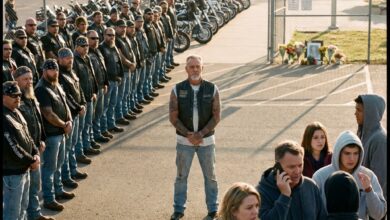
Two parents entered the classroom late. Then another. And another.
They weren’t wearing leather vests. They weren’t intimidating.
They were parents.
One woman approached Mrs. Brooks and placed a stack of papers gently on her desk.
“These are emails,” she said. “From you. Showing how often you’ve tried to help our kids.”
A man near the door spoke next. “My son struggled all year. She stayed after school twice a week. For free.”
Another parent added, “She paid for his supplies when we couldn’t.”
The room shifted.
The biker remained standing, silent.
Mr. Carter’s smile faded.
The principal straightened in his chair.
The power in the room changed—not through force, but through presence and truth.
Mrs. Brooks’ hands trembled slightly as she realized she wasn’t alone anymore.
Mr. Carter cleared his throat. “I didn’t know all that,” he muttered.
No one responded.
Mrs. Brooks looked at the biker for the first time, really looked at him.
He met her eyes and gave a small nod.
That was it.
He didn’t speak again.
When the meeting ended, he walked out quietly, blending into the hallway noise, just another parent picking up a child.
Later, Mrs. Brooks found a folded note on her desk.
Thank you for seeing my daughter.
No name.
Just that.
She sat alone in the empty classroom, fluorescent lights humming softly, holding the note in her hands.
And for the first time that night, she breathed.