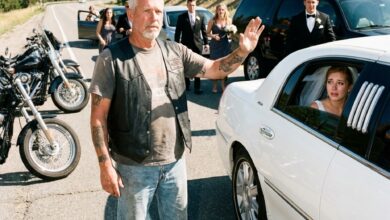
A Puppy Left in a Cardboard Box — The Biker Who Knelt Under Suspicious Eyes
No one noticed the puppy crying in the cardboard box—until a biker stopped his engine and knelt down while everyone else stepped back.
The box sat near a loading dock behind a strip mall in a small American town—creased, damp at the corners, held together by hope and cheap tape. Inside, something moved. A whimper. Thin. Broken. Too quiet to survive the afternoon heat.
People passed. A delivery driver glanced once and kept walking. A couple argued softly about being late. Indifference moved faster than concern. Someone muttered that it was probably trash. Another said it might be dangerous. Fear dressed up as caution.
The puppy—no older than six weeks—pushed its nose against the cardboard seam. A tiny body trembling, ribs showing, eyes still learning the world. The box had been left in the sun. Whoever dropped it there had already decided the outcome.
Then the sound cut through everything.
A motorcycle rolled in low and steady. Not loud. Not showy. Just heavy enough to make people look.
The rider killed the engine and swung a leg over. Leather vest. Worn boots. Sleeves rolled. A face that didn’t ask permission.
He walked straight to the box and knelt.
And the crowd—what little of it existed—stiffened.
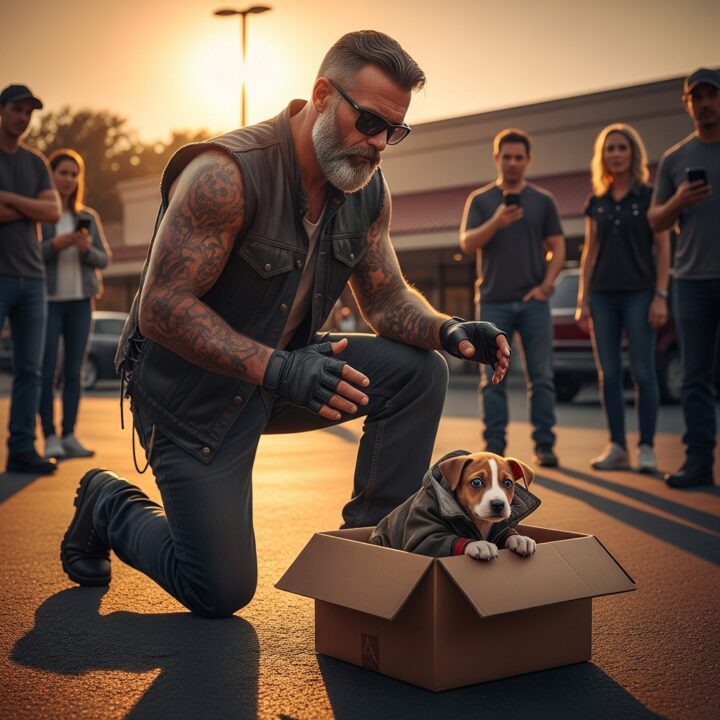
The biker didn’t hesitate. He reached for the box.
Someone shouted, “Hey—don’t touch that!”
Another voice, sharper: “What are you doing, man?”
The biker lifted the cardboard flap. The puppy cried louder now, panicked by the sudden light. A sound that scraped the inside of the chest.
To the onlookers, it looked wrong. A biker crouched low. Hands inside a box. A posture that invited suspicion.
A woman stepped forward, phone already raised. “Call someone,” she said. “Animal control. Or the cops.”
The biker didn’t argue. Didn’t explain. He slid his jacket off slowly and wrapped it around the puppy with practiced care. Gentle hands from a man built like a warning sign.
That only made it worse.
“He’s stealing it,” someone said.
“He’s gonna hurt it,” another insisted.
The biker stood, jacket bundled tight, the puppy’s head barely visible. The crowd closed in, fear feeding on itself. A security guard from the store jogged over, hand on his radio.
“Sir, put it down,” the guard said. “Step away.”
The biker looked at him once. Calm. Measured. Eyes that had seen escalation before.
“No,” he said.
Just that.
The word landed heavy.
Phones came up. Someone dialed 911. Judgment spread faster than facts.
The heat pressed down. Sirens felt inevitable even before they were heard. Every second stretched thin.
The puppy whimpered again, weaker now. The biker adjusted his grip, shielding it from the sun with his body. A wall made of leather and silence.
The security guard stepped closer. “Sir, last warning.”
The biker didn’t move. He set the puppy down gently at his feet—still wrapped, still breathing—and pulled his phone from his pocket.
He typed once. Then twice.
He raised the phone to his ear.
“Yeah,” he said quietly. “It’s me.”
He listened. Nodded. “No. I’m not leaving.”
He hung up.
No one knew who he’d called. The waiting became unbearable.
A child tugged at her mother’s sleeve. “Mom, the dog’s shaking.”
The biker crouched again, one knee to the ground, hand resting near the puppy—not touching now, just close. Restraint where force was expected.
Then, faint but unmistakable—
Engines.
The sound came first. Not loud. Not aggressive. Controlled. Familiar. Intentional.
Motorcycles rolled into the lot and parked in a clean line. One by one. No revving. No drama. Discipline without display.
Men and women dismounted. Different ages. Same calm. Same quiet awareness. A presence that rearranged the air.
They didn’t surround anyone. They stood back. Watched. Waited.
The security guard lowered his radio. The phones dipped. The crowd went still.
One of the riders—a woman with gray in her braid—stepped forward and spoke to the guard like they’d met before. Another rider nodded toward the box, then toward the biker still kneeling.
No one raised a voice.
A patrol car arrived. Doors opened. Officers took in the scene—the line of bikes, the kneeling man, the small wrapped shape on the ground. Context finally arrived.
One officer crouched near the puppy. “How long’s it been here?”
“Too long,” the biker said.
That was all.
Animal control arrived next. A blanket. Water. A scanner. The puppy’s heartbeat fluttered, then steadied.
Someone whispered, “He saved it.”
No one corrected them. The biker didn’t accept it.
It came out slowly, naturally—no announcement, no defense. The biker volunteered with a rescue. Had transported animals like this before. Knew how fast heat could kill. Knew when waiting meant losing.
The security guard cleared his throat. Apologized without saying the word. The woman with the phone lowered it completely. Eyes avoided the biker’s.
The puppy was lifted gently into a carrier. Safe now. Alive.
The biker stood, picked up his jacket, and stepped back. One of the riders clapped him on the shoulder—once. Quiet. Done.
As they left, engines starting one by one, the biker paused. He looked back at the cardboard box—empty, collapsed, harmless now.
He kicked it into the trash.
No speech. No lesson. Just a small correction made in time.
The lot returned to normal. Cars moved. People dispersed. But something stayed behind—the uneasy understanding of how close everyone had been to letting it end differently.
The last thing anyone saw was the biker riding away, posture steady, mirrors catching the sun.
And a puppy breathing—finally—out of danger.