A Mother Pushing a Wheelchair Through a Crowded Sidewalk — Until a Biker Stopped the Traffic
No one noticed the mother at first — not until the wheelchair jolted against the curb and her voice cracked, begging strangers to slow down.
It was late afternoon in a busy American downtown. Cars crept forward, horns snapped impatiently, engines idled hot under the sun. People hurried past with phones pressed to their ears, coffee cups sweating onto the concrete. The sidewalk pulsed with motion — too fast, too loud, too careless.
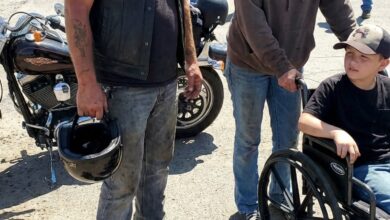
The woman pushed the wheelchair with both hands, her shoulders tight, her jaw clenched as if holding back something heavier than words. The boy in the chair couldn’t have been more than ten. His legs were still. His hands rested in his lap, thin fingers curled inward. A faded baseball cap shaded his face, but not the fear in his eyes.
The crosswalk light flickered.
Red.
Green.
Red again.
Traffic surged forward.
She hesitated — then tried anyway.
The wheelchair edged off the curb. A car swerved too close. Someone yelled. Another driver slammed the brakes and leaned on the horn, face twisted in anger.
“Watch it!”
“Get out of the road!”
“What is she doing?”
The mother froze, trapped between moving metal and human impatience. Her breath came fast. She was out of options, out of time, and completely alone.
That was when the motorcycle engine cut through the noise.
Not roaring.
Not racing.
Just close.
Very close.
People turned.
A biker had pulled up beside the crosswalk.
No one knew yet why he had stopped — or what he was about to do.
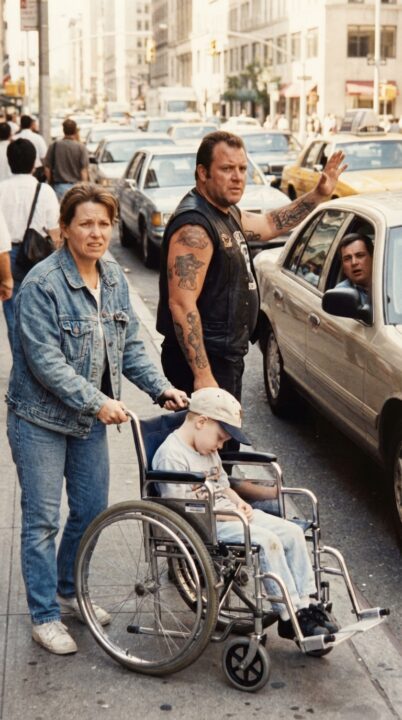
The biker dismounted without removing his helmet.
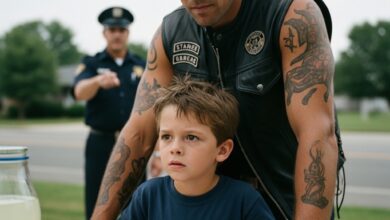
Sleeveless leather vest. Broad shoulders. Sun-worn arms marked with old tattoos. Heavy boots hitting pavement with deliberate steps. He moved straight toward the edge of the road.
And traffic stopped.
Not because of a signal.
Because he stepped into it.
Cars slammed brakes. Horns exploded. A delivery truck driver shouted something ugly out the window. Phones came up, recording.
“Hey!”
“Is this guy crazy?”
“Call the police!”
The biker raised one hand — not in greeting, but flat, steady, unmistakable.
Stop.
To anyone watching, it looked reckless. Aggressive. Like a confrontation waiting to happen. A biker blocking traffic in the middle of a crowded sidewalk was not a comforting sight.
The mother stiffened. Her eyes darted between the cars and the man now standing inches from moving steel. She pulled the wheelchair back slightly, unsure whether this stranger was help — or another danger.
“Ma’am,” someone shouted from behind her, “get away from him!”
Security guards from a nearby building stepped closer. One already had his radio in hand. Bystanders whispered, filming, narrating their own versions of the story.
A biker had taken over the street.
A biker was causing a scene.
A biker was about to make things worse.
The man didn’t argue.
Didn’t raise his voice.
Didn’t look at the crowd at all.
He only glanced back once — not at the cameras, but at the wheelchair.
Then he took one more step forward, placing himself fully between the cars and the mother.
The tension snapped tight.
Traffic backed up in every direction. Drivers leaned out of windows, furious now, shouting demands and threats. The guards moved closer, forming a loose semicircle around the biker.
“Sir, step out of the road!”
“You’re obstructing traffic!”
“This isn’t your place!”
The mother’s hands shook on the wheelchair handles. Her son looked up at her, eyes wide, confused by the sudden stillness — by the man standing where cars were supposed to be.
The biker finally spoke.
Just once.
Low. Calm. Certain.
“Give them a minute.”
That was it.
No explanation. No justification.
One of the guards reached for his phone. Another scanned the crowd, calculating what might happen next. Someone nearby muttered that bikers were always trouble. Someone else nodded.
The man took a step back — not away from the road, but closer to the wheelchair. He didn’t touch it. Didn’t touch the boy. He simply stood there, anchored, as if daring the chaos to move first.
Then he reached into his pocket.
Not quickly.
Not dramatically.
He pulled out his phone, typed a short message, and slipped it back.
No one knew who he’d contacted.
No one knew what he was waiting for.
The mother swallowed hard, her chest tight, her world narrowed to the space between that biker’s back and the first car in line.
The air held its breath.
And then — somewhere behind the noise, another sound began to rise.
The sound reached them before the sight did.
Not sirens.
Not shouting.
Engines.
Multiple.
Low and steady, rolling in from the far end of the street like a distant tide. Heads turned. Phones tilted. Even the angriest drivers paused, their horns falling silent one by one.
The biker in the road didn’t react.
He didn’t look back.
He simply shifted his stance — feet planted, shoulders squared, as if he had expected this moment all along.
Two motorcycles appeared first, easing to a stop behind the backed-up cars. Then four more. Then a line long enough to make the sidewalk feel suddenly narrow. They parked neatly, engines cutting off almost in unison. No revving. No show.
Just presence.
Men and women dismounted. Different ages. Different bikes. Same quiet discipline. They stood along the curb, spaced out, hands visible, eyes alert. No one spoke.
The crowd changed.
Security guards stopped advancing. Drivers rolled their windows up. A man who’d been yelling moments ago sank back into his seat. The power in the space shifted — not through force, but through certainty.
One of the bikers, older, gray threaded through his beard, stepped forward. He didn’t address the guards or the drivers. He spoke to the mother instead.
“You ready?” he asked gently.
She nodded, tears streaking down her face, unable to speak.
The biker in the road raised his hand again.
This time, no one questioned it.
Traffic stopped completely.
The crosswalk light turned green.
Together, slowly, they moved.
The mother pushed. The boy watched the world pass at walking speed. One biker walked ahead, scanning the road. Another stayed behind, shielding them from the cars. The man who had first stepped into traffic walked beside the wheelchair, close enough to protect — far enough to respect.
No one filmed now.
No one spoke.
They crossed the street as if time itself had slowed to let them through.
When the wheelchair reached the other curb, the biker lowered his hand.
Cars waited.
No one complained.
Only when the danger had passed did the truth surface — not announced, not explained, but quietly understood.
The biker who had stepped into traffic removed his helmet at last. Sweat darkened his hairline. His eyes were tired, steady, familiar with responsibility. Someone whispered his name — not because he was famous, but because they’d seen him before.
He volunteered with a local adaptive sports program.
He escorted veterans through parades when crowds got overwhelming.
He showed up when people in wheelchairs needed to move through places not built for them.
This wasn’t a stunt.
It was a habit.
The mother reached for his arm, fingers trembling.
“I didn’t know what else to do,” she said, voice breaking. “Everyone just kept driving.”
He shook his head once.
“You did what you could,” he replied. Nothing more.
The boy looked up at him from the wheelchair.
“Are you a police officer?” he asked.
The biker smiled — just slightly.
“No,” he said. “Just someone who stops when he should.”
The other bikers began to disperse, mounting up, engines humming back to life. No speeches. No congratulations. One by one, they rolled away, blending back into traffic, into anonymity.
The street resumed its rhythm.
Cars moved.
People walked.
Life continued.
But something lingered.
The image stayed with those who had witnessed it — a man standing in traffic, not to claim power, but to give it away. A line of bikers who didn’t intimidate, didn’t threaten, didn’t demand — they simply made space for someone who needed it.
The mother watched the last motorcycle disappear down the road. She wiped her face, squared her shoulders, and continued down the sidewalk with her son.
No cameras followed her.
No headlines were written.
Just a quiet crossing, made possible by people most had been taught to fear.
And long after the engines faded, the question remained — not spoken, but heavy:
How many times had help looked dangerous…
only because no one stayed long enough to see what it was really doing?