A man shoved a boy off the crosswalk — because the traffic light was broken and a truck was coming
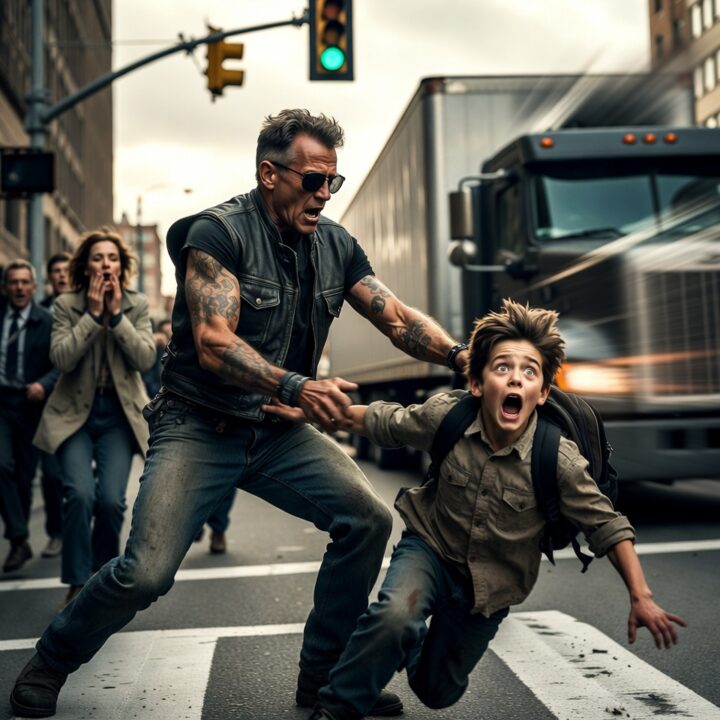
A biker shoved a 12-year-old boy out of a crosswalk at 4:17 p.m. — and exactly 6 minutes later, the entire intersection was sealed off by police.
Time stopped.
The boy hit the asphalt hard, backpack skidding across the white stripes. His palms scraped raw. His breath came out in short, panicked bursts.
Cars slammed their brakes.
Pedestrians froze mid-step. A coffee cup slipped from someone’s hand and shattered on the curb.
The man who shoved him stood in the road.
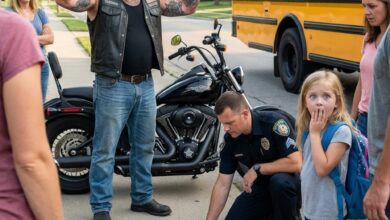
Mid-50s. White American. Leather biker jacket open at the chest. Oil-stained jeans. Heavy boots planted wide like he was bracing for impact. There was a faint smell of gasoline and old whiskey clinging to him — not drunk, but lived-in.
His jaw was tight. Eyes sharp. No apology.
To everyone watching, he looked dangerous.
The boy — skinny, pale, maybe twelve — pushed himself up on shaking hands. His lower lip trembled. One knee bled through his jeans. His eyes filled with tears, not from pain, but shock.
A woman screamed, “You just assaulted a child!”
Someone else shouted, “Call the cops!”
Behind them, the traffic light flickered.
Green. Yellow. Green again.
Wrong.
His name was Tom Halvorsen.
Once, long before the leather jacket and the road-worn face, Tom had been a highway incident response supervisor in Arizona. He’d worked crash scenes in heat that melted boots to asphalt. He’d pulled bodies from under trailers. He’d watched children die because a signal failed, or a driver assumed green meant safe.
Ten years earlier, a drunk driver ran a light that shouldn’t have been green.
Tom’s wife never made it home.
After that, he left the job. Sold the house. Bought a motorcycle.
He didn’t trust systems anymore.
Only instincts.
And today, his instincts were screaming.
The boy’s mother rushed forward, fury breaking through fear.
“What is wrong with you?!” she yelled, grabbing her son to her chest. “You pushed him!”
Tom didn’t raise his voice.
“Ma’am,” he said.
She cut him off.
“You don’t touch my kid!”
The crowd closed in. Phones came up. Someone was already streaming.
A man pointed at Tom’s jacket. “Figures. Biker thinks he owns the road.”
Tom glanced past them — at the light, stuttering again. At the slight downhill slope. At the long, empty stretch where vehicles picked up speed.
He spoke louder now.
“That signal’s malfunctioning.”
No one listened.
The boy sniffed and whispered, “I had the walk sign.”
Tom swallowed.
“So did my wife,” he said quietly.
A delivery driver leaned out of his car window.
“You touch him again, I’ll knock you out!”
Another man stepped closer, chest puffed.
Tom felt the shift — the moment when a crowd decides who the villain is.
Hands clenched. Voices overlapped.
The boy tried to step back into the crosswalk.
Tom lunged forward and grabbed the strap of the kid’s backpack.
“Don’t move!” he barked.
That did it.
Someone shoved Tom in the shoulder.
A fist raised.
The tension snapped tight like a wire about to break.
Tom didn’t swing back.
He just stood there, body angled toward the road, counting under his breath.
Tom reached into his jacket and pulled out his phone.
One call.
No saved name.
“Yeah,” he said, calm but urgent. “Signal failure. Crosswalk at Jefferson and 8th.”
A pause.
“Truck traffic heavy. Someone’s going to get hit.”
He hung up.
Put the phone away.
Then he stepped back into the crosswalk — alone.
The crowd stared.
“What are you doing?” someone yelled.
Tom didn’t answer.
He watched the road.
Six minutes later.
Sirens.
Police cruisers skidded to a stop, blocking the intersection. A city traffic truck followed, lights flashing. An unmarked SUV pulled up hard.
At the same time, a semi-truck crested the hill.
It didn’t slow.
The light turned green again.
The truck barreled through.
Exactly where the boy would’ve been standing.
People gasped as the wind from the trailer ripped through the crosswalk.
An officer stared at the signal, then at Tom.
“Who reported this?”
Tom raised his hand.
A traffic engineer jogged over, eyes wide.
“This light’s been misfiring all day,” he said. “We just lost remote control ten minutes ago.”
The boy’s mother covered her mouth.
Her knees buckled.
A man who’d been shouting earlier stepped toward Tom.
“You could’ve explained.”
Tom met his eyes.
“I tried.”
Another officer approached fast.
Sir, step back—”
Before the sentence finished, a third man appeared from the SUV.
Early 30s. Clean-cut. Badge clipped to his belt.
“Dad?”
Tom turned.
His son.
A city traffic enforcement lieutenant.
The crowd went silent.
The lieutenant looked at the signal, then at the truck marks on the asphalt.
He exhaled slowly.
“He saved a life,” he said.
Someone muttered, “Damn.”
Police took statements.
No charges.
Instead, the officer who’d first arrived turned to the crowd.
“Pushing someone is wrong,” he said. “But failing to act would’ve been worse.”
The signal was shut down. Barricades went up.
An official citation was issued — not to Tom, but to the city department that delayed repairs.
Justice didn’t come loud.
It came accurate.
The boy stood in front of Tom, holding his scraped hands.
“I’m sorry,” the boy said softly. “I thought you were mad at me.”
Tom knelt, eyes level.
“I was scared for you,” he replied.
The boy nodded, understanding something older than his years.
The sun dipped lower, turning the road gold.
Tom walked back to his motorcycle.
As he pulled on his helmet, the boy’s mother called out.
“Thank you,” she said, voice breaking.
Tom lifted one hand in acknowledgment.
Then he rode away.
Quietly.
If you had been standing there…
would you have seen danger — or a warning?
Tell us what you would’ve thought in the comments.