A Group of Teens Attacked a Homeless Old Man — Five Minutes Later, an Engine Silenced the Entire Block
The first punch landed before anyone decided whether to look away, and by the time they did, the old man was already on the ground.
It happened on a narrow side street just off a busy American avenue—one of those blocks people cut through without slowing down. Neon from a liquor store flickered against cracked pavement. Trash bags waited by the curb. The night smelled of rain and stale food.
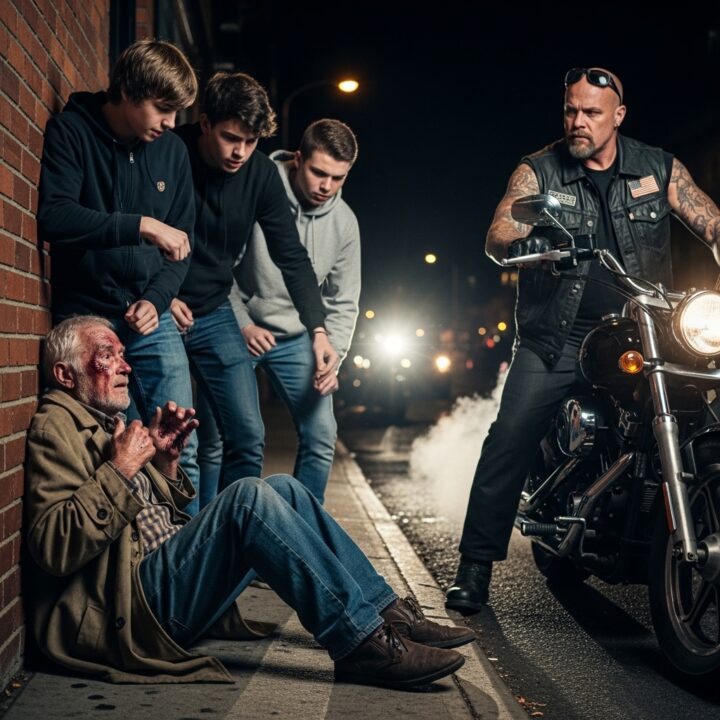
The old man had been sitting against a brick wall, his back hunched, hands wrapped around a paper cup with a few coins inside. His coat was too thin for the cold. His beard was gray, uneven, and wet from mist in the air.
Four teenagers circled him.
They weren’t desperate. They weren’t hungry. They were loud, energized, careless in the way youth sometimes mistakes cruelty for entertainment.
“Get up, old man.”
“Bet he’s got something on him.”
The old man raised one hand, palm open—not to fight, just to shield his face.
Someone kicked the cup.
Coins scattered and rolled into the gutter.
People passed at the corner. A couple slowed. A car idled at the light. No one stepped in. No one shouted. A few phones lifted briefly, then lowered again.
Fear sat heavy in the old man’s chest—not just of pain, but of being invisible.
Then, from the far end of the block, an engine growled to life.
Low. Steady. Close.
A motorcycle turned onto the street, its headlight cutting through the darkness—and every head snapped toward it.
The biker didn’t rush.
That alone made it worse.
He rolled forward slowly, controlled, the sound of the engine echoing between buildings. He stopped ten feet away and killed the motor.
Silence dropped hard.
He was a white American man in his early 40s. Broad shoulders. Short-sleeve black vest. Tattooed arms exposed to the cold. Dark glasses hid his eyes even at night.
To the teenagers, he looked dangerous.
To the bystanders, he looked like escalation.
“Back up,” one of the teens muttered, suddenly less confident.
The biker swung a leg off the bike and stepped forward.
He didn’t yell.
He didn’t threaten.
He just stood there—solid, unmoving, blocking the space between the group and the old man.
People shouted from the sidewalk.
“Hey! Leave it alone!”
“Don’t get involved!”
“Someone call the cops!”
One of the teens laughed nervously. “Mind your business, man.”
The biker said nothing.
He took one more step forward.
From the outside, it looked like intimidation. Like a biker about to start a street fight. Phones came out again. Someone dialed 911.
The old man tried to crawl backward, terrified now of everyone.
The biker knelt—not aggressively, but deliberately—placing himself between the old man and the group.
The misunderstanding hardened.
Now the biker wasn’t stopping violence.
He was the violence.
A police siren wailed somewhere nearby—not close enough to help, but close enough to raise the stakes.
The teenagers backed up, then circled wider, adrenaline still buzzing.
“Get up, biker,” one of them snapped. “You think you’re tough?”
The biker didn’t rise.
He reached into his vest.
Someone screamed.
“Gun!”
People scattered backward. A car honked. The old man flinched, covering his head.
The biker pulled out his phone.
Typed once.
Pressed call.
He spoke calmly, evenly—six words that carried no emotion at all.
“Yeah. Corner of Maple and Third.”
He ended the call and slipped the phone away.
No one knew who he’d called.
The air felt tight. Like a held breath.
The teens hesitated. The bystanders whispered. The old man’s hands shook uncontrollably.
For a moment, it felt like everything could tip—one shove, one wrong word, one panic-driven decision.
The biker stayed kneeling.
Waiting.
The sound came first.
Not sirens.
Engines.
Plural.
Low, synchronized, unmistakable.
Two motorcycles turned onto the block. Then another. Then another.
They parked in a clean line behind the first bike.
The riders dismounted with quiet precision.
No shouting.
No rushing.
No threats.
Just presence.
They wore similar vests. Similar posture. Men and women, late 30s to 50s, faces calm, eyes sharp.
One of them spoke—not loudly, but clearly.
“That’s enough.”
The teenagers froze.
Power shifted without a single punch thrown.
A woman from the biker group stepped toward the old man, draped a heavy jacket over his shoulders, and helped him sit up properly.
Another biker looked at the teens. “You want to explain why you’re four-on-one?”
No one answered.
Police cars finally arrived, lights washing over the street. Officers took control quickly now—too quickly to pretend they hadn’t been late.
The teens were separated. Statements were taken.
The crowd watched in silence, ashamed, uncertain.
One officer crouched beside the old man, speaking gently, asking his name.
Another turned to the first biker.
“You call for backup?”
The biker nodded once.
“Didn’t want it to get worse.”
That was all.
The old man was helped to his feet. An ambulance was offered. He declined, embarrassed but safe.
He looked at the biker, eyes glassy.
“Why… why’d you stop?” he asked.
The biker shrugged. “Because nobody else did.”
He didn’t stay for thanks.
The bikers mounted up and left one by one, engines fading into the city noise.
The street returned to normal.
But the image lingered—a man kneeling in the dark, silent, steady, refusing to look away.
And the knowledge that courage doesn’t always shout.
Sometimes, it just shows up—and holds the line.