A Biker Yelled at a Trash-Picking Boy — Because the Child Was Stepping Into a Rain-Soaked Live Wire Zone
“HEY! STOP RIGHT THERE!”
The shout tore through the rain like a slap.
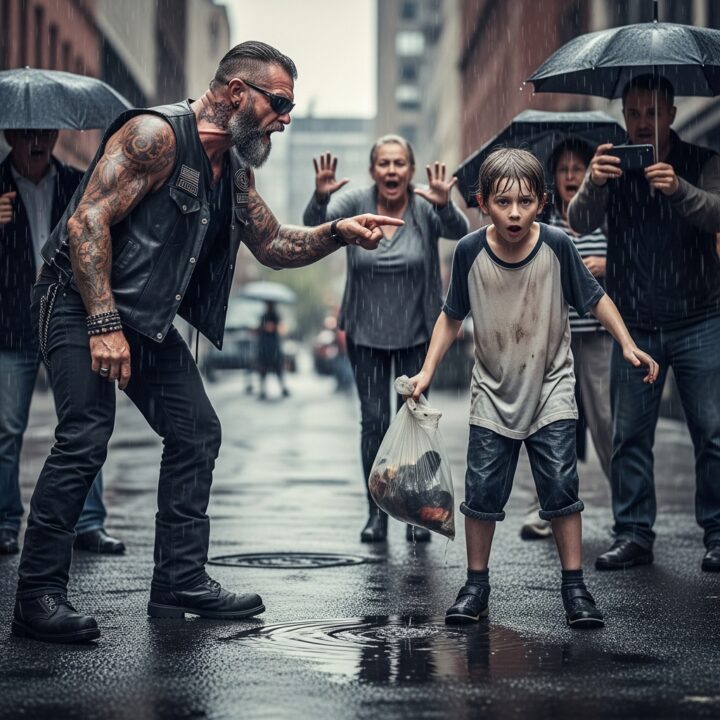
A small boy froze mid-step, one foot lifted above a shallow puddle, a plastic sack of recyclables hanging from his thin wrist. Across from him, a biker stood in the street, arm outstretched, voice loud, sharp, unforgiving.
People turned.
A woman gasped.
Someone muttered, “What kind of man yells at a kid like that?”
The biker looked exactly like trouble. Sleeveless black shirt clinging to his broad chest. Tattoos running down his arms. Dark sunglasses despite the gray sky. His motorcycle idled nearby, engine growling low and impatient.
The boy couldn’t have been more than ten. Rain soaked his clothes. Mud streaked his sneakers. He hugged the bag tighter, eyes wide, confused, embarrassed.
“I didn’t do anything,” the boy said softly.
“Don’t move!” the biker barked again, stepping closer.
That was when the crowd reacted.
“Back off!”
“Leave the kid alone!”
“He’s just picking trash!”
A middle-aged man stepped between them. A woman pulled out her phone. Another shook her head in disgust.
The biker didn’t explain.
Didn’t lower his voice.
Didn’t soften his face.
He just stood there, blocking the boy’s path, rain dripping from his beard, jaw clenched like a man about to explode.
And to everyone watching, he already had.
“Sir, calm down,” someone said.
“You’re scaring him.”
The biker ignored them.
His eyes weren’t on the boy’s face.
They were fixed on the ground.
The puddle shimmered unnaturally. Rain rippled across it, but beneath the surface, something darker pulsed—almost invisible unless you knew what to look for.
The biker took one step closer, then stopped himself. His boots stayed planted on dry concrete.
“Kid,” he said, voice lower now, urgent. “Drop the bag.”
The boy shook his head. “I need it.”
A thin wire lay half-submerged in the water, snaking out from a broken utility box on the side of the building. Rainwater pooled around it, turning the pavement into a silent trap.
No one else noticed.
They were too busy judging the man who looked like a bully.
The biker reached into his vest and pulled out a small metal tool—scarred, old, the kind electricians carry. His hand trembled as he held it, not from anger, but restraint.
“Sir, put that away,” someone warned. “Police are coming.”
The biker didn’t look up.
“Kid,” he said again, slower. “If you step there, the water’s live.”
The word barely registered.
“Live?” the boy whispered.
A gust of wind pushed the puddle outward. The wire shifted, sending a faint spark beneath the surface—so quick only one or two people caught it.
“What was that?” someone asked.
The biker’s shoulders tensed.
“Everybody back,” he said, louder now. “NOW.”
The boy’s foot hovered inches above the water.
Time stretched thin.
The biker lunged—not toward the boy, but past him.
He grabbed the collar of the child’s jacket and yanked him backward, hard enough that the boy stumbled and fell onto dry pavement.
The crowd erupted.
“That’s assault!”
“You can’t touch him!”
“Someone grab that guy!”
At the exact moment the boy’s foot left the puddle, a sharp crack split the air.
The water flashed.
A surge rippled through the puddle, snapping against the metal pole beside it. A pop. A hiss. The unmistakable sound of electricity meeting rain.
People screamed and jumped back.
The biker didn’t.
He dropped to one knee, using the tool to hook the wire and drag it free—careful, precise, every muscle screaming with control. Rain soaked him. Sparks danced inches from his glove.
“Don’t come near!” he shouted.
Someone finally saw it.
Then another.
“Oh my God,” a woman whispered. “It’s live.”
The boy stared, frozen, realization crashing over him. His hands shook violently now.
The biker threw the wire aside, away from the puddle, then collapsed back onto his heels, breathing hard.
Sirens wailed in the distance.
The boy scrambled to his feet and ran—not away, but back toward the biker, stopping just short.
“I—I didn’t know,” he said, voice breaking.
The biker stood, towering, rain dripping from his sleeves. He looked around at the crowd—faces pale now, eyes full of something heavier than anger.
“I used to work line repair,” he said quietly. “Lost a buddy to water like that.”
No one spoke.
A woman lowered her phone, hands trembling.
The man who had stepped between them earlier looked away.
Police and utility workers arrived within minutes. The area was taped off. Power cut. Danger gone.
One officer approached the biker. “We got calls saying you were harassing a child.”
The biker nodded once. “I get it.”
The officer glanced at the puddle, then at the boy. “Looks like you saved him.”
The biker shrugged. “Didn’t feel like saving. Felt like stopping something bad.”
The boy’s mother arrived, breathless, eyes wild with fear. She pulled her son into her arms, sobbing. When she looked up at the biker, tears streamed down her face.
“Thank you,” she whispered.
The biker didn’t respond. He just stepped back, giving them space.
Redemption didn’t come with applause.
It came with silence—and shame.
The rain slowed to a drizzle.
The crowd thinned. Conversations resumed, quieter now. People walked around the taped-off puddle, careful, thoughtful, eyes lingering longer than before.
The boy sat on the curb, wrapped in his mother’s jacket, clutching the plastic bag that had started it all. The biker walked past him toward his motorcycle.
Before he put on his helmet, he paused.
He reached into his vest and pulled out a folded bill, setting it gently beside the boy’s bag.
The boy looked up. “Sir—”
The biker shook his head once. “Just… watch your step.”
Then he rode off, tires hissing against wet asphalt, disappearing into the gray.
The puddle remained, cordoned off with bright tape.
A small danger, easy to miss. Deadly if ignored.
And long after the rain dried, some people still remembered the man who shouted first—
and the moment they learned that sometimes, the loudest warnings come from the people we judge the fastest.