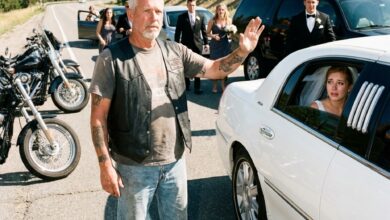
A Biker Was Thrown Out of the Wedding — Until the Bride Turned Around and Looked at Him
They grabbed his arm halfway down the aisle.
“Sir, you can’t be here.”
The music faltered. A few guests gasped. Someone whispered the word security like it was already too late. The biker—leather vest, road-worn boots, patches faded by sun and miles—stopped where he stood. He didn’t resist. He didn’t raise his voice. He just loosened his grip on the small box in his hand and let them guide him toward the back.
From a distance, it looked exactly like what everyone expected.
A problem.
A disruption.
The wrong man in the wrong place.
The chapel fell into a strange, held breath.
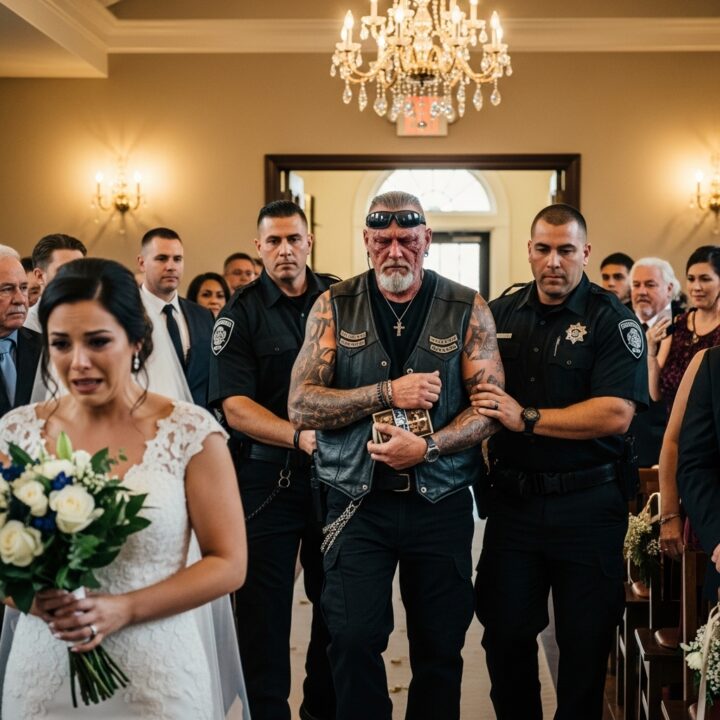
Crystal chandeliers hummed softly. Candle flames wavered. A program slipped from a trembling hand and landed on the runner with a whisper of paper. At the front, the officiant cleared his throat and pretended not to notice. The groom stared straight ahead, jaw set. The bride—lace and light and a thousand tiny pins holding everything together—did not turn around.
Not yet.
The biker paused near the doors as the guards tightened their hold. He nodded once, a habit learned long ago, and took a step back. The box in his palm caught the light—a simple thing, wrapped carefully, corners worn smooth by worry.
Outside, the late afternoon sun warmed the stone steps. Inside, the room stayed cold.
In the front row, an elderly woman pressed her hand to her mouth. Her knuckles were white. She looked from the biker to the bride’s back, as if waiting for one to recognize the other.
The guards whispered again. “We need to move. Now.”
The biker complied. Silence followed him like a shadow.
The bride stood very still.
If you watched closely, you might have noticed the way her fingers trembled against the bouquet. Or how her breathing had changed—shorter, uneven. She had practiced this walk for months, imagined it a thousand ways. None of them included a man in leather being escorted out like a stain.
The music tried to recover. The officiant lifted his hands.
“Dearly beloved—”
A memory cut through her like a blade.
A garage that smelled of oil and oranges. A man kneeling to tie her shoes with hands too big to be gentle but careful anyway. A laugh that came easy and left slow. A promise spoken without ceremony: I’ve got you.
Her heel shifted.
The room seemed to tilt.
She turned.
At the back of the chapel, the biker stood between two guards, eyes lowered, shoulders broad under the weight of a hundred stares. His beard had gone gray since the last time she’d seen him up close. The scar on his temple—thin and pale—caught the light.
He did not look angry.
He looked afraid of doing the wrong thing.
The bride’s breath caught. “Stop,” she said.
It wasn’t loud. It didn’t need to be.
The word moved through the room like a hand on a shoulder.
The guards froze.
She lifted her dress just enough to walk, steps careful but sure. The aisle stretched longer than it ever had. When she reached him, she didn’t look at the guards. She didn’t look at the guests.
She looked at him.
“Dad?” she whispered.
The biker swallowed hard.
“Hey, kid,” he said, voice rough. “You look… you look amazing.”
The guards released him without being told.
The silence changed shape.
Confusion replaced judgment. Murmurs rose and fell. Someone in the back said, “Is that—?” and someone else answered, “I thought he was—”
The bride took his hands. They were scarred and warm and shaking. “Why are they doing this?” she asked, tears threatening the careful work of her makeup.
He glanced at the vest, at the patches that told a story no one here had read. “Dress code,” he said lightly. “Figured I’d stand in the back. Didn’t want to make a fuss.”
She laughed once, broken and bright. “You came all this way to stand in the back?”
He nodded. “I promised I wouldn’t miss it.”
At the front, the groom finally turned. His eyes flicked from the biker to the bride’s face and softened. He took a step closer, hands open. “Sir,” he said, respectful. “Please. Stay.”
A coordinator hurried forward, face pale. “We can’t—there are rules—”
The bride’s voice was steady now. “He stays.”
No explanation. No argument.
Just a decision.
Later, when the story began to find its edges, it came out in pieces.
How the biker had arrived early and waited outside until the guests were seated. How he’d asked the usher where he could stand that wouldn’t distract. How the usher had seen the vest, the patches, the boots, and decided for everyone else.
Rules were rules.
Appearances mattered.
In the back pew, the elderly woman—now crying openly—found her voice. “He raised her,” she said to no one in particular. “When her mother couldn’t. He worked nights and came home smelling like rain. He never missed a recital.”
A man in a tailored suit leaned closer. “Why didn’t he just—”
“Because,” she said, wiping her cheeks, “he doesn’t explain himself.”
The reception hall hummed with a different kind of electricity.
Glassware chimed. Laughter rose and fell. The biker sat at a small table near the windows, vest folded neatly on the chair beside him. He wore a pressed shirt underneath, the kind you keep for days that matter. He watched the bride dance with the groom, eyes bright with something like relief.
Outside, motorcycles rolled in quietly—one, then another—parking along the curb with care. Men dismounted and stood back, hands clasped, heads bare. They didn’t come inside. They didn’t need to.
They were there.
A server approached the biker with a tray of champagne. “On the house,” she said, shy. “For… earlier.”
He smiled. “Thank you.”
A young boy wandered over, curious. “Are you really a biker?” he asked.
The biker knelt to eye level. “Sometimes,” he said. “Mostly I’m just a dad.”
The boy nodded, satisfied, and ran back to his seat.
The truth found its voice between courses.
A man with a calm presence and a surgeon’s posture stood and cleared his throat. “I’m Dr. Morales,” he said. “I don’t usually speak at weddings. But I owe this man something.”
Heads turned.
“I met him in a trauma bay eleven years ago,” the doctor continued. “He brought in a little girl after a highway accident. He held pressure for twenty minutes and talked to her the whole time. She never panicked. She never stopped breathing.”
The bride’s hand flew to her mouth.
“That man,” Dr. Morales said, nodding to the biker, “taught me what calm looks like. He taught me that showing up matters.”
The biker looked at his hands.
The room listened.
“He left before I could thank him,” the doctor finished. “Today seemed like the right time.”
Applause didn’t break out. It wouldn’t have fit. Instead, people nodded. People looked down. People adjusted their understanding.
When the music slowed and the lights softened, the bride crossed the floor and sat beside the biker.
“I was scared you wouldn’t come,” she said.
He shrugged. “I was scared I would.”
She laughed. “You always show up.”
He reached into his pocket and placed the small box on the table. “For you,” he said. “If it’s too late—”
She opened it.
Inside was a locket. Simple. Worn smooth. She opened it to find a tiny photograph—her, age six, missing two teeth and holding his helmet like a trophy.
Tears fell freely now.
“I carried this,” he said, voice low, “on the road. So I’d remember where I was going back to.”
She closed the locket and pressed it to her chest. “Walk me,” she said.
“To where?”
“Anywhere,” she said. “Just—walk with me.”
They crossed the floor together. Not fast. Not for show. Guests made room without being asked.
At the doors, the night air wrapped around them. The motorcycles hummed, respectful and low.
“You okay?” he asked.
She nodded. “I am now.”
The next morning, the photos told a different story than the whispers had.
A bride laughing with a man in a white shirt and folded vest. A father-daughter dance no one had planned but everyone remembered. A line of motorcycles gleaming in the dusk like a promise kept.
What didn’t show up in the pictures was the moment that mattered most.
The moment when a man chose not to fight being misunderstood.
And a woman chose to turn around.
If this story moved you or reminded you of a moment when love corrected a judgment, share your thoughts or experiences in the Facebook comments below.