A Biker Was Thrown Out of the ER — Ten Minutes Later, the Doctor Came Back to Apologize
“Sir, you need to leave the emergency room. Now.”
The sentence fell hard in the fluorescent-lit corridor.
Everything froze.
Monitors hummed. A gurney squeaked and stopped mid-push. A nurse’s clipboard hovered in the air, forgotten. The waiting room—already stretched thin with fatigue, fear, and quiet prayers—fell into a thick, unmoving silence.
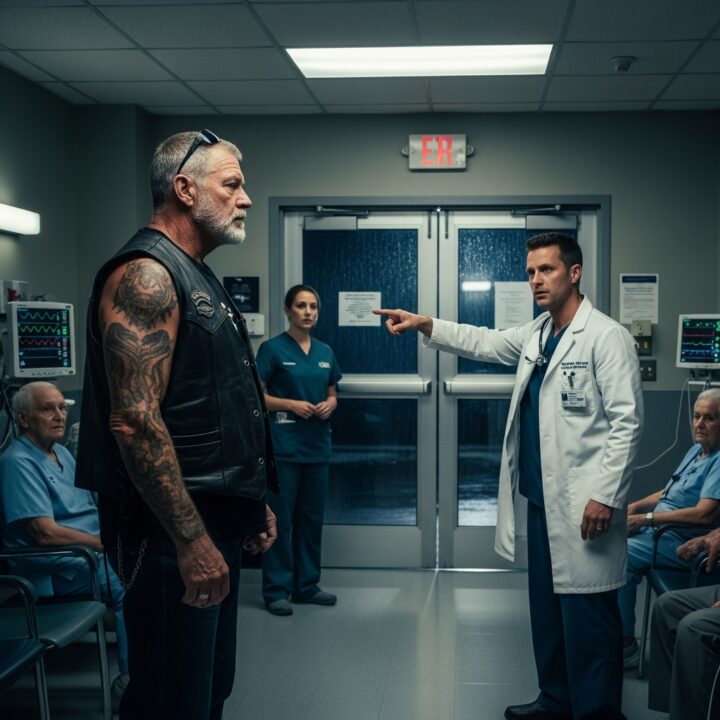
At the double doors stood a biker.
Late fifties. Broad shoulders filling a sleeveless leather vest. Short-sleeve shirt revealing faded tattoos. Heavy boots still damp from the rain outside. Sunglasses perched on his head, hair streaked with gray.
He was too big for the hallway. Too still. Too present.
A doctor stepped in front of him, palm raised, voice firm. “You’re causing a disturbance.”
The biker said nothing.
He shifted once—slow, measured—and that single movement tightened the room. A security guard angled closer. A woman clutching a paper bag of ice leaned back in her chair.
The biker’s jaw set. He looked past the doctor, down the corridor, toward a curtained bay where alarms chimed unevenly.
For a moment, it felt dangerous, wrong, on the edge of something no one wanted.
“Please,” the doctor said, colder now. “Leave.”
The biker met his eyes.
Then turned.
The doors swung shut behind him with a soft, final click.
The silence that followed felt unfinished.
The room exhaled.
A murmur rippled through the chairs. “Good.” “About time.” “You never know with people like that.”
The labels arrived easily. Biker. Trouble. Risk.
Inside, the doctor straightened his coat and told himself he’d made the right call. The ER was crowded. Tensions were high. He couldn’t afford distractions.
Outside, rain tapped the awning. The biker stood just beyond the glass, shoulders squared, hands relaxed at his sides. He removed his sunglasses and rubbed his eyes once—tired, contained, controlled.
He didn’t argue.
Didn’t knock.
Didn’t demand anything.
Through the glass, he watched the corridor with quiet focus, as if counting breaths.
A nurse glanced out, then away. An older man in a wheelchair shook his head. “Why do they always show up like that?”
The biker reached into his vest—not abruptly, not nervously—and pulled out his phone. He typed a short message. Paused. Then made a call.
Inside, no one noticed.
The doctor turned back to his charting. He felt the comfort of authority settle in—routine, rules, order.
Ten minutes would pass.
And then everything would change.
A triage alarm chirped—sharp, insistent—then escalated.
A nurse called out a name. A gurney rolled fast. The air shifted from waiting to urgency.
The doctor frowned at the monitor. Something wasn’t adding up.
At the desk, the phone rang. The charge nurse answered. Her posture changed. She listened. Her eyes flicked toward the glass doors.
“Yes,” she said slowly. “He’s outside.”
She hung up.
The doctor looked up. “What is it?”
The nurse swallowed. “Someone wants us to review the intake notes again.”
The doctor bristled. “We already—”
Outside, the biker ended his call and slipped the phone away. He stood straighter. Still. Patient.
Inside, a security guard glanced toward the entrance as a low, distant sound seeped through the rain.
Engines.
Not loud. Not chaotic. Measured.
The doctor felt a pinch of irritation. “What now?”
No one answered.
The sound grew clearer—steady, disciplined—then faded as engines cut off one by one.
The nurse’s radio crackled. “They’re here.”
The doctor felt a flicker of something he didn’t like.
Uncertainty.
They arrived without spectacle.
Motorcycles lined the curb in clean order, rain beading on chrome. Men and women dismounted calmly—leather vests, short sleeves, tattoos, sunglasses—faces composed, movements respectful.
They did not crowd the doors. They did not speak loudly.
They stood.
Together.
Inside, the waiting room sensed the shift. Conversations died. Heads turned. The security guard loosened his stance—not relaxed, but attentive.
The biker outside nodded once to the group.
The charge nurse approached the doctor. “The patient in Bay Three,” she said quietly. “The one you reassigned.”
The doctor opened his mouth. Closed it.
“Her husband,” the nurse continued, “is that man.”
The doctor felt the floor tilt.
“She has a rare reaction,” the nurse said. “He recognized it. He’s been managing her care for years. He tried to tell us.”
The engines outside were silent now.
The presence remained.
The doctor’s authority—solid minutes ago—felt fragile, exposed.
He took a breath.
Then another.
And turned toward the doors.
The doctor stepped outside.
Rain dotted his coat. The biker met his gaze—no anger there. No triumph.
“I was wrong,” the doctor said. The words came plain, bare, unadorned. “I’m sorry.”
The biker nodded once.
“My wife,” he said quietly. “She needs a specific protocol. I can show you.”
They walked back in together.
No cheers. No speeches.
Inside Bay Three, the doctor listened. Really listened. The nurse adjusted a setting. The alarm softened. The patient’s breathing steadied.
Outside, the motorcycles remained parked—silent guardians, disciplined, unassuming.
In the waiting room, eyes dropped. A woman folded her hands. An older man stared at the floor, thinking.
The biker stayed by the bed, hand resting lightly where it belonged.
When the crisis passed, the doctor stepped back. He removed his gloves. “Thank you,” he said.
The biker shrugged. “Just do the job,” he replied. Gently.
Later, as rain eased and engines started—low, respectful—the doctor watched from the doorway.
He had followed rules.
He had followed fear.
And ten minutes later, he had learned the cost of judging a book by its cover.
The doors closed. The night moved on.
The lesson stayed.