A Biker Was Refused Service Because of His Leather Jacket — But He Stayed
They told him to leave before he even sat down.
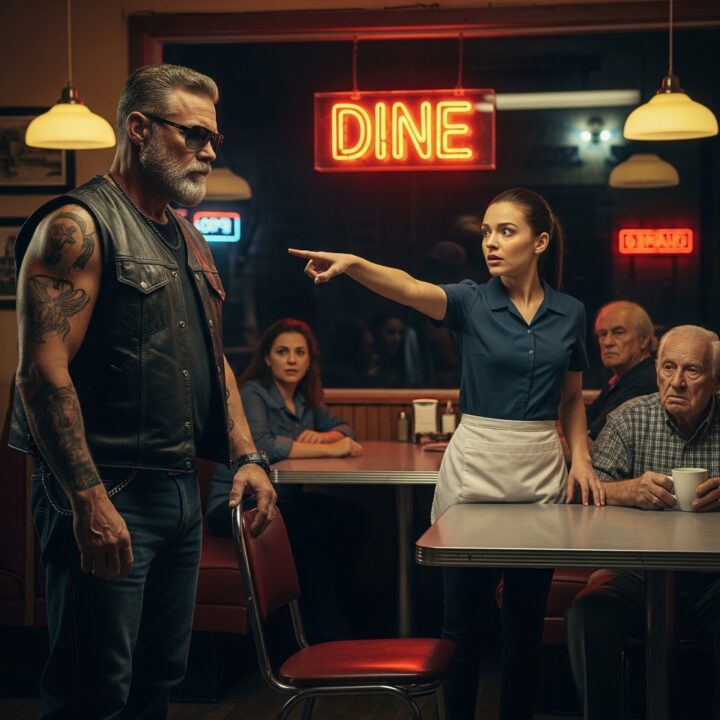
The waitress didn’t raise her voice. She didn’t need to. One look at the leather jacket, the faded patch on his chest, the road dust still clinging to his boots—and her smile disappeared.
“We don’t serve… that kind here.”
The words hung in the air longer than they should have.
The diner went quiet.
Coffee steamed in chipped white mugs. A spoon clinked once against porcelain, then stopped. The old neon sign above the counter buzzed softly, flickering like it couldn’t decide whether to stay on or give up. Somewhere in the back, a grill hissed, forgotten.
The biker didn’t move.
He stood there, helmet tucked under one arm, the other hand resting loosely at his side. Big man. Late forties, maybe early fifties. Gray threaded through his beard. A thin scar ran from his ear down to his jaw, half-hidden by stubble. His leather jacket was worn, not flashy—creased at the elbows, sun-faded at the shoulders, like it had seen more miles than most people see years.
Across the diner, an elderly man sat alone at a corner table. Paper placemat. Black coffee. Hands spotted with age, shaking just enough to notice when he lifted the cup. He watched the biker with wide, uncertain eyes, as if expecting something bad to happen any second.
The biker looked around once.
Families froze mid-bite. A teenage couple stopped whispering. A man in a pressed shirt folded his arms, already judging. Everyone waited for the obvious next step—for anger, for shouting, for the story they thought they already knew.
Instead, the biker slowly pulled out a chair.
He sat down.
The waitress stiffened. “Sir, you didn’t hear me.”
“I did,” he said calmly.
His voice was low. Not threatening. Not apologetic either.
The manager came out from behind the counter, wiping his hands on a towel. Mid-thirties. Clean-cut. Tired eyes. The kind of man who believed rules kept chaos away.
“You need to go,” the manager said. “You’re making people uncomfortable.”
The biker nodded once. “I’ll leave when I’m done.”
“With what?” the manager snapped. “You haven’t ordered anything.”
“That’s okay,” the biker replied. “I’m just sitting.”
That didn’t fit the script.
The manager hesitated. This wasn’t trespassing. This wasn’t loud. This wasn’t anything he could point to on paper. Just a man in a jacket, occupying a chair, refusing to disappear.
Around them, judgment thickened.
Someone muttered, “Figures.”
Someone else shook their head.
A phone slid halfway out of a pocket.
The elderly man in the corner lowered his cup. His eyes flicked from the biker to the exit, then back again. His breathing grew shallow, uneven, like he was bracing for something that lived in memory more than in the room.
The biker noticed.
Not obviously. Just a shift of attention. A quiet awareness. He leaned back slightly, angling his body so he wasn’t looming, wasn’t blocking anyone’s view, wasn’t a threat.
The manager sighed. “Five minutes,” he said tightly. “Then I’m calling someone.”
The biker nodded again. “That’s fair.”
Time stretched.
The waitress avoided the table. Plates were set down harder than necessary. Coffee was poured without eye contact. The neon sign buzzed. Outside, a semi roared past, rattling the windows for half a second before the diner settled back into its uneasy stillness.
Then it happened.
The old man’s cup slipped from his hand.
It didn’t shatter. Just cracked. Coffee spilled across the table, dripping onto his lap. His breath hitched. One hand clawed at his chest, the other gripping the table’s edge like it might float away.
For a heartbeat, no one moved.
Then the biker was on his feet.
Fast—but not frantic. Controlled. He crossed the diner in long strides, kneeling beside the old man before anyone had time to object.
“Hey,” he said gently. “I’ve got you.”
The manager barked, “Sir, don’t—”
“Call 911,” the biker said without looking up.
There was no panic in his voice. Just certainty.
The old man’s eyes locked onto his. “I—I don’t—”
“I know,” the biker said. He took the man’s trembling hand, firm but respectful. “Breathe with me. In. Out. Good. Stay with me.”
The diner watched in stunned silence.
The biker loosened the man’s collar. Checked his pulse with practiced fingers. Counted under his breath. His jacket fell open, revealing a plain T-shirt underneath—and a small, faded emblem near his shoulder. Not a gang mark. Not a threat.
A unit insignia.
The waitress covered her mouth.
The manager’s expression changed. Confusion replacing authority.
The biker spoke quietly, almost to himself. “Had a medic like this once. Kept his voice low. Saved my life.”
The old man squeezed his hand weakly. “You… you Army?”
The biker shook his head. “Marine.”
Sirens wailed in the distance.
Before they arrived, motorcycles rolled into the parking lot. One. Then another. Then three more. Big bikes. Quiet engines. Men dismounted calmly, removing helmets, scanning the scene without drama.
They didn’t rush inside. They didn’t crowd. They stood by the windows, hands clasped, eyes steady. Brothers, not brawlers.
The manager swallowed hard.
The paramedics burst in moments later. The biker stepped back immediately, hands raised just enough to give space. He answered questions. Short. Clear. Useful.
As they lifted the old man onto a stretcher, the man reached out.
“Don’t go,” he whispered.
The biker leaned in. “I’ll be right here.”
One of the paramedics glanced at him. “You medical?”
“Used to be,” the biker replied.
After they left, the diner felt different. Smaller. Quieter. Humbled.
The manager cleared his throat. “Sir… I owe you an apology.”
The biker shook his head. “You don’t owe me anything.”
The waitress approached slowly. “Can I… can I get you something?”
The biker looked at the empty chair where the old man had been sitting. “Just coffee,” he said. “Black.”
She nodded, eyes wet.
When she brought the mug, she placed it gently. Like it mattered.
The biker didn’t smile. He didn’t preach. He didn’t ask for recognition.
He simply sat there, hands wrapped around the warmth, waiting until he knew the old man was safe.
Outside, his brothers waited too.
Because dignity doesn’t demand a seat.
And honor doesn’t leave when it’s told to.
If this story made you pause, share your thoughts or a moment when someone surprised you by doing the right thing—quietly—in the comments below.