A Biker Was Banned from the Diner — Until the Staff Realized He Hadn’t Ordered a Thing
They told him to leave before he even sat down. “Sorry, sir. We don’t serve… that here.”
The word that hung in the air, unfinished but clear enough. Leather vest. Faded patches. Heavy boots still dusted with road grit. The biker stood by the counter, hands relaxed at his sides, saying nothing. He nodded once, as if he’d heard it before. Because he had.
The bell above the diner door chimed when he stepped back, the sound too loud for a room that had gone suddenly quiet.
For a moment, everything froze.
The grill hissed behind the counter. Coffee steamed in chipped mugs. A spoon rattled against porcelain where a woman’s hand had begun to shake. The jukebox at the corner clicked and went silent between songs. No one looked directly at him. Everyone watched.
The biker didn’t argue. He didn’t ask for a manager. He didn’t defend himself. He simply took two steps back and waited near the door, rain tapping softly against the glass outside.
That was when the waitress noticed something odd.
There was no menu in his hands.
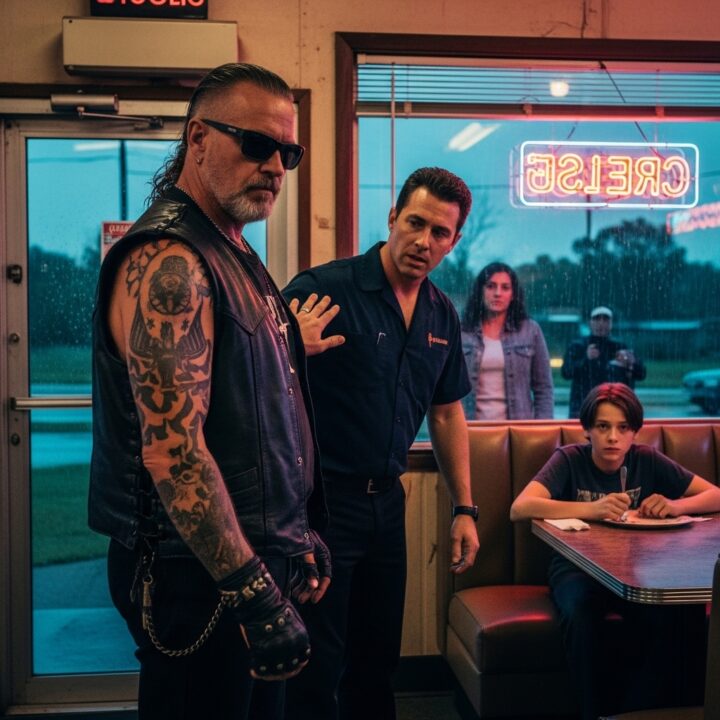
The diner sat off a two-lane highway in the Midwest, the kind of place that lived on routines and regulars. Same faces. Same booths. Same orders. The staff could tell you what half the customers wanted before they opened their mouths.
The biker didn’t fit the pattern.
Mid-fifties, maybe older. Broad shoulders held up by muscle that had softened with time. Gray threaded through his beard. A thin scar cut across his knuckles. His vest carried patches from a riding club people whispered about but didn’t know.
Danger. Trouble. Wrong crowd.
That was the picture everyone saw.
What they didn’t see was the way his eyes kept drifting to the far booth by the window. The one with the cracked vinyl seat and the small vase of plastic flowers. The one where a teenage boy sat hunched over a plate of fries he wasn’t eating, hoodie pulled tight around his face.
The boy’s hands shook.
Across from him, an empty seat.
The waitress followed the biker’s gaze and felt a knot form in her chest.
The biker hadn’t sat down.
He hadn’t ordered.
He hadn’t even taken off his gloves.
He was just… waiting.
The manager stepped out from the back, wiping his hands on a towel. He’d been told there was “a situation.” He took in the scene quickly—the biker by the door, the uneasy customers, the boy by the window.
“Sir,” the manager said, firm but polite, “we’re going to have to ask you to move along.”
The biker nodded again. “I understand.”
His voice was calm. Low. Not threatening.
The manager frowned. “Then why are you still here?”
The biker glanced at the booth by the window.
“I’m not here to eat,” he said.
That gave the room pause.
The waitress stepped closer. “You… didn’t order?”
“No, ma’am.”
“Then why come in?” someone muttered from the counter.
The biker didn’t answer right away. He looked at the boy again. The boy had noticed him now, eyes darting up and away, fear flickering across his face.
“I’m waiting for someone,” the biker said quietly.
The manager crossed his arms. “You can wait outside.”
“I can,” the biker agreed. “But I won’t.”
That was enough for a few customers to shift uncomfortably. Someone reached for their phone. Someone else whispered about calling the police.
The biker lifted his hands slightly, palms open. “I’m not causing trouble,” he said. “I promise.”
Promises didn’t mean much when wrapped in leather.
The emotional spark came from a small, almost invisible moment.
The boy at the booth dropped his fork.
It clattered loudly against the plate, echoing through the diner. He flinched like he’d been struck, then bent down too fast to retrieve it. His breathing quickened. Short. Shallow.
The biker took a step forward without thinking.
The manager reacted instantly. “Hey—don’t—”
The biker stopped himself. Hands back at his sides. “Sorry,” he said. “Habit.”
The boy’s hands were shaking now. Fries scattered on the table. His eyes filled, but he fought it, jaw clenched tight like someone who’d learned early that crying didn’t help.
The waitress knelt beside him. “Honey, are you okay?”
The boy shook his head.
That was when the biker spoke again.
“He doesn’t like loud noises,” he said softly. “Especially metal on ceramic.”
Every head turned.
The waitress looked up. “How do you know that?”
The biker swallowed. “Because I taught him how to breathe through it.”
Silence fell heavy.
The boy froze.
Slowly—reluctantly—he looked up at the man in leather.
“Dad?” he whispered.
The word barely made it past his lips, but it hit the diner like a dropped tray.
The manager’s arms fell to his sides.
The waitress stood slowly, eyes moving between the two of them.
The biker took off his gloves and set them on the counter. His hands were steady now. “Hey, kid,” he said. “I told you I’d come.”
The boy pushed back from the table so hard the chair scraped loudly. He flinched again, then bolted forward, stopping inches from the biker like he didn’t trust his own eyes.
“You said you weren’t allowed,” the boy said, voice breaking.
“I wasn’t,” the biker replied. “But things change.”
The room breathed again.
Someone near the counter cleared their throat. “What’s going on?”
A woman in the back whispered, “That’s his father?”
The boy nodded fiercely. “That’s my dad.”
The manager rubbed his face. “Sir… I didn’t know.”
The biker nodded. “You couldn’t.”
The truth came gently, the way real truths often do.
The biker’s name was Jack. He used to come to the diner every Sunday morning years ago. Same booth. Same coffee. Pancakes cut into squares.
With his son.
Then came the accident. A drunk driver. A hospital room full of beeping machines. A doctor who shook his head before he even spoke.
Jack had lost everything that night—except his boy.
But grief changed him. Anger followed. Then silence. His marriage didn’t survive it. Custody became complicated. Courts and paperwork and quiet rooms where men learned to keep their voices low.
Jack joined a riding club not for trouble, but for the road. For the quiet that came at sixty miles an hour. For brothers who didn’t ask questions but stood anyway.
When his son’s anxiety worsened—panic attacks triggered by sound, by crowds—Jack learned how to help. How to kneel, how to count breaths, how to stay calm when the world got loud.
Last month, the boy ran away from a foster placement that hadn’t understood him. He’d come back here because this was the last place he remembered being safe.
Jack had tracked him down.
And waited.
The presence of brotherhood arrived without announcement.
Motorcycles rolled into the lot outside, engines cut low and clean. Men dismounted and stood by their bikes. Sleeves rolled. Sunglasses removed. No one came inside.
They didn’t need to.
Jack glanced toward the window, then back at his son. “You ready?” he asked.
The boy nodded, then hesitated. “Can we eat first?”
The waitress smiled through tears. “On the house,” she said quickly.
The manager nodded. “Of course.”
Jack didn’t argue. He took the booth by the window, sitting opposite his son. He didn’t touch the menu until his boy did.
They ate quietly.
When a plate slipped later and clinked, Jack reached across the table and squeezed his son’s hand. Counted breaths. One. Two. Three.
It passed.
A man at the counter stood. “Sir,” he said to Jack, voice thick, “I judged you.”
Jack nodded. “Most people do.”
“I’m sorry.”
Jack looked at his son. “He’s safe,” he said. “That’s what matters.”
The manager approached. “You’re welcome here,” he said. “Both of you.”
Jack nodded again. “Thank you.”
When they finished, Jack stood and put on his vest. His son slipped on a jacket and took his hand without being embarrassed by it.
At the door, Jack paused.
“I didn’t order,” he said gently.
The waitress shook her head. “You did,” she replied. “Just not food.”
Outside, the rain had stopped. The bikes waited. The road stretched on.
Jack helped his son onto the back seat, helmet snug, hands steady.
They rode away quietly.
No sirens.
No applause.
Just the hum of an engine and a promise kept.