A Biker Was Accused of Threatening a Child in the Park — Until a Public Camera Revealed the Truth
“Get away from my son. Now.”
The shout cut through the park like a snapped wire.
Everything stopped.
A soccer ball rolled to a halt near the swing set. Two elderly men on a bench froze mid-conversation. Even the birds seemed to scatter at once.
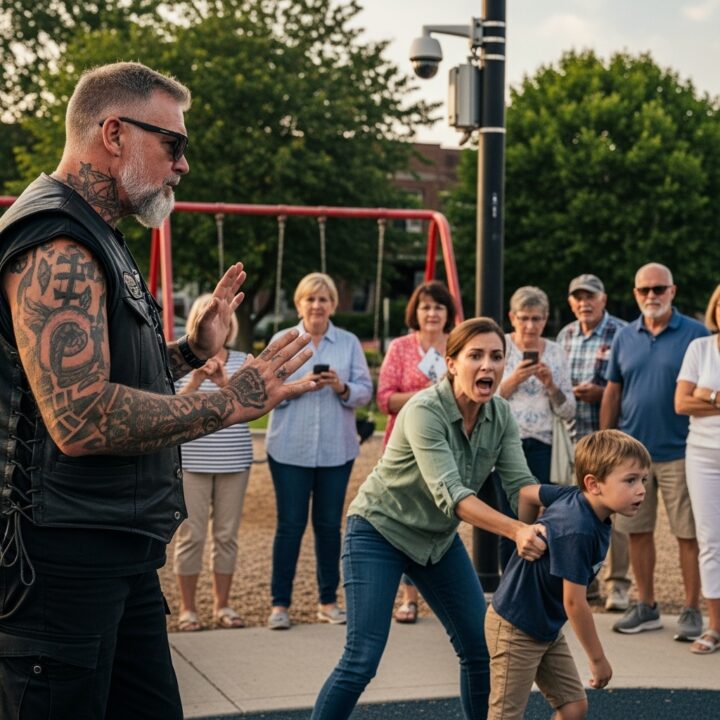
Near the sandbox stood a biker.
Late fifties. Broad frame. Sleeveless denim vest. Dark sunglasses. Tattoos winding down his arms like old maps. One hand slightly raised, palm open, frozen in the air.
Too close to the child.
The boy—no more than six—stood rigid, eyes wide, lower lip trembling.
The mother rushed forward, pulling the child back hard, her breath sharp and fast. Her face burned with fear and anger.
“Don’t talk to him!” she yelled, positioning herself between the boy and the biker.
Phones came out. Whispers started instantly.
“Did you see that?”
“He was leaning in.”
“What was he doing to that kid?”
The biker lowered his hand slowly.
He didn’t step back right away.
That hesitation felt dangerous.
The air grew tight, heavy, suffocating.
A man nearby muttered, “Someone call the police.”
The biker finally took one step back.
Too late.
All eyes were already on him.
The moment locked itself in place—like a paused frame in a film where everyone has already decided who the villain is.
Fear spread faster than facts ever do.
A small crowd formed, instinctively widening the circle around the biker, leaving him isolated in the open space near the playground. Parents pulled children closer. A woman clutched her daughter’s shoulder too tightly.
“He doesn’t belong here,” someone said out loud.
Another voice followed. “Look at him.”
Leather. Ink. Sunglasses.
Enough for judgment.
The mother’s voice shook now—not weak, but furious, protective, certain.
“He was talking to my child. Getting too close.”
The biker said nothing.
He stood with his arms at his sides, shoulders squared, face unreadable. He didn’t remove his sunglasses. Didn’t argue. Didn’t defend himself.
That silence unsettled people.
A park maintenance worker stepped closer, uncertain but alert. A retired couple watched with narrowed eyes. Someone was already on the phone, voice low and urgent.
The word police drifted through the air.
The biker shifted his weight once. Slowly.
A man snapped, “Don’t move.”
For a moment, it felt like anything could happen.
And everyone watching felt the same quiet, uncomfortable thing settle in their chest—
How easily they had chosen a side.
The situation tightened.
A police siren echoed faintly in the distance—close enough to be real, far enough to stretch the tension thin.
The biker glanced toward the sound, then back to the ground near his boots. He took a breath. Deep. Controlled.
Then he reached into his vest.
Several people reacted at once.
“Hey!”
“Don’t do that.”
“Keep your hands where we can see them.”
The mother pulled her child farther back.
The biker moved slowly. Deliberately.
He pulled out his phone.
Unlocked it.
Typed with one thumb.
No rush. No panic.
The siren grew louder.
He lifted his head and spoke one short sentence.
“There’s a camera.”
That was all.
No explanation. No accusation.
Just a fact.
People looked around, confused. Some followed his gaze toward the tall metal pole at the edge of the park, where a small black dome sat quietly above the path.
A public security camera.
No one said anything.
The biker slipped the phone back into his vest and stood still again.
Waiting.
No one knew what he had done. Or who he had contacted. Or what that camera had seen.
The police car turned into the parking lot.
And suddenly, everything felt irreversible.
The motorcycles arrived before anyone expected them.
Not roaring. Not aggressive.
Just a low, steady, measured sound rolling in from the street beyond the trees.
Heads turned.
Two bikes. Then four. Then more.
They parked in a clean line along the curb, engines cutting one by one. No revving. No chaos.
Men and women dismounted quietly. Leather vests. Denim. Calm faces. Sunglasses reflecting the afternoon light.
They didn’t surround anyone. Didn’t speak.
They stood.
Together.
The police officer stepped out of the cruiser, hand resting near his belt, eyes scanning the scene. He paused when he noticed the camera pole, then the gathered crowd, then the biker standing alone.
“What’s going on?” he asked.
Before anyone could answer, a voice crackled from the officer’s radio.
“Footage is up,” dispatch said. “You’ll want to see this.”
The officer’s posture changed.
The crowd felt it.
The biker remained still.
Disciplined. Silent.
Not defended by words—but by presence.
The video played on a patrol tablet.
No sound. Just truth.
It showed the boy wandering toward the path where cyclists passed. Showed a loose dog running nearby. Showed the biker stepping in—not toward the child, but between him and danger.
It showed the biker lowering himself slightly, palm raised, speaking calmly. Pointing back toward the playground.
Guiding. Not threatening.
Protecting.
The officer exhaled slowly.
The mother stared at the screen, her face draining of certainty. Her hands trembled now—not with anger, but with something closer to regret.
“I… I didn’t know,” she whispered.
The biker said nothing.
He nodded once. Barely.
The officer cleared his throat. “Sir, you’re free to go. Thank you for keeping the child safe.”
The biker turned to leave.
No speech. No glare. No triumph.
As he walked past the mother, she spoke again, softer this time. “Thank you.”
He paused.
Removed his sunglasses.
His eyes were tired. Kind. Human.
“Watch your kids,” he said gently.
Then he walked toward the bikes.
Engines started again—low and respectful.
As they rolled away, the park felt different.
Quieter.
Heavier.
A few people stood where they were, staring at the empty space where judgment had stood moments before.
And somewhere above them, a camera kept watching—patient, unblinking, waiting for the next moment when truth would need defending.