A Biker Walked Into a Parent-Teacher Meeting — And Refused to Sit Down
“Sir, please take a seat. You’re blocking the aisle.”
The request was polite.
The refusal was not loud.
That made it worse.
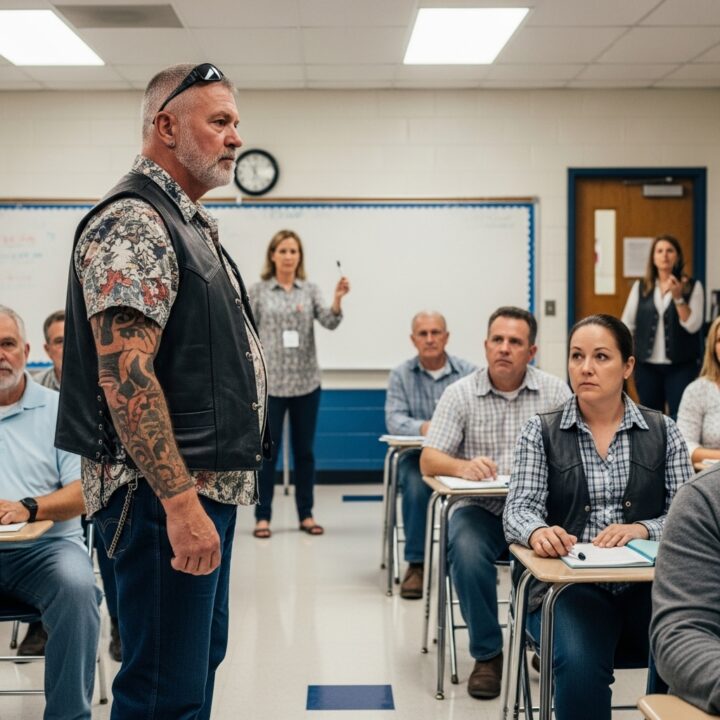
The biker stood at the back of the classroom, arms resting loosely at his sides, leather vest creaking softly, tattooed forearms exposed, dark boots planted wide on the linoleum floor. He did not move. He did not speak.
Every folding chair in the room was filled.
Parents sat shoulder to shoulder, clutching notebooks and printed schedules, the faint smell of coffee and copier toner hanging in the air. A whiteboard behind the teacher listed homework assignments in neat blue marker.
And then there was him.
Tall. Broad. Unmistakably out of place.
Whispers moved faster than breath.
Why is he standing?
Why won’t he sit down?
Who lets someone like that in here?
The teacher paused mid-sentence, marker hovering, eyes flicking between the biker and the exit. A school aide near the door straightened, hand tightening around a walkie-talkie.
The biker remained still, silent, unyielding.
And the room—once orderly, predictable, safe—felt suddenly tight, uneasy, on edge, as if one wrong word might tip it into something no one wanted.
Judgment filled the silence where explanation should have been.
Parents leaned toward one another, voices low and sharp. A man in a pressed jacket frowned openly. A woman crossed her arms, eyes never leaving the biker’s boots.
The assumptions came easily.
Leather meant trouble.
Standing meant defiance.
Silence meant threat.
The principal appeared in the doorway, drawn by the tension. She took in the scene—the crowded room, the standing biker, the faces already set against him.
“Is there a problem?” she asked.
The teacher hesitated. Someone else answered for her.
“He won’t sit,” a parent said. “It’s disruptive.”
The biker finally shifted his weight.
A small movement.
Enough to tighten the air.
“I’m fine standing,” he said calmly.
His voice was low. Even. Controlled.
That should have eased things.
It didn’t.
“Sir,” the principal said, voice firm now, “this meeting is for parents. If you can’t follow basic rules—”
“I’m here for my daughter,” he replied.
A ripple moved through the room.
People glanced around, searching for a child who matched him. No one saw one. The doubt settled deeper.
The biker did not explain further.
He simply stood there, eyes forward, jaw set, absorbing the looks, the quiet hostility, the unspoken verdict that had already been delivered.
And that restraint—that refusal to defend himself—made everyone more uncomfortable with their own thoughts.
The meeting tried to continue.
It failed.
Every sentence from the teacher felt strained. Every cough echoed. The biker’s presence grew heavier with each passing minute, not because he did anything—but because everyone else did.
The principal leaned closer. “Sir, if you don’t take a seat, I’ll have to ask you to leave.”
The biker nodded once.
“I can’t,” he said.
That was all.
A murmur rose.
The school aide’s walkie-talkie crackled. A security guard appeared at the end of the hall, visible through the open door.
The biker reached into his vest.
Several parents stiffened at once.
“Hey,” someone hissed.
He moved slowly, carefully, pulling out his phone and typing a brief message. He didn’t look up while he did it.
Then he slipped the phone away.
The principal exhaled sharply. “Sir, this is your last warning.”
The biker met her eyes.
“I’ll stand,” he said quietly. “I always do.”
No one knew what that meant.
The guard took a step forward.
And somewhere outside, far beyond the classroom walls, a low, familiar sound began to build.
The sound arrived before the explanation.
Engines.
Not loud.
Not aggressive.
Measured. Steady. Disciplined.
Heads turned toward the windows as motorcycles rolled into the school parking lot, lining up neatly, engines cutting off one by one. The sound faded, leaving behind a silence that felt thicker than before.
Men and women dismounted.
Leather vests. Short sleeves. Tattoos. Sunglasses.
They did not crowd the entrance.
They did not speak.
They simply stood together, hands relaxed, posture respectful.
The security guard stopped.
The principal’s confidence faltered.
The biker in the classroom did not turn around.
He did not acknowledge them.
He just stood there—exactly as he had been.
A teacher near the back whispered, “Oh.”
The principal stepped closer, lowering her voice. “Sir… why won’t you sit?”
The biker finally spoke more than a sentence.
“Because my legs don’t bend,” he said gently.
He lifted his pant leg slightly.
Metal braces caught the light.
The room went still.
The truth unfolded quietly, without ceremony.
Years ago, the biker had been hit by a drunk driver while riding. Multiple surgeries. Permanent damage. Standing was easier than sitting. Less pain. More dignity.
His daughter—small, quiet, seated in the front row—had been watching him the entire time, hands folded tight, eyes shining with pride and fear.
The principal swallowed.
“I’m sorry,” she said.
So did others. Some with words. Some only with lowered eyes.
The biker nodded once. No bitterness. No satisfaction.
Outside, the other bikers waited. They hadn’t come to intimidate. They had come because he’d asked them to wait—just in case.
The meeting resumed.
This time, no one complained about him standing.
When it ended, the biker walked down the aisle, daughter at his side. She slipped her hand into his.
“Thank you for coming,” she whispered.
He squeezed back.
Outside, engines started again—low, respectful—and rolled away into the evening.
Inside the classroom, parents sat longer than usual, staring at empty chairs, replaying the moment they had decided who someone was—before they knew why he stood.
The lesson stayed.
Sometimes, what looks like defiance is just survival.
And sometimes, the bravest thing a person can do—
is remain standing.