A Biker Stood Up During a Charity Auction — When Everyone Thought He Came to Cause Trouble
“Sir, please sit down.”
The auctioneer’s voice was polite but strained, amplified just enough to carry across the room.
The biker did not sit.
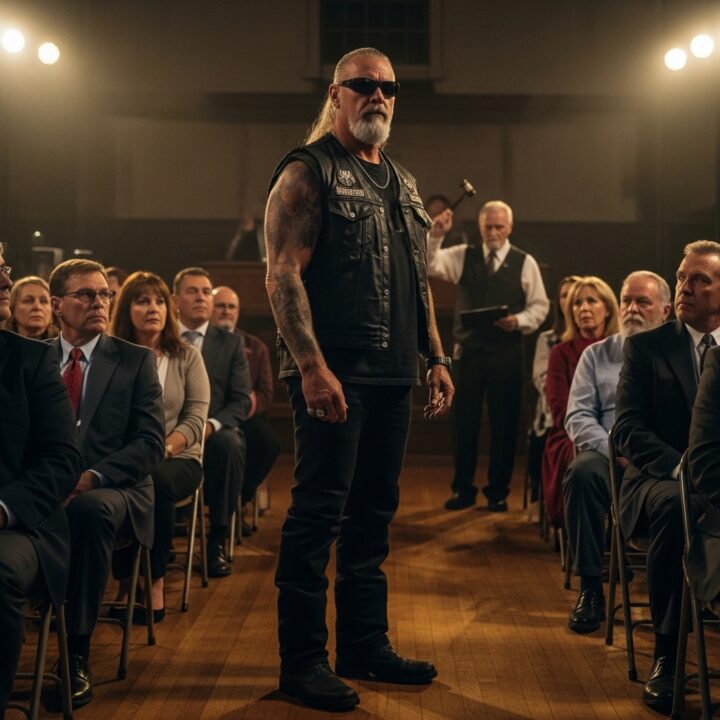
He stood in the center aisle of the town’s old community hall, hands resting loosely at his sides. Sleeveless leather vest. Faded patches. Thick arms marked by old tattoos. His boots stood out sharply against the polished wooden floor where most people wore dress shoes.
The room froze.
The auction had been running smoothly—smiling volunteers, folded bidding paddles, soft laughter rising and falling between items. This was a charity night. A good cause. The kind of event where people expected comfort, not confrontation.
And now there was a biker standing in the middle of it.
A woman in the front row turned in her seat, eyes narrowing. A man whispered something under his breath. Chairs creaked as people shifted uncomfortably.
From a distance, it looked wrong.
Uninvited.
Threatening.
The biker didn’t raise his voice. Didn’t wave his arms. He simply remained standing, blocking the line of sight to the stage.
The auctioneer cleared his throat. “Sir, we’re in the middle of bidding.”
The biker nodded once.
“I know,” he said.
That was all.
No explanation. No apology.
The silence that followed pressed down harder than shouting ever could. And in that suspended moment—between generosity and suspicion—everyone in the room thought the same thing:
He’s about to ruin this.
The unease spread quickly.
A volunteer moved closer to the aisle, her smile stiff and rehearsed. “Is there a problem?” she asked quietly.
The biker didn’t look at her. His gaze stayed fixed on the stage, on the item currently up for auction—a framed photograph donated by a local photographer.
Behind her, someone murmured, “Why is he even here?”
This was a small American town where people recognized each other by first name and reputation. Bikers carried reputations of their own, most of them earned long before anyone in the room had met this man.
Trouble.
Disruption.
Noise.
A board member leaned toward the auctioneer. The word security passed between them.
The biker felt the shift. He must have. But he didn’t react.
That restraint made people more uncomfortable, not less. It forced them to confront the way they were filling in the blanks.
A man in a blazer stood up halfway. “If you’re not here to bid,” he said sharply, “you should leave.”
The biker turned his head slightly. Just enough to acknowledge the voice.
“I’m here,” he said, “for the same reason you are.”
The man scoffed. Others nodded in agreement, assuming they understood what that meant.
The auctioneer hesitated, then lifted his gavel again. “We’ll continue.”
The biker stayed standing.
The tension crept higher, slow and relentless.
The auctioneer called for bids. A paddle lifted. Then another. The room tried to move on, but the biker’s presence made that impossible.
Eyes kept drifting back to him.
A volunteer approached from behind. “Sir,” she whispered, “I’m going to have to ask you to step outside.”
The biker inhaled. Slowly.
He reached into his vest.
Several people stiffened at once.
From the outside, the movement looked exactly like what everyone feared. Phones were raised discreetly. A woman near the back shifted her chair closer to the exit.
The biker pulled out his phone.
Typed a short message. Paused. Sent it.
He slid the phone back into his pocket.
“I’ll stay right here,” he said quietly.
The volunteer swallowed. “We can call the police.”
The biker nodded. “You can.”
No challenge in his voice. No sarcasm.
The auctioneer’s hand hovered above the gavel, uncertain now. The bids slowed. The room held its breath, waiting for something to happen—an argument, an outburst, an end to the evening.
Instead, a sound drifted in from outside.
Low.
Distant.
Steady.
Engines.
The sound grew closer, unmistakable now.
Motorcycles pulled up outside the community hall, one after another, engines cutting almost in unison. No revving. No show.
People turned in their seats as the doors opened.
Bikers entered quietly. Men of different ages—some gray-haired, some broad and weathered. Sleeveless vests. Tattoos worn without apology. Helmets tucked under arms.
They didn’t spread out. They didn’t stare anyone down.
They simply stood near the walls, respectful of the space, eyes forward.
The room shifted.
Not fear this time.
Awareness.
The auctioneer lowered the gavel.
One of the bikers nodded to the man in the aisle. “You ready?” he asked.
The standing biker gave a small nod in return.
He reached into his pocket again, this time pulling out an envelope. He walked calmly toward the stage, footsteps measured, unhurried.
People watched in stunned silence.
He handed the envelope to the auctioneer.
“For the kids,” he said.
The auctioneer opened it, his brow furrowing as he scanned the contents. His face changed—confusion giving way to something heavier.
The amount inside eclipsed every bid that night.
A murmur rippled through the room.
The biker turned back toward the aisle, gesturing briefly to the men who had come in behind him. They stepped forward together, setting additional envelopes on the table beside the stage.
No announcements.
No speeches.
Just quiet movement.
The truth didn’t arrive with applause.
It settled slowly.
The charity director stood, voice unsteady. “This… this covers the entire goal,” she said. “And then some.”
Silence followed.
The biker adjusted his vest. “We didn’t want the attention,” he said. “Just wanted to make sure it was enough.”
A woman in the front row wiped her eyes. A man who had earlier demanded the biker leave stared at the floor.
The auction resumed, but the mood had changed. Lighter. Humbled.
When it ended, the bikers didn’t linger. They filed out quietly, engines starting one by one, the sound fading into the night.
The man who had stood in the aisle paused at the door, looking back once at the room he had unsettled.
No anger in his expression.
No satisfaction.
Just resolve.
Those who remained sat with a quiet discomfort—the kind that comes from realizing how easily judgment forms, and how rarely it waits for understanding.
They remembered the moment they had mistaken restraint for threat. Silence for hostility. Presence for disruption.
And the image stayed with them:
A man in leather, standing alone in the middle of generosity—not to take from it, but to give without asking for anything in return.
Sometimes the loudest act of kindness begins in silence.
And sometimes, the people we expect to cause trouble are the ones carrying the most discipline, the deepest loyalty, and the strongest sense of responsibility to something bigger than themselves.