A Biker Slapped a Teen in a Crowded Supermarket — The Full Video Changed Everything
The moment my hand struck the teenager’s face in the middle of aisle seven, thirty phones went up at once.
It was 4:36 p.m. on a Thursday inside a Kroger on West Main Street in Lexington, Kentucky. After-work rush. Shopping carts squeaking. Country music playing too loud over cheap speakers.
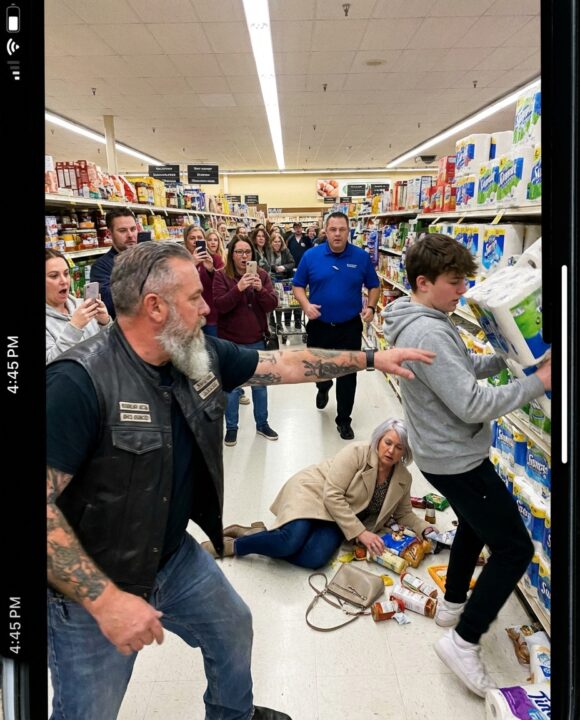
And then the crack.
Not loud enough to echo.
But loud enough to freeze everything.
A boy—sixteen, maybe seventeen—staggered back, one hand flying to his cheek. He stared at me like I’d just broken some invisible rule.
People gasped.
Someone shouted, “Oh my God!”
A woman near the cereal display whispered, “Did he just hit that kid?”
Yes.
I did.
And from where they were standing, it looked exactly as bad as it sounded.
I’m a fifty-three-year-old man. Six feet tall. Gray beard. Sleeveless black leather vest with club patches. Tattoos down both arms.
The kid wore a hoodie and skinny jeans. Baby-faced. Young enough to still have acne.
It didn’t matter what happened before that second.
All anyone saw was a biker slapping a teenager in public.
Phones recorded. Voices rose. Someone yelled for security.
The boy stumbled backward into a display of paper towels.
His eyes were wide—not just shocked. Panicked.
Behind him, on the polished supermarket floor, an elderly woman lay crumpled near the end cap.
But most people didn’t see her yet.
They saw me.
And when the first video clip hit social media twenty minutes later, the caption read:
“Violent biker assaults minor in grocery store.”
By the time police arrived, the crowd had already chosen their villain.
And I hadn’t said a single word.
“Sir, step away from him!”
The store manager, mid-40s, pale and shaking, positioned himself between me and the kid like I was about to attack again.
Security rushed in, out of breath.
The teenager tried to bolt toward the exit.
I caught his wrist.
Not hard.
Just firm enough to stop him.
That looked worse.
The crowd exploded.
“Let him go!”
“What’s wrong with you?”
“Call the cops!”
I could feel the heat of judgment before I even heard it.
And maybe I deserved some of it.
Because the truth is, I didn’t think before I acted.
I reacted.
The old woman on the floor let out a small, confused groan.
That’s when a few heads finally turned.
Her purse was ripped open. Groceries scattered. Apples rolling toward the dairy case.
One shoe half-off her foot.
“She fell,” someone whispered.
But the video didn’t show that part.
It showed my hand.
My vest.
My size.
The kid jerked against my grip. “I didn’t do anything!”
I looked him straight in the eye.
“You pushed her.”
He shook his head violently.
“I tripped!”
But I had seen it.
Clear as daylight.
He had grabbed her purse strap.
She resisted.
He shoved.
She fell.
It lasted maybe three seconds.
Three seconds that no one recorded.
Only the slap.
The slap was clean. Visible. Shareable.
Police arrived at 4:49 p.m.
Two officers.
Hands near their belts.
“What happened?”
The crowd answered for them.
“He hit a kid!”
“He assaulted him!”
I released the boy slowly and stepped back.
The officers positioned themselves between us.
The kid pointed at me. “He attacked me!”
I didn’t defend myself loudly.
Didn’t shout.
Didn’t posture.
I just said, “Check the cameras.”
That’s all.
But the crowd didn’t care about cameras.
They cared about optics.
And optics said: middle-aged biker assaults teenager.
The elderly woman was helped into a seated position. She looked dazed.
“Ma’am, did he hit you?” an officer asked gently.
She blinked.
Confused.
And then her eyes met mine.
And something inside me cracked.
Because I recognized those eyes.
Even after twelve years.
My mother had more gray in her hair than I remembered.
Her hands trembled the same way.
Her left eyebrow still arched slightly higher than the right when she was trying to process something.
But she didn’t say my name.
Not yet.
The officer repeated the question.
“Ma’am, did this young man push you?”
She hesitated.
Looked at the kid.
Then at me.
And in that split second, I saw everything we hadn’t said to each other in twelve years.
The last time I saw her, we had screamed across a kitchen table. Words about disappointment. Words about wasted potential. Words about my “dangerous lifestyle.”
I left.
She didn’t call.
I didn’t either.
And now she was sitting on a grocery store floor because a kid thought she looked easy to rob.
The teenager tried to edge away again.
Security blocked him.
The officers spoke into their radios.
The crowd continued filming.
I could already imagine the headlines.
“Biker with history of aggression assaults youth.”
Because that’s how stories work online.
Nobody waits for context.
The officer turned to me.
“Why’d you hit him?”
“Because he knocked her down,” I said calmly.
“That’s not how you handle it.”
Maybe he was right.
But in that moment, I wasn’t thinking about policy.
I was thinking about the sound of my mother’s body hitting tile.
The officer nodded toward the ceiling.
“We’ll check footage.”
Minutes felt longer than the twelve years I’d been gone.
The teenager’s bravado started to crack.
He stopped making eye contact.
Sweat beaded on his forehead.
One officer guided my mother gently toward a bench.
I stayed back.
Didn’t approach.
Didn’t kneel.
Didn’t claim anything.
I pulled out my phone.
Not to post.
Not to defend myself.
I sent a single text to Marcus.
Five words.
“I need a witness. Kroger.”
I didn’t explain more.
Didn’t say who.
Didn’t say why.
The officer’s radio crackled.
“Asset Protection pulling footage now.”
The crowd leaned in.
The kid’s breathing quickened.
And from outside the sliding glass doors, faint but unmistakable, I heard something familiar.
Engines.
Approaching slowly.
The engines didn’t rev hard.
They didn’t storm the parking lot.
They rolled in low and steady, like men who knew exactly where they were going and had no intention of making a scene.
Through the glass doors of the Kroger, I saw three bikes park neatly along the curb. Then two more. Helmets came off slowly. No shouting. No swagger.
Inside, the crowd shifted uneasily.
“Great,” someone muttered. “Now there’s more of them.”
The word them always lands the same way.
Marcus stepped through the sliding doors first. Mid-50s, steady eyes, sleeveless vest. Behind him, four others from the club stood back respectfully.
They didn’t approach the kid.
They didn’t approach my mother.
They simply stood near the entrance.
Visible.
Present.
Disciplined.
From the outside, it might have looked like intimidation.
But inside that fluorescent-lit grocery store, it felt like something else.
It felt like witness.
The store manager wiped sweat from his forehead. The officers tensed for a moment but didn’t escalate.
Marcus nodded once at me.
“You good?” he asked quietly.
“I’m fine.”
That was the only exchange.
No defense speeches. No chest-puffing. No threats.
The officer returned from the back hallway with another employee from Asset Protection.
“We’ve got the footage,” he said.
The entire store seemed to inhale at once.
A small monitor was rolled out near the service desk.
Phones were still recording.
The viral narrative was still alive.
Until the screen flickered on.
Aisle seven.
Timestamp: 4:35 p.m.
Clear as day.
The kid walking behind my mother.
His hand darting for her purse strap.
Her grip tightening.
His shove.
Her fall.
Groceries scattering.
Her head narrowly missing the shelf corner.
Then me stepping in.
The slap.
The monitor went silent.
No commentary.
No spin.
Just footage.
The kid’s face drained of color.
The crowd’s energy shifted from outrage to embarrassment in seconds.
One woman lowered her phone slowly.
Another whispered, “Oh.”
The officer turned to the teenager.
“You want to explain that?”
He didn’t answer.
He couldn’t.
Handcuffs clicked softly a moment later.
Not dramatic.
Not violent.
Just final.
My mother watched the screen without speaking.
Her eyes were wet—but not from pain.
From recognition.
And when she finally looked at me, the noise in the store faded into something else entirely.
The crowd dispersed more quietly than it had gathered.
No one apologized loudly.
No one offered speeches.
They just slipped away, embarrassed by how fast they had chosen a villain.
My mother sat on the bench near the pharmacy counter while a paramedic checked her wrist.
“Nothing broken,” he said gently.
She nodded.
I stayed a few feet away.
Twelve years is a long time to stand on opposite sides of pride.
The officers approached me.
“Sir,” one said carefully, “you should’ve let us handle it.”
“I know.”
It wasn’t defiance.
It was truth.
“I reacted.”
He studied me for a moment.
“You’re not being charged.”
That sentence felt strange.
Because online, I was already guilty.
Marcus and the others remained near the entrance, not inserting themselves.
Just waiting.
That’s the part people misunderstand about men like us.
We don’t show up to dominate.
We show up so no one stands alone.
The paramedic packed up his kit.
My mother adjusted her coat slowly.
Up close, I could see how much smaller she seemed.
Age had thinned her shoulders.
Softened her voice.
“I didn’t recognize you at first,” she said quietly.
I swallowed.
“That makes two of us.”
A faint smile flickered across her face.
“I suppose you’re still riding.”
“Yeah.”
“You always did run toward noise.”
That almost made me laugh.
There were a thousand things we could have said.
About the fight.
About the silence.
About birthdays missed and holidays avoided.
Instead, she did something simple.
She reached for my hand.
Not dramatic.
Not public.
Just a light grip.
“I’m glad you were here,” she said.
And just like that, twelve years of distance narrowed into one grocery aisle.
Outside, the bikes started one by one.
Low.
Controlled.
No celebration.
Marcus waited near the door.
“You coming?” he asked.
“In a minute.”
I walked my mother to her car.
Loaded her groceries into the trunk.
She paused before getting in.
“Dinner sometime?” she asked carefully.
“Yeah,” I said. “Dinner.”
No promises beyond that.
Just a start.
As I stepped back, she looked at me again—not with disappointment this time.
With something softer.
Pride, maybe.
Or relief.
When I walked back toward my bike, I noticed something strange.
No one was filming anymore.
No one was shouting.
The viral clip would fade by morning.
But what stayed with me wasn’t the slap.
It was the moment the footage played.
The moment truth slowed the room down.
The moment a crowd learned how quickly they had judged.
I pulled my helmet on.
The engine vibrated beneath me.
And for the first time in years, I didn’t feel like the villain in someone else’s story.
I just felt like a son who happened to be there at the right time.
If you want to read more stories about misunderstood bikers and the moments where appearances collapse under truth, follow the page.