A Biker Pounded on the ICU Doors Demanding the Ventilator Be Removed — Nurses Thought He’d Lost His Mind
He slammed his fist against the ICU glass and shouted, “Take it out—he signed the papers,” and every nurse in the corridor froze.
It was 2:17 a.m. at St. Mark’s Medical Center in Denver, Colorado. The night shift had settled into its quiet rhythm—monitors beeping softly, fluorescent lights humming over waxed floors, the smell of antiseptic hanging in the air.
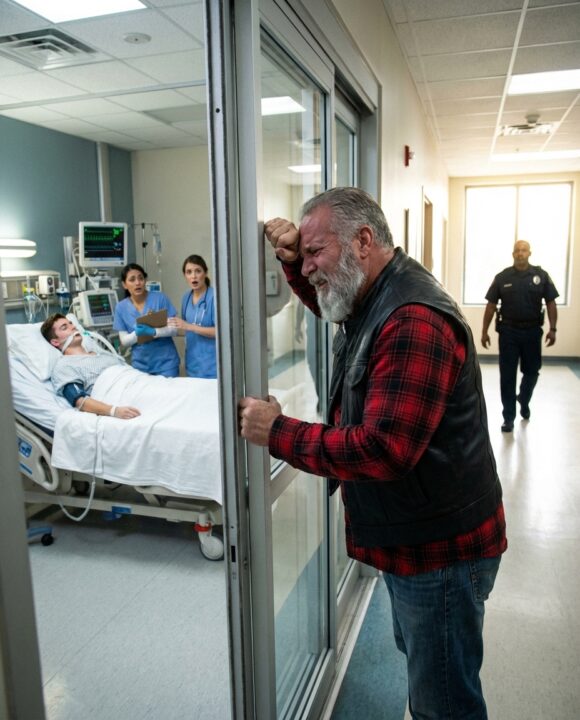
Inside Room 14, twenty-six-year-old Daniel Mercer lay motionless beneath a web of tubes. The ventilator rose and fell with mechanical precision. A green line blinked across the heart monitor.
Outside the room, a charge nurse held a clipboard close to her chest. “Sir, you cannot behave this way.”
The man at the glass didn’t look calm.
Tall. Broad-shouldered. Gray at the temples. Sleeveless leather vest over a faded flannel shirt. Heavy boots still dusted with road grit.
A biker.
To the staff, he looked like trouble that had wandered in from the street.
Security was already being called.
“He’s unstable,” someone whispered near the nurses’ station.
The man hit the glass again—not wildly, but hard enough to echo down the hall.
“He signed a donor directive!” he said, voice cracking under the weight of exhaustion. “He didn’t want this.”
Inside the room, Daniel’s chest continued its mechanical rise and fall.
No one outside the ICU knew the details.
All they saw was a leather-clad man demanding life support be removed in the middle of the night.
A younger nurse stepped back, shaken. “This is traumatic for staff.”
The biker lowered his hand slowly.
His jaw tightened.
“I’m his father.”
No one had asked.
Security’s footsteps echoed down the hallway.
And the tension shifted from grief to confrontation.
By 2:24 a.m., two hospital security officers stood between the biker and the ICU doors.
“Sir, you need to calm down.”
“I am calm,” he replied quietly.
He didn’t look it.
His breathing was uneven. His eyes red from something more than anger.
The charge nurse, Rebecca Sloan, crossed her arms. “We cannot remove life support without proper authorization.”
“He signed a DNR and organ donor directive at twenty-one,” the father said steadily. “It’s on file.”
Rebecca shook her head. “The insurance review is still pending.”
The word hung like something sour.
Insurance.
Daniel had been admitted three days earlier after a motorcycle accident on I-25. Severe head trauma. Brain swelling. No meaningful neurological response.
The father had not left the hospital.
He had slept in a plastic chair.
A hospital social worker approached cautiously. “Sir, this is a medical decision.”
“It was his,” the father replied.
From the outside, it looked like rage.
Like a reckless man trying to kill his own son.
A nurse whispered, “This is why we have protocols.”
The father stepped closer—not crossing the security line.
“You’re keeping him on a machine because the billing hasn’t cleared,” he said.
Rebecca’s expression hardened. “That is not how this works.”
“Then explain it.”
No one did.
Because explanation would require saying things out loud.
A resident physician approached, clipboard in hand. “We’re waiting for confirmation from the insurer and legal department.”
“Confirmation of what?” the father asked.
“That withdrawal won’t conflict with coverage terms.”
The father let out a short breath—almost a laugh, but without humor.
“So you’re extending his suffering because paperwork is slow.”
Security stepped closer.
“Sir, if you continue—”
“I’m not asking you to break rules,” he said quietly. “I’m asking you to follow his.”
That line cut through the hallway.
Still, to the bystanders—visiting families in the waiting room—it looked ugly.
A biker shouting at nurses.
Demanding removal of a ventilator.
A grieving man who had lost perspective.
Security radios crackled.
Hospital administration was being notified.
And the father reached into his vest pocket.
“Don’t,” one guard warned sharply.
He stopped.
Slowly pulled out his phone instead.
Typed three words.
Sent them.
The guard frowned. “Who are you calling?”
The father looked through the glass at his son’s still face.
“People who don’t wait on billing cycles.”
The tension sharpened.
No one knew what that meant.
But somewhere outside, in the hospital parking lot—
engines would soon begin to gather.
At 2:36 a.m., the ICU corridor felt smaller.
Hospital administration had arrived. A legal liaison. A risk management officer.
The father stood surrounded—not aggressive, not retreating.
Just planted.
The legal liaison spoke carefully. “Mr. Mercer, we are not disputing your son’s documented wishes. We are clarifying liability.”
Liability.
The father nodded once.
“I’ve read the forms.”
“You understand there could be complications if coverage is denied post-withdrawal.”
The words sounded clinical.
Detached.
As if Daniel were a file.
Inside the room, the ventilator continued its rhythm.
Artificial breath after artificial breath.
The father’s voice dropped lower.
“He didn’t want to live like this.”
Rebecca crossed her arms tighter. “We are following procedure.”
“Procedure isn’t mercy.”
That line made a few nurses glance away.
Security adjusted their stance.
The risk officer spoke next. “You cannot coerce medical staff.”
“I’m not,” the father said.
He stepped back two inches.
Raised both hands slightly.
No threat.
No shove.
Just a man trying not to explode.
From the waiting room, whispers floated in.
“Is that his dad?”
“Why is he acting like that?”
“Some people can’t handle grief.”
The father heard it.
Didn’t respond.
Because he wasn’t fighting the nurses.
He was fighting the clock.
He took his phone out again.
Checked the screen.
No visible reply yet.
The legal liaison continued, “We expect an insurer response by morning.”
“Morning?” he echoed.
It was 2:41 a.m.
Morning felt like years.
Inside the ICU room, a nurse adjusted Daniel’s IV.
The father watched through the glass.
“His brain activity is gone,” he said quietly.
The resident avoided eye contact.
“We’re awaiting final confirmation.”
The father nodded slowly.
He leaned closer to the glass—but didn’t touch it this time.
“You promised me,” he whispered under his breath.
Security shifted again, ready in case he lunged.
He didn’t.
Instead, he typed one more message.
Three words.
Sent.
Then he slipped the phone back into his vest.
The hallway held its breath.
Because somewhere beyond the hospital walls—
something had been set in motion.
And at 2:49 a.m., faint through the quiet night air—
the first motorcycle engine echoed across the parking structure.
The sound reached the ICU before anyone saw headlights.
Not loud. Not reckless.
Just a low, steady rumble that didn’t belong in a hospital parking lot at three in the morning.
A nurse near the window frowned. “What is that?”
Security glanced toward the elevator lobby.
Through the glass doors at the end of the corridor, silhouettes began to appear.
One bike. Then three. Then six.
Engines cut in sequence.
Silence followed.
The kind of silence that makes fluorescent lights feel louder.
Inside the ICU hallway, tension sharpened.
“Are these with him?” a resident whispered.
The father didn’t turn around.
He already knew.
The elevator doors opened.
Four riders stepped out first—two men, two women. Leather vests. Clean boots. Faces serious but controlled.
No shouting.
No drama.
Just movement with purpose.
A woman in her early fifties, short silver hair pulled back tight, removed her helmet and approached the legal liaison calmly.
“Mercer family?” she asked.
The liaison blinked. “Excuse me?”
She held up a slim leather folder.
“Advance directive copies. Signed and notarized. Organ donor registry confirmation. And pre-authorization correspondence from the transplant network.”
The words landed heavy.
The legal liaison stiffened. “Those documents are already in review.”
She nodded politely. “We reviewed them too.”
Behind her, another rider—mid-thirties, wearing a plain black tee under his vest—spoke quietly.
“Regional transplant coordinator is on her way. She was notified at 2:28 a.m.”
The legal officer hesitated.
“That’s… unusually fast.”
The silver-haired woman gave a small shrug.
“Some calls get returned quickly.”
The father finally turned around.
His face didn’t show triumph.
Just exhaustion.
Rebecca, the charge nurse, looked between the folder and the father.
“You organized this.”
He shook his head slowly.
“No. He did.”
He nodded toward Daniel’s room.
“He signed the forms five years ago.”
The elevator doors opened again.
This time, a woman in a navy blazer stepped out briskly, carrying a hospital ID clipped to her pocket.
“I’m Dr. Lena Patel, transplant coordination,” she said, breath slightly quickened. “I received confirmation from the donor registry and insurer escalation desk. There is no restriction on withdrawal under the documented directive.”
The hallway shifted.
Not violently.
But unmistakably.
The legal liaison flipped through the folder again.
The risk officer cleared his throat.
“We will need attending physician confirmation.”
Dr. Patel nodded. “He’s already been paged.”
Inside Room 14, the ventilator continued its steady rhythm.
Mechanical.
Impersonal.
But now, for the first time since 2:17 a.m., the hospital staff were no longer speaking about liability.
They were speaking about consent.
Rebecca’s voice softened slightly. “We need to reconvene the care team.”
The silver-haired biker stepped back.
No celebration.
No nod of victory.
Just quiet alignment.
Outside the ICU glass, more riders stood along the corridor wall—not blocking, not crowding—simply present.
Not a mob. Not a protest. Just witnesses who refused to let paperwork outlast a promise.
The attending physician arrived minutes later.
He reviewed the file.
Looked at the father.
Then through the glass at Daniel.
He exhaled.
“We’ll proceed according to his directive.”
The father closed his eyes briefly.
Not in triumph.
In relief.
At 3:31 a.m., the ICU room was quieter than it had been all night.
The ventilator was still running.
But the energy had changed.
Dr. Patel stood beside the attending physician. Rebecca adjusted the monitor leads gently.
The father stood at Daniel’s bedside.
No shouting now.
No glass between them.
He placed one rough hand over his son’s.
“Hey, kid,” he said softly.
No one else spoke.
The machines hummed.
The attending physician explained the process in measured tones. There would be medication. Comfort ensured. No suffering.
The father nodded at each step.
He wasn’t reckless.
He wasn’t unhinged.
He was listening.
Outside the room, the riders stood in the hallway with heads slightly bowed.
No phones out.
No whispers.
Just presence.
At 3:44 a.m., the ventilator was removed.
The room didn’t erupt into chaos.
It grew still.
Daniel’s breathing did not return.
It wasn’t supposed to.
The father leaned forward and pressed his forehead gently to his son’s.
“I got here,” he whispered.
No one in the hallway heard that part.
They only saw the biker who had pounded on ICU glass hours earlier.
The “angry man.”
The “disruptive father.”
Now standing quietly in a hospital room lit by dim monitors.
When he stepped back into the corridor, his face was composed.
Dr. Patel approached him.
“Organ procurement team is ready,” she said gently.
He nodded once.
“Thank you.”
Rebecca hesitated, then stepped forward.
“I’m sorry if it felt like we weren’t listening.”
He considered that.
Then said, “I know you have rules.”
It wasn’t forgiveness.
It wasn’t blame.
Just acknowledgment.
The silver-haired biker placed a hand briefly on his shoulder.
No words.
Outside the hospital, dawn had begun to break.
A pale blue light replaced the night.
The motorcycles started quietly, one at a time.
No roaring departure.
Just engines easing back onto empty streets.
The father remained behind.
Paperwork to sign.
Final steps to complete.
Hours later, when he finally stepped into the parking lot, only one bike remained.
He mounted slowly.
Didn’t look back at the hospital.
Not because he was angry.
But because the fight had never been about the building.
It had been about a promise.
And in the early Denver morning, as the last motorcycle rolled away under soft light—
a father who looked like a threat had kept his son’s final wish.
No speeches were given.
No headlines captured the nuance.
But somewhere, three strangers would receive organs before sunrise.
And a man in a leather vest rode home alone—
not victorious.
Just certain that silence would have cost more.