A Biker Blocked an Ambulance in a Quiet Neighborhood — As Neighbors Reached for Their Phones
“Get out of the way!”
The paramedic’s voice cut through the neighborhood, sharp and urgent.
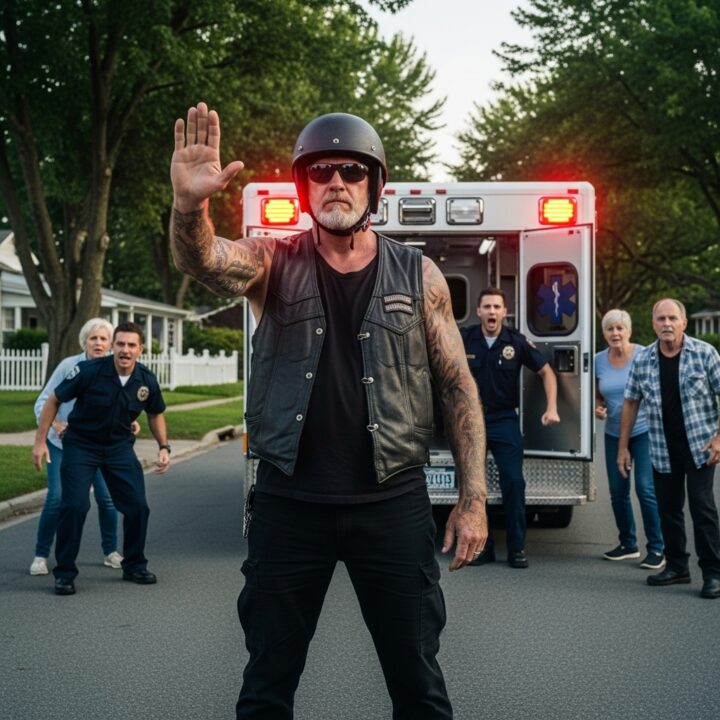
The ambulance sat at an awkward angle in the narrow street, lights flashing red against white fences and trimmed hedges. Sirens were off now, replaced by the hum of the engine and the rising tension in the air.
And directly in front of it stood a biker.
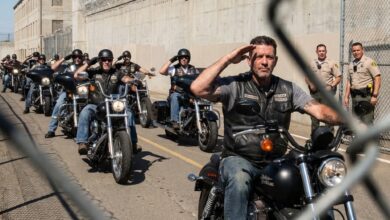
He had parked his motorcycle sideways across the road, blocking the ambulance completely. Sleeveless leather vest. Thick arms marked with old tattoos. Helmet still on. Boots planted wide, unmoving.
To the neighbors watching from porches and driveways, it looked unthinkable.
A man stepped forward, hands raised. “Are you crazy? Someone’s dying!”
Another voice followed. “Call the police!”
The biker didn’t shout back.
Didn’t move.
He lifted one hand slowly—not in surrender, but in a steady signal to wait.
The ambulance driver leaned out the window, face tight with anger. “Move the bike. Now.”
The biker shook his head once.
The street fell into a stunned silence. Children were pulled back by their parents. A woman covered her mouth in disbelief.
In that frozen moment, all anyone could see was this:
A dangerous man in leather standing between an ambulance and someone who needed help.
The anger came fast.
“This is exactly what people say about them,” someone muttered.
“They think the rules don’t apply,” another snapped.
Phones were out now. Cameras pointed. A man in a polo shirt paced, already speaking loudly into his phone about obstruction and arrest.
The biker remained where he was.
From the outside, his silence looked like arrogance. Like power being abused. He didn’t explain himself. Didn’t justify his actions. That only made the assumptions louder.
A paramedic jumped down from the ambulance. “Sir, step aside. We don’t have time for this.”
The biker looked past him—down the street. Toward a small house with a sagging porch and a door standing open.
“Thirty seconds,” the biker said.
The paramedic stared at him. “You don’t get to decide that.”
The biker didn’t argue.
He simply stood there, one hand resting lightly on the handlebars, the other relaxed at his side.
Someone shouted that he should be dragged out of the way. Another warned the biker he’d regret this.
The word police floated through the crowd again.
The neighborhood, usually calm and predictable, now buzzed with accusation and fear.
And the biker took it all without a word.
The tension sharpened.
The paramedic turned back toward the ambulance, clearly preparing to call it in. The driver’s knuckles whitened on the steering wheel. The clock was ticking—everyone could feel it.
The biker reached into his vest.
Several people stiffened.
Slowly, deliberately, he pulled out his phone and tapped out a message. Short. Precise. He didn’t look at the screen for long before slipping it back into his pocket.
“I’m not leaving,” he said calmly.
The paramedic shook his head in disbelief. “You’re risking a life.”
The biker’s voice dropped, steady and controlled. “So are you. If you go through right now.”
That sentence landed heavy.
The crowd murmured. Some laughed nervously. Others grew angrier.
A woman shouted, “Who do you think you are?”
The biker didn’t answer.
Instead, he stepped slightly to the side—not enough to open the road, but enough to point clearly down the block.
That’s when a few people noticed it.
Not the biker.
The street.
A large oak tree had come down earlier that morning, its branches partially cleared but its trunk still unstable, leaning over the narrow road at an angle. The ambulance, if it moved forward, would pass directly beneath it.
The paramedics hesitated.
Before anyone could say more, a sound rolled in from a distance.
Low. Steady.
Engines.
The sound grew closer, unmistakable now.
Motorcycles turned onto the street in pairs and threes, slowing as they approached. No revving. No display. Just controlled movement.
They parked along the curb, engines cutting one by one.
Men dismounted. Sleeveless vests. Tattoos. Gray hair mixed with dark. Helmets tucked under arms.
They spread out calmly, some directing neighbors back, others scanning the tree above the road.
One biker looked up at the branches and shook his head. “That’s ready to come down.”
Another nodded. “Wind shifts, it goes.”
The paramedic followed their gaze. So did the driver.
A crack echoed overhead—soft, but enough.
The oak shifted.
The bikers moved immediately. Two ran forward, guiding the ambulance back several feet. Another waved the neighbors away from the danger zone.
Moments later, the tree gave way.
It crashed down exactly where the ambulance would have been.
The street erupted—not in cheers, but in stunned silence.
The biker who had blocked the road lowered his helmet visor and exhaled slowly.
“Now,” he said.
The bikers moved together, clearing debris just enough to create a safer path. One directed the ambulance down a side street the neighborhood rarely used.
The paramedics didn’t argue this time.
They followed.
The ambulance reached the house from the opposite direction. Safely.
Later, after the patient was stabilized and taken to the hospital, the street returned to its quiet rhythm. The bikers remained only long enough to ensure the road was secure.
People stood where they had been shouting minutes earlier. Silent now.
A man who had threatened to call the police approached the biker slowly. “I… I thought you were just being difficult.”
The biker removed his helmet. His face was older than many expected. Tired. Calm.
“I used to be a volunteer responder,” he said. “You learn when to slow things down.”
No pride in his voice. No lecture.
The paramedic walked over. “You were right,” he said. “We didn’t see it.”
The biker nodded once.
The bikers mounted their motorcycles and rode off in small groups, engines fading into the distance.
The neighborhood didn’t clap.
Didn’t celebrate.
They just stood there, thinking.
About how fast judgment had come.
About how easily fear had filled in the gaps where understanding should have been.
And the image stayed with them long after the street was cleared:
A man in leather, standing in front of an ambulance—not to stop help, but to make sure it arrived alive.
Sometimes the most dangerous-looking choice is the one that saves the most lives.
And sometimes, the people we’re quickest to condemn are the ones paying the closest attention.