A Mother Slapped a Biker and Ordered Him to Strip at a Route 66 Gas Station — Then She Saw the Dead Man’s Name Hidden Inside His Vest
I slapped the biggest biker at the gas station hard enough to turn his head, grabbed the collar of his leather vest, and screamed for him to take it off while twenty strangers lifted their phones and prepared to call the police.
His name was Ray “Hammer” Dawson.
I did not know that yet.
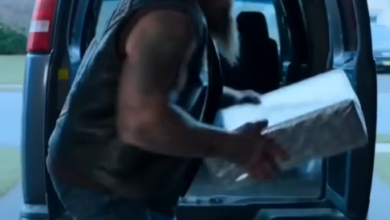
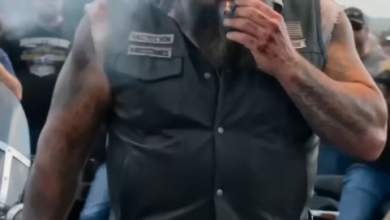
All I knew was that he stood six-foot-four beneath the harsh Arizona sun, nearly 280 pounds packed beneath a faded black T-shirt and a leather cut, with a shaved head, a thick black-and-gray beard, scarred knuckles, and tattooed forearms resting beside a midnight-blue Harley-Davidson Road King.
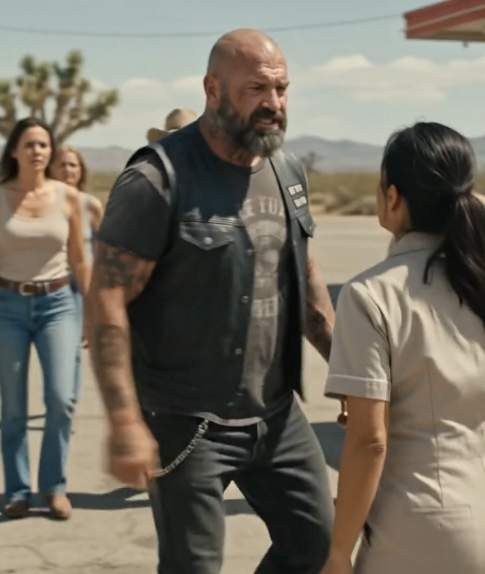
He looked like a man who had survived fights other people only told stories about.
And something venomous had just crawled beneath his collar.
I was forty-two then, a widowed mother working double shifts at a motel outside Kingman, Arizona. I had stopped at the Route 66 Desert Star for six gallons of regular, a burnt coffee, and enough courage to tell my nineteen-year-old son, Gabriel, that I could not cover the rest of his nursing-school tuition.
Then I saw the creature.
An Arizona bark scorpion dropped from the wooden canopy above pump four. It landed on Hammer’s shoulder, vanished beneath the raised collar of his vest, and slipped toward the back of his neck before I could form a complete thought.
I ran.
Hammer turned when he heard my shoes scrape across the concrete. His right hand moved instinctively toward my wrist, but I struck his neck first, trying to pin the scorpion beneath the leather before it reached his shirt.
The slap cracked across the station.
Every conversation stopped.
“Take it off!” I shouted.
Hammer stared at me.
“Your vest. Take it off now!”
A white man filling a pickup abandoned the nozzle and stepped closer. Two teenage boys near the ice freezer began recording. The cashier reached beneath the counter, probably for the alarm button, while a woman pulled her little girl behind a minivan.
Nobody had seen the scorpion.
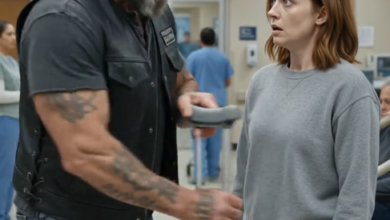
They had only seen a tired Latina woman attack an enormous tattooed biker and order him to remove his clothes.
Hammer’s expression hardened.
“What did you put on me?”
“Nothing. Something went inside your collar.”
He started to reach behind his neck.
“Don’t touch it!”
That sounded worse.
One of the teenagers whispered, “She’s got a weapon.”
The man by the pickup shouted, “Leave her alone!”
Hammer had not touched me.
He slowly raised both hands, watching my face instead of the gathering crowd. Then he unclipped the front of his leather cut.
“Tell me where.”
“Behind your neck. Moving down.”
He pulled one shoulder free. The leather creaked. His vest dropped open, exposing a faded gray T-shirt and a pale rope of scar tissue across his left collarbone. Inside the leather was a small hand-sewn strip of white cloth bearing a name in blue thread.
THOMAS KEENE.
My breath caught.
I knew that name.
For eleven months, every tuition statement from Mohave Community College had carried the same line beneath Gabriel’s balance:
Payment received through the Thomas Keene Memorial Fund.
The mysterious fund had paid exactly what my son needed each time I fell short. No website existed. No office answered when I called. The college would tell me only that the donor insisted on remaining private.
Hammer tore the vest away.
A pale scorpion fell onto the concrete between his boots, tail raised. He trapped it beneath an empty oil container before it could disappear under the pump.
The crowd exhaled at once.
Phones lowered.
The man by the pickup muttered an apology to nobody in particular. The cashier removed her hand from beneath the counter. Hammer looked at the red mark my palm had left across his beard.
“You hit hard,” he said.
“You’re welcome.”
One corner of his mouth moved, but not enough to become a smile.
As he lifted the vest, a folded receipt slipped from an inside pocket and landed faceup near my shoe. I bent to retrieve it.
At the top was the community college’s bursar office.
Below it was my son’s student identification number.
The payment was $2,840.
Paid in cash three days earlier.
Hammer snatched the receipt from my hand, but he was too late. I had already seen the signature at the bottom.
Not Thomas Keene.
Raymond Dawson.
I looked at the stitched name inside his vest, then at the tuition receipt, then at the terrifying stranger whose life I had just protected without knowing he had been protecting my son for nearly a year.
“Who was Thomas Keene?” I asked.
Hammer’s fingers closed around the receipt.
Across the highway, five more Harleys turned into the station, their V-twin engines rolling through the desert like distant thunder.
Hammer put his vest back on.
“He was the reason your boy still has a father’s name to sign.”
Then he mounted his motorcycle and started the engine before I could ask what that meant—or why a dead man had been paying my son’s tuition through a biker who seemed determined to remain invisible.
Part 2 — The Man Who Paid in Cash
I should have let him ride away.
Instead, I stepped in front of the Harley.
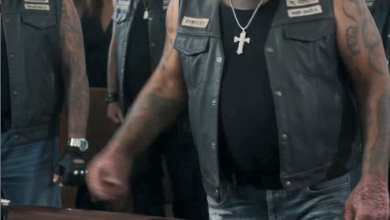
Hammer’s engine settled into a heavy idle that vibrated through my shoes. The five riders entering the station spread out behind him, not aggressively, but with the unconscious precision of men who had traveled thousands of miles together. Their cuts carried the same small iron-lantern emblem, though no one reached for me or told me to move.
A broad Black biker with a silver beard switched off his Road Glide first. His name, I later learned, was Boone Carter, a sixty-four-year-old Army veteran with an artificial knee and the habit of studying exits before faces.
Beside him stood Luis “Sparks” Ortega, a fifty-year-old Latino electrician with a gray braid, oil-darkened hands, and sunglasses that reflected my frightened expression back at me.
“You know her?” Boone asked.
“No,” Hammer said.
I held up my phone. On the screen was a photograph Gabriel had sent me that morning: his tuition account with a zero balance.
“You know my son.”
Hammer looked at the image, then toward the highway.
“Move away from the bike, ma’am.”
“Did you pay this?”
“No.”
“I saw the receipt.”
“You saw paper on the ground.”
“It had Gabriel Ruiz’s student number.”
The other bikers became quiet. Sparks tilted his head toward Hammer as if waiting to see which lie he would choose.
Hammer chose silence.
That made me angrier than denial.
For almost a year, I had believed the money came from a scholarship Gabriel earned through grades. He was a good student, but not the sort who collected trophies. He worked weekend shifts at a grocery store, drove a Honda with a cracked dashboard, and studied anatomy at our kitchen table after midnight while I washed motel sheets that never seemed to come clean.
When the first $1,900 appeared in his account, Gabriel assumed the school had awarded emergency aid. The bursar said the donor wanted no contact. The second payment arrived after our transmission failed. The third came the week I spent our savings repairing a leaking roof.
Each time we were about to lose the semester, Thomas Keene reached out from the grave.
Now the ghost was sitting on a Harley.
“Why my son?” I asked.
Hammer’s gaze moved to the motel logo embroidered on my shirt. “You work nights?”
“That is none of your business.”
“How many?”
“Usually six.”
“And the boy works?”
“Twenty-four hours a week.”
“Then the money went where it was supposed to.”
He eased the motorcycle into gear.
I did not move.
Boone rubbed a hand across his beard. “Hammer.”
One word.
Warning or permission—I could not tell.
Hammer killed the engine again. Heat rose from the cylinders. The station smelled of gasoline, hot rubber, old coffee, and the sharp mineral scent of a storm gathering somewhere beyond the dry hills.
“What did my husband have to do with Thomas Keene?” I asked.
That stopped him.
My husband, Miguel, had died seven years earlier when a tired delivery driver crossed the centerline outside Seligman. Gabriel was twelve. I was thirty-five. The police returned Miguel’s wedding ring inside a plastic evidence bag, and for months I kept expecting to hear his work boots at the door.
Hammer studied my face.
“Your husband’s name was Miguel Ruiz?”
“Yes.”
“Worked county road maintenance?”
“Yes.”
“Drove a yellow service truck?”
My throat tightened. “How do you know that?”
Hammer looked down at the Harley’s fuel tank. A small crescent-shaped dent marked the left side beneath the handlebar. He brushed it once with his thumb.
“Because he pulled me out of a ditch.”
The answer opened more questions than it closed.
According to Hammer, twelve years earlier, he and Thomas Keene had been riding west through a winter storm after visiting a veterans’ hospital in Flagstaff. Black ice covered a bridge near Ash Fork. Thomas’s motorcycle went down first. Hammer swerved to avoid him, broke through a guardrail, and landed twenty feet below the highway.
Miguel found them before emergency crews arrived.
He climbed down the embankment in freezing rain, shut off Hammer’s leaking fuel line, and used his county jacket to press against a wound in Thomas’s side. The bridge radio was dead, so Miguel ran nearly half a mile uphill to stop traffic and flag down help.
Thomas lived through the night.
He died seventeen months later.
Hammer did not explain why.
“What does any of that have to do with Gabriel’s tuition?”
“Your husband said he had a boy.”
“That still doesn’t answer me.”
“It’s the answer I’ve got.”
He started the Harley once more, and this time I stepped aside.
The riders left in staggered order, chrome flashing beneath the noon sun. Hammer rode last. His engine was deeper than the others, a slow mechanical pulse that remained in the air after the motorcycles crossed the interstate ramp and disappeared.
I stood beside pump four holding coffee I no longer wanted.
The cashier came outside with a bag of ice for my swollen hand. Her name was Denise, and she had worked at Desert Star long enough to know most travelers by what they bought.
“You’re lucky,” she said.
“Because he didn’t hit me?”
“Because he stopped.”
She told me Hammer passed through Kingman on the first Saturday of every month. Sometimes alone. Sometimes with the Iron Lanterns. He always bought twenty dollars of fuel, one black coffee, and a packet of powdered donuts he never ate.
Then he drove toward Ash Fork.
“Where does he go?”
Denise glanced at the road.
“Same cemetery every time.”
That evening, I told Gabriel what happened.
He listened without interrupting, still wearing his green grocery-store apron, then pulled a white envelope from his backpack. It had arrived at the college two days earlier and carried no return address.
Inside was a single typed sentence:
Finish the work your father began.
Under it, someone had drawn a small iron lantern.
Part 3 — The Ride to Ash Fork
Gabriel wanted to find Hammer.
I wanted answers.
Those are not the same thing.
My son saw a stranger who had rescued his education when his mother could not. I saw a man who knew too much about my husband, used the name of someone dead, and had followed our financial problems closely enough to know the exact amount missing from every tuition payment.
“How did he know when to pay?” I asked.
“Maybe Dad told him about us.”
“Your father died seven years ago. You started college last year.”
“Then maybe he checked.”
“That is what frightens me.”
Gabriel folded the letter along its original crease. He had Miguel’s careful hands and my inability to leave a question alone.
“I’m going to Ash Fork Saturday.”
“No.”
“I’m nineteen.”
“And still living under my roof.”
“I can sleep in the Honda if that makes you feel better.”
It did not.
So three days later, we drove east together.
Interstate 40 cut through miles of sunburned rock, truck stops, abandoned buildings, and old Route 66 signs fading beneath the Arizona sky. Gabriel held the envelope on his knee. I kept both hands on the wheel and wondered whether gratitude could become suspicion when it arrived without permission.
We found Hammer at Juniper Ridge Cemetery shortly after ten.
Six Harleys stood beside the gravel road. Their engines were silent. The Iron Lanterns had formed a loose half-circle around a plain headstone beneath a juniper tree, leaving Hammer alone at the center.
He wore the same vest.
Thomas Keene’s name was stitched inside it.
Hammer knelt in the dirt with a powdered donut in one hand and a paper cup in the other. He placed both beside the stone, then removed a tarnished dog tag from beneath his shirt and laid it across the carved name.
Thomas Daniel Keene.
1971–2015.
Teacher. Brother. Father.
Gabriel stopped beside me.
“Father?”
A child’s toy motorcycle sat at the base of the marker. Its red paint had faded nearly pink.
Hammer heard our footsteps. He did not turn immediately.
“Told you not to follow me.”
“You never told us that,” Gabriel replied.
“Thought it loudly.”
Boone coughed into his fist, perhaps hiding a laugh. Hammer stood, brushed dust from his knees, and faced my son for the first time.
Gabriel was not small. At nineteen, he was nearly six feet, lean and brown-skinned, with thick black hair that refused to lie flat. But beside Hammer, he looked younger than I had seen him in years.
“You’re Miguel’s boy,” Hammer said.
“Gabriel.”
“I know.”
“How?”
Hammer picked up the coffee. “Your school keeps records.”
“Schools don’t hand financial records to strangers.”
“No.”
“Then someone inside is helping you.”
Hammer drank.
The silence confirmed it.
A woman stepped from behind the bikers. She was white, perhaps fifty, with gray beginning at her temples and reading glasses hanging from a cord around her neck. She introduced herself as Dr. Helen Keene, Thomas’s widow and the dean of student support at Mohave Community College.
My anger found a target.
“You gave him our information?”
“I told him which students qualified for the memorial assistance,” she said. “I did not share anything beyond what your son authorized on his emergency-aid application.”
“I never applied to Thomas Keene.”
Gabriel lowered his eyes.
He had.
After our transmission failed, he submitted a form asking the school for help. He had hidden it because he thought I would feel ashamed.
He was right.
Dr. Keene explained that the memorial fund was legitimate but small. Thomas had left no money behind. What remained came from private donations raised by the Iron Lanterns, deposited through the college, and assigned according to need.
“Ray gives the most,” she said.
Hammer stared at the highway.
“How much?” I asked.
“That is private.”
“How much?”
Hammer’s voice dropped. “Enough.”
Gabriel stepped closer. “Why under his name?”
For the first time, Hammer looked genuinely cornered.
Boone answered for him.
“Because Thomas spent his life putting his name on other people’s second chances.”
Thomas had taught English and adult literacy at Northpoint Correctional Center. Hammer met him there at thirty-two, after a parking-lot fight left one man with a broken jaw and Hammer with an eighteen-month sentence.
Hammer entered prison able to rebuild a diesel engine but unable to write a job application without help. He distrusted teachers, counselors, guards, preachers, and any man whose hands had no scars.
Thomas Keene had all ten fingers stained with blue ink.
“He made me read,” Hammer said.
“What?” Gabriel asked.
“Everything I hated.”
Thomas brought him Steinbeck, Baldwin, Hemingway, and a battered motorcycle-repair manual missing half its pages. When Hammer refused essays, Thomas told him to write instructions for rebuilding a carburetor. When Hammer wrote three pages without punctuation, Thomas handed them back with only five words across the top:
Make the reader breathe, Raymond.
“He called you Raymond?” I asked.
“Once.”
“What happened?”
“I broke his nose.”
Boone turned away, shoulders shaking.
Hammer added, “He called me Hammer after that.”
Thomas helped Hammer earn his GED. After release, he convinced a diesel garage to hire him. Years later, Thomas bought an old Harley that stalled every twelve miles and asked Hammer to teach him how to ride.
“He was terrible,” Sparks said.
“Still is,” Hammer replied, looking at the grave.
Was.
Nobody corrected him.
Gabriel crouched beside the headstone and touched the toy motorcycle. “Was this his son’s?”
The mood changed.
Dr. Keene removed her glasses.
Hammer closed one scarred hand around the dog tag.
“No,” he said. “It belonged to mine.”
Then an engine roared on the cemetery road.
A single rider approached too fast, scattering gravel. He wore no Iron Lantern emblem. When he removed his helmet, I saw a young man with Thomas Keene’s eyes and enough anger for every person standing there.
“Get away from my father’s grave,” he told Hammer.
Part 4 — The Son Who Wanted the Name Back
His name was Caleb Keene.
He was twenty-eight, thin through the shoulders, with a dark beard and a pale scar near his temple. He stepped off his motorcycle without lowering the kickstand properly, letting the machine lean farther than it should before Boone caught the handlebar.
Caleb did not thank him.
He stared at Hammer.
“You’re still using his name.”
Hammer picked up the donut and coffee from the grave. “Morning, Caleb.”
“Don’t.”
Dr. Keene moved between them. “Your father wanted the fund.”
“My father wanted a hundred things before he died. That doesn’t mean this man gets to turn him into a club patch.”
The Iron Lanterns remained silent. Nobody surrounded Caleb. Nobody ordered him to leave. Yet I saw the brotherhood tense in small ways—boots repositioning on gravel, shoulders straightening, Sparks sliding his sunglasses onto his head.
Hammer gave the dog tag to Dr. Keene.
“What do you want?” he asked.
“I want you to stop paying strangers under Dad’s name.”
Gabriel stood.
“I’m one of those strangers.”
Caleb looked him over. “Then you should know where the money comes from.”
Hammer’s jaw tightened.
“Caleb.”
“No. She deserves to know.” He pointed at me. “Her son deserves to know.”
My stomach turned.
The tuition had been paid in cash. I had seen Hammer’s prison record in his face before anyone told me it existed. For one ugly second, I imagined stolen motorcycles, drug money, debts collected behind bars.
Caleb saw the suspicion.
“That’s what he does,” he said. “He makes people take money first. Then they find out what it cost.”
Hammer walked toward him.
Boone said, “Brother.”
Hammer stopped.
Caleb pulled a folded newspaper clipping from his jacket and threw it onto the ground between us. The headline described a motorcycle collision on Interstate 40 twelve years earlier—the same crash where Miguel had found Hammer and Thomas below the bridge.
The article said Thomas Keene suffered internal injuries after losing control on black ice. It said Raymond Dawson escaped with a fractured shoulder and severe lacerations.
It did not mention another passenger.
Caleb pointed to the photograph beneath the headline.
A boy sat on Hammer’s Harley at a charity ride. He looked about fifteen, with a narrow face and a leather jacket too large for him.
“That’s Eli Dawson,” Caleb said. “Hammer’s son.”
Hammer bent, picked up the clipping, and folded it carefully.
“Enough.”
“He died that night.”
Gabriel looked from the clipping to the toy motorcycle near Thomas’s grave.
“I thought Thomas died later.”
“He did,” Caleb replied. “Eli didn’t.”
The story Hammer had told us was incomplete.
Eli had been riding behind his father that afternoon, returning from the veterans’ hospital where the Iron Lanterns delivered winter coats. Hammer had checked the forecast and knew temperatures would drop. Boone urged him to wait until morning. Thomas offered to keep Eli at a motel.
Hammer chose the road.
When Thomas’s motorcycle slid, Hammer swerved. The Road King broke through the guardrail with both father and son aboard. Hammer landed in brush. Eli struck the rocky embankment.
Miguel reached them first.
He found Hammer conscious but trapped beneath the motorcycle. Eli lay several yards lower, unmoving. Thomas crawled toward the boy despite his own internal injuries.
Miguel could not carry all three.
“He chose Eli first,” Caleb said. “Your husband carried Hammer’s son up that embankment while Thomas stayed below pressing his jacket against Hammer’s side.”
The ambulance took Eli and Hammer. Thomas initially refused transport because only one unit had arrived and he believed the boy still had a chance.
Eli died before reaching the hospital.
Thomas’s untreated internal bleeding caused permanent damage. He survived surgery, returned to teaching, and lived another seventeen months. Then an aneurysm near the injured tissue ruptured while he was grading papers at home.
Caleb had been sixteen.
“I lost my father because he stayed with this man,” he said.
Dr. Keene spoke quietly. “Your father made that choice.”
“He made it because Hammer took a child onto an icy highway.”
Hammer did not defend himself.
That seemed to hurt Caleb more.
“You started the fund because you couldn’t pay Dad back,” Caleb continued. “Then Miguel died, so you moved on to his kid. How many dead men are you going to turn into receipts before you admit you’re buying forgiveness?”
Gabriel stepped between them.
“You think my tuition forgives him?”
“I think he does.”
Hammer’s voice cut through the cemetery.
“No.”
One word.
Caleb stopped.
Hammer removed his leather vest. In the sunlight, the inside lining revealed more than Thomas’s stitched name. Below it were two smaller strips of cloth.
ELI DAWSON.
MIGUEL RUIZ.
My knees weakened.
Hammer laid the vest across Thomas’s headstone. Without it, he looked older. The faded T-shirt clung to shoulders shaped by decades of mechanical work, but there was no armor left in him.
“I don’t pay to be forgiven,” he said. “I pay because the dead can’t.”
Caleb’s eyes filled, though no tears fell.
Hammer continued. “Your dad had one year left on the loan for your technical program when he died. The fund paid it.”
Caleb’s face changed.
Dr. Keene looked sharply at Hammer. “Ray.”
He had not known.
For twelve years, Caleb believed the remaining tuition at his aviation-mechanics school had disappeared through life insurance. In truth, Hammer sold Eli’s restored 1969 Camaro and paid the balance anonymously through Thomas’s memorial fund.
“That car was for your son,” Caleb whispered.
“Was.”
“You loved that car.”
“Not enough to bury it.”
Caleb looked at the toy motorcycle, then at his father’s name sewn inside the vest he hated.
The confrontation everyone expected never came. No punch. No shouting. Hammer simply put the leather back on and secured it across his chest.
Then Caleb asked the question none of us had considered.
“If Miguel saved you and Eli, why didn’t you help his family when he died seven years ago?”
Hammer looked at me.
“I tried.”
Part 5 — The Envelope I Sent Back
Seven years earlier, three weeks after Miguel’s funeral, an envelope arrived at our house.
I remembered it because there was no return address. Inside were forty hundred-dollar bills wrapped in a strip of brown paper. No letter. No name. Just cash.
I assumed it came from Miguel’s road-maintenance crew.
Grief made every act of kindness feel like a debt I could never repay. I was afraid the money had been collected by coworkers with families of their own, so I called the county office and asked who sent it.
Nobody knew.
I turned it over to the police.
An officer held it for ninety days, then mailed it back after finding no evidence of a crime. By then, fear had hardened into pride. I donated the money to a roadside-victim assistance charity in Miguel’s name.
Hammer knew.
“The charity sent a receipt,” he said.
“You sent that cash?”
He nodded.
“Why didn’t you include your name?”
“Didn’t want you thinking you owed me.”
“You could have told me who you were.”
“Would you have taken it?”
No.
We both knew the answer.
After that, Hammer watched from a distance.
He kept Miguel’s obituary folded in his garage toolbox. Once a year, he drove through Kingman and left flowers near the county maintenance yard. When Gabriel graduated from high school, Hammer saw the announcement in the local paper. He learned Gabriel wanted to enter nursing because the paramedic who stayed with Miguel after the crash had treated our family with more kindness than any official in the weeks that followed.
Then tuition nearly ended the plan.
Hammer contacted Dr. Keene.
The Thomas Keene Memorial Fund had paid six students over eleven years. Hammer selected none of them personally. Dr. Keene reviewed applications, removed identifying information, and sent the Iron Lanterns a list of amounts needed. Club members raised money through repair work, raffles, long-distance rides, and weekend construction jobs.
Gabriel’s case appeared as Student 27B.
Hammer recognized Miguel in the essay.
Gabriel had written about the yellow county truck, the winter bridge, and the belief his father carried through every emergency: if you arrive first, you belong to the problem until help comes.
Hammer paid the first balance from savings.
For the second, he rebuilt three engines after his regular shift and sold a custom fuel tank he had spent eighteen months shaping.
The third payment—the receipt that fell at my feet—came from his son’s motorcycle.
Not the Harley he rode.
Eli’s.
The boy had owned a small used Sportster, bought in pieces with grocery-store wages and rebuilt beside his father. After Eli died, Hammer kept it under a canvas cover in the back of his garage. He changed the oil every year. Inflated the tires. Turned the engine by hand so nothing seized.
He never started it.
When Gabriel’s final-year tuition increased, the fund ran short by $2,840. Hammer sold the Sportster to Boone’s nephew on one condition: nobody could repaint the dent Eli put in the tank while learning to balance it in their driveway.
“You sold your son’s bike for mine?” I asked.
Hammer examined his hands.
“Sold a machine.”
“Don’t call it that.”
His eyes lifted.
That was when I understood why he had said it. If he called the Sportster Eli’s bike, he might have been unable to let it go. If he called it a machine, it could become textbooks, laboratory fees, uniforms, and one more semester.
Gabriel walked to him.
“I can repay you.”
“No.”
“When I graduate—”
“No.”
“I have to do something.”
Hammer looked toward Thomas Keene’s grave, where the powdered donut still sat beside cold coffee.
“Finish.”
Gabriel swallowed. “And then?”
“Find somebody who’s short.”
“That’s all?”
“That’s how it works.”
Caleb sat on the low stone border near the grave. His anger had not vanished, but it no longer knew where to stand.
“You should have told me about my tuition,” he said.
Hammer shrugged. “You finished.”
“You let me hate you.”
“Wasn’t fatal.”
Dr. Keene laughed once through the tears she had been holding. Caleb did not, though the corner of his mouth trembled.
I touched the name sewn inside Hammer’s vest.
“Why carry all three?”
The leather shifted beneath my fingers.
“Thomas taught me to write a future. Miguel gave me enough time to live one. Eli was supposed to be in it.”
The words came rough, as if he had pulled them from somewhere that resisted being opened.
Then Hammer looked at the red mark still faintly visible across his neck from my hand.
“Scorpion saved you a longer investigation.”
It took me a moment.
“You knew I would keep looking?”
“Saw you slap a man twice your size.”
“I was saving your life.”
“It was a small scorpion.”
“It was headed down your shirt.”
“Still small.”
I almost slapped him again.
Instead, I laughed in a cemetery for the first time in my life.
The Iron Lanterns began walking back toward their motorcycles. Gravel shifted beneath heavy boots. Leather creaked. Keys clicked into ignitions, but nobody started an engine until Hammer picked up the little toy motorcycle and placed it upright against Thomas’s headstone.
Caleb stood beside him.
“Dad hated powdered donuts,” he said.
Hammer looked down at the unopened packet.
“He ate them every ride.”
“He threw them away when you weren’t watching.”
Hammer considered this betrayal in silence.
Then Caleb reached into his jacket and handed him a fresh coffee.
“No sugar,” he said. “That was what he actually drank.”
Hammer accepted it.
It was not forgiveness.
Not yet.
But it was a beginning with both men’s names on it.
Part 6 — What the Iron Lanterns Did at Night
Gabriel refused to treat the tuition as a gift.
Hammer refused repayment.
Their argument lasted six months.
During that time, Gabriel began spending Thursday nights at the Iron Lanterns’ garage on the edge of Kingman. The building had once been a transmission shop. Its windows rattled whenever two Harleys started at once, and the concrete floor carried decades of oil stains no amount of scrubbing could remove.
The club used the front bays for motorcycles.
The rear room belonged to the fund.
There were no framed photographs of donors and no plaques bearing Hammer’s name. Only folding tables, application numbers, envelopes, and a dry-erase board listing tuition deadlines. Dr. Keene brought files with names removed. Boone managed deposits. Sparks repaired donated appliances and sold them. Other riders rebuilt engines, replaced roofs, escorted veterans to appointments, or worked security at county fairs.
Every dollar went onto the board.
Hammer’s rules were simple.
No photographs of recipients.
No public presentations.
No speeches.
No one owed the club a patch, a prayer, a handshake, or a thank-you.
Gabriel found his own way to repay them. As a nursing student, he began offering free blood-pressure checks during Saturday repair days. He organized first-aid kits for every motorcycle and persuaded the riders to carry naloxone, tourniquets, glucose gel, and emergency contact cards.
Hammer objected to the paperwork.
He submitted anyway.
Caleb started coming too.
At first, he worked at the far end of the garage and spoke only to Boone. He had inherited Thomas’s refusal to leave broken things alone. An aircraft mechanic by training, he could hear a failing bearing before Hammer admitted there was a problem.
One evening, Boone’s nephew rolled Eli’s Sportster into the garage.
The dent remained in the fuel tank.
Hammer froze with a wrench in his hand.
The nephew explained that the clutch was slipping and asked whether Hammer would show him how Eli had adjusted it. Nobody moved. Even the radio seemed too loud.
Hammer crossed the floor, knelt beside the motorcycle, and placed two fingers against the dent.
“Cable’s too tight,” he said.
That was all.
For three hours, he worked with Gabriel and Caleb beside him. He showed them how to set free play, inspect the plates, and listen for the change in idle when the clutch engaged cleanly.
Near midnight, the Sportster started.
Its engine was smaller and sharper than Hammer’s Road King, but the sound filled the garage differently. Hammer remained crouched beside it, one hand resting on the concrete.
Gabriel offered him the handlebars.
Hammer shook his head.
Caleb sat on the bike instead.
He rode one slow circle around the parking lot, then stopped in front of Hammer and switched off the engine.
“My father would’ve stalled it,” Caleb said.
“Twice,” Hammer replied.
“Three times.”
“Four in gravel.”
They stood there in the cooling tick of the motor.
Later that semester, Gabriel received a clinical-placement badge with his full name printed beneath the word STUDENT NURSE. He drove to the garage before coming home.
Hammer examined the badge as though checking a machine part.
“Crooked.”
“It’s clipped to fabric.”
“Still crooked.”
Gabriel straightened it.
Hammer nodded. “Better.”
My son handed him a sealed envelope. Inside was the first fifty dollars from his hospital stipend.
Hammer pushed it back.
Gabriel placed it in the Thomas Keene donation box.
“Not repayment,” he said. “For whoever’s short.”
Hammer looked at him for a long moment.
Then he wrote fifty on the board beside Student 31F.
Part 7 — The Next Person Who Arrived First
Gabriel graduated the following May.
I saved a seat for Hammer between Dr. Keene and Caleb. He never used it.
He stood at the back of the auditorium near the exit, wearing a clean black shirt instead of his leather cut. I recognized him only because a strip of blue thread showed at the collar where Thomas’s name had been sewn into the lining.
When Gabriel crossed the stage, Hammer did not clap above his head or shout like the rest of us. He struck one scarred fist twice against his chest.
Gabriel saw him.
He answered the same way.
After graduation, Hammer disappeared before photographs. We found a small box beneath his empty chair. Inside was a used stethoscope that had belonged to an Iron Lantern medic killed years earlier, along with a note written in Hammer’s blocky handwriting.
ARRIVE FIRST. STAY UNTIL HELP COMES.
Three months later, Gabriel began work in the emergency department at Kingman Regional.
His first major case arrived after midnight.
A motorcycle had gone down east of town. The rider was Caleb. A deer had crossed the highway, forcing him off the shoulder. His injuries were painful but survivable—a fractured wrist, torn ligaments, and enough road rash to ruin his jacket.
Hammer reached the hospital before the ambulance.
When staff told him he could not enter the treatment bay, he sat against the wall and waited. He did not threaten anyone. He did not pace. He held Caleb’s helmet between both hands until Gabriel came outside.
“He’s stable,” my son said.
Hammer’s shoulders dropped by half an inch.
“Can I see him?”
“Two minutes.”
Inside the room, Caleb opened one eye.
“You look scared,” he whispered.
Hammer set the helmet beside the bed. “Medication.”
“I’m already medicated.”
“More.”
Gabriel laughed. Caleb did too, then winced.
Before dawn, Dr. Keene arrived and found Hammer adjusting her son’s blanket with hands built for engines. She kissed his cheek. He looked more frightened by that than by any highway.
I watched from the doorway.
The first time I met Hammer, I struck him because something dangerous had slipped beneath his armor.
Years later, I understood there had always been something beneath that vest: three dead men’s names, one unpaid debt, and a future he kept financing without asking anyone to forgive him.
The next Saturday, we met at Desert Star again.
Hammer parked at pump four. Gabriel checked his blood pressure while I inspected his collar theatrically for scorpions. He tolerated both procedures with the expression of a man enduring an unnecessary government inspection.
“You hit me again,” he warned, “I’m pressing charges.”
“You would have to tell the police why the first slap happened.”
“I’ll lie.”
“You’re terrible at it.”
Five Iron Lanterns waited near the highway. Caleb was among them, his healing wrist resting lightly on the handlebar. Hammer fastened his vest, covering the names inside, then started the Road King.
The V-twin shook dust from the pavement.
Before leaving, he handed Gabriel an envelope for Student 31F. My son slipped it into his nursing bag without opening it.
Hammer looked at me.
“Collar clear?”
“For now.”
He joined the others and turned east toward Ash Fork, six taillights shrinking beneath the morning sun until the desert road swallowed them.
The dead had paid forward again.
Follow our page for more powerful biker stories about misunderstood riders, hidden sacrifices, and the quiet humanity beneath the leather and scars.