The Newspaper Boy Was Beaten Outside the Station — A Biker Turned His Bike Around After Just Ten Seconds
The first punch landed while commuters kept walking, and it took exactly ten seconds for a biker to turn his motorcycle around.
The train station was loud in the way cities always are—announcements echoing, shoes scraping concrete, doors hissing open and shut. People hurried with their heads down, eyes fixed on phones, minds already somewhere else.
Near the ticket machines, a boy stood with a bundle of newspapers tied by string. He couldn’t have been more than thirteen. Thin jacket. Backpack too big for his shoulders. Voice cracking as he called out the headlines.
When the man grabbed him, it happened fast.
A shove.
A newspaper falling apart on the ground.
A sharp word that made the boy freeze.
The man was angry about change. About something small. Something meaningless. His hand swung again, and the boy stumbled backward, fear flashing across his face like a reflex he’d learned too early.
People slowed—but didn’t stop.
Some looked away.
Some pretended not to see.
One woman frowned, then stepped aside.
The boy raised his arms, not to fight, but to protect his head. That instinct alone said everything.
At the edge of the station driveway, a motorcycle rolled past.
The biker heard the sound before he saw it.
A cry that didn’t belong in a crowd.
Ten seconds.
That’s how long it took for him to brake, glance in the mirror, and turn around.
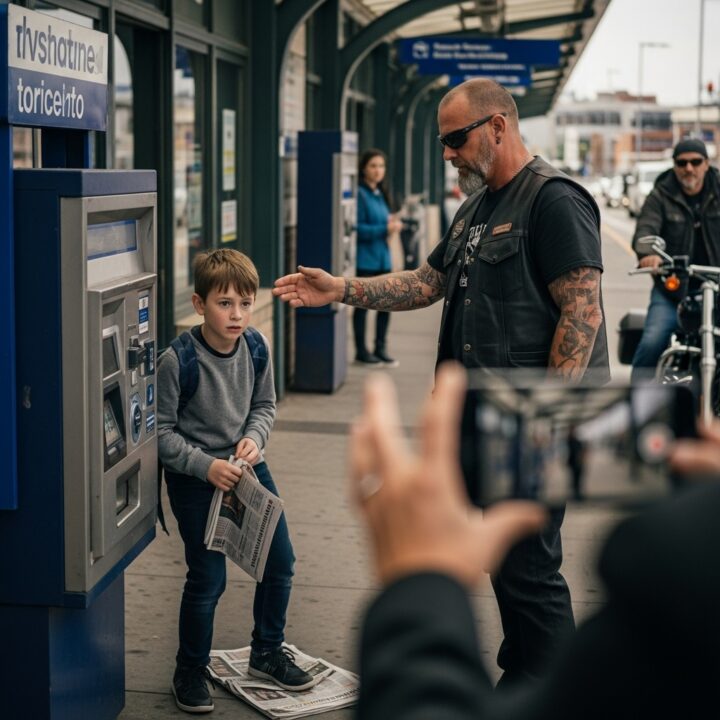
The biker dismounted quickly.
Late forties.
Short-sleeve leather vest.
Arms marked with old tattoos.
Helmet still on.
To the people watching, it looked like trouble doubling itself.
A biker walking fast toward a confrontation outside a train station doesn’t read as rescue. It reads as escalation.
Someone shouted, “Hey!”
Another voice said, “Call security.”
The man who’d hit the boy turned, already defensive. “Mind your business,” he snapped.
The biker stepped between them.
Not touching.
Not pushing.
Just standing close enough to matter.
“Walk away,” the biker said.
Two words. Flat. Calm.
The man scoffed. The crowd tightened. Phones rose higher. The scene tilted toward something ugly.
Security guards began moving in from the station doors. A whistle blew. A commuter yelled that the biker was making it worse.
The boy crouched down, shaking now, hands trembling as he tried to gather scattered newspapers. His lip was bleeding slightly—not dramatic, but real.
The biker didn’t look at the crowd.
Didn’t explain himself.
He took off his helmet slowly and set it on the ground.
That simple motion—controlled, deliberate—made people uneasy in a different way.
This wasn’t a man posturing.
This was a man deciding.
The security guards reached them.
“Sir, step back,” one ordered, eyes fixed on the biker’s vest.
The man who’d struck the boy pointed. “He threatened me,” he said quickly.
The accusation hung there, heavy and dangerous.
The biker nodded once. “I didn’t.”
That was all.
The guard looked at the boy. Looked at the biker. Looked at the phones recording everything.
This was the moment when stories usually break the wrong way.
The boy’s hands shook harder. He was crying now, silently, embarrassed by the sound. If this went wrong, he knew who would pay for it.
The biker reached into his pocket.
Several people flinched.
Instead of a weapon, he pulled out his phone.
Typed one message.
Sent it.
Then he crouched down next to the boy, his back turned to the crowd—an act that looked reckless and felt intentional.
“You okay?” he asked quietly.
The boy nodded, not trusting his voice.
The guards hesitated. Radios crackled. Someone whispered, “What is he doing?”
No one knew.
They only knew time felt stretched thin.
The sound came first.
Not sirens.
Engines.
Low, steady, controlled.
Motorcycles rolled into the station driveway and parked in a clean line. Riders dismounted without urgency, movements practiced, eyes scanning the scene.
No shouting.
No revving.
No threats.
Just presence.
The crowd went silent.
Security stopped moving.
The biker who’d turned back stood up slowly and stepped aside, revealing the boy fully for the first time. One of the riders approached a guard and spoke quietly, showing something on his phone.
The guard’s posture changed.
Authority shifted—not loudly, not dramatically—but unmistakably.
Another rider knelt beside the boy, offering a bottle of water. A third gathered the scattered newspapers, stacking them neatly.
The man who’d struck the boy took a step back.
No one blocked the bikers now.
No one filmed anymore.
The station felt different—as if the rules had been rewritten without anyone announcing it.
It came out in pieces.
The biker who’d turned around was a former youth outreach volunteer. The riders were part of a group that checked transit hubs after school hours, watching for kids who worked late selling papers or snacks.
They weren’t there for drama.
They were there because someone once hadn’t turned around for them.
The security guards handled the paperwork. The man who’d hit the boy stood off to the side, suddenly small, suddenly quiet.
The boy wiped his face with his sleeve, embarrassed again—but different now.
The biker handed him his helmet. “Hold this,” he said. “It’s heavy.”
The boy smiled for the first time.
No speeches followed.
No lectures about right and wrong.
When the bikers mounted up, the crowd parted naturally. People watched them leave with expressions that looked like thought.
The station noise returned slowly.
Announcements.
Footsteps.
Life moving on.
The boy stood with his newspapers stacked neatly beside him, helmet returned, shoulders a little straighter.
As the motorcycles disappeared, one small detail lingered:
A man who had been walking away chose to turn back.
And because of that choice, a boy went home safe that night.
No one called it heroism.
It didn’t need a name.
It just needed ten seconds.