A 52-Year-Old Biker Pulled a Young Bride from the Altar as Guests Screamed “Kidnapper”—Then She Showed Police the Message That Summoned Him
I shoved open the chapel doors, walked past sixty stunned wedding guests, took the bride by the hand, and pulled her away from the altar before she could say two words that might have trapped her forever.
Someone screamed.
A man in the second row shouted that I had a weapon, although both my hands were visible. Three guests rushed into the aisle. The wedding photographer raised her camera, then lowered it when she saw the bride’s face.
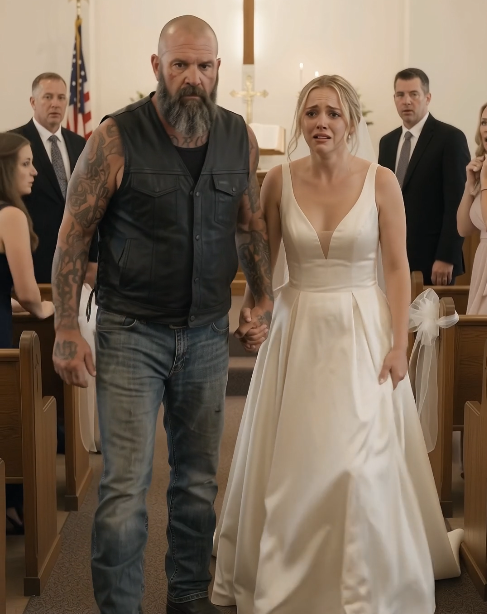
She was not fighting me.
She was trying not to collapse.
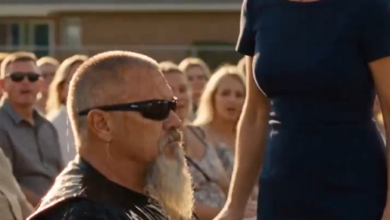
My name is Cal Mercer, though most riders call me Bear. I was fifty-two, six-foot-five, and roughly 280 pounds, with a shaved head, a thick gray-black beard, tattooed forearms, and a plain leather cut stretched across shoulders that made narrow doorways inconvenient.
At the altar stood Ava Bennett, twenty-four years old, wearing an ivory gown with tiny pearl buttons and a veil pinned too tightly against her blond hair.
I had not seen Ava in seven years.
The last time we spoke, she called me a liar and asked why I had stopped being her foster father when she needed me most.
I had no answer she believed.
Now I had one hand around hers as I led her away from the man she was supposed to marry.
The groom, Nathan Cole, caught my shoulder before we reached the aisle.
“Take your hands off my wife.”
“She isn’t your wife yet.”
His best man stepped toward me. I released Ava immediately and raised both hands so nobody could claim I was holding her against her will.
“Ava,” I said, “tell me to leave, and I’m gone.”
Her eyes moved toward Nathan.
Not toward me.
That told me enough.
Nathan’s face remained calm, but his fingers closed around her wrist where the long lace sleeve hid the mark of his grip.
“You’re confused,” he told her. “You asked him to come because you’re having another episode.”
Ava’s breathing changed.
“I didn’t—”
“Yes, you did.” His voice stayed gentle for the guests. “You’ve been overwhelmed all week.”
A bridesmaid named Lena Park stood three feet away, white-faced and trembling. She knew something. I could see it in the way she stared at Nathan’s hand.
But she said nothing.
Nobody did.
From the back of the chapel came the hard sound of police radios. Nathan had arranged off-duty security because he claimed Ava’s family might “create a scene.”
Two uniformed officers moved down the aisle.
Guests stepped aside.
One pointed toward me. “Sir, back away from the bride.”
I obeyed.
That surprised Nathan.
Men like him depend on appearances. A giant biker disobeying police would have given him the picture he needed. Instead, I backed away, opened my hands, and kept my voice low.
“She contacted me.”
Nathan laughed. “She hasn’t had a phone for two weeks.”
The first officer looked at Ava. “Ma’am, did you ask this man to come?”
Ava opened her mouth.
Nothing emerged.
Nathan leaned close enough to whisper, but the room was so silent I heard him.
“Think carefully.”
My brothers waited outside. I had brought no one into the chapel except Tasha Brooks, a forty-eight-year-old Black woman who had ridden with our club longer than most men could tolerate her honesty.
Tasha stood near the exit holding a brown canvas bag.
Inside were flat shoes, jeans, a sweatshirt, water, a prepaid phone, and a weatherproof motorcycle jacket in Ava’s size.
We did not know whether Ava would leave.
We only knew she deserved the ability to choose without standing barefoot in a wedding gown.
The officer repeated his question.
“Ava, are you here voluntarily?”
“Yes,” she whispered.
Nathan relaxed.
Then she added, “But I don’t want to marry him.”
The room seemed to lose air.
Nathan caught her arm again. “You’re panicking.”
Ava pulled away.
“I said no.”
Her mother was not among the guests. Denise Bennett had driven from Cincinnati that morning but had been stopped at the entrance by Nathan’s security team. They told her Ava had changed her mind and did not want her there.
Ava knew none of that.
Nathan had blocked Denise’s number three months earlier. He told Ava her mother had called her selfish, unstable, and ungrateful. Every message Ava attempted to send disappeared from the shared tablet Nathan controlled.
He had been building an empty space around her.
Then he filled it with his own explanations.
I knew only part of this when I entered the chapel. All I possessed was one message sent from a number I did not recognize at 6:13 that morning:
“If you still think of me as your daughter, come before I say yes.”
No name.
No explanation.
Just a photograph of the chapel entrance and the time of the ceremony.
I knew it was Ava because of one detail. She ended the message with three periods—the same way she had written every note she slipped beneath my workshop door as a teenager.
The officer asked to see my phone.
I handed it over.
Nathan moved forward. “That proves nothing. Anyone could have sent it.”
Ava reached beneath the flowers tied around her bouquet. Her fingers found a second phone taped beneath the stems.
Lena gasped.
Ava removed it and handed it to the officer.
“I sent the message.”
Nathan’s calm expression broke.
“Where did you get that?”
Lena finally spoke.
“I gave it to her.”
Nathan turned toward the bridesmaid with a look so cold that she stepped backward.
The officer separated them.
Ava unlocked the phone. Her message to me appeared beside photographs of a locked desk drawer, her passport, driver’s license, Social Security card, and birth certificate stacked inside.
There were also messages from Nathan:
You don’t need identification once we’re married.
Your family only confuses you.
If you embarrass me tomorrow, I’ll make sure everyone knows you’re unstable.
The second officer called for additional units.
Nathan said the messages were taken out of context. His mother accused Ava of staging the entire scene. Guests began speaking at once.
Through the noise, Ava gripped my vest.
“Did you come because you forgave me?” she asked.
“No.”
Her face fell.
“I came because there was never anything to forgive.”
Before we could reach the exit, Nathan shouted that I was not her father, had never adopted her, and had abandoned her when she was seventeen.
Ava stopped walking.
The accusation still owned part of her.
Police positioned themselves between us and the doorway while Tasha held out the coat and flat shoes. Outside, the low rumble of twelve idling Harleys rolled through the chapel walls.
Ava looked toward freedom.
Then she turned back toward the bridal suite.
“My mother’s ring,” she whispered. “He took it.”
I told her we could replace a ring.
She shook her head.
“No. I’m done leaving pieces of myself behind.”
Before Ava could leave the man who controlled her documents and cut off her family, she had to walk back into the room he still believed belonged to him.
Part 2 — The Girl Who Called My Garage Home
I met Ava when she was twelve.
A county caseworker brought her to my house on a Wednesday evening carrying a trash bag filled with clothing and a plastic grocery sack containing schoolbooks. Her mother, Denise, had entered a residential treatment program after years of prescription-drug dependency. Ava’s father had never been part of her life.
My wife, Marie, and I had been licensed foster parents for three years.
We had no biological children. Two miscarriages had nearly ended our marriage before grief pushed us toward a different kind of family.
Most placements stayed for days or months.
Ava stayed five years.
The first night, she refused the bedroom we prepared. She slept on the living-room couch wearing her shoes, with the trash bag tied around her wrist.
Marie did not force her upstairs.
She placed a blanket over the back of the couch, left a lamp on, and told Ava where breakfast would be.
At 2:00 a.m., I found the girl standing inside my garage.
She had heard tools fall when I moved a motorcycle stand.
“What are you doing?” she asked.
“Fixing a clutch.”
“Why?”
“Because it’s broken.”
That answer seemed to reassure her. In Ava’s experience, adults often gave explanations that changed depending on what they wanted.
Machines were simpler.
Broken things had reasons.
For months, Ava followed me into the garage after school. She handed me sockets, labeled storage drawers, and learned to recognize the difference between ordinary engine noise and the sound of something about to fail.
She hated loud voices but loved motorcycles.
A V-twin rumble was loud without being angry.
On her thirteenth birthday, I gave her a pair of clear safety glasses and a patch with no club name, only a small embroidered wrench. She sewed it inside her backpack.
“That makes you shop crew,” I said.
“Does shop crew get paid?”
“Shop crew owes me rent.”
She rolled her eyes.
That was the first time she acted like a child in our home instead of a guest preparing to be removed.
Marie taught her to cook. I taught her to change oil. Denise wrote letters from treatment, but Ava refused to open them. We kept every envelope in a blue box without pressuring her.
“You can read them when you’re ready,” Marie said.
“What if I’m never ready?”
“Then the box stays closed.”
At fifteen, Ava called Marie “Mom” by accident.
She cried afterward.
Marie pretended not to notice until Ava walked back into the kitchen and said it again on purpose.
She never called me Dad.
She called me Cal.
But on school forms, where a parent’s signature was required, she always watched my hand until I finished writing.
At seventeen, our family broke apart in six weeks.
Marie was diagnosed with an aggressive brain tumor. Her condition deteriorated faster than anyone expected. I slept at the hospital, missed foster-agency meetings, and became difficult to reach.
A new caseworker reviewed the placement and determined that I could not provide adequate supervision alone.
Denise had completed treatment and remained sober for almost two years, but her housing was not yet approved. A maternal aunt in Indiana offered temporary kinship care.
Ava was moved.
I told her it would last only until Marie stabilized.
Marie died eleven days later.
After the funeral, I called the caseworker. My foster license had been placed on inactive status. Because Ava was approaching adulthood and living with family, the agency discouraged disrupting her placement.
I appealed informally.
I wrote letters.
I called.
Most messages went unanswered.
What I did not do was drive to Indiana and stand before Ava.
Grief had hollowed me out. I believed she needed a stable home, not a man who slept in his clothes and could not enter the kitchen without hearing Marie.
Ava interpreted my silence differently.
She believed Marie had been the person who wanted her, while I had merely tolerated the arrangement. When Marie died, Ava assumed I no longer saw a reason to keep pretending.
Her aunt reinforced that story.
“Cal signed off,” she told Ava.
I had signed paperwork acknowledging the transfer.
To Ava, that signature meant abandonment.
She aged out of care at eighteen and moved to Nashville for college. Denise regained stability and attempted to reconnect, but their relationship remained fragile.
I sent birthday cards for three years.
None received replies.
Then Ava changed addresses.
The trail ended.
My club brothers told me to find her through social media. I refused because I feared intruding into a life that no longer wanted me. That fear disguised itself as respect.
The result was another silence Ava had to interpret alone.
Seven years passed.
Then, one Tuesday, Tasha entered my garage carrying a wedding invitation she found at a coffee shop owned by a former foster parent. The bride’s photograph was Ava.
The groom was Nathan Cole, thirty-one, a financial consultant from a wealthy Nashville family.
Tasha wanted to attend.
“We weren’t invited.”
“You raised that girl.”
“That doesn’t make the invitation ours.”
“You hiding behind manners now?”
I looked at the photograph for a long time.
Ava appeared beautiful.
She did not look happy.
Her smile ended before reaching her eyes, and Nathan’s hand rested at the base of her neck instead of around her waist.
I still did nothing.
Three months later, the message arrived.
If you still think of me as your daughter, come before I say yes.
I called the number.
No answer.
I texted one question:
Are you in immediate danger?
The reply came two minutes later.
Not if I do what he says.
That sentence changed everything.
Tasha read it over my shoulder.
“We ride now.”
The wedding was four hours away.
We had three.
Part 3 — The Road to Magnolia Chapel
Twelve motorcycles left Dayton before sunrise.
Nobody wore club insignia. We did not want Nathan’s family claiming an organized threat. The riders came because Ava might need transportation, witnesses, money, clothing, or simply enough people nearby to prevent her from being isolated again.
I established rules before engines started.
No weapons inside.
No blocking vehicles.
No touching Nathan unless somebody faced immediate physical danger.
If Ava chose to remain, we left.
Boone disagreed.
“She asked you to stop the wedding.”
“She asked me to arrive before she said yes.”
“Same thing.”
“No.”
The difference was consent.
I was not riding to decide Ava’s future. I was riding to make sure she could decide it without Nathan controlling the room.
Tasha carried the escape bag. She included clothing in three sizes because we did not know Ava’s measurements, toiletries, a phone charger, cash, and soft black shoes without heels.
“Why shoes?” I asked.
“Because men plan rescues around engines,” she said. “Women remember brides can’t run in four-inch heels.”
Rain followed us through Kentucky.
The road smelled of wet asphalt and diesel. My gloves remained tight around the handlebars while the message repeated in my head.
If you still think of me as your daughter.
Ava did not know I had never stopped.
That was my fault.
Intentions do not comfort people who only experience absence.
Halfway to Nashville, a second message arrived while we stopped for fuel:
He has my wallet. Mom isn’t coming. Lena will help if she doesn’t get scared.
I called Denise.
The number from an old agency file still worked.
A woman answered cautiously.
When I said my name, she became silent.
“You don’t get to call yourself her father,” she said.
“I’m not calling myself anything.”
“Then why are you calling?”
“Ava asked me to stop her wedding.”
Denise’s breath caught.
She had been invited, then uninvited. Nathan told her Ava had decided contact with family was harmful to her mental health. Denise suspected the message was false but feared arriving would humiliate her daughter publicly.
I gave her the chapel address.
She was already twenty minutes away.
At Magnolia Bridal & Chapel, private security stopped Denise in the parking lot. Nathan had placed her name on a no-entry list.
Our motorcycles arrived moments later.
Guests turned toward the sound.
Security guards moved between us and the entrance. I removed my helmet slowly and kept my hands visible.
“I’m here to speak to Ava Bennett.”
“She doesn’t want visitors.”
“She contacted me.”
One guard requested proof. I showed the message without handing him my phone.
He called someone inside.
A man returned through his earpiece: Ava did not know me and wanted me removed.
That answer did not match the text.
Still, I could not force my way into a private venue based only on a message.
Then Lena appeared behind the glass entrance.
She was Asian American, about twenty-five, wearing a dark green bridesmaid dress. She saw me, glanced toward security, and quickly touched her right hand to her left shoulder.
Ava used the same signal as a teenager.
It meant come now.
Lena disappeared.
Tasha moved beside me.
“You saw it?”
“Yes.”
The guard warned us police had been called.
“Good,” I said.
He looked surprised.
Police could separate Ava from Nathan and ask whether she wanted help. Their arrival protected her choice better than twelve bikers forcing entry.
But the ceremony had begun.
Music drifted through the walls.
I heard guests stand.
Ava was already walking toward the altar.
Denise pushed past the parking-lot barrier. Security stopped her again. She shouted her daughter’s name, but the chapel doors had closed.
I looked at the nearest officer approaching from the street.
“Your cameras cover the lobby?”
“Yes.”
“Then keep them running.”
I walked through the entrance.
The guard grabbed my arm.
I stopped and faced him.
“Take your hand off me, and I’ll walk. Keep it there, and we both wait for police.”
He released me.
I did not run.
Running would look like attack.
I moved fast enough to reach the chapel doors before the officiant reached the vows.
Behind me, Tasha called, “Bear, she chooses.”
I nodded.
Then I entered.
Ava stood beneath a wooden arch wrapped in white flowers. Nathan held both her hands. His parents smiled from the first row.
When Ava saw me, her expression changed from fear to disbelief.
I spoke only her name.
She pulled one hand from Nathan’s grip.
That was her first choice.
I walked toward her.
Nathan stepped between us. “Get out.”
“Ava decides.”
“She’s my fiancée.”
“Ava decides.”
Guests raised phones. The officiant moved backward. Lena began crying without making a sound.
I stopped six feet from the bride.
“If you want me gone, say it.”
Ava looked at the exit.
Then she stepped off the altar.
That was her second choice.
I offered my hand.
She took it.
Only then did I lead her down the aisle.
Part 4 — The Phone Hidden Beneath the Bouquet
Police reached the chapel doors before we did.
Two Nashville officers entered with open hands and firm voices. They ordered everyone to stop moving and directed me away from Ava.
I complied.
Nathan immediately began narrating the event.
He told officers I was an estranged former foster parent with a motorcycle gang. He claimed Ava suffered anxiety, had become emotionally confused, and might be experiencing a breakdown.
Every sentence contained enough truth to make the lie sound responsible.
I was estranged.
The bikers were outside.
Ava was shaking.
The first officer asked her to step into a private side room. Nathan attempted to follow.
The officer blocked him.
“She’s my fiancée.”
“She can speak for herself.”
That sentence gave Ava more space than the entire wedding had.
Lena entered the room with her. A female officer joined them. I remained in the lobby under observation while Nathan’s family demanded my arrest.
Tasha walked inside carrying the brown bag.
A guard tried to stop her.
“She needs shoes,” Tasha said.
The guard looked confused.
“That is what you people forgot to plan for.”
Five minutes passed.
Then ten.
My heartbeat stayed heavy beneath my leather cut. Outside, engines had gone silent. The club understood that noise could be mistaken for pressure.
Denise waited behind the police line.
She asked whether Ava was safe.
I said yes, though I did not know.
The side-room door opened.
Ava emerged without her veil. Tasha’s motorcycle jacket covered the wedding gown, and soft black shoes had replaced the heels.
She looked smaller.
She also looked like herself.
The officer held two phones. One belonged to Ava. The other was the hidden prepaid device Lena taped beneath the bouquet.
Ava confirmed she had summoned me.
She showed police the messages.
Nathan claimed she had misunderstood ordinary relationship boundaries. He said he kept her documents because Ava frequently misplaced things. He restricted contact with Denise because her past addiction caused emotional harm.
Ava listened.
Then she asked him one question.
“Where is my passport?”
Nathan said it was safe.
“Where?”
“At home.”
“In what?”
“A desk.”
“Locked?”
He did not answer.
The officer asked whether Ava had access to the key.
She did not.
Her driver’s license had been removed from her wallet three weeks earlier. Nathan told her she should not drive before the wedding because stress made her careless.
Her bank card had disappeared next.
Nathan said married couples should consolidate finances.
When Ava objected, he canceled her phone plan, provided a replacement device, and linked it to his account. Calls to Denise failed. Messages vanished. Nathan explained that Denise had blocked her.
The isolation happened one reasonable-sounding step at a time.
A locked document drawer.
A shared bank account.
A canceled number.
A mother labeled harmful.
A former foster father described as indifferent.
By the wedding morning, Ava could not rent a hotel room, access most of her money, or prove her identity without Nathan.
Yet guests saw a beautiful chapel and assumed she had chosen every detail.
Lena told police she had witnessed Nathan take Ava’s wallet. She also admitted she knew Ava wanted to leave but had been too frightened to intervene openly.
Nathan had threatened to tell Lena’s employer that she stole from his company if she disrupted the ceremony. The accusation was false, but Lena was on a temporary work contract and feared even an investigation.
“I’m sorry,” she told Ava.
Ava held her hand.
“You brought the phone.”
It did not erase Lena’s silence.
It acknowledged the moment she finally broke it.
Police determined Ava was an adult leaving voluntarily. They had no lawful reason to detain me for kidnapping. The text message, Lena’s account, and Ava’s own statement made consent clear.
Nathan was not arrested immediately. The officers explained that allegations concerning withheld documents, threats, and financial control required investigation. They arranged for an officer to accompany Ava when retrieving essential belongings.
Nathan’s mother called the situation a misunderstanding.
His father offered Ava money to return and discuss matters privately.
She refused.
Denise approached from the parking lot.
Ava saw her through the glass.
For three months, Nathan had told her that Denise wanted no contact. Now her mother stood in the rain with both hands pressed against the police barrier.
Ava opened the door.
Denise did not rush forward. She stopped several feet away.
“Did you really tell them not to let me in?” she asked.
“No.”
“Did you block me?”
“No.”
Denise’s shoulders fell.
Ava crossed the distance.
Their embrace lasted long enough for guests to stop recording.
Then Ava pulled back.
“My ring.”
Denise looked at her bare right hand.
“What ring?”
“Grandma’s.”
Denise had given Ava her mother’s small sapphire ring as something old for the wedding. Nathan disliked it because it did not match the jewelry selected by his family.
He removed it while Ava dressed and placed it in the bridal suite safe.
He said she could have it after the honeymoon.
The ring was not expensive.
That was not why it mattered.
It belonged to three generations of women who had survived men making decisions on their behalf.
I told Ava police could retrieve it later.
She shook her head.
“If I leave without it, he’ll say I forgot.”
Tasha touched her shoulder. “You don’t prove anything by going back alone.”
“I won’t go alone.”
Ava looked at the female officer.
“Will you come with me?”
The officer agreed.
Ava turned toward the chapel.
She was still wearing the wedding gown beneath Tasha’s jacket. The hem dragged through rainwater, gathering dirt along its edge.
Nathan stood inside holding the safe key.
For the first time that day, he looked afraid.
Not of me.
Of a woman returning with witnesses.
Part 5 — The Ring Nathan Believed He Owned
The bridal suite was upstairs.
Ava climbed slowly because the gown restricted her legs. Tasha walked on one side, the officer on the other. I remained downstairs as instructed.
That mattered.
My instinct was to stand between Ava and every threat. But protection that ignores another person’s choices can begin resembling control, even when built from love.
Ava needed witnesses.
She did not need another man deciding where she could walk.
Nathan followed with a second officer. His attorney was already on speakerphone, advising him not to touch anything or make additional statements.
The suite contained discarded makeup tissues, champagne glasses, garment bags, and a wall mirror surrounded by lights. The safe sat inside a closet.
Nathan claimed the ring was not there.
Ava asked him to open it anyway.
He refused.
The officer explained that Ava reported personal property inside. Nathan could consent to access, return the item voluntarily, or allow the matter to proceed through a property report and potential warrant process.
Nathan looked toward his parents.
His mother nodded.
He opened the safe.
Inside were Ava’s passport, birth certificate, Social Security card, driver’s license, two bank cards, the sapphire ring, and an envelope containing $1,800 in cash.
Ava said the money belonged to her.
She had saved it before moving into Nathan’s house.
He called it their honeymoon fund.
The officer documented each item. Nathan did not contest the identification documents once they were visible together.
Ava placed the ring on her right hand.
Then she gathered her papers.
Her fingers trembled so badly that the birth certificate slipped to the floor.
Tasha picked it up and handed it back without saying, I told you so or You should have left earlier. Those phrases satisfy witnesses but wound survivors.
Ava had not stayed because she enjoyed control.
She stayed because Nathan dismantled her exits gradually, then convinced her that every locked door had been installed for her protection.
When she returned downstairs, Denise saw the documents held against her chest.
“He had all of those?”
Ava nodded.
Denise looked toward Nathan with a mother’s fury.
I stepped between them.
“Not here.”
Denise stared at me.
“You don’t tell me what to do with my daughter.”
“No. I’m telling you not to give him a reason to make today about your reaction.”
She understood.
Anger can be justified and still become useful to the wrong person.
Denise exhaled and stepped back.
Ava approached me.
The sapphire ring sat crooked on her finger.
“Why didn’t you find me?” she asked.
The question deserved no defense.
“I thought leaving you alone was respecting what you wanted.”
“You thought wrong.”
“Yes.”
“You signed the transfer.”
“Yes.”
“My aunt said you didn’t fight.”
“I called the agency. I wrote letters. Then I stopped.”
“Why?”
“Marie died, and I became a coward.”
The word surprised her.
I did not blame regulations, grief, or her aunt. Each had mattered, but none changed the experience of a seventeen-year-old girl waiting for the only father she trusted.
“I should have come,” I said. “I should have stood in front of you and let you tell me to leave.”
Tears filled her eyes.
“I waited.”
“I know.”
“No, you don’t.”
She was right again.
There is no apology large enough to recover seven years. All a person can do is stop asking forgiveness to work faster than repair.
“I’m here now,” I said. “You decide what that means tomorrow.”
Ava looked at Bluebird parked near the curb. She had spent her teenage years cleaning its chrome and pretending not to enjoy riding behind me.
Tasha offered her a helmet.
Ava did not take it.
Not yet.
Instead, she walked to Denise’s car.
Her mother unlocked the passenger door.
Ava paused before entering, then returned to me and held out the prepaid phone.
“Keep this.”
“Why?”
“So next time I call, you answer.”
“I answered this time.”
“Next time shouldn’t require a wedding rescue.”
“No.”
A faint smile appeared.
The police arranged for Ava to stay with Denise while investigators documented the messages and property. Lena provided a full statement. The chapel preserved security footage. Guests who had recorded the confrontation were asked not to post Ava’s face, though not everyone respected the request.
By evening, edited clips began appearing online.
A giant biker dragging a bride from an altar.
Guests shouting.
Police blocking the door.
Without context, the video made me look exactly like the criminal Nathan described.
The club received threats. People identified our garage. A local news channel requested an interview.
We declined.
Ava released one written statement through an attorney:
I asked Cal Mercer to come. I left voluntarily. Please stop turning the moment I escaped control into entertainment.
That should have ended public speculation.
It did not.
Nathan appeared in an interview two days later. He called himself a devastated fiancé and suggested Ava had been manipulated by an extremist motorcycle group.
He displayed photographs of our bikes.
He did not show the locked safe.
He did not show the messages.
He did not mention the blocked mother waiting outside.
Public opinion split.
Ava considered responding with every piece of evidence.
Her attorney advised patience.
I gave the same advice, though silence felt unbearable. The club wanted to defend itself. Boone proposed publishing the entire message history.
Tasha stopped him.
“Those messages belong to Ava.”
That settled it.
Brotherhood was tested again.
Could we endure being misunderstood without using a young woman’s private terror to repair our reputation?
We chose silence.
Ava had spent months losing control of her story.
We would not take it from her while claiming to help.
Part 6 — The Father Who Never Signed Away His Love
The investigation lasted five months.
Nathan was charged with offenses related to unlawful retention of identification documents, financial misconduct, and intimidation. The final legal outcome was less cinematic than the wedding interruption. Attorneys negotiated. Evidence was reviewed. Some allegations resulted in formal penalties; others became part of a protective-order proceeding.
Ava obtained a protection order.
She recovered her separate savings.
She also regained access to accounts Nathan had redirected and replaced every identification document in case copies remained.
The hardest work happened outside court.
Ava moved into a small apartment near Denise. The first night, she pushed a chair beneath the doorknob even though the lock worked.
She kept her passport beneath her pillow.
She bought three inexpensive phones because losing access to one made her panic.
Denise wanted to fix everything immediately. Ava needed distance and closeness in alternating amounts. Some days they cooked together. Other days Ava did not answer the door.
Recovery did not move in a straight line.
Neither did our relationship.
For the first month, Ava called me only when her car made strange noises. Mechanical questions felt safer than emotional ones.
“Brake squeal,” she would say.
“Morning or evening?”
“What difference does that make?”
“Moisture.”
She brought the car to my garage. I repaired it without charge. She left without hugging me.
That was enough.
Later, she asked about Marie’s final days.
I told her the truth. Marie had asked for Ava repeatedly. She had made me promise not to let grief turn our home into another place the girl could not return to.
I broke that promise through absence.
Ava cried quietly beside the workbench.
Then I showed her the blue box.
Every letter Denise sent during treatment was inside. So were my returned birthday cards, school photographs Marie saved, and the small wrench patch from Ava’s first backpack.
“You kept it?”
“I kept everything except the person.”
The sentence hurt both of us.
Ava placed the patch in her palm.
“You were my father.”
“Foster father.”
“That isn’t what I said.”
I looked away because my eyes had filled.
She did not call me Dad that day.
She did something harder.
She gave me another chance to earn the word without demanding it.
Lena remained part of her life. Their friendship changed after the wedding. Ava felt betrayed by Lena’s earlier silence, while Lena struggled with shame.
They attended counseling together.
Lena never claimed that providing the hidden phone erased the weeks she stayed quiet. She accepted Ava’s anger and kept showing up.
Eventually, Ava asked her to accompany her to retrieve the wedding dress from storage. They donated it to a nonprofit that repurposed formal gowns for theatrical programs.
The stained hem remained.
Ava requested that it not be cleaned away.
“Why?” Lena asked.
“Because I walked through the rain.”
Tasha gave Ava the motorcycle jacket from the escape bag. Inside, she sewed a small interior pocket large enough for identification documents and a phone.
“No one gets your exits again,” she said.
Ava began riding with us on short weekend trips. She wore her own helmet and decided when to stop. Nobody placed her in the center of the formation unless she requested it.
On the first ride, we traveled to a diner outside Bowling Green.
Ava sat across from me, turning her mother’s sapphire ring around her finger.
“Why did you bring twelve bikers?” she asked.
“One might break down.”
“Eleven?”
“Witnesses.”
She smiled.
Then she asked the question I had waited years to hear.
“Do you still think of me as your daughter?”
I placed both hands flat on the table.
“You never stopped being one.”
Her eyes filled.
“So why did your message say ‘if’?” I asked.
“Because I needed to know whether you would come.”
“I should’ve come years ago.”
“Yes.”
No easy forgiveness.
No dramatic erasure.
Just truth sitting between us without destroying the table.
Ava reached across and took my hand.
“Then don’t leave early this time.”
I stayed until the diner closed.
Part 7 — The Ring She Chose to Keep
Three years later, Ava stood in another ceremony.
Not a wedding.
She had completed training as a victim advocate and was being sworn into a nonprofit program that helped young adults leaving foster care recognize financial control, document withholding, digital isolation, and coercive relationships.
Denise sat in the front row.
Lena sat beside her.
Tasha wore the same black jacket she had carried into Magnolia Chapel, though the emergency pocket now held tissues.
I stood near the aisle.
Ava wore her grandmother’s sapphire ring.
After the ceremony, she handed me a small envelope. Inside was a photograph taken when she was sixteen, sitting on Bluebird in my garage while Marie laughed behind us.
“I thought this was gone,” I said.
“My aunt had it.”
“Why give it to me?”
“So you’ll stop pretending the seven missing years are the only ones that count.”
I looked at her.
“Does that mean I’m forgiven?”
“It means we’re still working.”
Fair enough.
Outside, several motorcycles waited, but no formation surrounded her. Ava had driven her own car. She had her own keys, accounts, phone, documents, and apartment.
Choice was no longer an emergency item packed by somebody else.
Before leaving, she touched the ring.
“I almost left this in that safe.”
“You went back.”
“With witnesses.”
“That was smart.”
“You told me it could be replaced.”
“I was wrong.”
She smiled. “You’re getting good at saying that.”
Denise called her name from the parking lot.
Ava turned, then looked back at me.
“Dad, are you coming?”
The word arrived without ceremony.
No altar.
No guests gasping.
No police at the door.
Just one daughter asking whether her father intended to walk beside her.
I followed.
At the curb, Bluebird waited beneath the afternoon sun. Ava placed one hand on its worn leather seat, where a teenage girl had once learned that powerful machines responded to patience rather than force.
She did not climb on.
Neither did I ask her to.
We walked toward Denise’s car together while Tasha started the Harley behind us. The V-twin’s low rumble followed across the lot, steady but never close enough to push.
Ava still wore the ring.
She carried everything else herself.
Follow our page for more unforgettable biker stories about hidden courage, second chances, and the quiet moment someone finally chooses freedom.