A Biker Was Forced Out of a Nursing Home — Until an Old Man Called His Name
“Sir, you need to leave. Now.”
The nurse didn’t raise her voice. She didn’t have to. The words alone were enough to turn heads.
A biker stood in the hallway of the nursing home, leather vest still on, helmet hanging from his fingers. To anyone watching, he looked out of place. Dangerous. Like trouble that had wandered into the wrong building.
A few residents peeked out from their rooms. A staff member crossed her arms. Someone whispered, “Why is he even here?”
The biker didn’t argue.
He simply stopped walking.
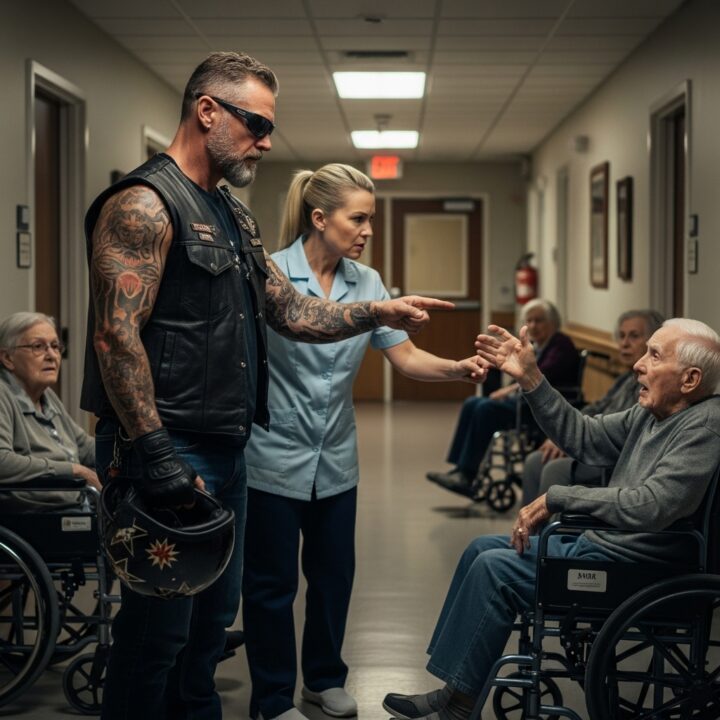
The hallway felt suddenly narrow. Too quiet. Fluorescent lights hummed overhead, casting a pale glow on beige walls decorated with framed photos of smiling residents and faded holiday posters. A medication cart sat abandoned near the nurse’s station, one wheel slowly turning before settling into stillness.
The biker’s boots were loud on the tile. Too loud for a place built on whispers and slow movements.
He was in his late forties. Broad shoulders. Sleeveless shirt under the vest, arms inked with tattoos softened by age. A thin scar traced the side of his neck, disappearing into his collar. His face was calm, but his jaw was tight—like a man holding something in place.
Across the hallway, an elderly man sat slumped in a wheelchair near the window. Late eighties, maybe more. His hands trembled in his lap. A thin blanket covered his knees, carefully folded by someone who no longer came often.
The old man stared at the biker with cloudy eyes. Not fear. Something else.
Recognition, trying to surface.
The nurse stepped closer. “We have rules,” she said. “Visitors must be approved. And… your appearance is upsetting some of our residents.”
Upsetting.
The biker nodded once. “I understand.”
He turned slightly toward the exit.
That should have been the end.
Then a voice broke through the silence.
“Jack?”
It was barely louder than a breath.
Everyone froze.
The old man’s lips moved again, dry and trembling. “Jack… is that you?”
The biker stopped mid-step.
Slowly, he turned back.
“Mr. Harris?” he asked, disbelief cutting through his calm.
The old man’s eyes widened. His fingers clawed weakly at the arms of his wheelchair. “Jack Mercer,” he said, clearer now. “I knew you’d come.”
The nurse frowned. “Sir, do you know this man?”
The biker swallowed. “Yes, ma’am. I do.”
The old man lifted a shaking hand. The biker crossed the distance in three strides and gently took it, kneeling so they were eye level. The leather creaked softly as he moved.
“I didn’t think you’d remember me,” Jack said quietly.
The old man smiled—a small, fragile thing. “I never forgot.”
The hallway held its breath.
Rules don’t like moments like this. They don’t fit neatly into policy.
The nurse hesitated. “Sir, we still—”
“He saved my life,” the old man said suddenly, voice stronger than anyone expected.
Every head turned.
The nurse blinked. “I’m sorry?”
“Vietnam,” the old man continued. “1969. Jungle. Bad day.” He squeezed Jack’s hand. “He pulled me out when everyone else thought I was gone.”
Jack shook his head gently. “I just did my job.”
“You stayed,” the old man insisted. “You carried me. You didn’t leave.”
The words echoed down the hallway.
A staff member lowered her clipboard.
The nurse cleared her throat. “Sir… what is your relationship to Mr. Harris?”
Jack glanced at the old man before answering. “He’s my brother,” he said. Then, softer, “In every way that matters.”
The old man laughed—a dry, cracking sound. “Told you someone would come.”
Something shifted.
The nurse’s posture softened. “I… didn’t know.”
Jack nodded. “Most people don’t.”
He explained quietly. About weekly visits that stopped when the nursing home changed ownership. About calls that went unanswered. About riding three hours that morning because he’d felt something was wrong.
“I didn’t mean to cause trouble,” Jack said. “I just wanted to see him.”
The old man tightened his grip. “Don’t let them send you away.”
Jack met his eyes. “I’m right here.”
Outside, engines rumbled.
Low. Controlled.
Through the glass doors at the end of the hallway, motorcycles rolled into the parking lot and stopped in a neat line. Men and women dismounted quietly. Leather vests. Tattoos. Sunglasses pushed up on heads. They didn’t approach the building.
They just stood.
The nurse noticed. “Are… are those with you?”
Jack nodded once. “They’re family too.”
The old man smiled wider. “Always liked your friends.”
The nurse took a breath. “I’ll speak with the director,” she said. “Please… stay.”
Jack nodded, gratitude flickering across his face before settling back into calm.
He stayed with the old man, listening as memories surfaced in fragments—names, places, moments stitched together by shared silence. Jack didn’t rush him. Didn’t correct him. Just stayed.
That was the pattern.
The director arrived minutes later. Questions were asked. Records were checked. Stories were confirmed.
The rules bent.
Not because they were broken.
Because someone remembered why they existed.
When visiting hours ended, Jack helped tuck the blanket back over the old man’s knees.
“You came,” the old man whispered. “Just like you said you would.”
Jack rested his forehead briefly against the man’s. “I always do.”
Outside, the bikers waited.
Jack paused at the door, looking back down the hallway one last time.
Honor doesn’t wear a uniform.
Family doesn’t always share a name.
And some bonds are strong enough to outlive memory itself.
If this story touched you, share your thoughts—or a moment when someone showed up for you when it mattered most—in the comments below.