A Biker Held the Funeral Home Door — Even After the Family Asked Him to Leave
“Please let go of the door. You’re not welcome here.”
The request was firm, but not loud.
That made it worse.
Inside the small-town funeral home, the air smelled of flowers and polished wood. Folding chairs were arranged in careful rows. A casket rested at the front of the room, closed, draped in a simple cloth. Family members sat close together, faces drawn tight by grief.
At the entrance stood the biker.
One hand pressed against the doorframe. The other gripping the edge of the heavy wooden door. Sleeveless leather vest. Faded patches. Tattooed arms rigid with restraint. He was blocking the way—keeping it from closing.
From the outside, it looked aggressive.
Unnecessary.
Disrespectful.
A woman near the front—mid-forties, eyes red, jaw set—rose from her seat. “This is a private service,” she said. “You need to leave. Now.”
The biker did not respond.
He didn’t step forward.
He didn’t step back.
His presence filled the doorway, casting a long shadow across the threshold.
People shifted uncomfortably. Someone whispered that security should be called. Another muttered that this wasn’t the place for “his kind.”
The funeral director froze, hands folded nervously in front of him.
The biker’s jaw tightened. His breathing stayed slow and controlled. To everyone watching, it looked like stubborn defiance.
Like a man refusing to accept boundaries.
The door creaked softly under his grip.
And in that suspended moment—between grief and outrage—the room stood perfectly still.
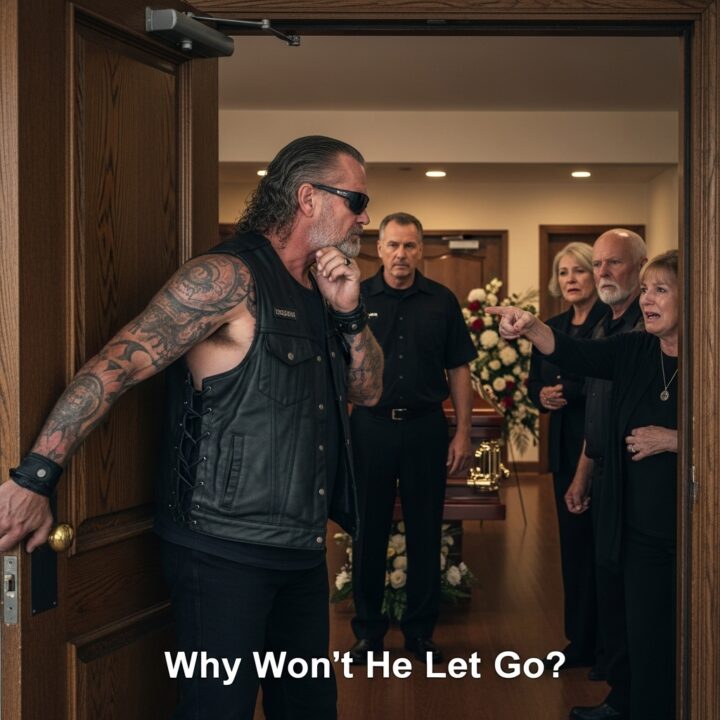
Anger settled in quickly.
An older man stood, pointing toward the door. “Have some respect,” he said. “You’re making this harder than it already is.”
Several heads nodded.
A few eyes glared openly.
The biker remained silent.
That silence was unsettling. It gave people space to project whatever story they wanted onto him. A troublemaker. A stranger seeking attention. A man who didn’t understand decorum.
The funeral director took a cautious step closer. “Sir,” he said quietly, “the family has asked you to leave.”
The biker looked past him—into the room. At the casket. At the faces twisted by loss.
“I can’t,” he said.
Just two words.
The director blinked. “You can’t…?”
The biker shook his head once. No explanation.
The woman from the front row moved closer now, grief sharpening her voice. “You have no right to be here. He wasn’t your family.”
The biker’s shoulders stiffened. He swallowed.
Still, he did not let go.
To everyone watching, it looked like control. Like dominance. Like a man imposing himself on a moment meant for mourning.
Someone mentioned calling the police.
The word hung heavy in the air.
The tension tightened like a held breath.
The funeral director raised his phone slightly, uncertain. “If this continues, I’ll have to contact authorities.”
The biker nodded. “Do what you need to.”
He reached into his vest pocket.
Several people stiffened.
Slowly—deliberately—he pulled out his phone. Typed a brief message. Paused. Sent it.
He placed the phone back where it had been.
“I’ll stay here,” he said quietly.
No one knew who he had contacted.
No one knew why.
The woman at the front covered her mouth, shaking her head. “This is unbelievable.”
The biker’s hand tightened on the doorframe. His knuckles whitened, not with anger, but effort. As if holding something back.
The possibility of police intervention loomed. The room felt smaller. Brighter. Too quiet.
And then—just as the director lifted his phone to make the call—a sound rolled in from outside.
Low.
Steady.
Engines.
The sound arrived before the sight.
Motorcycles lined the street outside the funeral home, parking in careful formation. Engines cut. Helmets removed.
Men dismounted calmly. No rush. No shouting.
They entered in pairs and threes, stopping short of the doorway. Leather vests. Sleeveless shirts. Tattoos worn like history, not threat.
They stood behind the first biker, forming a quiet line.
Not blocking the entrance.
Not pushing forward.
Just present.
The funeral director lowered his phone.
The woman from the front stared, confusion softening her anger. “What is this?” she whispered.
One of the bikers stepped forward slightly. “We’re here for him,” he said, nodding toward the casket. “Same as you.”
The room fell silent.
An older man seated near the aisle squinted, then leaned forward. His brow furrowed.
“That patch,” he murmured. “I recognize it.”
He stood slowly. Walked closer. Studied the biker at the door.
“You were there,” he said quietly. “The night of the accident.”
The biker closed his eyes briefly. Then nodded.
“He pulled him out,” the man continued, voice thickening. “Held him until help came. Wouldn’t let go.”
A ripple moved through the room.
The woman near the front sank back into her chair, hands trembling. “You… you were with him?”
The biker finally released the door.
“I promised,” he said. “I wouldn’t let him be alone.”
The truth settled gently.
Not like a revelation.
Like something finding its place.
The biker stepped aside. The door closed softly behind him.
No one applauded.
No one spoke.
The service resumed.
This time, the biker stood at the back with his brothers, heads bowed, hands clasped. Silent. Respectful.
When it ended, the family approached him slowly.
The woman who had demanded he leave stopped in front of him. Her eyes searched his face.
“I didn’t know,” she said.
He nodded. “You couldn’t.”
She hesitated, then reached out. Touched his arm briefly. “Thank you… for keeping your word.”
He didn’t answer. He didn’t need to.
Outside, the bikers mounted their motorcycles and rode away in quiet order.
Inside, people lingered longer than planned.
They carried home a small, uncomfortable lesson—about appearances. About how easily grief turns into judgment. About how honor doesn’t always wear the clothes we expect.
And the image stayed with them:
A man in worn leather, holding a funeral home door not to intrude—but to keep a promise.
Sometimes dignity looks like standing your ground.
And sometimes, the people we want to push away are the ones who understand loyalty the most.